‘Creeping Colonization’ – An Israeli Blueprint

By Najla M. Shahwan

The Israeli government has initiated a significant expansion of settlements in the occupied West Bank and East Jerusalem , and while 2025 was a year of settlement expansion, 2026 is intended to be a year of “action on the ground” focusing on accelerating construction, retroactively legalizing outposts, and deepening control in strategically sensitive areas.

New construction projects, such as bypass roads and barriers, are actively slicing through the West Bank, creating disconnected “islands” of Palestinian areas and facilitating the expansion of settlements.

This strategy, heavily driven by Israeli far-right coalition members, aims to establish, legalize, and expand numerous settlements and outposts, effectively creating “de facto annexation”.

On his part, Israeli Finance Minister Bezalel Smotrich announced a plan to allocate 2.7 billion shekels in the 2026 state budget to establish 17 new colonies in the West Bank over the next five years.

Plans for 22 new settlements in the West Bank were approved in early 2026, building upon a record number of approvals in 2025, which totaled 41 new settlements.

Israel has moved to start construction on the contentious E1 project, with a tender for 3,401 homes posted in late 2025/ early 2026.

This project aims to connect Maale Adumim settlement with East Jerusalem, which analysts warn will divide the West Bank in two and block the contiguity of a future Palestinian state.

Plans are also advancing for a major new 9,000-unit settlement project in East Jerusalem, at the site of the former Atarot/ Qalandiya airport.

Besides, a new settlement named Mishmar Yehuda (or Givat Adumim) was recently approved, located near Kedar and Ma’ale Adumim.

Reports from May 2025 and January 2026 indicate a surge in the legalization of previously unauthorized settler outposts, transforming them into permanent, legal settlements under Israeli law.

Following the repeal of the 2005 Disengagement Law, plans are underway to rebuild and expand settlements in the northern West Bank, such as Homesh and Sa-Nur.

Settlement activity is heavily concentrated in the East Jerusalem area, the northern West Bank, and the Jordan Valley to sever Palestinian territorial continuity.

Settlement expansion has been accompanied by increased settler violence and attacks, with over 1,800 incidents documented in 2025, according to the UN.

Settlers have been involved in the killings of Palestinians, including children, and have caused thousands of injuries through physical assaults, shootings, and arson.

In the first weeks of 2026, the UN Office for the Coordination of Humanitarian Affairs (OCHA) recorded at least 55 settler attacks causing injury or property damage and injuring 30 Palestinians. These attacks, often targeted water systems and schools, have directly led to the displacement of over 100 Palestinian Bedouin and herding households.

In the Jericho area community of Ras ‘Ein al ‘Auja, at least 77 households began dismantling their homes following intensified nighttime settler attacks and threats.

Settler attacks have completely displaced 29 Palestinian communities since October 2023, more than one a month on average, UN data showed.

Attacks frequently target Palestinian property, including the burning of homes, destruction of vehicles , poisoning water sources , steeling livestock , devastating agricultural livelihoods and uprooting or chain sawing of olive trees.

Settler violence is a key driver of forced displacement, creating a coercive environment that has forced dozens of Palestinian communities to leave their homes.

Since October 7, 2023, thousands of Palestinians have been displaced due to settler attacks.

The Office of the United Nations High Commissioner for Human Rights (OHCHR) and various UN bodies have reported that the distinction between settler violence and state violence has become increasingly blurred, with settlers wearing uniforms and acting alongside or as part of the Israeli security forces.

The line between settler and state violence has blurred “to a vanishing point,” according to a 2025 UN report.

This is attributed to the involvement of settlers in official “settlement defense squads” and “regional defense battalions,” which are part of the Israeli army’s structure.

The UN has noted a high level of impunity for perpetrators, with very few investigations into settler attacks resulting in convictions.

The European Union, various international bodies, various nations, including the UK, Canada, and Germany, have urged Israel to halt these activities, citing that the settlements are obstacles to peace , illegal under international law and undermine the possibility of a two-state solution.

The UN human rights office has repeatedly called on Israeli authorities to protect Palestinians from these attacks, end the cycle of violence, and hold perpetrators accountable.

However as of January 2026, reports indicate that Israel is disregarding all condemnations and warnings and accelerating its actions in the occupied West Bank, shifting from a “slow creep” of control to a rapid expansion of settlements and infrastructure, which observers characterize as de facto annexation.

This, combined with increased settler violence and military actions, is profoundly altering the landscape of the West Bank.

This ongoing process, which was often referred to as “creeping annexation’’, and now some analysts call it “running annexation’’ aims to permanently incorporate the West Bank into Israel by creating irreversible, on-the-ground facts.

Najla M Shahwan contributed this article to the Jordan Times

Continue reading
Smotrich Retracts Saudi Offensive Comments

Israel’s far-right Finance Minister Bezalel Smotrich retracted insulting comments he made on Thursday against Saudi Arabia.

“My statement about Saudi Arabia was definitely unsuccessful, and I regret the offense it caused,” the extremist minister said on his account on US social media company X.

“Nevertheless, and simultaneously, I expect the Saudis not to harm us and not to deny the heritage, tradition and rights of the Jewish people to the historical regions of their homeland in Judea and Samaria (West Bank) and to establish true peace with us.”

Smotrich issued insulting comments against the kingdom early Thursday, rejecting any normalization with ties with Riyadh in return for a Palestinian state.

“If Saudi Arabia tells us ‘normalization in exchange for a Palestinian state,’ friends — no thank you,” Smotrich said at a conference organized by the Zomet Institute and the Makor Rishon newspaper.

“Keep riding camels in the desert in Saudi Arabia, and we will continue to develop with the economy, society and state and the great things that we know how to do,” added the extremist minister.

There was no immediate comment from Saudi Arabia on Smotrich’s comments.

Saudi Arabia has repeatedly conditioned reaching a deal to normalize ties with Israel on Tel Aviv’s acceptance of a Palestinian state and the launch of a serious political process leading to that state.

Ignorance

Smotrich’s comments against Saudi Arabia drew fire from Israeli opposition leaders.

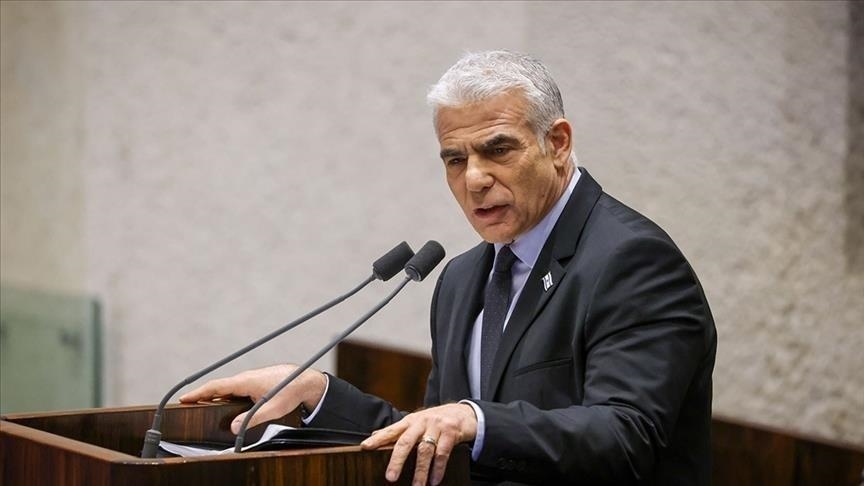
“To our friends in the Kingdom of Saudi Arabia and the Middle East, Smotrich does not represent the State of Israel,” Yair Lapid, leader of Yesh Atid Party, wrote on US social media company X, calling on the finance minister to apologize.

Benny Gantz, leader of the opposition Blue and White Party, said on X that Smotrich’s comments against Saudi Arabia “reflect ignorance and a lack of awareness of his responsibility as a senior minister in the government and the cabinet.”

Smotrich, known for his extremist views, has long advocated expanding Israeli settlements in the West Bank and the annexation of the occupied territory according to Anadolu.

Continue reading
Who is The ‘True’ Terrorist Here?!

By Mohammad Abu Rumman

“This is not a geopolitical battle; it is a spiritual battle. A battle of the ages. It is not horizontal. It is not left or right, liberal or conservative. It is a vertical battle… a battle of heaven against hell, good against evil. People must see it in this context, or they will completely fail to understand it.”

With these words, Mike Huckabee, the U.S. ambassador to Israel, described the ongoing war of extermination in Gaza during an interview with NBC. He criticized the move by several European states to recognize Palestine at the United Nations this month, adding: “You do not stand with Israel merely because you agree with its government… but because it defends the traditions of Abraham, Isaac, and Jacob.”

This rhetoric aligns seamlessly with statements made by members of Netanyahu’s government. Finance Minister Bezalel Smotrich, for example, openly called for the “complete destruction of Gaza” and the forced displacement of its residents to other countries, invoking biblical injunctions about “erasing the memory of Israel’s enemies.” What is striking is that such discourse is no longer viewed as fringe or shocking in Western and global media and political circles. It has become commonplace—voiced by ministers, politicians, and even Netanyahu himself—steeped in extremism and religious absolutism toward “the other.” In this case, the “other” is the Palestinians as a whole, along with anyone who dares oppose the Israeli far right.

Here, the urgent question arises: how should terrorism and extremism be redefined today? Who is the true terrorist? And what form of terrorism most threatens regional security and societal peace?

Following the September 11 attacks in 2001, the United States declared its “war on terror,” rallying dozens of states against al-Qaeda and later ISIS. ISIS was undeniably a brutal extremist group that committed massacres, established a so-called caliphate, and tore down borders between Syria and Iraq. Yet it remained an isolated, besieged organization—globally reviled, stripped of legitimacy, and unsupported by institutions or states. What we witness today, by contrast, is state terrorism practiced openly, backed by major powers, and legitimized through religious rhetoric presented as divine will. The irony is palpable: Israel engages in territorial expansion, rejects recognized borders, launches cross-border military strikes, and has a prime minister who frames his mission in explicitly spiritual and historic terms—the realization of Greater Israel.

Skeptics may argue that labeling Israel a terrorist state changes nothing; it clashes with power dynamics and U.S. strategic interests. Perhaps. Yet it remains essential to reshape Arab, Islamic—and indeed universal—awareness of these realities, and to recalibrate the very language and definitions we use. These should form part of today’s Arab political, media, and diplomatic discourse. If an international coalition against terrorism is to exist, the actor most deserving of that designation is Israel’s government—not transient groups like ISIS or al-Qaeda. Huckabee’s words and the declarations of Netanyahu’s ministers are not aberrations; they are clear manifestations of this reality: state terrorism, sanctified by religion and legitimized internationally. If there is a rogue state whose leaders should stand before the International Criminal Court for genocide and mass killings, it is Israel.

This framing is of enormous significance for international, regional, and even domestic debates. Otherwise, Arab political and intellectual circles will continue to be dragged along by narratives that consistently place the blame on extremist movements emerging here or there—movements that are, in truth, the predictable outcomes of political dysfunction. Whether born of Israeli aggression or Arab authoritarianism, such groups are less causes than consequences. To blame them alone is to misread the sequence of cause and effect.

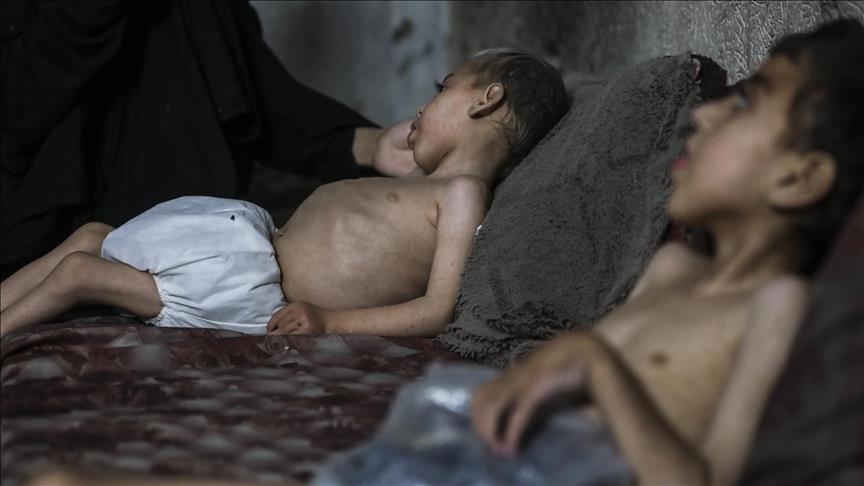
Today, amid the genocidal war on Gaza, a new political generation is coming of age. It witnesses, daily and directly, the starvation, slaughter, and devastation visited upon children, women, and civilians. It also sees the deafening global silence, alongside Arab paralysis and strategic impotence. What reactions can we reasonably expect from such a generation? This is not an attempt at justification, but rather an explanation of what is taking shape: a coming wave of anger among youth, or a wave that others may channel into particular political or religious agendas. That wave is already being born—out of the crucible of Gaza.

The writer is a columnist in The Jordan Times

Continue reading
Lapid: Gaza Take Over Disastrous For Israel

Israeli opposition leader Yair Lapid on Friday sharply criticized the Cabinet’s latest decision on Gaza, calling it “a disaster that will lead to many more disasters.”

In a statement, Lapid accused Prime Minister Benjamin Netanyahu of capitulating to the extremist demands of far-right ministers Itamar Ben-Gvir and Bezalel Smotrich.

The criticism from Lapid, head of the Yesh Atid party, comes after Israel’s Security Cabinet approved a plan by Netanyahu to take control of Gaza City, according to Anadolu.

“In complete contradiction to the opinion of the military and security ranks, without considering the erosion and exhaustion of the fighting forces, Ben Gvir and Smotrich dragged Netanyahu into a move that will take months,” said Lapid.

He added that this will “lead to the death of the hostages, the killing of many soldiers, cost tens of billions to the Israeli taxpayers, and lead to a political collapse.”

He warned that Israel will be “trapped in the field without a goal, without defining the picture of the day after, in a useless occupation that no one understands where it is leading.”

Israel has been facing mounting outrage over its destructive war on Gaza, where more than 61,200 people have been killed since October 2023.

Last November, the International Criminal Court issued arrest warrants for Netanyahu and his former Defense Minister Yoav Gallant for war crimes and crimes against humanity in Gaza.

Israel also faces a genocide case at the International Court of Justice for its war on the enclave.

Continue reading
Israel Faces Diplomatic Breakdown as Famine Cripples

Israel is heading toward a major diplomatic breakdown as famine spreads in Gaza, the daily Yedioth Ahronoth reported on Friday.

The newspaper revealed that Prime Minister Benjamin Netanyahu’s government ignored mounting international warnings about an unfolding humanitarian catastrophe in the besieged Palestinian enclave.

The report states that on March 2, Israel’s Security Cabinet made a decision to halt the entry of food aid into Gaza. This move came despite clear assessments from Israel’s own security establishment about the worsening famine, as well as urgent warnings from Gen. Ghassan Alian, the coordinator of Government Activities in the Territories, and several international relief organizations.

Unnamed political and security sources told the Yedioth Ahronoth that the decision “was not rooted in strategic considerations but was driven by political pressure from National Security Minister Itamar Ben Gvir and Finance Minister Bezalel Smotrich,” both known for their far-right policies according to Anadolu.

The daily noted that the Israeli government was fully aware Gaza was “on the brink of famine,” yet continued to block aid entry endangering the lives of countless Palestinian civilians.

The EU reportedly issued a stern warning to Israel regarding the consequences of the deepening crisis, even hinting at suspending its partnership agreement with Tel Aviv.

This came after a similar warning from the administration of US President Donald Trump, a staunch supporter of Israel, urging Netanyahu to act, while the prime minister “wasted time and hesitated to make decisions,” the report added.

Yedioth Ahronoth concluded that “Israel has steered itself into both a humanitarian disaster in Gaza and an impending diplomatic collapse on the global stage.”

Rejecting international calls for a ceasefire, the Israeli army has pursued a brutal offensive on Gaza since Oct. 7, 2023, killing more than 60,000 Palestinians, most of them women and children. The relentless bombardment has destroyed the enclave and led to food shortages.

Last November, the International Criminal Court issued arrest warrants for Netanyahu and his former Defense Minister Yoav Gallant for war crimes and crimes against humanity in Gaza.

Israel also faces a genocide case at the International Court of Justice for its war on the enclave.

Continue reading