Netanyahu ‘Reassures’ Iran Via Putin

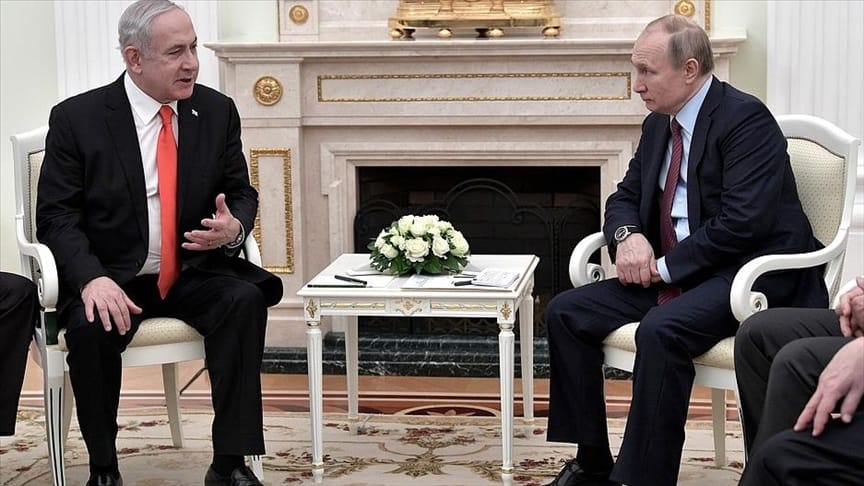
Israel’s Prime Minister Benjamin Netanyahu sought the help of Russian President Vladimir Putin to relay reassuring messages to Iran that Tel Aviv does not intend to attack it, amid fears of a preemptive strike by Tehran, Israeli media reported on Monday.

Public broadcaster KAN, citing unnamed diplomatic sources, said Netanyahu asked Putin to convey “reassurance” messages to Iran that Israel has no plans to launch an attack.

Accoring to the outlet, the messages were recently delivered to Iran, including through phone calls between Netanyahu and Putin, amid concerns that Tehran might move to strike Israel preemptively to avert a possible Israeli attack.

KAN reported that the Russian president said last October that he had been asked to pass along a message to Iran stating that Israel was “not interested in escalation.”

Netanyahu, however, told the Knesset on Monday that Israel sent a message to Iran that if Israel is attacked, it would face “very severe consequences.”

KAN said that there was concern within Israel that a miscalculation by Iran could lead to an attack driven by fears of an imminent Israeli strike.

In recent weeks, Israeli political and security leaders have held discussions on various security issues, including the Iranian file.

Speculation has recently increased in Israeli media about a potential Israeli strike on Iran, against the backdrop of what has been described as Tehran’s “rebuilding of its ballistic missile program.”

Israel launched a 12-day war against Iran in June, with Tehran retaliating with drone and missile attacks. The US military bombed three major Iranian nuclear facilities — Fordo, Natanz, and Isfahan — using bunker-buster bombs during the assault, before Washington managed to strike a ceasefire deal between the two arch-foes according to Anadolu.

Continue reading
Iran Condemns Israeli Recognition of Somali Region

Iran strongly condemned on Saturday Israel’s recognition of the breakaway region of Somaliland as a “flagrant violation of Somalia’s sovereignty and territorial integrity.”

Criticizing the Israeli move as “malicious,” Foreign Ministry spokesperson Esmail Baghaei emphasized the importance of “preserving the national sovereignty, unity, and territorial integrity” of Somalia.

Baghaei asserted that the recognition aligns with Israel’s broader policy “to destabilize countries in the region and exacerbate insecurity in the Red Sea and the Horn of Africa.”

Expressing support for the firm condemnation by the Organization of Islamic Cooperation (OIC) and the African Union (AU), Baghaei called on the international community to take “decisive action” to “neutralize this expansionist and threat-creating move by the occupying regime.”

On Friday, Israel became the first country to officially recognize Somaliland, with Prime Minister Benjamin Netanyahu announcing that the two sides had signed a joint declaration establishing full diplomatic relations “in the spirit of the Abraham Accords.”

In response, Somalia’s government denounced the move as an “attack” on its sovereignty and an “unlawful action,” reaffirming Somaliland as an “inseparable” part of its territory.

The Israeli move has been widely condemned by several countries, including Türkiye, Saudi Arabia, Egypt, and Qatar according to Anadolu.

Notably, Somalia was among the countries that severed diplomatic ties with Iran in January 2016 following a mob attack on the Saudi embassy in Tehran.

In March 2024, a year after Iran and Saudi Arabia restored diplomatic relations through a China-brokered deal, Somalia announced its readiness to mend ties with Iran.

In August of the same year, the top diplomats of Somalia and Iran met on the sidelines of the OIC summit in Jeddah and agreed to revive and deepen diplomatic relations.

Continue reading
Iran Denies Role to Assassinate Israeli Envoy

Iran denied allegations Friday that it attempted to assassinate Israeli ambassador to Mexico, Einat Kranz-Neiger

It called the claims “a fabricated lie” to damage Tehran’s relations with Mexico.

The Iranian Embassy said the reports were “a major falsehood and media fabrication intended to harm the friendly and historic relations between Iran and Mexico.”

“Iran categorically rejects these baseless allegations,” it said, stressing that “we would never harm the good image of our Mexican friends. Betraying Mexico’s interests would be like betraying our own. Respect for Mexican law remains our top priority.”

The denial followed a report by US-based news outlet Axios, which cited unnamed American and Israeli officials claiming that Iran’s Islamic Revolutionary Guard Corps (IRGC) Quds Force attempted to assassinate the Israeli ambassador earlier this year.

Axios said Mexican security forces allegedly foiled the plot, a claim that Israel’s Foreign Ministry later said was accurate.

Mexico also has rejected the allegations. The Foreign Ministry said there were no reports of an attack on Kranz-Neiger and denied security forces had thwarted any such operation.​​​​​​​

“The Ministry of Foreign Affairs reiterates its commitment to maintaining open and continuous communication with all diplomatic missions accredited in our country,” it said, adding that Mexico remains committed to “respectful and harmonious cooperation with all security institutions” within the framework of national sovereignty according to Anadolu.

Continue reading
Gaza: Changing The Middle East Face

By Mohammad Abu Rumman

The Al-Aqsa Flood operation marked a turning point in the modern political history of the Middle East. Its repercussions have gone far beyond the Palestinian and regional arenas, extending to the international system and reshaping the foreign policies of global powers toward the region.

The timing of the operation was particularly significant: it came at a transitional moment in the regional order, in the absence of consensus among international and regional actors on the rules of the game. While a fragile balance of deterrence existed between the so-called “Axis of Resistance”—led by Iran (alongside the Syrian regime, Hezbollah, Shiite political forces in Iraq, the Houthis in Yemen, and Hamas and Islamic Jihad)—and Israel, the latter was in the midst of a new phase of regional integration through the Abraham Accords.

Several Arab capitals had already normalized relations, and others were on their way, creating an unprecedented political landscape. This shift coincided with the declining influence of traditional Arab powers such as Egypt, Iraq, and Syria, and the rising centrality of the Gulf states. Many analysts began describing this new configuration as a “New Middle East”: wealthy, economically driven, and detached from historical conflicts—unlike the “Old Middle East,” where entrenched crises defined politics.

Turkey, meanwhile, had entered its own phase of recalibration. Once a champion of the Arab Spring and regional Islamist movements, Ankara sought reconciliation with Arab states, even attempting to restore ties with Bashar al-Assad’s regime (though rebuffed by Damascus), while focusing more narrowly on national security and northern Syria.

On the Palestinian front, Israel had grown complacent toward Gaza, convinced Hamas had no incentive to disrupt the status quo. Tensions, however, were mounting in the West Bank, with small armed groups emerging in places like Nablus, Tulkarm, and Jenin. Within Israeli and Western policy circles, talk was spreading about the prospect of a “mini-state in Gaza” as a substitute for a Palestinian state.

At the international level, President Joe Biden’s administration lacked enthusiasm for either the Abraham Accords or Trump’s “Deal of the Century,” yet it effectively followed the same trajectory: pursuing “regional peace” by integrating Israel into a new economic order and reducing the Palestinian question to daily livelihood concerns—employment, services, and economic relief in Gaza and the West Bank—rather than a political resolution.

The Al-Aqsa Flood and the subsequent two-year genocidal war in Gaza shattered these calculations and fundamentally restructured strategic assumptions. Whether the outcome will ultimately benefit or harm the Palestinian cause remains too complex to assess in simple terms, but what is clear is that the pre-October 7 regional order no longer exists.

From a Palestinian perspective, the conflict has restored international attention to the cause, leading to a renewed recognition of its centrality. In the Gulf, the previously dominant security paradigm—which cast Iran as the chief threat while framing Israel as a potential partner—collapsed entirely. A new consensus has emerged: Gulf security is inseparable from the Palestinian issue, and the notion of Israel as a “strategic friend” has been critically reassessed.

Skeptics may argue that these shifts have not altered the balance of power on the ground, and they are partially correct. Yet the strategic narrative has changed. Before October 7, the trajectory was toward the erasure of the Palestinian cause (closing UNRWA, moving the U.S. embassy to Jerusalem, normalization, and de facto annexation of the West Bank). Today, there is growing recognition—regionally and internationally—that Israeli policies themselves are the root of instability, not Iran or other regional actors. As Emirati political scientist Abdulkhaleq Abdulla put it on X (September 25): “When weighing who poses a greater threat to Gulf security and regional stability—Iran or Israel—the evidence points clearly to Israel. Israel’s brutal behavior has made it more dangerous than an exhausted Iran. The Gulf needs a new defensive and geopolitical strategy for the Middle East beyond Iran.”

Israel, however, now perceives a surplus of power and is pressing for a new political and security order that extends beyond the occupied territories. With the partial unraveling of the Iranian alliance and the breakdown of the “Syrian corridor” that once linked Tehran to the Mediterranean, Israel has set its sights on even more ambitious goals, including the proposed “David Corridor” and establishing buffer zones around its borders in Syria, Lebanon, and Gaza.

In response, a tentative regional coalition has begun to take shape, bringing together Saudi Arabia, Egypt, Jordan, and Qatar, with notable support from Turkey and Pakistan. The latter signed a defense pact with Saudi Arabia following Israel’s strike on Qatar and has since become more engaged in regional diplomacy. While fragile and constrained, this alignment presents a rare historic opportunity to rebuild a regional balance of power and establish a new deterrence framework.

Another striking development is the shift in Europe’s stance toward Israel. For the first time, Israel has lost significant ground in Western public opinion and media narratives, particularly among younger generations and in universities. This has pushed Israel closer to isolation—a position from which former U.S. President Donald Trump had tried to rescue it through his proposed Gaza peace plan, which was largely about securing U.S. and Israeli interests, without offering real guarantees for Palestinian statehood or ending the occupation.

In conclusion, it is still too early to judge the full strategic consequences of the Al-Aqsa Flood and the war in Gaza. Scenarios remain open, and outcomes uncertain. Yet one thing is indisputable: the region today is no longer what it was before October 7.

Abu Rumman is an Academic Advisor of the Politics and Society Institute and Professor of Political Science in The University of Jordan and published this article in The Jordan Times.

Continue reading
Middle East End Game!

By Dr Khairi Janbek

For the last four decades, each time a tragic event or another took place in the Middle East, the slogan that gets thrown onto the arena is that of a “new Middle East”. No one is certainly not against a new Middle East per se, but against the one in which someone acts stupidly and then against the stupid acts of someone else to stop the first one from acting stupidly.

Such a series of stupid events makes one think that the notion of the Middle East is supposed to be worse for the peoples of the region except most probably, Israel. Into the fray, is the idea of Israeli Prime Minister Benjamin Netanyahu who wants to change the face of the region, giving the impression this region is the face and Netanyahu is the make-up artist whom to make this “face beautiful” for Israel and probably with those grudging consent of those around it.

Now, considering what has been achieved on the ground as far as Israel is concerned in relation to Netanyahu’s end game may well be too early to tell, but at least one can say that Israel has gained a respite with its seeming regional  supremacy.

The start was with crippling the threat capability of Hezbullah and although it has not been destroyed, the responsibility for dealing with this Iranian proxy is now left to the new Lebanese government, which means that the latter will have to bear the new/old responsibility.

Then Syria came along. After the demise of the Assad regime, all Syrian military capabilities became fair game for Israeli bombardement, but in fairness, they were already so during the past Assad regime. Now, however, Israel has gone further, occupying the buffer zone between the two states while expanding its security zone deep inside Syria. Here, the project being pursued is a push for a federal structure to make the country incapable of becoming a future threat to Israel.

As for the 12-day campaign of bombardment and counter-bombardment by Israel and Iran with US cameo appearance, it is hard to reach any conclusions because of the great damage on both sides that is not really known as it verges on exaggerations, either for seeking international sympathy or as a show of awkward display of power.

Here, the end game was for Iran to be stopped from backing its proxies in Yemen, Iraq, and Lebanon and to eliminate its nuclear capability, if indeed it has reached such a level. Here, again, it is very hard to say to what extent the Iranian nuclear program has been set back, and to what extent Iran will go on the diplomatic path to stop its military support for its regional proxies.

Inevitably, we go back in circles, to the bleeding wound of Gaza, bleeding for the Palestinians, Arabs and Israelis. End game, ideal scenario and possible solution are all lost between the Israeli genocide policy, Arab impotence and naïveté , EU flip-flopping in accordance with the change of wind, and Trumpist absurd proposals and change of mind.

The issue here is far beyond Hamas, it’s Gaza and its people. As things stand the strip is divided into three regions under starvation. A massive refugee camp for people on their own land which for all intents and purposes, will no longer be their land. All in all, Israel is, with the consent of all, will be the supreme power in the region. 

Dr Janbek is a Jordanian writer based in Paris, France.

Continue reading