West Bank: A Ticking Time-Bomb

By Ismail Al Sharif

Imagine you are sitting with your children at home when a violent knock shakes the door. You open it to find a blond, European-looking man holding a weapon in one hand and a Torah or Talmud in the other, with soldiers behind him.

He orders you to leave the house, saying: “God gave me this house 3000 years ago.” You reply, “But it’s my home; I was born here, and my father and grandfather were born here before me.”

They push you aside, storm into your house, and throw your furniture outside. Your children cry, they throw your wife out, and your blood boils. You wrest the weapon from the blond man and shoot him. They kill you, and then a bulldozer comes to demolish your house.

The next day, the world’s newspapers headline: “Army kills terrorist after he tried to attack occupation soldiers.”

You might go out in the morning to graze your sheep, and in the distance, you see a few fair-haired young men who have pitched a tent on a fenced-off plot of land on a hill. At first, the scene seems fleeting, but soon you see them approaching your land, wandering among your olive trees and your flock, then attacking you, stealing your livestock, and burning your trees.

After that, they seize part of your land and annex it to the area they have taken over. The fence extends day by day, growing longer and wider. Over time, your land, and the land of your relatives, friends, and all the people of your village, becomes part of the nucleus of a new settlement.

Roads change, streets are closed, and checkpoints are erected, until reaching a place only a few hundred meters away becomes a journey that takes hours.

These scenes are repeated daily in the West Bank, where settlers terrorize, assault, and kill Palestinians under the protection of the occupation army, while ministers from the occupation government appear in the background of these attacks. The goal is clear: To empty the West Bank of its original inhabitants, both Muslims and Christians, and uproot them from their land, paving the way for its seizure and Judaization.

All of this is happening in full view of the world, amidst President Donald Trump’s objections and the condemnation of the international community, at a time when his 20-point peace plan was announced in a celebratory atmosphere on September 29th of last year.

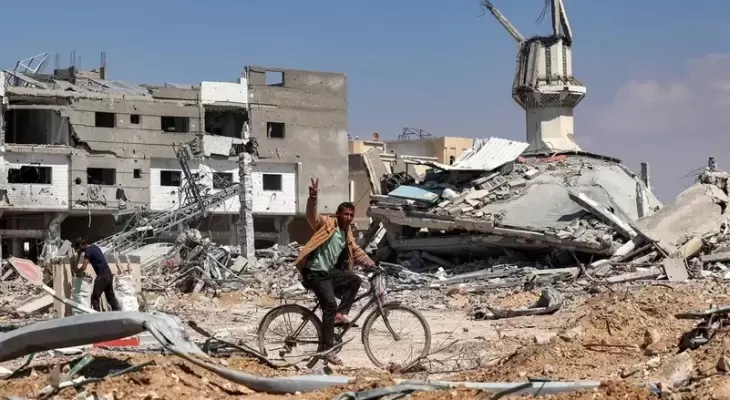
However, time has revealed that this plan was nothing but ink on paper. The occupation continues to control over 60% of the Gaza Strip, demolishing buildings and bulldozing agricultural lands in the areas under its control. It also continues its daily bombardment of the Strip, which, since the plan’s launch, has resulted in the deaths of approximately 1,200 Gazans and injured more than 3,600 others. This is while the siege continues and humanitarian aid is prevented from entering.

As for the West Bank, settlement outposts have expanded, and the occupation government recognized 19 additional settlements after the plan’s launch. This coincides with an unprecedented escalation in settler attacks, the continued demolition of homes and displacement of their residents, as well as the ongoing incursions into Palestinian cities, villages, and refugee camps.

The government of war criminal Benjamin Netanyahu makes no secret of its plans to annex the West Bank and thwart any attempt to establish a Palestinian state, while its leader orders the occupation army to launch continuous military campaigns in West Bank cities, villages, and refugee camps.

The West Bank today sits atop a powder keg, fueled by accumulated feelings of anger, fear, frustration, and resentment, awaiting a spark that could ignite the situation. Then, the sporadic confrontations could transform into a widespread popular uprising, which could very well extend beyond the borders of the West Bank.

No one knows how wide the circle of confrontation might widen, where it might spread, or the extent of the repercussions it might have in Jerusalem, the Palestinian territories within Israel, and neighboring countries. Arab governments and their armies may find themselves facing mounting popular and political pressure, pushing them either to engage in a confrontation they do not want, or to take positions and actions they have long sought to avoid.

This article was originally written in Arabic by Ismail Al Sharif and published in Jordan’s daily newspaper Ad Dustour and is reprinted in crossfirearabia.com. Mr Al Sharif long worked in newspaper management and publishing in Amman. 
Continue reading
Free Hussam Abu Safieh: 600 Days in Israeli Jail

By Ismail Al Sharif

This is the last time you’ll see me. They brought me here to kill me’ – Dr. Hussam Abu Safieh.

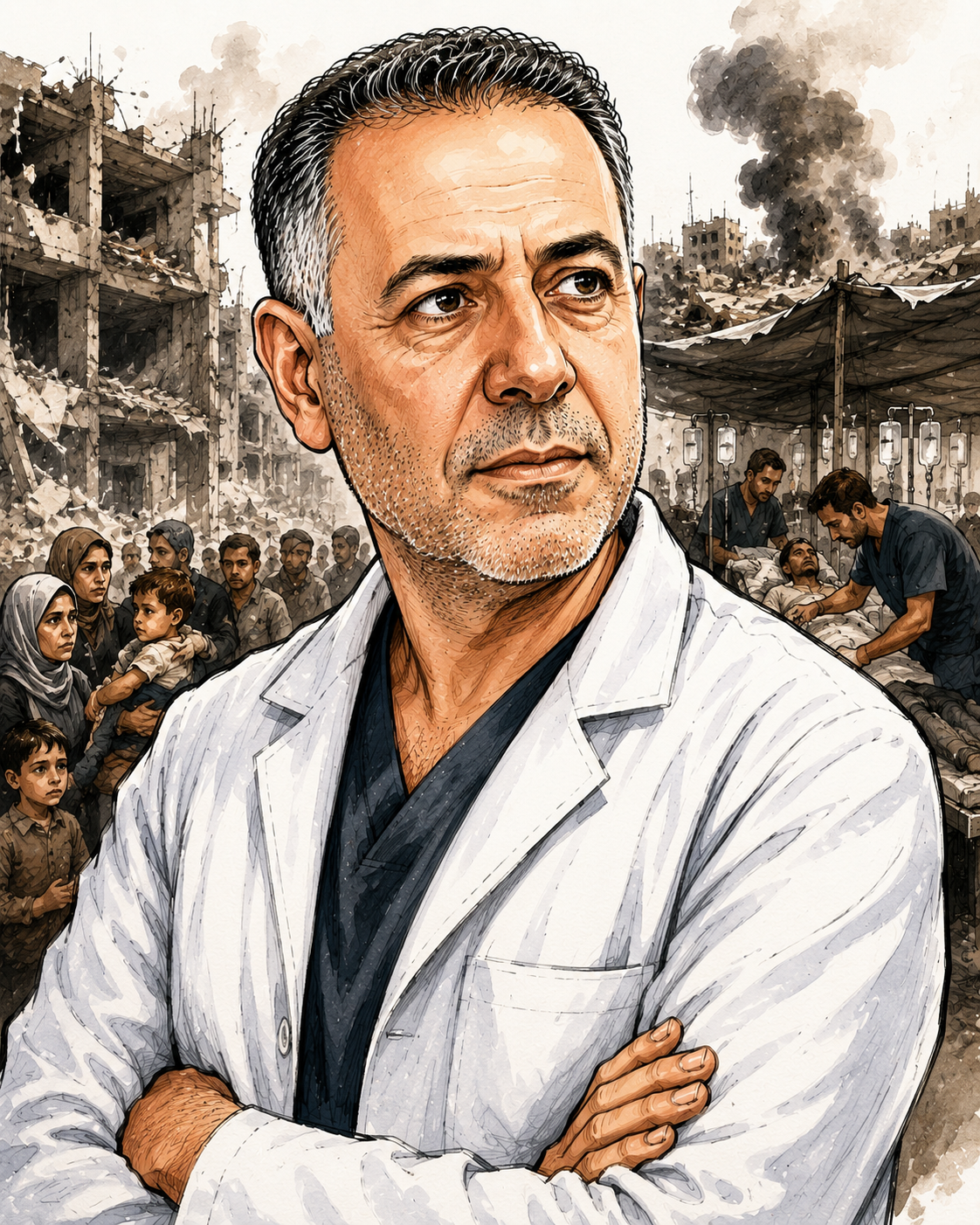
Dr. Hussam Abu Safieh, a pediatrician and director of Kamal Adwan Hospital, has been detained by the Israeli occupation forces for nearly 600 days without trial or charges.

His only crime was trying to save the children of Gaza, condemning the crimes he witnessed, and documenting the suffering of the injured children who arrived at the hospital. He shared their images and testimonies with the world; these sparked a wave of outrage and solidarity with the Palestinian people of Gaza.

The occupation has not only bombed hospitals and cut off their electricity, causing premature babies to die in their incubators, and not only prevented medicine from reaching the wounded and denied them treatment, but it has also targeted doctors, paramedics, aid workers, journalists, and anyone who reached out to save the victims.

It doesn’t want witnesses to its crimes. But wants a fully-fledged crime committed in secret, then justified with a ready-made accusation: Belonging to Hamas, or being present in a place allegedly used by members belonging to the organization.

Dr. Abu Safieh was abducted while on duty and subsequently subjected to torture and ill-treatment. His lawyer, Nasser Odeh, documented severe injuries, difficulty breathing, and repeated episodes of unconsciousness during a visit to him on 2 July this month. He was brought to the meeting handcuffed and shackled, surrounded by masked soldiers who concealed their faces, as their actions constitute a crime.

More than 200 healthcare workers have been killed in Gaza, many as a result of direct targeting, while more than 300 doctors and healthcare workers remain detained without trial or charge; as if saving children has become a crime.

Similarly, the Israeli occupation forces abducted Palestinian surgeon Khaled al-Sir from Nasser Hospital in Khan Younis while he was working and detained him for six months before releasing him from Ofer Prison. His family remained unaware of his fate throughout this period.

The thirty-two-year-old doctor described his arrest as a “nightmare,” after he was subjected to torture, humiliation, and denied medical care. He considered himself lucky to have emerged unscathed, while some of his colleagues lost limbs due to being denied medical treatment.

No war has ever claimed so many victims among those who dedicated their lives to saving others. Despite appeals from international, human rights, and grassroots organizations, Dr.  Abu Safieh and his colleagues have not been released.

Appeals are no longer enough; what is needed is genuine political pressure, and the issue of detained doctors must be at the forefront of the priorities of Arab leaders and politicians. Remaining silent about the detention of those who gave their lives to save people is not merely a sign of weakness, but a dereliction of the most basic human and moral obligations.

This is a translated piece written by Ismail Al Sharif and published in the Arabic Addustour newspaper in Amman and appears in crossfirearabia.com

Continue reading
Israel and The Banality of Evil

By Ismail Al Sharif

‘…As though you and your superiors had any right to determine who should and who should not inhabit this world – we find that no one, that is no member of the human race, can be expected to want to share the earth with you. This is the reason, and the only reason, for which you deserve to be hanged,” – Hannah Arendt, German-Jewish philosopher.

When you read the sentence: “We had to create conditions more painful than death,” you might think it’s taken from a horror novel or a dystopian narrative that depicts future or imaginary societies in which values ​​collapse, injustice prevails, and environmental and social devastation rages. It’s the “corrupt city,” the exact opposite of utopia, the ideal city.

You might think the sentence appeared in one of Ahmed Khaled Tawfik’s “Utopia,” George Orwell’s “1984,” or Albert Camus’s “The Plague.” You might think it was a line in the testimony of a serial killer who plagued the police for a full decade before dozens of bodies were discovered buried in his garden.

But would you believe that this statement was uttered by Minister of “Zionist Heritage,” Amichai Eliyahu? He wasn’t angry, he wasn’t agitated, and no spittle was flying from his mouth. He said it with calm, measured calm, wearing a smart suit and tie, his face sporting a trimmed beard that, at first glance, you might mistake for a dignified sheikh or a holy man.

His statement was devoid of any emotion, like a routine uttering from a government employee, explaining to people that the power outage was due to a heat wave, or that the road closures were due to temporary maintenance work.

Have you ever wondered how decisions to commit genocide are made? And how countries became complicit in these?

My direct answer: Decisions to commit genocide are made when they are put on the agenda, when they are announced from golf courses or discussed at dinner tables. When children and women are killed by bombs, and hospitals and shelters are destroyed, a dapper bureaucrat takes the stage.

He starts his day with a jog around his house, has breakfast with his children, kisses his wife goodbye, asks her what she needs from the market, and instructs his children to behave.

This same bureaucrat takes center-stage to defend genocide, beautifying it, whilst sanitizing it linguistically, using flowery terms such as: “Precision strikes,” “human shields,” “collateral damage.”

He like other bureaucrats are creative in manipulating the vocabulary: Torture is transformed into “interrogation,” starvation into “economic pressure,” and ethnic cleansing into “security buffer zones” or “humanitarian cities.” Even death traps are remarketed under glamorous names, such as the “Gaza Humanitarian Foundation.”

Let’s return to the Minister of “Zionist Heritage,” who concludes his statement by saying: “Death is no longer enough. It must be painful, prolonged, and free from any international accountability.”

Even the most brutal of tyrants in history were careful to conceal their intentions when committing crimes. When the Qarmatians slaughtered pilgrims in Mecca in 317 AH, they claimed they were doing so to destroy idols. When the pilgrims committed the Euphrates Massacre against the people of Iraq, the pretext was “sedition.” Even when the United States committed the My Lai massacre during the Vietnam War, it described it as “military engagement.”

But this time, and for the first time in history, this man comes out publicly and admits to committing genocide, while dressed in his finest suit and tie. It is the most brutal and horrific genocide in our modern history and under our eyes.

Perhaps, one day, criminals like him will be brought to justice and charged with war crimes. They will defend themselves coldly: “We were following orders,” or “it was just a business procedure,” without pain, without remorse, and without the slightest sense of guilt or responsibility.

This is exactly what Hannah Arendt described as the “banality of evil.”

This article by Ismail Al Sharif was originally written in Arabic for the Addustour daily.

Continue reading