Carthage: Rock City of Art
 CrossFireArabia
- June 26, 2026
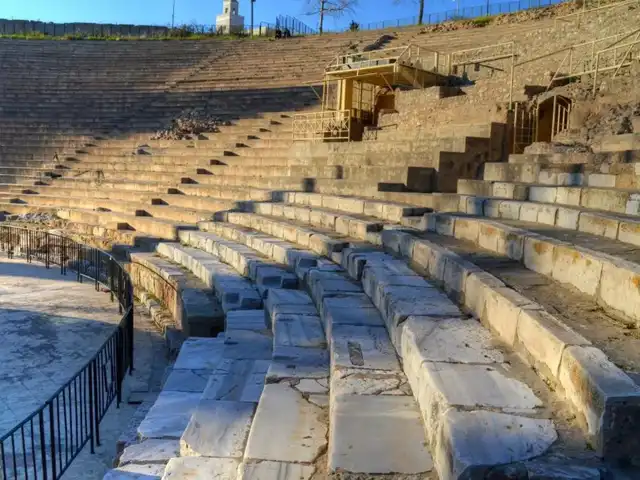
Regardless of the heat, it is breathtaking, the blue sea from one side, houses, residential buildings on the other, and a sprawling theatre in the middle.
It’s the world-famous Carthage Theater, an impressive monument that has been on the UNESCO Heritage List since 1979 because of its cultural significance and structure that goes back to the mid-2nd Century AD when it was built.
Below the sun beats down, almost scorching but up here, right in the top rows of the theatre, it lightens with welcome breaks of cool winds that spanks you across the face. The Orchestra sits at the bottom and beyond is a modern stage. The structure seems to have been developed among shrubbery and enormously tall-length trees that gives the place a special ambiance.
I sat down marvelling at what’s in front of me, an impressive, imposing auditorium that at first does not strike the eye. In fact seeing it from below at the stage level, the theatre is quite modest, but that soon changes because from up here, you see the domineering prowess of the semi-circular auditorium as the optical lens takes over, sweeping the rows, seating sections and aisles of this structure.
| All this you see in seconds, but you are quickly consumed by it all, taking a back seat, almost a deep breath to understand the dominance of stones, mortar and the actual dynamics of it all. This is the place where history was once played a decisive role in dictating world events under-footed by Greco-Roman rivalry, that resulted in a whole city being built, Carthage, and gaining prominence as one of the most important fertile lands in the region. |
As it did in its different epochs, today the Carthage Theater stands as a home of culture and the arts, a place to get away to, when you want to escape from the trials and tribulations of daily life as in the case of the Carthage International Festival that began in 1968, but with a long artistic tradition since 1906.
I am told the theatre holds the capacity for 10,000 people which is considered “safe” and does not pose any risk. Today, it is the so-called Agency for Development of National Heritage and Cultural Promotion which operates under the Tunisian Ministry of Culture that is responsible for the maintenance of the site. Many say if squeezed together the site can hold up to 15,000 spectators.
The whole complex is vast with a diameter of 105 meters and around 40 tiers of seating, divided up by winding stairs, technically named in Latin, scalaria. The theatre does not follow the typical examples of other theaters and for example, there are no praecinctio sections splitting the blocs of seating and leading to the vomitoria. If anything here the vomitoria, is within the seating complex, which is different than say the South Theater in Jarash, Jordan.
But this maybe due to the fact that the Carthage theatre had been in ruins in fact, partially burned down in 439 AD and excavated towards the late 19th Century when the theatre was found in 1904. In 1968 full restoration began but it followed in stages, building on the first four or five original rows going all the way upwards. Thus, it can be called the Carthage Theater is a modern theatre that cherished its past history all those centuries ago when an a Phoenician queen, called Elyssa, together with her sailors rode the waves of the Mediterranean and established a citadel that became Carthage, and latter conquered by the Romans.
The Theater stands amidst as a historical monument whose modernity can still harp back to authentic eras developed in modern stages. I was told by one that the original structure went all the way up, pointing his finger to a wall that had been built to encase the structure.
The ruins overstretched the wall, for beyond laid the remains of the Odium, a formation that is in need of much development, and which, in addition to the amphitheatre below, served an ongoing Carthage complex related to what is today a small but beautiful village stretching to the Tunisian capital and its port. Indeed its port points to its strategic prominence of Carthage, developing the place as a vital granary for Rome.
With the benefit of the past, today Carthage looks forward to a glorious future of culture and arts in spite of what architects and archaeologists terms as risk mitigation factors, restoration and innovations, terms and jargons preferred to be put back on one’s mind, especially by members of the general public.
This article was first written from Tunis by Dr Marwan Asmar for Hackwriters.com