Four Days in Cairo: A Journey Into The Faces of Egypt
 CrossFireArabia
- August 16, 2026
By Dr Marwan Asmar
EDITOR’S NOTE: This article has been made with the help of AI. I just fed it the information and it came up with the “writing glow”. I feel almost like an “information thief” but in today’s technological gadgetories we are bound to adopt. The question then becomes are we real writers or have we become mere hybrids? Can we call ourselves writers? But remember these technologies are only as good as the information we give them. I am consoling myself in a sense but I believe this is really a worthwhile article.
Some trips are remembered because of the places we visit. Others stay with us because of the people who shared them with us. Our four-day journey to Cairo was a combination of both. It was a family trip—my wife and I, our son who came from Germany to join us, three nieces and a nephew—and although it lasted only from 15 to 18 July, it somehow felt much longer. Cairo has that effect on you. Every day is crowded with people, places, sounds, history and impressions.
We left Amman in the early hours of the morning, when the city was still quiet, and a few hours later landed at the Cairo International Airport. Cairo was already awake and bustling.
A mini-bus was waiting to take us across the enormous city to the new and impressive Giza Palace Hotel. Plush, modern and comfortable, the hotel is an interesting introduction to the new face of Greater Cairo. Around us were wide highways, new developments and a city expanding relentlessly into areas that only a few decades ago were desert.
But we had not come to Cairo to stay inside a hotel. Our journey began almost immediately.
Wednesday: Into the Heart of Cairo
While the rest of the family followed their own plans, my wife and I decided to separate from the group and head straight back into Downtown Cairo. And there was really only one place to begin: The famous Tahrir Square.
Tahrir is more than a traffic circle or a public square. For anyone familiar with Egypt’s modern history, the name itself carries enormous significance. Yet standing there, what struck us first was not politics or history but Cairo itself.
Noise. Cars. Horns. People. Movement.
Cairo seems incapable of standing still. We managed to find a taxi and plunged deeper into the city toward Khan al-Khalili.
Here, Cairo changed again.

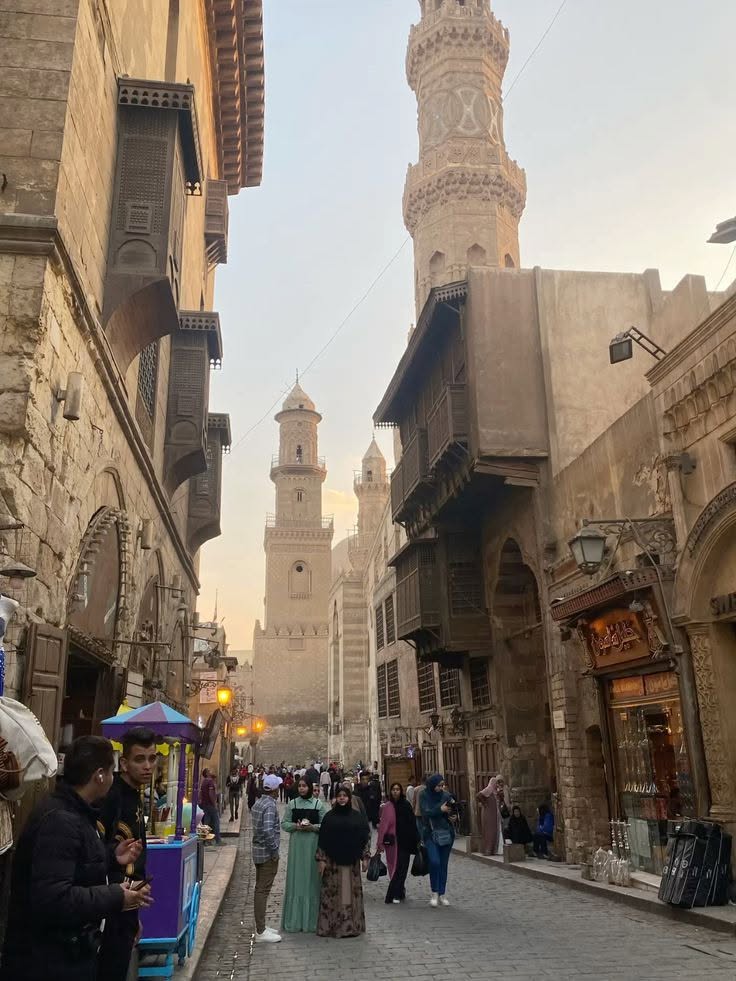
The broad streets of Downtown gave way to the atmosphere of old Cairo: Narrow streets, small shops, street sellers, cafés, souvenirs, lamps, jewellery, spices and people constantly negotiating, selling, buying and talking.
The street sellers were part of the experience. They called to us, displayed their goods and tried every possible way to persuade us to stop. There was something wonderfully theatrical about it all.
Khan al-Khalili is not a place to hurry through. You wander. You look. You bargain. And occasionally you buy something you never intended to buy.
Nearby stood another Cairo landmark: Al-Azhar, one of the great historic centres of Islamic scholarship. The mosques of the surrounding area were magnificent, and suddenly the commercial noise of the market existed beside another world of minarets, courtyards, stone and centuries of religious learning.
That is something Cairo does exceptionally well. It places different worlds beside one another without feeling the need to separate them.
By the end of the day, however, history, walking, traffic and the July heat had taken their toll. Exhausted but satisfied, we made our way back to the hotel.
Thursday: Mummies, Pyramids and the Nile
The following morning, Thursday, we rejoined the family.
Our first major destination was the National Museum of Egyptian Civilization, where one of the most memorable experiences was seeing Egypt’s famous royal mummies.
There is something difficult to describe about standing only metres away from the preserved remains of people who ruled Egypt thousands of years ago.
These were names we had encountered in books and documentaries, belonging to a civilization so ancient that it can sometimes seem almost mythical. Yet here they were.
The experience makes history unexpectedly personal.
From Egypt’s ancient rulers we travelled to the monuments that have come to symbolize their civilization throughout the world: Pyramids of Giza.
No number of photographs quite prepares you for the pyramids.
Their familiarity almost works against them. We have seen their triangular outlines thousands of times. But when you actually stand beneath them and see the enormous stones from which they were constructed, their scale becomes real.
And naturally, there were the camel owners.

They enthusiastically urged us to ride, adding another layer of noise, humour and negotiation to the experience. Around one of the world’s greatest archaeological sites, everyday Egyptian life continued at full volume.
That evening brought another change of atmosphere. We walked along the Nile near Zamalek.
The riverfront was alive. Families, young people, couples and tourists were everywhere. Restaurants and cafés were busy, while boats covered in lights moved along the water offering evening trips on the Nile.
After the dust and heat of Giza, the Nile provided a completely different Cairo—cooler, more relaxed and intensely social.
The city seemed to have come to the river for the evening.
Friday: Civilization, Salah al-Din and Another Cairo
Friday began with a visit to one of Cairo’s malls before we continued exploring the city.
We again encountered the enormous historical depth of Egypt through its museums, while our route also took us past the imposing Citadel of Salah al-Din.
The Citadel rises dramatically above Cairo, a reminder that this city’s history did not begin and end with the Pharaohs. Cairo is also a great medieval Islamic city, shaped by dynasties, armies, scholars, merchants and rulers who left behind mosques, fortifications and entire neighbourhoods.
By then, however, another important Egyptian experience was waiting for us: food. We stopped at a grand restaurant and enjoyed a hefty fish meal—the kind of meal that makes further sightseeing immediately afterwards seem unnecessarily ambitious.
Later, the rest of the family continued to Tagamoa El Khames (Fifth Settlement) and one of its large malls. My wife and I decided that we had done enough exploring for one day and stayed behind at the hotel.

Sometimes knowing when to stop is also part of travelling although one of my nieces later told me it’s a massive mall nothing like she’d ever seen before.
The Cairo Between the Monuments
Looking back, some of the strongest impressions of the trip did not come from any particular tourist attraction. They came from simply looking at Cairo and its people lounging about and going about their business.
The enormous highways were particularly striking. On one of my sojourns I counted up to 15 lanes of traffic, almost or more than the width of a football field. Modern Cairo has built an extraordinary network of wide roads, bridges and elevated highways cutting across and around the metropolitan area. They give the impression of a city determined to keep expanding.
Then there were the buildings. Tall residential blocks rose everywhere, many in dark grey colour that seems characteristic of parts of Cairo’s urban landscape. Some appeared unfinished; others seemed to merge into enormous working-class neighbourhoods stretching towards the horizon and on either side of a plush highway.
Then, sometimes only a short drive away, another Cairo appeared. Modern towers. Expensive residential developments. Shopping malls. Hotels. Landscaped compounds and impressive buildings.
The contrasts were impossible to miss, it’s a didactic Cairo.
Old and new. Rich and poor. Monumental and ordinary.
Ancient pyramids stand beside a modern metropolis. Medieval mosques exist amid the noise of cars and motorcycles. Working-class neighbourhoods stretch for kilometres, while new affluent districts continue to rise farther into the desert.
And running through it all is the wonderful blue Nile, nice to fathom rather than read about.
Perhaps this is what makes Cairo so fascinating. It does not present itself neatly to the visitor. It is noisy, crowded and occasionally exhausting. Its traffic can test anyone’s patience. On the city roads you have to learn to be patient. But it is a city that is also full of life.
Cairo does not whisper its presence, it echoes it and announces it.
Saturday: Back to Amman
On Saturday, 18 July, our mini-bus once again carried us through Cairo’s roads, this time toward the airport.
Four days earlier, we had arrived as a family ready for a short holiday. Now we were leaving with memories of Tahrir Square, Khan al-Khalili, Al-Azhar, royal mummies, the pyramids, camel owners, Salah al-Din’s Citadel, huge meals, shopping malls and evenings beside the Nile.
But perhaps the most valuable memory was simply that we had experienced it together.
My wife and I had our own Cairo adventure on that first day. Our son had travelled from Germany to be with us. Our nieces and nephew shared the larger family journey. For four intense days, three generations of experiences, personalities and interests were packed into one enormous city.
As the plane carried us back toward Amman, Cairo was left behind—but certainly not forgotten.
There are quieter cities. There are easier cities. There are cities that reveal themselves more gracefully.
But few cities possess Cairo’s extraordinary combination of history, chaos, grandeur, contradiction and life. It was only four days.
But it is a trip we will remember for a very long time.