Youssef Heikal: Last Mayor of Yafa
 CrossFireArabia
- September 2, 2026
From Palestinian Heritage:
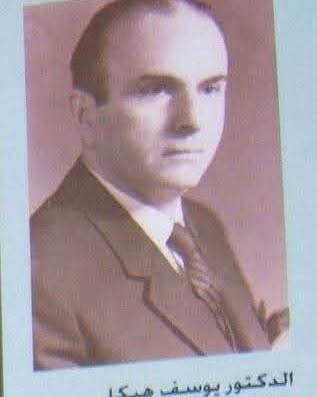
Youssef Heikal was politician and a legal scholar who he was born in Yafa in 1907, called in English Jaffa. His father was a prominent figure and a nationalist.
He received his primary and preparatory education in Jaffa and completed his secondary education at the Arab College in Jerusalem and then traveled to France, earning a Bachelor of Law degree from Paris, a Postgraduate-diploma in Political Science and International Relations, a Postgraduate-diploma in Economics, and a Phd in Legal and Economic Sciences.
He traveled to Britain and received a doctorate in political science from the University of London. Due to his academic excellence, the university awarded him the Hutchinson Medal, which is given annually to the top graduate student at the university. Youssef Heikal was the only Arab to receive this medal since its inception. He began his career as the director of Islamic endowments and schools in Palestine from 1939 to 1943, and then served as a judge in the Central Court of Nablus from 1943 to 1945.
He completed postgraduate studies in law at the University of Montpellier in France and went on to study Criminology, Economics and Political Science at the Sorbonne, with honors. He then completed his doctorate in 1935. Until 1937, he studied at the London School of Economics. That year, he returned to Jaffa and published his book, “The Palestine Question.”
In 1938, he was appointed Director of Waqf (Islamic endowments) in the district of Lod. He was later promoted to Director of Waqf and Islamic Schools throughout Palestine and appointed to the Committee for the Supervision of Arab Education. In these positions, he traveled and spoke throughout the country about the need for Arab unity. In 1942, his book, based on his speeches, “Towards Arab Unity” (or “Towards Arab Unity”), was published. From 1943 to 1945, he served as a judge in the Magistrate’s Court in Nablus.
In 1945, he was elected Mayor of Jaffa. He served in this capacity until May 5, 1948, when he left for Jordan. In Jordan, he served on the Jordanian Armistice Commission and established the Palestinian Ministry to address the Palestinian refugee problem. He served for 16 years as his country’s ambassador to Washington (1959-1962), Paris, London, and Taipei. and United Nations institutions.
In 1969, he published his book “The June Defeat” (or “The June War”) about the Arab defeat in the Six-Day War. In 1971, his book “Palestine: Before and After” (or “Palestine: Before and After”) was published.
He died in Amman, Jordan in 1989.