World Ships Sail to Break Gaza Siege

Sixteen ships set sail from Tunisian ports as part of the Global Sumud Fleet for Gaza, a large-scale international flotilla of civilian boats aiming to break Israel’s blockade on the territory and deliver humanitarian aid.

Khaled Boujemaa, a member of the Maghreb contingent of the Global Sumud Flotilla, told Anadolu that 11 of the ships departed from Bizerte Port in northern Tunisia from Saturday evening until late Sunday.

Three ships set sail from Gammarth Port in the capital, as two others left Sidi Bou Said Port near Tunis, Boujemaa said.

On Sunday, spokesperson Ghassan al-Hanshiri also told Anadolu that two ships left from Gammarth Port toward Gaza and “a third Tunisian ship was preparing to depart shortly,” noting that “a total of eight Tunisian ships are currently docked at Gammarth.”

He pointed out that other ships remain in Sidi Bou Said Port, while vessels from Italy and Spain have already departed, and all will meet in the Mediterranean on their way to Gaza.

On Saturday, the very first vessel of the Global Sumud Flotilla departed Tunisia’s Bizerte Port, in addition to 18 boats from Sicily’s Augusta Port, toward Gaza.

According to an Anadolu correspondent and flotilla spokesperson, the flotilla includes dozens of ships and hundreds of participants from 47 Arab and Western countries, among them prominent politicians, artists, and parliamentarians.

The initiative began last month, with ships departing from Barcelona, Spain, and Genoa, Italy. Over the past week, European boats arrived in Tunisian waters to join their Maghreb counterparts before continuing toward Gaza. Organizers described the mission as unprecedented, contrasting it with previous attempts involving single boats that were intercepted by Israel and their passengers deported.

This convoy is the largest of its kind, aiming to challenge the blockade and deliver humanitarian aid to Palestinians in Gaza, where famine conditions have taken hold under Israel’s months-long closure of all crossings.

The Israeli army has killed nearly 65,000 Palestinians, most of them women and children, in Gaza since October 2023. The relentless bombardment has rendered the enclave uninhabitable and led to starvation and the spread of diseases.
Continue reading
‘Arab Spring’ Continues Withering

By Saleem Ayoub Quna

After December 2010 when a desperate and angry Tunisian young man of the name of Mohammad Bouazizi, dramatically immolated himself, an unprecedented wave of mass protests against incumbent totalitarian regimes swept five Arab capitals: Tunisia, Cairo, Tripoli, Yemen and Damascus.

The simultaneous civic uprising in these countries was deceitfully baptized as the “Arab Spring”, which initially won the hearts of millions of Arabs. But it did not take long before the average Arab citizen started realizing that it was one thing to get rid of a dictator or topple a regime, and completely another thing to have a plan for the day after!

It was the same course of events in the five capitals except for Tunisia: Street demonstrations, clashes with police, havoc and death, under the watchful eyes of disguised outside interference and finally a forced humiliating departure, imprisonment or execution of the incumbent ruler and his entourage.

In Tunisia, the military sat on the fence! Consequently, the violence and loss of life was minimal there, while in the other four countries the toll was higher and kept rising until the end.

The last leg of the fake “Arab Spring” was Syria, where the clashes between the forces of the regime and the opposition groups, mostly of Islamic orientation, dragged on and gradually turned into open urban warfare.

Syria’s distorted model of the “Arab Spring” took nearly 14 years, simply because the regime, at a certain crucial turning point in 2015, resorted to outside direct support, namely from Russia, Iran and Hezbollah.

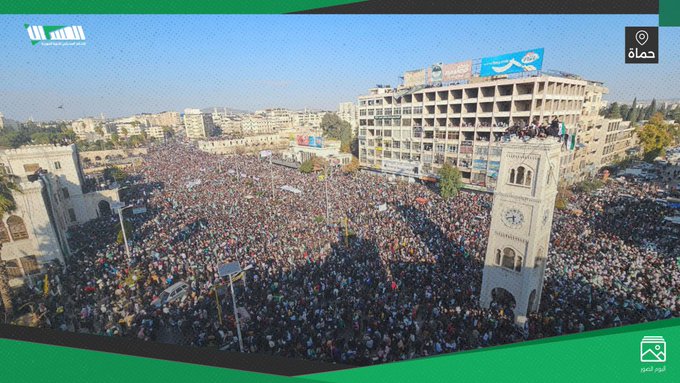
Opposition groups in Syria and their sympathizers never forgot or forgave the brutal crackdown they were subjected to in the city of Hama back in 1982 by the Hafez Al-Assad’s regime.

Of course Russian, Iranian and Hezbollah’s response to help Assad’s regime in 2015, was not an act of charity. Each party had their own agenda and motivations; Iran sought to ascertain its regional clout, while continuing to arm Hezbollah in Lebanon through Syria and Iraq; Russia wanted to strengthen its foothold in Syria in a move to counter balance American encroaching measures in northern-eastern Syria, the oil rich land, where the latter supported the local Kurdish population.

Hezbollah was paying back the debt for the Syrian regime that facilitated the transfer of Iranian military hardware.

Today, Syrians are celebrating the end of the 53rd year of the rule of the Assad dynasty, except, maybe by a handful of them. As the saying goes: Loss and defeat are born orphans; victory and success gets many adopters!

The Syrian groups who took over from the previous regime are multiple in number and diverse in outlook; like an art work of a mosaic, from a distance, it looks picturesque and colorful, but from within and in detail, it clearly lacks coherence and chemistry.

As things stand now in Syria and its surroundings, there is not much room for optimism, despite the big change! Many outside players are gossiping about the future of this beleaguered country in ways that reveal that what they are doing is more than gossiping. They are working on concrete ideas and plans for the day after in Syria while, during the coffee breaks, they watch those who are dancing and chanting in the squares and streets of Damascus!

This opinion was especially written for Crossfire Arabia by Saleem Ayoub Quna who is a Jordanian author writing on local, regional and international affairs and has two books published. He has a BA in English Literature from Jordan University, a diploma from Paris and an MA from Johns Hopkins University in Washington. He also has working knowledge of French and German.

Continue reading