Making Arabic The Future Language!

By Ali Abu Hablah

On December 18, 2025, the world celebrates World Arabic Language Day, an occasion that transcends mere celebration to touch upon the core of cultural and intellectual conflict in a rapidly changing world. This day commemorates the 1973 United Nations General Assembly resolution adopting Arabic as an official and working language of the UN system, in recognition of its historical and cultural significance.

This year’s celebration, organized by UNESCO at its headquarters in Paris, carries the theme:

“Innovative Pathways for Arabic: Policies and Practices for a More Inclusive Linguistic Future.” This theme reflects a growing awareness that the future of Arabic can no longer be secured through emotional rhetoric or historical glorification, but rather through public policies, educational strategies, and serious investment in technology and innovation.

Arabic is not simply a means of communication; it is the language of the Holy Quran, the language of the Prophet’s sayings (Hadith), and a repository of poetic, intellectual, and philosophical heritage. It is also a liturgical language for several Eastern churches. It is spoken today by more than 400 million people and is widespread throughout the Arab world and its surrounding regions, as well as in the diaspora across five continents. It is also one of the most influential languages ​​in the history of world languages.

For centuries, Arabic played a pivotal role as the language of science, politics, and administration. It contributed to the transmission of Greek and Roman knowledge to Europe and served as a bridge for dialogue between cultures along land and sea trade routes. However, this historical leadership is now met with a worrying paradox: Decline of Arabic’s presence in scientific research, higher education, and digital content, in favor of other global languages.

This decline is due to a complex set of factors, most notably the dominance of foreign languages ​​in universities, weak Arabization policies, a decline in translation activity, and the digital revolution, which Arabic has not adequately kept pace with. The widespread use of local dialects, especially through media and social media platforms, has also contributed to weakening the presence of Standard Arabic in the public sphere. This does not mean that the dialects themselves are responsible for the crisis, but rather that it reflects the absence of a balanced linguistic vision. In this context, the 2025 slogan acquires strategic significance, linking the future of Arabic to three fundamental paths:

First, language policies, as no language can be protected without clear legislation guaranteeing its presence in education, administration, and media.

Second, innovation and technology, given that the survival of a language today depends on its presence in artificial intelligence, software, search engines, and the digital content industry.

Third, linguistic inclusivity and equity, by making Arabic accessible to multilingual societies, supporting low-income groups, and promoting linguistic justice without compromising the integrity of the language or politicizing it ideologically.

UNESCO’s celebration of World Arabic Language Day constitutes a platform for global cultural dialogue, but at the same time, it places a heightened responsibility on Arab states and their educational and cultural institutions. The problem does not lie in a lack of international recognition, but rather in the absence of a comprehensive Arab linguistic project that restores Arabic to its role as a language of knowledge and production, not merely a language of heritage and celebration.

Ultimately, the Arabic language does not face an existential crisis, but rather a crisis of management and awareness. It must either be integrated into the core of the civilizational and developmental project, as a language of science, law, and technology, or it will remain confined to occasions and speeches. On World Arabic Language Day 2025, the question remains: Do we want Arabic to be the language of the past, or the language of the future?

Ali Abu Hablah originally wrote this article for the Arabic Addustour newspaper.

Continue reading
The Pharaoh, Sphinx and The Museum

After years of anticipation, the Grand Egyptian Museum by the Pyramids opened on Saturday evening, marking the world’s largest archaeological complex dedicated to a single civilization.

The museum was opened in an official ceremony attended by President Abdel Fattah al-Sisi and delegations from 79 countries, including 39 led by kings, princes, and heads of state and government.

The launch featured musical performances in one of the museum’s courtyards, with the three pyramids visible in the background.

Performers appeared in distinctive pharaonic attire, resembling a grand procession according to Anadolu.

Egyptian Prime Minister Mostafa Madbouly described the museum as a “unique global edifice” and an “exceptional event in Egypt’s history.”

“This dream has lived in our imagination for years. This world-class monument is a gift from Egypt to humanity — a nation with more than 7,000 years of history,” he told a press conference before the opening.

Madbouly thanked everyone who contributed from the idea’s inception to the completion of the project, noting that most of the construction was carried out over the past seven years.

He explained that the concept dated back around 30 years, followed by preparatory work, design competitions, and architectural studies, before the construction began.

Board of Trustees member and businessman Mohamed Mansour predicted that the museum would attract over five million visitors annually.   

‘Fourth pyramid’

The idea of the Grand Egyptian Museum originated in the 1990s under former Culture Minister Farouk Hosni, who envisioned an open museum encompassing the pyramids, the Sphinx, and surrounding temples.

Former President Hosni Mubarak laid the foundation stone for the museum in 2002, and site preparation began in May 2005, but the project stalled for years.

Work resumed in 2014 under President Sisi, who expanded the plan to make it the largest museum in human history.

Between 2017 and 2023, construction, digital infrastructure, display design, and service and investment facilities were completed. The museum began trial operations in October 2024, pending its official opening as the world’s largest archaeological complex dedicated to a single civilization — Ancient Egypt.

Located two kilometers from the Giza Pyramids, the museum covers 490,000 square meters. Visitors can view the pyramids through the five-story glass facade, designed to align with the Great Pyramid’s height, and take photos with the pyramids while exploring King Tutankhamun’s treasures.

The project cost around $1 billion, financed through two Japanese loans totaling $800 million, in addition to Egyptian government funding, donations, and partnerships.

The entrance hall features a colossal statue of Ramses II, and the museum houses over 57,000 artifacts chronicling Egypt’s history. The Grand Staircase spans 6,000 m² — the height of a six-story building — and the museum includes 12 main galleries, temporary exhibition halls, and the Tutankhamun collection with over 5,000 artifacts displayed together for the first time since the tomb’s 1922 discovery.

It also includes a children’s museum, artifacts from Queen Hetepheres, mother of King Khufu, the Khufu boat museum, and various pieces from the Greek and Roman eras.

The design represents sun rays converging from the three pyramids, forming a conical structure — the museum itself — appearing as a “fourth pyramid” when viewed from above.

The logo, unveiled on June 10, 2018, emerged from an international UNESCO-supervised design competition. It reflects the building’s architectural identity, inspired by the orange glow of sunset over the plateau and fluid Arabic calligraphy evoking desert dunes.

Continue reading
Film: A Gaza That No Longer Exists

By Kazim Alam

In the summer of 2023, the London-based Palestinian filmmaker Yousef Alhelou travelled to Gaza with a simple mission to capture the vibrant pulse of a place that has long been off-limits to the world.

What he did not know was that his footage would soon become an unintentional obituary. 

The Phoenix of Gaza, a 48-minute documentary, was filmed just months before Israel launched what Alhelou now calls a “genocidal war” on the strip. 

Premiered in London in February 2025, the documentary stands as a hauntingly beautiful archive of a Gaza that no longer exists.

Over a period of two years, Israel dropped more than 85,000 tonnes of bombs on Gaza, reducing the enclave to dust. Alhelou’s film now serves as an archive, a memory, and a monument.

Through his lens, we witness a Gaza that was already a “Riviera of the Middle East,” a place of joy and defiance that Israel turned into a mass graveyard.

“We refused to vanish. We refused to give up,” he says. 

He shows us an authentic view of the place now touted as the “Riviera of the Middle East” in AI-generated videos. 

Gaza before annihilation

Shot in July and August 2023, The Phoenix of Gaza is breathtakingly beautiful.

The film opens in London. We see him in his London apartment, packing his bags, his voice brimming with anticipation as he prepares to return to Gaza after a decade away.

He calls his mother, who showers him with prayers for safe travels, while his 10-year-old son makes a quick appearance. 

“I wanted to show the world the life of Gazans, the daily life, the hustle and bustle,” he tells TRT World.

Little did Alhelou know that this footage, shot in July and August of 2023, would become a historical artefact, the last unvarnished portrait of Gaza before its annihilation at the hands of Israeli forces.

Where once there were vibrant markets, there is now rubble. Where children played, there are now craters. Photo: TRT World / Yousef Alhelou

Where once there were vibrant markets, there is now rubble. Where children played, there are now craters. Photo: TRT World / Yousef Alhelou

Through sweeping drone shots, we see a city that defies its 20-year siege.

Clean roads hum with smooth traffic, high-rise buildings adorned with solar panels, born of necessity after Israel bombed Gaza’s only power plant in 2006.

Greenbelts and trees dot the urban sprawl, while public parks appear full of families lounging on picnic chairs, children playing, and people strolling along the pristine Mediterranean beach.

“We managed to beautify and decorate our prison of Gaza,” Alhelou says, emphasising the resilience of a people who transformed a “high-density concentration camp” into a vibrant urban centre.

The beach is crowded, the water clear. Palestinian flags flutter as water-skiers speed by. The imagery defies the narrative of Gaza as a place of only suffering.

His approach is unpretentious: he walks through markets, parks, streets. He chats with shopkeepers, children, and the elderly.

At a public square, a phoenix statue, which is the emblem of Gaza’s municipality, stands as a symbol of rebirth, a motif that resonates throughout the documentary.

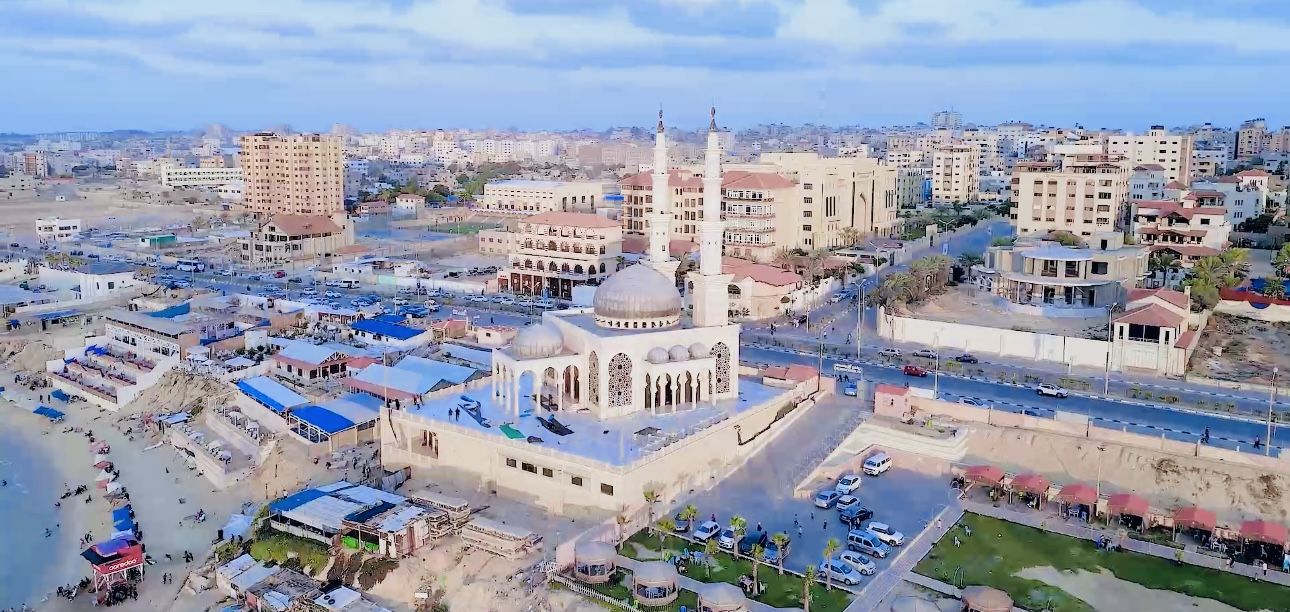
He takes us to the ancient gold market, its shopfronts full of jewellery, and the 1,400-year-old Great Omari Mosque, a UNESCO-protected site, later reduced to rubble by Israeli bombs.

On Omar al-Mukhtar Street, named after the famed Libyan anti-colonial warrior, restaurants and shops appear full of customers, scenes now unimaginable as the street currently lies in ruins.

In the Shujayyah neighbourhood of Alhelou’s childhood, children roam the same streets that he did in the 1980s, unaware that many would soon perish in Israel’s indiscriminate bombings.

He films the 700-year-old Pasha Palace, where Napoleon once slept for three nights, and the Church of Saint Porphyrius, built in 1160, both destroyed by Israeli bombs.

He explores beachside cafes and Gaza’s culinary scene by hopping to the roadside food stands. He visits the Ottoman Hamam, a space for relaxation, near the historic Jewish neighbourhood, which predated the Israeli occupation of Palestine.

The documentary highlights the educational achievements in Gaza, a place that has one of the world’s highest literacy rates on a per capita basis.

Scenes of cultural events – music, art, and a wedding ceremony – capture the “heartbeat of Gaza”, while a student appreciation ceremony celebrates young graduates with song and dance.

Even Gaza’s cemeteries tell a story. Alhelou lingers in the English cemetery, where 3,500 graves of World War I soldiers are meticulously kept, a gesture of dignity, in sharp contrast to the thousands of Palestinians now buried beneath collapsed buildings.

Elegy for family under rubble

He left Gaza in late August 2023. The war’s toll is personal.

“This genocidal war impacted me in the sense that I cannot believe that my city, the place of my birth, has been destroyed and that it’s beyond recognition,” he says.

Alhelou’s eldest sister, Asma, and her seven children were killed in Israeli strikes and are still buried under the rubble. His elderly parents and siblings remain in Gaza, fighting a daily battle for survival amid Israel-imposed starvation. 

The documentary, initially intended for his Arabic-speaking followers, has taken the shape of an elegy meant “to keep the memory and the legacy of Gaza for generations to come.”

The contrast between Gaza then and now is gut-wrenching. Where once there were vibrant markets, there is now rubble. Where children played, there are now craters. 

The Riviera of Gaza, which Alhelou compares to Singapore and Dubai, is gone. It has been replaced by a landscape where “there is no infrastructure, no electricity, no water, no food, no places to visit”.

The “man-made starvation” orchestrated by Israel is particularly harrowing. “I cannot believe that we are facing starvation in the 21st century,” Alhelou says.

TRTWorld

Continue reading
Paris Exhibit Itches Out GAZA

As Israel’s continues its devastating war and relentless humanitarian blockade, the ancient Gaza Strip – once a radiant Mediterranean hub of commerce, culture, and religious coexistence – now faces a deeper erasure: not just from maps, but from the world’s collective memory.

A new exhibition at the Institut du Monde Arabe in Paris, titled ‘Gaza’s Saved Treasures: 5,000 Years of History,’ seeks to resist that disappearance. Running from April to November this year, the show presents around 100 archaeological masterpieces that illuminate Gaza’s extraordinary legacy as a crossroads of civilizations – from the Bronze Age to modern times.

The exhibition is both a celebration and a lament: a tribute to Gaza’s millennia-old cultural wealth, and a sober reckoning with what has been lost to Israel’s deadly occupation.

Gaza’s strategic location has always made it a coveted prize for empires – Egyptian, Persian, Roman, and Ottoman – but it was also a channel for connection, where cultures and religions converged.

The exhibit – with amphorae, oil lamps, coins, statuettes, and mosaics on display – tells the story of Gaza as a vital Mediterranean port and cultural meeting point.

Its history – shaped by Canaanite, Egyptian, Philistine, Neo-Assyrian, Babylonian, Persian, Greek, Roman, Byzantine, Islamic, and Crusader influences – reveals a city that flourished at the heart of ancient trade and intellectual exchange.

Among the most striking items is a dazzling Byzantine mosaic from Jabaliya, part of an ecclesiastical complex reflecting Gaza’s early Christian heritage.

Nearby, amphorae once used in the wine trade testify to the city’s crucial role in Mediterranean commerce, while figurines blend Egyptian motifs with Hellenistic gods, echoing a world of syncretism and porous cultural boundaries.

Race against oblivion

Since the start of Israel’s war on Gaza in October 2023, the territory’s cultural heritage has suffered catastrophic damage.

According to UNESCO, nearly 70 cultural sites have been destroyed or severely damaged, including the historic Greek Orthodox Church of Saint Porphyry – one of the oldest active churches in the world.

Where once stood mosaics, temples, and centuries-old tombs, there are now craters and rubble due to Israel’s ongoing bombardment. In this context, the exhibition in Paris becomes something urgent and defiant: a safeguard for memory, a museum in exile.

Much of the exhibition’s content is drawn from a trove of over 500 artifacts housed since 2007 at Geneva’s Museum of Art and History, entrusted to Switzerland by the Palestinian National Authority for safekeeping.

Many of the works stem from Franco-Palestinian excavations launched in 1995, supplemented by pieces from private collections – some of which are being shown publicly for the first time.

The curators have taken care not to separate Gaza’s ancient grandeur from the present-day suffering inflicted by Israel.

One dedicated section of the exhibition uses satellite imagery and field reports to map the devastation inflicted on cultural heritage since 2023.

French, Swiss, and Palestinian scholars have contributed rare documentation – including early 20th-century photographs of Gaza – that provide a visual archive of what once was and what may never return.

The exhibition makes no attempt to hide the political context. It explicitly refers to the destruction as part of “Israel’s brutal genocide,” anchoring the cultural annihilation in a broader system of occupation, blockade, and war.

By doing so, the Paris exhibition challenges the silence often surrounding cultural loss in war zones, raising questions about the responsibilities of international institutions and the politics of preservation as reported in Anadolu.

Continue reading
Bahrain Revives Its Pearling Legacy

Bahrain, with its shallow waters and rich oyster beds, has long been synonymous with pearls, which formed the backbone of the island nation’s economy for thousands of years. Diving for pearls, otherwise known as pearling, remains part of the country’s cultural DNA.

“I always say that all Bahrainis have pearl diving in their blood,” Mohamed Alslaise, a pearl diver and field researcher for the Bahrain Institute for Pearls and Gemstones (DANAT) tells UN News. “Almost all the families that moved from the Arabian Gulf or Iranian coast to Bahrain were divers.”

Mr. Alslaise is passionate about preserving and reviving this age-old tradition, notes that many families in the Gulf nation have a member who was either a pearl diver or contributed in some way to the pearl diving industry.

Pearling in the Persian Gulf shaped Bahrain’s economy for thousands of years but, following a peak around the turn of the 20th century, the perfection of cultured pearls by Japan in the 1930s caused a sharp and devastating decline in the industry.

Khaled Salman, a diver since the 1970s, explains that while diving continues, it’s no longer done in the old way.

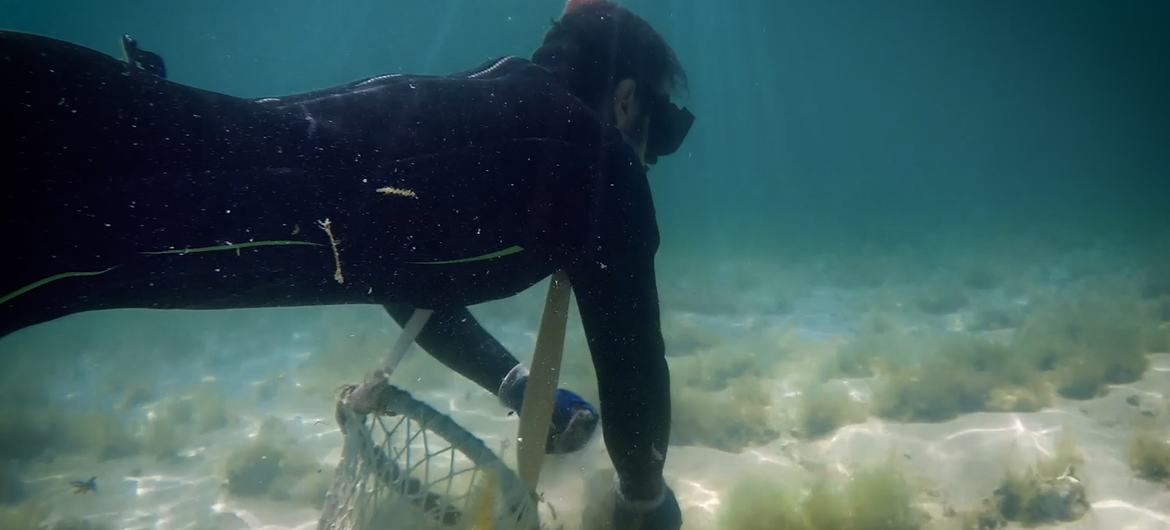
Bahraini diver, Mohamed Alslaise extracting pearls from oysters.

UN Video/Hisae Kawamori

Bahraini diver, Mohamed Alslaise extracting pearls from oysters.

“Nowadays, larger quantities are extracted due to advancements in technology, allowing divers to stay underwater for longer periods. In the past, a diver would stay underwater for four minutes, but now scuba divers can remain underwater for an hour or more.”

Due to lower pearl prices, Salman notes, “Many people don’t sell the pearls they extract; they store them until prices rise and then sell them to traders in Bahrain.”

Some pearls are used in local industries, while others are marketed outside Bahrain. He also highlights three types of pearls: synthetic, cultured, and natural, adding that “distinguishing between these types requires experience and modern equipment.”

The decline in pearling also affected Bahrain’s shipbuilding industry. Abdulla, a designer of wooden ships and boats for over 35 years, shares his perspective: “Bahrain is famous for its shipbuilding industry, which was integral to pearling. There are several types of ships, varying by design, but now smaller ships are used for pearling due to decreased demand.”

The wood for shipbuilding is imported from Africa and Singapore, and, says Abdulla, the lifespan of a ship can extends beyond 100 years.

Abdulla, a designer of wooden ships and boats for over 35 years.

UN Video/Hisae Kawamori

Abdulla, a designer of wooden ships and boats for over 35 years.

Folklore, songs and tradition

“Most Bahraini traditions are connected to the pearl diving industry. For instance, the pearl diving songs,” says Mr. Alslaise. “The folklore of pearl diving has been passed down for generations. We still sing the same songs, which were originally sung to boost morale on the boats.”

Bahrain’s historic pearling site, known as the Pearling Pathhas been inscribed as a World Heritage Site by the United Nations Educational, Scientific, and Cultural Organization (UNESCO). The site testifies to the pearling tradition and the wealth it generated in the Gulf region for millennia.

According to UNESCO, the area consists of 17 buildings in Murharraq city, three offshore oyster beds, part of the seashore and the Qal’at Bu Mahir fortress on the southern tip of Muharraq Island, from where boats used to set off for the oyster beds.

There are shops, storehouses, a mosque, and the homes of wealthy merchants in the area. According to UNESCO, the location is the only complete example of the pearling cultural tradition and the wealth it produced during the period when the Gulf economy was dominated by trade from the second century until Japan developed cultured pearls.

It also constitutes an outstanding example of traditional utilization of the sea’s resources and human interaction with the environment, which shaped both the economy and cultural identity of the island’s society.

A band performing a pearl diving song in Bahrain. The folklore of pearl diving has been passed down for generations.

UN News/ Abdelmonem Makki

A band performing a pearl diving song in Bahrain. The folklore of pearl diving has been passed down for generations.

Pearling is back 

“I am one of the people who fell in love with pearl diving without any guidance from my parents or family,” Mr. Alslaise. “The generation before us was not allowed to dive when they were young because, after oil was discovered, all the jobs shifted to the oil industry.”

According to Mr. Alslaise, since 2017, when Bahraini authorities introduced pearl diving licenses, many people who signed up had no prior knowledge of pearl diving.

“Now, seven years down the line, many Bahrainis have reconnected with this heritage. Over 1,000 divers are now registered and dive regularly to create an income for themselves.”

Continue reading