The Mass Graves of Gaza

 Thousands of families continue to bury their children in random mass graves, a phenomenon brought on by over 11 months of systematic killings of Palestinians by Israel in every Gaza Strip governorate. The situation is worsening as a result of the Israeli occupation army’s constant targeting of people who attempt to enter these makeshift cemeteries to bury their loved ones.

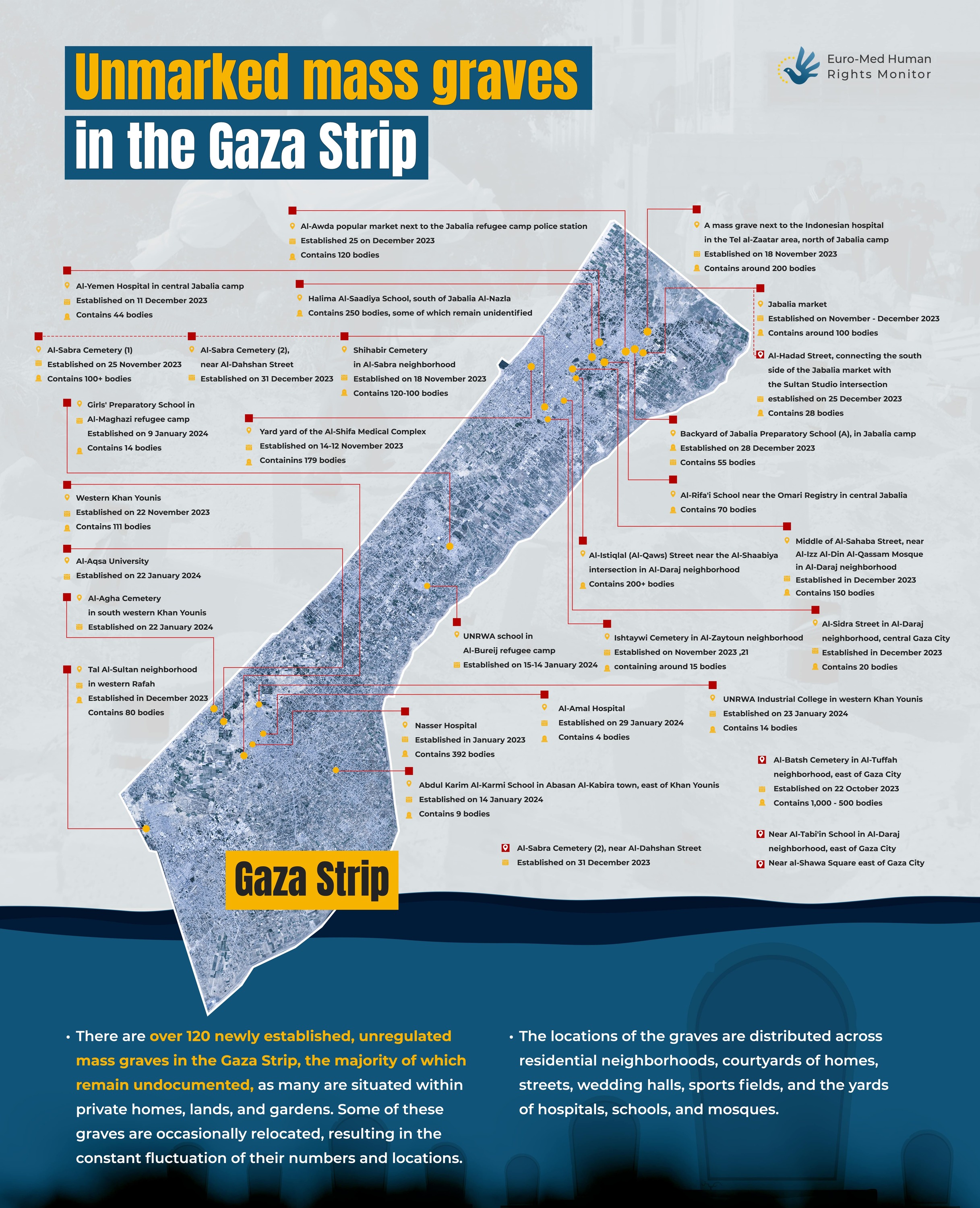
Euro-Med Monitor has released an infographic design that shows the locations and dates of approximately 30 randomly established mass graves in the northern, central, and southern governorates of Gaza, containing roughly 3,000 dead victims of Israel’s genocide in the enclave. The infographic also depicts 120 random mass graves in which three or more people are buried, and which were established in the Gaza Strip between now and last October.

Random graves

Since many random graves are found inside houses and other private spaces and some are periodically moved to new locations, the majority of them are still unrecorded. Thus, the number and location of these graves remain constantly changing. Furthermore, the Israeli occupation army is continuously bulldozing both makeshift cemeteries and official graves, disfiguring the victims’ bodies, and even stealing some of them, in grave violation of international law.  

Al-Batsh Cemetery, located in Gaza City’s eastern Al-Tuffah neighbourhood, is the largest documented mass grave in the Gaza Strip. Between 500 and 1,000 people have been buried there since the cemetery’s founding on 22 October 2023, just two weeks after Israel’s genocidal war on Gaza began.

Euro-Med Monitor field teams have been documenting the mass and random graves across the enclave since the establishment of the first mass grave in Al-Shifa Medical Complex on 15 October 2023, when it became impossible to transfer the dead victims to the official cemetery in Gaza City due to the large number of corpses and the danger presented by Israeli forces. Over time, more of these mass graves have been created, one after another, eventually totaling at least 120.

backyards, courtyards

These graves have been established throughout residential areas, in the backyards and courtyards of homes and hospitals, public road intersections, wedding halls, sports fields, schools, and mosques.

“Random mass graves have become something of a phenomenon in Gaza,” according to a Euro-Med Monitor field researcher in Gaza City whose name is being withheld due to safety concerns. “They are seen on the roads, in traffic islands, [and] near markets and residential buildings at random.”

Added the researcher: “Residents resort to using various tools as tombstones to write the names of the victims on—instead of cement and stone—including plastic food trays, plastic barrels or gallon jugs, wood or cardboard, and other household items.”

Families are forced to create these random graves due to the difficulty of accessing the main graves as a result of the continuous Israeli bombing and targeting of individuals, in addition to Israel’s division of the Gaza Strip’s governorates and destruction of infrastructure; imposition of the blockade; scarcity of fuel and means of transportation; and the fact that the main graves are already filled with corpses due to the large and ever-increasing number of victims.

Some of the officially documented mass graves contain the remains of yet-to-be identified people, buried months ago during the ongoing genocide.

Euro-Med Monitor teams have documented 29 random mass graves in the various governorates of the Gaza Strip. These include:

North Gaza Governorate:

1. A mass grave in Al-Awda Market next to the Jabalia refugee camp police station, established on 5 December 2023, containing about 120 bodies.

2. A mass grave next to the Indonesian Hospital in the Tel al-Zaatar neighbourhood, north of Jabalia Camp, established on 18 November 2023, containing about 200 bodies.

3. A mass grave in the Jabalia Camp market, established on 7 December 2023, containing about 100 bodies.

4. A mass grave in the backyard of Jabalia Preparatory School (A), in Jabalia Camp, established on 28 December 2023, containing more than 55 bodies.

5. A mass grave in Al-Rifai School, opposite Al-Omari Registry in Jabalia Al-Balad, containing more than 70 bodies.

6. A mass grave in Halima Al-Sadia School, south of Jabalia Al-Nazla, containing more than 250 bodies, some of whom are still unidentified.

7. A mass grave in Al-Yaman Hospital in Jabalia Camp, established on 11 December 2023, containing about 44 bodies.

8. A mass grave built on a traffic island along Sultan Street in Block (2) in Jabalia, established in November 2023.

Gaza City Governorate:

9. A mass grave in the courtyard of Al-Shifa Medical Complex, established on 12-14 November 2023, containing approximately 179 bodies.

10. Al-Sabra Cemetery (1), established on 25 November 2023, containing more than 100 bodies.

11. Al-Istiqlal Street Cemetery (Al-Qaws) near the Al-Sha’biya intersection in Al-Daraj neighbourhood, containing more than 200 bodies.

12. Al-Sabra Cemetery (2), near Al-Dahshan Street, established on 31 December 2023.

13. Al-Batsh Cemetery in Gaza City’s eastern Al-Tuffah neighbourhood, established on 22 October 2023, containing between 500–1,000 bodies.

14. A mass grave in Al-Sahaba Street, near Ezzedine Al-Qassam Mosque in the central Gaza City neighbourhood of Al-Daraj, established in December 2023 and containing 150 bodies.

15. A mass grave in Al-Sidra Street in the central Gaza City neighbourhood of Al-Daraj, established in December 2023 and containing about 20 bodies.

16. Shahibar Cemetery in Al-Sabra neighbourhood, established on 18 November 2023 and containing about 100–120 bodies.

17. Ishtiwi Cemetery in Al-Zeitoun neighbourhood, established on 21 November 2023 and containing about 15 bodies.

18. A mass grave near Al-Shawa Square, east of Gaza City.

Deir al-Balah Governorate (central Gaza Strip):

19. A mass grave in UNRWA school in al-Bureij refugee camp in the central Gaza Strip, established on 14-15 January 2024.

20. A mass grave in a girls’ preparatory school in al-Maghazi refugee camp in the central Gaza Strip, established on 9 January 2024, containing approximately 14 bodies.

Khan Yunis Governorate (southern Gaza Strip):

21. A mass grave in western Khan Yunis, established on 22 November 2023, containing approximately 111 bodies.

22. A mass grave in Abdul Karim Al-Karmi School in the town of Abasan Al-Kabira, in the east of Khan Yunis, established on 14 January 2024, containing approximately 9 bodies.

23. Three mass graves in Nasser Hospital, established in January 2023, containing approximately 392 bodies.

24. A mass grave in Al-Amal Hospital, established on 29 January 2024, containing approximately 4 bodies.

25. A mass grave at Al-Aqsa University, established on 22 January 2024.

26. A mass grave at the UNRWA Industrial College, in the west of Khan Yunis, established on 23 January 2024, containing approximately 14 bodies.

27. Al-Agha Cemetery, established by the Al-Agha family on their land after the Israeli army destroyed the family’s main cemetery in the Austrian neighbourhood, west of Khan Yunis city, established on 22 January 2024.

Rafah Governorate (southern Gaza Strip):

28. A mass grave in the Tel al-Sultan neighbourhood, in the west of Rafah, established in December 2023, containing approximately 80 bodies.

Israel’s ongoing military attacks and direct targeting of Palestinian civilians by shelling, sniping, or shooting from quadcopter drones continue to prevent families from reaching regular cemeteries in which to bury their relatives in a dignified manner that respects human dignity, and make the process of counting, registering, and identifying all of the victims impossible.

Since most of the victims have not died from epidemics or infectious diseases, the accumulation of dead bodies or their improper burial does not present a serious health risk to the public. However, if the remains of these bodies—including feces—leak into residents’ drinking and use water sources, this may result in a variety of intestinal diseases among the living.

Israeli attacks on cemeteries

Since the start of Israel’s genocide in the Gaza Strip, Euro-Med Monitor teams have documented numerous Israeli attacks on dozens of cemeteries through deliberate shelling and targeting, exhuming and vandalising graves, and stealing dozens of corpses. These attacks have pushed residents to create new random cemeteries and transfer the bodies of their relatives there.

Israel’s imposition of inhumane conditions on Gaza Strip residents constitutes a serious violation of the provisions of international humanitarian law (IHL). IHL guarantees respect for the dignity of the dead and the proper treatment of corpses, especially the Fourth Geneva Convention of 1949, which stipulates in Article 17 that conflicting parties must “take the necessary measures to ensure that the dead are buried in a dignified manner and that their honour is protected”.

The World Health Organisation and the International Committee of the Red Cross must play their role in ensuring the dignity of the bodies buried in dozens of mass graves in Gaza, and ensure their burial in accordance with international standards.

In addition to applying pressure from abroad on Israel to immediately end its genocide against the Palestinian people in the Gaza Strip, the international community must compel Israel to follow international law, which stipulates that bodies must be respected and protected during armed conflicts. It also requires Israel to take all reasonable steps to prevent the dead and deceased from having their bodies mutilated, and to ensure that they are buried properly.
EuroMed Human Rights Monitor

Continue reading
Stop The Horror: UN Condemns Israeli Attacks on Schools

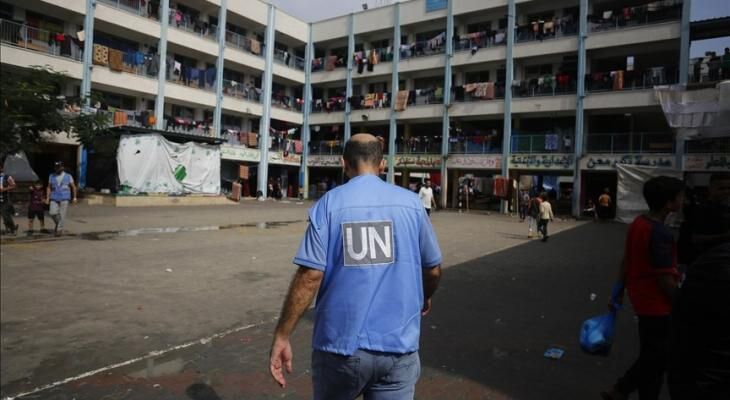
The UN Human Rights Office condemns the increasing frequency of Israeli Defense Forces (IDF) strikes on schools where hundreds of thousands of forcibly displaced Palestinians have sought shelter, conducted with apparent disregard for the high rate of civilian fatalities.

In the latest of such strikes, at around 0430 hours this morning during dawn prayer, a mosque inside Al Tabae’en School was struck by the IDF at least three times with an initial report of at least 93 Palestinians killed, including 11 children and 6 women. The majority of fatalities appear to have been inside the mosque performing their prayers. Additionally, dozens of others were reportedly seriously injured, with the majority being children, women, and older people.

This is at least the 21st strike on a school, each serving as a shelter, that the UN Human Rights Office has recorded since 4 July. These strikes have resulted in at least 274 fatalities, including women and children.

Despite IDF statements that all measures are taken to avoid civilian harm, the repeated strikes on IDP shelters in areas to which the populations have been forced to move, and the consistent and predictable impact on civilians, suggest a failure to strictly comply with obligations required by International Humanitarian Law (IHL), including the principles of distinction, proportionality, and precautions in attack.

Furthermore, these systematic attacks on schools came in the context where more than 90 per cent of Gaza’s population has been displaced while the Israeli military continues detonating residential buildings and restricting the entry and distribution of humanitarian assistance. IDPs face indescribable horror after 10 months of hostilities, including multiple forced displacements, the rapid spread of diseases, and ongoing denial of access to the basic necessities of life. For many, schools are the last resort to find some shelter and possible access to food and water.

In most of the incidents, the Israeli military asserts that the schools were used by Palestinian armed groups and that they took measures to reduce civilian harm. While the co-location by armed groups of military objectives with civilians or the use of the presence of civilians with the objective of shielding a military objective from attack constitute violations of IHL, it does not negate Israel’s obligation to comply strictly with IHL, including the principles of proportionality, distinction and precaution when carrying out military operations. Israel, as the occupying power, is obliged to provide the population it has forcibly displaced with basic humanitarian needs, including safe shelter.

ENDS

For more information and media requests, please contact:

UN Human Rights office at [email protected]

Tag and share

Twitter @OHCHR_Palestine

Facebook UN Human Rights Palestine

Reliefweb

Continue reading
Israel Bombs Schools to Force People Out of Gaza

The Israeli army is increasingly targeting schools that provide shelter for the displaced population in Gaza City, killing and wounding hundreds of them in the process. It has also issued orders for the illegal forced evacuation of Gaza from the north to the south, in a systematic effort fueled by revenge to drive residents from their homes and places of displacement and rob them of any stability.

In just eight days, Israeli aircraft attacked nine schools in Gaza City that served as shelters for thousands of displaced people. They destroyed the schools above the heads of the occupants, killing 79 Palestinians and injuring 143 more—mostly women and children—in addition to several other victims who were buried beneath the rubble and could not be retrieved due to the lack of the necessary tools.

The latest of these attacks occurred on Thursday, 8 August, at 3:00 p.m. when Israeli aircraft bombed the Al-Zahraa and Abdul Fattah Hamouda schools in the Al-Tuffah neighbourhood east of Gaza City, where thousands of displaced people are housed. The attack resulted in the deaths of 17 civilians and the injuries of dozens more, many of whom were women and children.  Sixteen more were reportedly missing under the rubble

Last Sunday, on 4 August, Israeli aircraft bombed the Al-Nasr and Hassan Salama schools in Gaza City, killing 30 Palestinians and wounding 19 others. The day before, Israeli planes attacked four schools in the Sheikh Radwan neighbourhood of eastern Gaza that were being used as shelter centres; 17 Palestinians were killed and 60 others were injured in the attack. Earlier this month, Israeli aircraft bombed the Dalal Al-Maghribi school in the Shuja’iyya neighbourhood of eastern Gaza, leaving 15 dead and 29 injured.

Although the Israeli army repeatedly attempts to justify the bombings by claiming that they target military or political figures, without providing evidence to support these claims, the bombing and destruction of schools above the heads of displaced people inside them has no valid justification and serves no military purposes.

Initial investigations by Euro-Med Human Rights Monitor’s field team indicate that the Israeli army deliberately destroyed the remaining shelter centres to deny Palestinians the few remaining places to seek refuge after the systematic destruction of homes and shelters, including schools and public facilities, over the past ten months.

By continuing to bomb the entire Gaza Strip and concentrating on shelters, such as those housed in UNRWA schools, the Israeli bombing strategy clearly indicates a policy intended to deprive Palestinians of security and stability, if only temporarily.

In the course of their ten-month military attack on the Gaza Strip, Israeli forces continue to bomb civilian targets, kill large numbers of civilians, target refugee centres—the majority of which are housed in UN facilities—and carry out mass murders there, all of which are considered crimes against humanity and full-fledged war crimes.

The last four days have seen new forced evacuation orders for tens of thousands of residents in Khan Yunis, the central governorate, and northern Gaza. These events coincide with the policy of bombing shelter centres in Gaza City, suggesting that Israel is purposefully stepping up the evacuation orders to force Palestinians to leave their destroyed homes without even the option to resettle in nearby tents.

In its crime of genocide, ongoing since 7 October, Israel has adopted a systematic policy of targeting the civilian population of the Gaza Strip, in blatant disregard of the civilian protections mandated by international humanitarian law. This includes Israel’s targeting of areas designated as humanitarian zones, as well as its increased bombing of shelters and relocation centres over the heads of the displaced in an effort to impose forced relocation and destroy all essentials of life.

A series of displacement orders targeting large residential communities in Khan Yunis, in the southern Gaza Strip, have been issued by the Israeli army in recent days. The most recent of these orders was issued on Thursday evening, 8 August, and it included all of the eastern towns of Khan Yunis as well as the city centre’s neighbourhoods, Sheikh Nasser, Al-Satar, and Al-Mahta, which are communities with over 200,000 residents. These orders coincided with aerial and artillery bombardment and the beginning of a ground incursion into the eastern outskirts of the city.

Concurrently, the Israeli army distributed incitement leaflets against leaders of the Palestinian factions. This suggests that the purpose of these directives and military actions is not military necessity but rather acts of incitement and retaliation against the locals and displaced people, whom Israel targets to exact political pressure and retaliation

Last Wednesday the Israeli army issued new evacuation orders for tens of thousands of residents in Beit Hanoun town and the Al-Manshiya and Sheikh Zayed neighbourhoods in northern Gaza, ordering them to head to the west of Gaza City, which was also bombed. The following day, the evacuation order was modified to direct residents to relocate to the central Gaza Strip, to Al-Zawayda and Deir al-Balah. These areas were heavily targeted by Israeli raids and bombings, including one that destroyed tents housing displaced people inside the Shuhada al-Aqsa Hospital in Deir al-Balah, resulting in the deaths of three Palestinians and the injuries of eighteen more.

Civilians in the Gaza Strip are paying the price for Israeli military attacks that violate with impunity the rules of international humanitarian law, especially the principles of distinction, proportionality, and military necessity.

Accordingly, all countries must fulfil their international obligations by enacting effective sanctions against Israel and ceasing all forms of military, political, and financial assistance. This includes immediately cutting off arms exports to Israel; otherwise, these nations must be found to be complicit in crimes that have been committed in the Gaza Strip, including genocide.

As genocide is one of the international crimes that the International Criminal Court is mandated to investigate, it is imperative that the Court move forward with its investigation of all crimes committed by Israel in the Gaza Strip, broaden its investigation into all individuals responsible for these crimes, and issue arrest warrants against them.

Euro-Med Human Rights Monitor

Continue reading
Israel: Making Gaza Uninhabitable

After more than 300 days of war, over 15,000 children have been reported killed. Nowhere is safe in Gaza. Ground incursions and heavy fighting persist with 86% of Gaza’s areas under forced evacuation.

The humanitarian “safe zone” is under repeated attacks and evacuations, severely limiting humanitarian operations and forcing food distribution points and kitchens to close and evacuate.

Almost 40,000 Palestinians have been reported killed, up to 70% being women and children, and over 91,000 have been reported injured. Additionally, it is estimated that more than 10,000 people are missing under the rubble. Over 6% of the entire population of the Strip has been either killed, injured or is missing.

The indiscriminate bombing of hospitals, schools, UN and INGO facilities, and residential buildings have caused massive destruction. More than 60% of residential buildings and 80% of commercial facilities have been damaged or destroyed, including 57% of cropland, limiting the functionality of the food system.

This is while 88% of all schools sustained damages and 650,000 students are impeded to attend classes.

Out of 36 hospitals, only 16 are partially functioning, of which 11 are partially accessible due to insecurity or physical barriers, such as damage to entrances and surrounding roads. Very heavy restrictions on humanitarian access, lack of adequate medical care and prevention measures have entailed the spread of diseases, including Hepatitis A, especially among children in overcrowded shelters.

Polio has been detected in water in some areas of Gaza, which raises fears of an outbreak.

Humanitarian Access

Israel allowed less than 1,000 aid trucks to enter Gaza in July, compared to the pre-war average of 500 truckloads per day, including fuel. This situation exacerbates the breakdown of law and order, which continues to pose challenges for aid delivery in Gaza. Rafah crossing remains closed by the Israeli forces.

West Bank

Security in the West Bank is sharply deteriorating, with hundreds of Palestinian deaths, thousands of arrests, and severe mobility restrictions impacting daily life. Since 7 October, at least 605 fatalities were registered among Palestinians, including 144 children.

Nearly 3,600 Palestinians, including over 1,600 children, have been displaced, due to settler violence and intimidation, home demolitions, and destruction of residences during militarized law enforcement operations.

Reliefweb

Continue reading
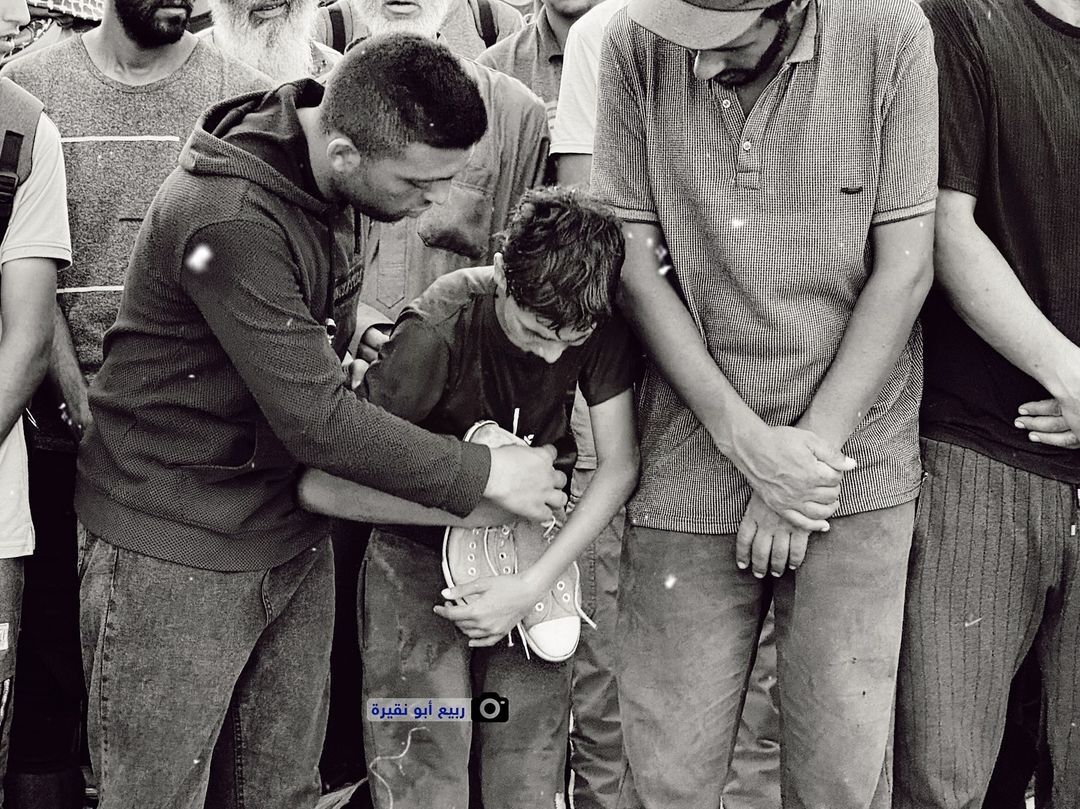
Boy Clings to Shoes of His Dad Killed by Israeli Bombs

A heart-wrenching scene from a funeral in Gaza shows a Palestinian child clinging to his father’s shoe. His father was killed by the ongoing Israeli bombardment of civilian areas in the Gaza Strip.

The Israeli genocide on Gaza continues after 10 months with the number of martyrs topping the 39,000-mark and those injured standing at over 91,000.

Continue reading