
Religion, Nationalism, Middle East Style!
 Dr Khairi Janbek
- November 5, 2024
Dr Khairi Janbek
When you consider yourself as a member of the greatest group in existence, irrespective of its characteristics, it is only natural to assume that the values of this group are the greatest, and consequently, the only valid values which are permissible to hold.
However, we must not delude ourselves, because religion cannot be neatly put in the pigeonhole as a moral, or personal spiritual force, for the very ancient nature of organised religion has given it a powerful role in defining peoples personal and group identities,
in other words, religion plays a national as well as personal, moral, and spiritual roles.
Nationalist and religious identities are both manifestations of the need for belonging, as people have the basic need to belong, a need which can be expressed in inclusive or an exclusive way leading to serious consequences.
Dualism
In the context of the Arab world, dualism has ruled supreme, the choice has always been, either religion or nationalism, but Iran, Israel and Turkey, have managed to fuse religion into nationalism. Each one of those countries, reflecting on themselves individually, thought of themselves as great nations, consequently, this meant that great nations require great religions, and not only that, but their own perspective of their own faiths can only be the true path.
The Arab world till now, shows that religion and nationalism remain irreconcilable, which makes it difficult for the Arab individual to understand Iranian, Israeli, and Turkish societies.
In fairness however, one must say that, the reluctance of any Arab state to claim representation of Islam is very likely to bring severe opposition from both Islamists and nationalists.
Therefore by separating Islam from nationalism, the individual Arab state strengthens its own brand of legitimacy, and as we see, every Arab state is comfortable with the abstract notion of an Islamic Umma (greater nation) in as much as it is comfortable with the abstract notion of Arab Umma (greater nation).
Dr Khairi Janbek is a Jordanian writer based in Paris and the above opinion is that of the author and doesn’t reflect crossfirearabia.com.
Jordan: United Kingdom Plan and Dashing The Chance for Peace
- Dr Khairi Janbek
- October 29, 2024
By Khairi Janbek
In order to reinforce the concept of the unity of the two banks, which was reaffirmed at the Cairo Arab Summit in 1970, and in order to placate the rising Palestinian sentiments, King Hussein unveiled on 15 March, 1972, his United Arab Kingdom Plan (UAK).
In an address to the nation on that day, the late King elaborated on the proposed plan, as the Hashemite Kingdom of Jordan would, after the withdrawal of Israel from the West Bank, become the United Arab Kingdom comprising of two regions: First: Region of Palestine ie. West Bank and any future territories to be liberated and whose inhabitants opt to join in, with Jerusalem as its capital. Second: Region of Jordan, is East Bank and its capital Amman.
Furthermore, Amman would be the administrative capital of both regions. The King would be the head of state. There would be a local parliament and local government for each region, as well as a federal government and a parliament. There would be one federal supreme court and one army.
The late King added, this arrangement is his preference, though he intended to give the Palestinians, after liberation, the opportunity to determine their own future, and pledged to respect their choice.
Despite the fact that this plan was only a proposal, it drew violent reactions from the PLO as well as the Arab states who all in the 1970 Arab League Summit reaffirmed the unity of the two banks.
The late Mr. Yasser Arafat considered the plan a mere ressurection of Jordan’s long standing policy of insisting that the West Bank was an integral part of Jordan, and the Palestinians residents were Jordanian citizens. He considered that, a real threat to his own claim of representing the Palestinian people.
The late president Sadat of Egypt wanted to identify his own regime with the Palestinan cause, and announced before a cheering crowd at the Palestine National Council (PNC) meeting in Cairo on 10 April 1972, the break of diplomatic relations with Jordan. Syria, in order not to be upstaged by Egypt, cut diplomatic relations with Jordan and closed its borders.
Significantly the Plan remained under consideration until the Rabat Arab Summit of 1974, when the Arab states decided the sole representative of the Palestinian people should by the PLO.
The Rabat Summit forced Jordan to withdraw from direct involvement in the peace process at the time when the eyes of the whole world and the attention of the USA, were focused on the settlement of the Arab-israeli conflict.
The Rabat decision confused the issue. Instead of concentrating on the basic problem of Israel’s occupation of Arab lands, the questions of Palestinian national rights and independent Palestinian state were introduced. The nature of the problem changed overnight.
Jordan tried to seperate the issue of withdrawal from the issue of national rights of the Palestinian people. Jordan stood for the ending of the Israeli occupation of all Arab lands; occupied after 1967 war, establish peace and then address the question of Palestinian national rights within the context of inter-Arab relations.
But the Arabs states supported the claims of the PLO as the sole representative of the Palestinian people, and the PLO leadership was not prepared to accept Israel’s withdrawal from the West Bank in favor of Jordan, fearing that would prevent it from attaining its goal; Creation of an independent Palestinian state.
The various Arab states supported the PLO for their own reasons, and were totally content to dump the Palestinian problem on the shoulders of the PLO.
The Late President Sadat and ex-US Secretary of State Henry Kissinger, exploited the PLO’s position and the Arab support to it, and manipulated events in order to enable Egypt to sign a separate peace with israel.
The Rabat decision which neutralized Jordan’s role, and paved the way for Egypt’s separate peace with Israel, enabled Tel Aviv to tighten its grip on the West Bank and the Golan Heights.
Developments since Rabat have shown that, Jordan’s position for a comprehensive peace settlement with Israel, would have been the best chance for a lasting peace. A chance dashed in Rabat.
Dr Khairi Janbek is a Jordanian writer based in Paris and the above opinion is that of the author and doesn’t reflect crossfirearabia.com.

Oslo Accords, Old Memories
- Dr Khairi Janbek
- October 24, 2024
By Dr Khairi Janbek
When the Oslo Accords was signed, the greatest achievement was seen as being, the breakthrough in the impasse of mutual recognition between the PLO and Israel. They both recognized each other’s right to exist, and that was all about it. Of course everyone knew then as much as now, that crucial issues were not addressed, but the whole picture was: Israelis and Palestinians will no longer kill each other.
As for how to proceed in order to establish a two-state solution from there on was left to the future to take its own course without any hint even at the end of the five-year transitional period when there was supposed to a be sovereign Palestinian state. From then on it was a matter of illusions; Palestinian illusions as well as Israeli illusions.
For the PLO, the hope was that by accepting 22% of the Palestinian lands and relinquishing the right on the rest of the territories, a Palestinian state can be built with parts of East Jerusalem as its capital, while for the Israelis, a Palestinian “ bantustan” governed by the PLO, dependent on Israel with limited ‘petro-dolar’ support was the limit.
But who came out to make a name for himself right from the start as the fierce opponent of Oslo; it was of course Mr Benjamin Netanyahu. Was his opposition taken seriously, indeed it was, but all hopes were pinned on US support to keep the situation stagnant in the format of a no Palestinian state but also no Israeli re-occupation.
However, this stagnation is brought in back today as Oslo came to end by the Palestinians and Israelis effectively killing each other and a situation of non-contextual relevance to the once seen as a historical agreement. Indeed, when the guns spill death, words tend to be superfluous, but ultimately the guns will stop and the words will start flowing again with the Oslo Accords consigned to the shelves of history.
What would all this mean in a US election year it is hard to say, and even harder to predict. How would the future occupant of the White House call the shots in the Middle East, given the fact, and forgive the cliche, the region is indeed on the brink of a big war.
Will there be a new pressure from the US for a new wider peace accord between the Arabs and the Israelis that can guarantee within it at least, the minimum of Palestinian rights, or a semblance of an accord forced on the wreckage of a post big regional war, for which the winner gets the spoils? It is a hard to tell, but it won’t take too long to find out.
Dr Khairi Janbek is a Jordanian writer based in Paris and the above opinion is that of the author and doesn’t reflect crossfirearabia.com.
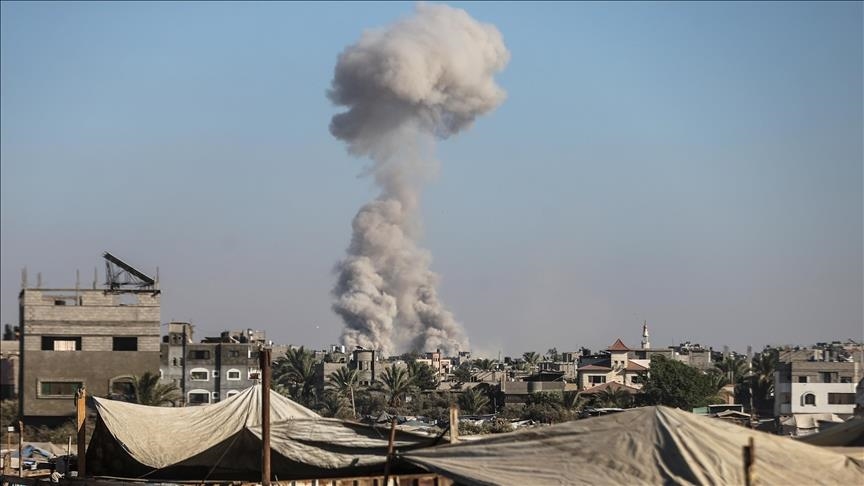
Nervous Mideast Awaits: Gaza, Lebanon and Possibly Iran
 CrossFireArabia
- October 22, 2024
In recent days, the region has witnessed significant events, the most notable of which was the assassination of Yahya Sinwar, the de facto leader of Hamas. This event, heavily relied upon by Israel, came at a time when the military focus had already shifted to the Lebanese front. This shift has kept the war atmosphere ablaze, making it difficult for the international community to put more pressure on Netanyahu to end the war in Gaza.
Meanwhile, Israel will likely manoeuvre by appearing to offer concessions in humanitarian aid and relief efforts, while in reality escalating its pressure on Hamas and seeking to take advantage of the uncertainty within the movement following Sinwar’s death. This situation may force Hamas to urgently craft a new political strategy for the coming phase, especially as its upcoming political battle promises to be one of its most complex challenges.
On the Lebanese front, Hizbollah managed to deliver strikes inside Israel in recent days, the most prominent of which was the drone attack targeting Israeli Prime Minister Benjamin Netanyahu’s residence. Although the attack did not cause significant damage, its symbolism was considerable. Netanyahu quickly seized the opportunity to shift the narrative in his favour, moving from a position of blame in the eyes of some allies to portraying himself as a victim. This allowed him to launch a new campaign of mobilization. Through this effort, Netanyahu aims to gain a green light for a series of operations that could go beyond military and security targets to also include political objectives in Lebanon and Iran, with potential extensions into Syria and Iraq.
At the same time, Israel has intensified its attacks on Hizbollah across various regions of Lebanon, targeting individuals and locations, particularly in Beirut’s southern suburbs. It is clear that Israel aims to dismantle the urban infrastructure of this area while also contributing to ongoing demographic displacement efforts. The broader goal appears to be turning the southern suburbs into an uninhabitable zone, displacing its residents. Ultimately, Israel seeks to reshape Lebanon’s security landscape by creating a deep buffer zone in the south, ensuring a different form of international presence that would replace the current UNIFIL forces, and stripping Hezbollah of its social strongholds in the future.
As Israel works to contain the surrounding fronts, from Gaza to the West Bank, it continues to escalate its strikes against Lebanon and maintains Syria under constant attack to disrupt the presence of Iran and Hezbollah and cut off potential logistical supplies. These actions indicate that Israel is paving the way to target Iran’s Revolutionary Guard Corps (IRGC).
At the same time, Yemen and Iraq remain potential sources of threat. The United States’ robust engagement in targeting the Houthis with specialized operations, particularly using B-2 bombers, suggests that Iraq might be the front activated to distract Israel and create a security crisis within its borders. This aligns with recent operations from Lebanon that aim to create internal security turmoil in Israel, seeking to disrupt daily life. These efforts are expected to escalate through multiple operations using diverse methods, as has already been observed in recent weeks.
The intensification of attacks on Lebanon, the isolation of Syria, and the significant US military buildup, including the deployment of the “THAAD” missile defence systems to Israel, all fall under the broader preparations for what could come after an Israeli strike on Iran. This further suggests that the groundwork has been laid for a significant and targeted attack on the IRGC.
Sensing this looming threat, Iran’s foreign minister has embarked on a wide-reaching diplomatic campaign across the region, though it appears that none of its objectives have been met. The campaign’s primary goal was to prevent military action against Iran while highlighting the dangers of entering an open confrontation with Iran and the security risks it would pose across the region.
The region’s entry into a phase of direct targeting of Iran opens the door to new repercussions. Large swaths of geography could face waves of violence and attacks, particularly given the possibility that various groups and cells may act independently. This raises the level of security threats across much of the region, including areas that are not currently involved in the active conflict zones.
Dr Amer Al Sabaileh, a professor in Jordan University, is a columnist for the Jordan Times