Gantz: Netanyahu, Cabinet Unfit For Office

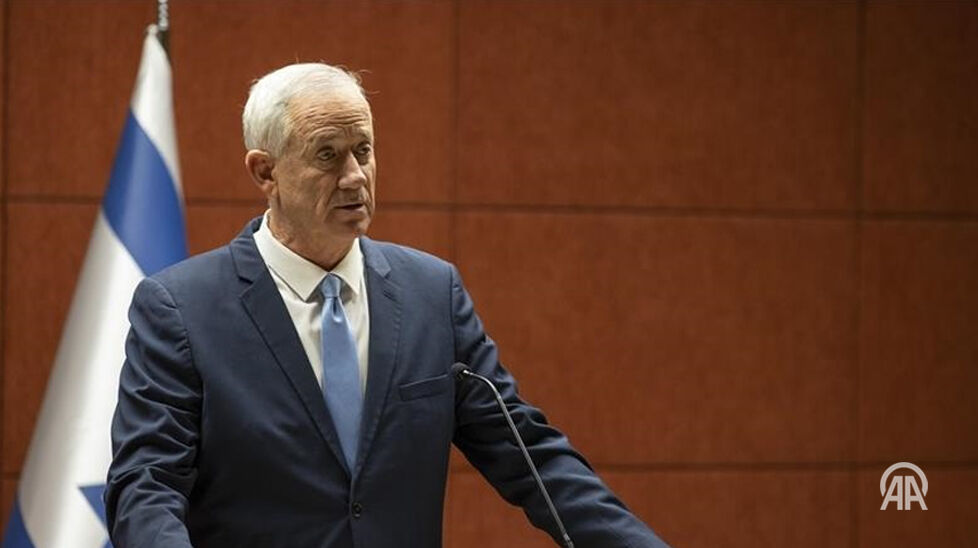
Former War Cabinet member Benny Gantz, Tuesday, lashed out at Benjamin Netanyahu and his extreme rightwing Cabinet. He said both, the prime minister and his ministers ,are unfit to perform their duties amidst the ongoing war in Gaza.

He was talking about the recent spat between Netanyahu and his Defense Minister Yoav Gallant, according to local radio FM103 as reported in Anadolu.

Gantz, head of the opposition National Unity party, said their differences over the conduct of the war in which Netanyahu continues to speak about “total victory” over Hamas in Gaza do not serve either of the extreme politicians from the Likud Party.

But it is clear Gantz is on the side of Gallant who represents the army’s view which at best wants a political solution to the war. Gantz says the Netanyahu government is not qualified or able to achieve its declared goals of “absolute victory” against the Islamist group Hamas in Gaza and the rest of the Palestinian resistance movement, nor is it able to secure the release of the 115-or Israeli captives held in different parts of Gaza.

For Gantz, the release of those in captivity are a top priority and wants the Israeli government to reach a deal to secure their freedom but many in Israel, including their relatives, feel Netanyahu is not interested in securing a political deal and continues to brush off any mediation efforts.

Animosity

On Monday, Netanyahu and Gallant traded words about the conduct of the war in Gaza Strip. Gallant accused the Prime Minister of obstructing a prisoner swap deal with the Palestinian group. This is while Netanyahu lashed out at the Defense Minister, accusing of following an anti-Israel stance.

Last week, Egyptian, Qatari, and US mediators called on Israel and Hamas to finalize the details of a cease-fire where the hostages can go back to their homes and the guns and missiles can stop.

While Israel said it will send a delegation to the talks, Hamas demanded the mediators present a plan to implement the ceasefire proposal supported by US President Joe Biden that it had agreed to on 2 July.

But indirect talks mediated by the US, Qatar, and Egypt continue to be intractable after 10 months of bloody mayhem. Netanyahu continues to talk about a partial ceasefire where he would secure the release of the hostages and offer no commitment to ending the war, something which Hamas rejects. The group wants the about 1.5 million displaced refugees to return back to their homes including to north Gaza while Netanyahu says this is not possible.

The Israeli onslaught on the Strip has since 7 October 2023 killed roughly 39,900 people while the Gaza Media Office states the number of deaths have already topped the 40,000-mark. These are mostly women and children with the injured standing at over 92,000 people.

More than 10 months into the Israeli onslaught, vast tracts of Gaza lie in ruins amid a crippling blockade of food, clean water, and medicine reports the Turkish news agency.

Israel is accused of genocide at the International Court of Justice, which ordered it to immediately halt its military operation in the southern city of Rafah, where more than a million Palestinians had sought refuge from the war before it was invaded on May 6.
Continue reading
Israel Kills 100 People at Morning Prayers

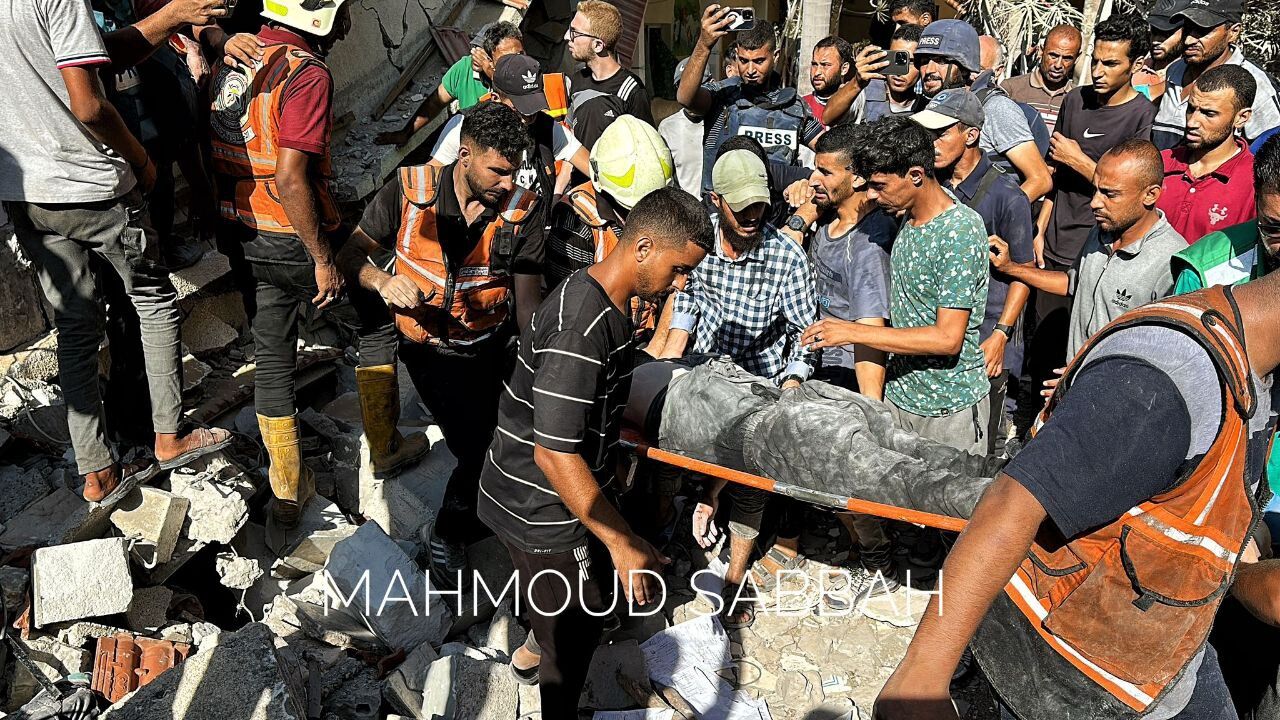
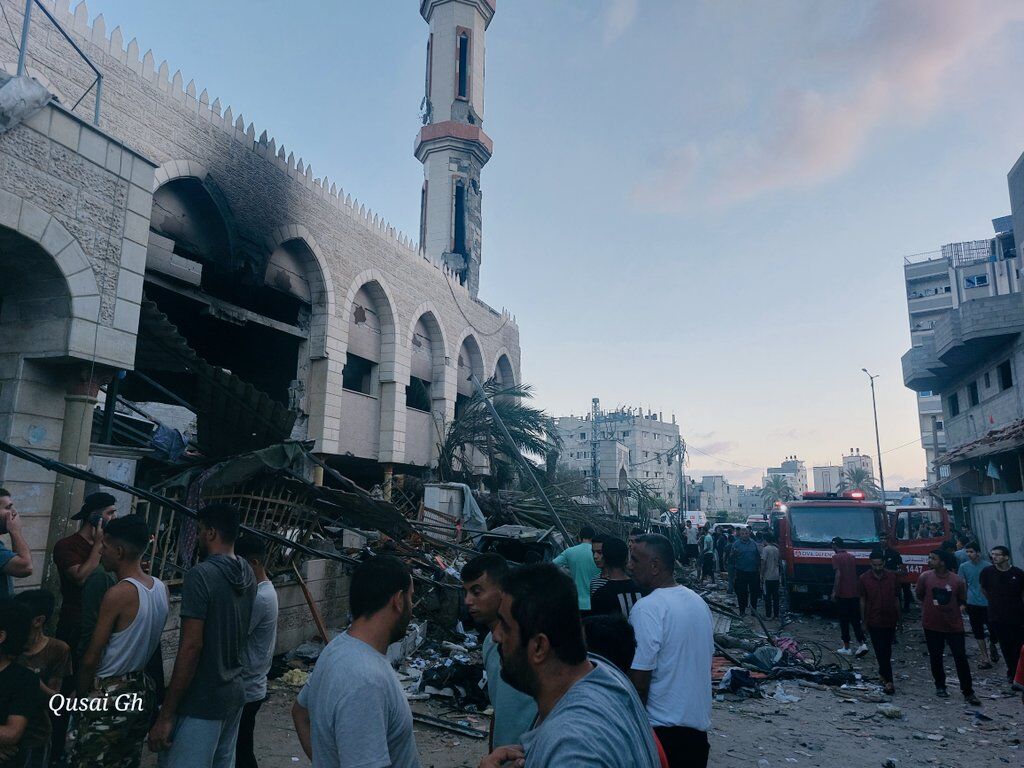
More than 100 Palestinians were killed and dozens injured, Saturday morning, after the Israeli occupation forces bombed the “Al-Tabi’een” school, which houses displaced people in the Al-Daraj neighborhood east of Gaza City.

Local sources reported that the occupation warplanes bombed the school while Palestinians were performing the dawn prayer, and they were specifically targeted after the Takbeer of the dawn prayer.

Eyewitness reports says the limbs – arms, hands, feet and heads of those performing prayers were scattered around the school’s prayer hall in what is described as one of the worst massacres committed by the Israeli army yet.

The Civil Defense said that the bodies of citizens caught fire as a result of the Israeli bombing of the school, noting that the crews are trying to control the fire to retrieve the bodies of the martyrs and rescue the wounded but it’s a difficult and painful exercise.

Reports say the four-storey school was hit by three missiles each weighing 2000 pounds according to Al Jazeera. The prayer hall which was at the bottom of the building was itself hit by a devastating missile with blood spluttering everywhere.

Director of Ambulance and Emergency in the Gaza Strip described the massacre as a heinous crime, while the spokesman for the Civil Defense in the Gaza Strip confirmed that the Israeli bombing of the school led to the martyrdom of 90% of the displaced people there.

In the first response from the Israeli occupation army, the Air Force confirmed that it targeted the school because it was used by the resistance as a headquarters, which is the excuse that the occupation uses every time it commits a massacre. Reporters say this is an outright lie.

About 350 families were sheltering at the school amounting to around 1000 people. It recently received dozens of displaced persons from the town of Beit Hanoun, after they were forced by the occupation to leave their homes for the safe area.

According to the Civil Defense, the Israeli airforce used American-made missiles that reach high temperatures of up to 7,000 degrees Celsius, causing bodies to melt and fires to ignite.

All the martyrs are scattered remains, and the majority of injuries are to the upper body (head and chest), with burns of the first and second degrees, in addition to limb amputations, according to the administration of the Baptist Hospital.

This is not the only school targeted; the occupation targeted five schools in northern Gaza last week, according to the Civil Defense.

The Baptist Hospital is the only one dealing with injury cases in Gaza City after the occupation destroyed Al-Shifa Hospital and rendered 25 hospitals and medical centers out of service, according to the Ministry of Health.

The Israeli occupation forces continue their aggression on the Gaza Strip, by land, air and sea, since October 7, 2023, which resulted in the martyrdom of 39,699 Palestinians, the majority of whom are children and women, and the injury of 91,722 others, in an incomplete toll, as thousands of victims are still under the rubble and on the roads, and ambulance and rescue crews cannot reach them.

Continue reading
Israel Bombs Schools to Force People Out of Gaza

The Israeli army is increasingly targeting schools that provide shelter for the displaced population in Gaza City, killing and wounding hundreds of them in the process. It has also issued orders for the illegal forced evacuation of Gaza from the north to the south, in a systematic effort fueled by revenge to drive residents from their homes and places of displacement and rob them of any stability.

In just eight days, Israeli aircraft attacked nine schools in Gaza City that served as shelters for thousands of displaced people. They destroyed the schools above the heads of the occupants, killing 79 Palestinians and injuring 143 more—mostly women and children—in addition to several other victims who were buried beneath the rubble and could not be retrieved due to the lack of the necessary tools.

The latest of these attacks occurred on Thursday, 8 August, at 3:00 p.m. when Israeli aircraft bombed the Al-Zahraa and Abdul Fattah Hamouda schools in the Al-Tuffah neighbourhood east of Gaza City, where thousands of displaced people are housed. The attack resulted in the deaths of 17 civilians and the injuries of dozens more, many of whom were women and children.  Sixteen more were reportedly missing under the rubble

Last Sunday, on 4 August, Israeli aircraft bombed the Al-Nasr and Hassan Salama schools in Gaza City, killing 30 Palestinians and wounding 19 others. The day before, Israeli planes attacked four schools in the Sheikh Radwan neighbourhood of eastern Gaza that were being used as shelter centres; 17 Palestinians were killed and 60 others were injured in the attack. Earlier this month, Israeli aircraft bombed the Dalal Al-Maghribi school in the Shuja’iyya neighbourhood of eastern Gaza, leaving 15 dead and 29 injured.

Although the Israeli army repeatedly attempts to justify the bombings by claiming that they target military or political figures, without providing evidence to support these claims, the bombing and destruction of schools above the heads of displaced people inside them has no valid justification and serves no military purposes.

Initial investigations by Euro-Med Human Rights Monitor’s field team indicate that the Israeli army deliberately destroyed the remaining shelter centres to deny Palestinians the few remaining places to seek refuge after the systematic destruction of homes and shelters, including schools and public facilities, over the past ten months.

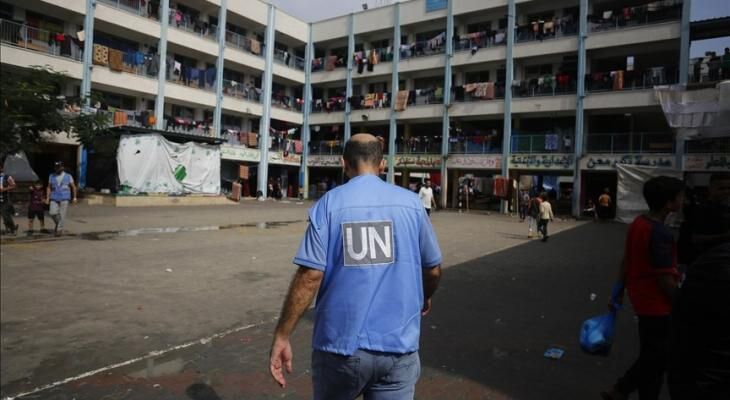
By continuing to bomb the entire Gaza Strip and concentrating on shelters, such as those housed in UNRWA schools, the Israeli bombing strategy clearly indicates a policy intended to deprive Palestinians of security and stability, if only temporarily.

In the course of their ten-month military attack on the Gaza Strip, Israeli forces continue to bomb civilian targets, kill large numbers of civilians, target refugee centres—the majority of which are housed in UN facilities—and carry out mass murders there, all of which are considered crimes against humanity and full-fledged war crimes.

The last four days have seen new forced evacuation orders for tens of thousands of residents in Khan Yunis, the central governorate, and northern Gaza. These events coincide with the policy of bombing shelter centres in Gaza City, suggesting that Israel is purposefully stepping up the evacuation orders to force Palestinians to leave their destroyed homes without even the option to resettle in nearby tents.

In its crime of genocide, ongoing since 7 October, Israel has adopted a systematic policy of targeting the civilian population of the Gaza Strip, in blatant disregard of the civilian protections mandated by international humanitarian law. This includes Israel’s targeting of areas designated as humanitarian zones, as well as its increased bombing of shelters and relocation centres over the heads of the displaced in an effort to impose forced relocation and destroy all essentials of life.

A series of displacement orders targeting large residential communities in Khan Yunis, in the southern Gaza Strip, have been issued by the Israeli army in recent days. The most recent of these orders was issued on Thursday evening, 8 August, and it included all of the eastern towns of Khan Yunis as well as the city centre’s neighbourhoods, Sheikh Nasser, Al-Satar, and Al-Mahta, which are communities with over 200,000 residents. These orders coincided with aerial and artillery bombardment and the beginning of a ground incursion into the eastern outskirts of the city.

Concurrently, the Israeli army distributed incitement leaflets against leaders of the Palestinian factions. This suggests that the purpose of these directives and military actions is not military necessity but rather acts of incitement and retaliation against the locals and displaced people, whom Israel targets to exact political pressure and retaliation

Last Wednesday the Israeli army issued new evacuation orders for tens of thousands of residents in Beit Hanoun town and the Al-Manshiya and Sheikh Zayed neighbourhoods in northern Gaza, ordering them to head to the west of Gaza City, which was also bombed. The following day, the evacuation order was modified to direct residents to relocate to the central Gaza Strip, to Al-Zawayda and Deir al-Balah. These areas were heavily targeted by Israeli raids and bombings, including one that destroyed tents housing displaced people inside the Shuhada al-Aqsa Hospital in Deir al-Balah, resulting in the deaths of three Palestinians and the injuries of eighteen more.

Civilians in the Gaza Strip are paying the price for Israeli military attacks that violate with impunity the rules of international humanitarian law, especially the principles of distinction, proportionality, and military necessity.

Accordingly, all countries must fulfil their international obligations by enacting effective sanctions against Israel and ceasing all forms of military, political, and financial assistance. This includes immediately cutting off arms exports to Israel; otherwise, these nations must be found to be complicit in crimes that have been committed in the Gaza Strip, including genocide.

As genocide is one of the international crimes that the International Criminal Court is mandated to investigate, it is imperative that the Court move forward with its investigation of all crimes committed by Israel in the Gaza Strip, broaden its investigation into all individuals responsible for these crimes, and issue arrest warrants against them.

Euro-Med Human Rights Monitor

Continue reading
Gaza: A Painter’s Tragedy Toolkit

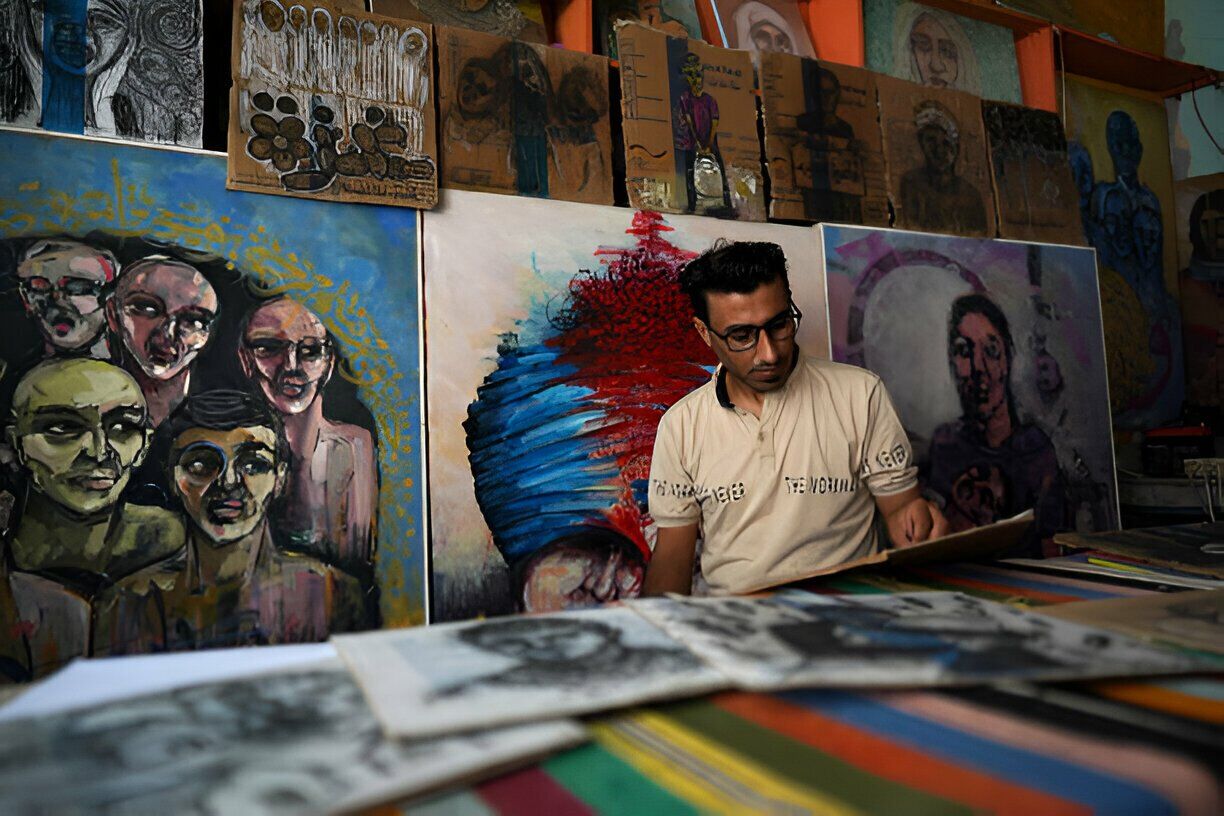
As if his works were from distant crumbling past, Gaza artist Ahmad Mahna documents the aggression on his little enclave. He uses the aid boxes dropped from the parachuted air to feed the starved to draw on and tell a painter’s story of the ongoing Israeli genocide.

Mahna says the goal of drawing is not only to document Israeli crimes but to send a message to the world, there are people in Gaza who love life and have needs beyond food and drink and want to tell the world of the need to stop the criminal actions against them meted by Israel and their forced forced displacement while the world looks on in silence as narrated in Al Mayadeen.

As a citizen living in a besieged enclave, Mahna has always been accustomed to difficult circumstances and never felt bound by the routine methods followed by world artists to see their creations come to light.

When he does not find the appropriate tools, he turns to whatever is available to him. Such may include paper, pencil, wall, piece of cloth, glass and even an old, neglected wooden board. In the artist’s eyes, these “worn-out” things can be transformed into inspiring artworks.

“Being across from an UNRWA school is a major incentive to draw,” Mahna pointing to the scenes of displaced people running to shelters as the aggression thickens combined with people fleeing guns and bombs thrown on displacement camps, queues to obtain water, bread and firewood, and scenes of the wounded carried on shoulders.

These tragedies become sad but rich material for Mahna to transfer such oppression and grief onto paper and from there on pass to the world.

Today the Gazan artist left his mark everywhere through his works and murals, saying it was difficult to stand idly by amidst the horrors he was witnessing, so he armed himself with his charcoal pen, and divided the “carton” into four paintings beginning with “A Four-Year-Old Girl Carrying a 16-Liter Gallon of Water”, and published it on the social media.

It became an instant hit, generating much and unexpected interest with many asking him to draw more about the sufferings of the displaced. Today,  Mahna is a “beacon” for many artists, and the owner of dozens artistic pieces which tell the world, through simple lines, the meaning of the ethnic cleansing that is taking place in Gaza, through such titles as “Escape from Death”, ” Last Embrace” and others.

Mahna says the painting comes out of a “first-time situation I experience” with emotions flooding whether its love, fear, anger or sadness. He fills his painting with details that convey a reality of interconnected circuits surrounding the lives of residents including death to provide basic needs daily, movement of passersby to and from hospitals that has become a daily routine due to the bombs and air-raids, and the incessant spread of diseases that is everywhere.

Because the tent has become the main “hero” in the story of Palestinian displacement, Mahna transfers the canvas into a painting with rich details, focusing on the scorching temperatures that melt the people inside, the insects, scorpions, and snakes that surround them like a barbaric army from every direction, and the sounds they hear from every corner, nullifying the individual privacy and the human need for rest and calm.

Coffee and Painting

“There is no one left who has not been affected by the war,” says Mahna, a former employee in one of the art institutions in Gaza. He lost his job and had to look for an alternative to provide him with his daily bread, so he opened a tea and coffee kiosk whilst making wall paintings where passersby would stop not only for the coffee but contemplate the paintings with respect for the skilled maker, as if directing words of thanks to him for what he conveys for their suffering.

Like others, Mahna did not comprehend the ongoing war of extermination till three months after the massacres when he shook off the cloak of despair and decided to stand up again. Thus, he opened his own studio under his downtrodden house. Only then did he feel he returned to the world he belonged to, amidst the looks of children escaping the boredom of the shelter that now surround him from every direction, reminding him of his societal role in managing workshops to relieve their psychological stress through art.

Mahna describes himself as a street artist because his drawings express the state of society and its conditions. From drawing destroyed homes and the color of the rubble, Mahna gives passersby hope in a city reduced to ruins. He has plenty to draw from images of corpses, limbs, mass graves, grief of bereaved mothers over their sons and their screams over those who remained under the rubble to the depiction of the ungodly famine in north Gaza.

Mahna faces difficulty in obtaining drawing materials. Charcoal pencils can run out at any time. Aid boxes have also become difficult to obtain in light of the increasing gas crisis, as residents prefer to burn them to prepare food instead of producing several paintings to look at while they are starving. He pointed out he faces the same problem that forced him to set fire to the wood that supports his paintings, but he is still trying to keep art alive in Gaza despite everything.

Continue reading
Bibi Tells Israel Army No Escape From Gaza

Military expert Major-General Fayez Al-Duwairi confirmed that Israeli Prime Minister Benjamin Netanyahu is trying to prolong the war on Gaza by carrying out assassinations in the Lebanese and Iranian capitals in the hope of “reshuffling the cards” in the region.

He explained – in his analysis of the military scene in Al Jazeera – if Netanyahu had achieved his goals in the Gaza Strip, he would not have bombed the southern suburb of Beirut and assassinated chief of the Hamas political bureau Ismail Haniyeh, in Tehran.

He pointed out Netanyahu wants to save himself, and does not care about the Israeli prisoners held in Gaza. Netanyahu recovered a very small number through military operations, while more than 100 prisoners returned as part of the exchange deal concluded with Hamas late November 2023 according to Assawsana.

Al-Duwairi stressed the war of attrition of the occupation army is continuing in Gaza. He said it will keep going on while noting talk about the third phase of the war has become a thing of the past in light of the presence of four Israeli military divisions inside the Gaza Strip.

According to the military expert, the presence of this large number of Israeli forces means “a return to square one of the fighting despite the passage of more than 300 days since the outbreak of the war,” and which started soon after 7 October of last year.

He stressed the resistance videos that are broadcast daily from various combat zones in the Gaza Strip speak for themselves. They show the resistance’s performance on the ground.

He pointed out the statements of the Chief of Staff of the Occupation Army Herzi Halevi in which he called for seizing any opportunity to conclude a deal to cease fire in Gaza and exchange prisoners, indicate this means his army want to “escape from the sands of Gaza.”

Continue reading