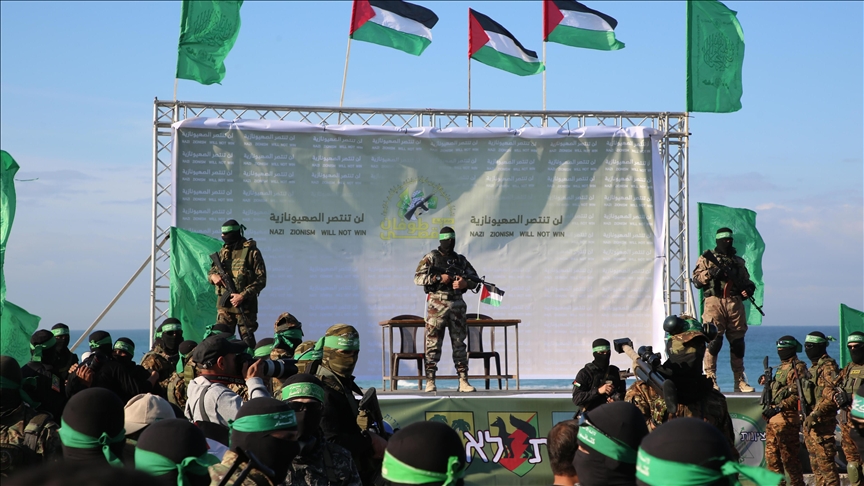
Al-Qassam Brigades, the armed wing of Hamas, Saturday handed over three Israeli hostages in two locations in the Gaza Strip to the International Committee of the Red Cross as part of the ongoing prisoner exchange deal.
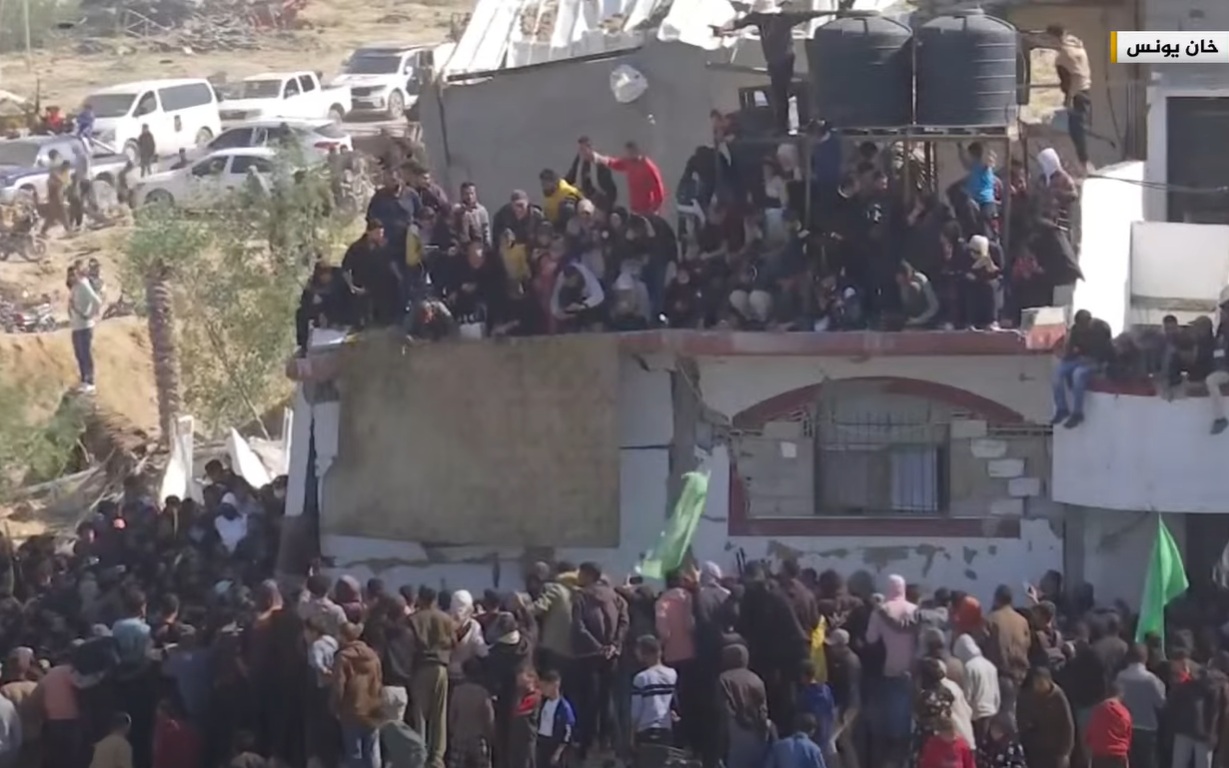
According to an Anadolu correspondent, two Israeli hostages – Ofer Calderon and Yarden Bibas – were handed over to the Red Cross in Khan Younis in southern Gaza.
GAZA EXCHANGE: Today Hamas has handed over 3 Israeli hostages in Gaza to Red Cross, two are U.S. citizens.
Waving to the crowds, Ofer Calderon and Yarden Bibas – were handed over to the Red Cross in Khan Younis in southern Gaza.
The third Israeli captive, Samuel Siegel, who also holds US citizenship, was handed over to representatives of the Red Cross in the Gaza City seaport by the Al-Qassam Brigades.
The Palestinian group confirmed handing over the three Israeli captives, including a US-Israeli dual national, in Gaza in exchange for the release of a new batch of the “heroic prisoners from occupation’s prisons.”
Hamas also said that despite harsh conditions in Gaza, the Al-Qassam Brigades offered required health care to captives.
Separately, the Israeli army confirmed that the three hostages were handed over to the army by the Red Cross, and were taken to Israel.
According to an Anadolu correspondent, the transfer took place amid significant presence of Palestinians.
Members of Al-Qassam Brigades were also heavily deployed in the area to oversee the transfer, the correspondent added.
The Red Cross vehicles, which arrived in Khan Younis and Gaza City earlier in the day, facilitated the handover as per the terms agreed for today’s exchange.
This marks the latest stage in the multi-phase swap deal between Hamas and Israel which has seen the release of Palestinian prisoners in exchange for Israeli hostages and soldiers.
The exchange process has been taking place under international mediation efforts.
Following their release, the Israeli side is expected to release later in the day 183 Palestinians from Israeli jails, including 111 arrested by the Israeli army in Gaza after Oct. 7, 2023, according to an earlier statement by the Hamas-run Prisoners’ Information Office.
Israeli military analyst Amos Harel has dismissed a “total victory” for Tel Aviv in the Gaza war, arguing that such assertions, promoted by supporters of Prime Minister Benjamin Netanyahu, are contrary to the ground reality.
Harel, a military affairs analyst for the Israeli newspaper Haaretz, in his write-up published on Friday, stated, “One has to be a blind follower who has shed all vestiges of doubt and criticism to believe that Israel actually defeated Hamas.”
“The organization sustained a tremendous military blow, but it certainly did not surrender,” he noted, adding that “that’s not consistent with Netanyahu’s declarations about the war’s goals, or with his promises in its course.”
US mediation efforts
Harel also touched on the role of the US in the region, highlighting that the administration of President Donald Trump is pushing for the full implementation of a multi-phase ceasefire and prisoner exchange agreement between Israel and Hamas. This contrasts with Netanyahu’s preference to focus solely on the initial phase.
The ceasefire, which began on Jan. 19, is set to last for 42 days in its first stage, with negotiations ongoing for subsequent phases under the mediation of Egypt, Qatar, and the US.
According to Harel, “The visit to the region by Steve Witkoff, US President Donald Trump’s special Mideast Envoy, attested to the mood of the administration.
“Washington views the first phase of the deal as a necessary point of transition to the second phase, which in itself is preparation for the bigger deal.
“Washington views the first phase of the deal as a necessary point of transition to the second phase, which in itself is preparation for the bigger deal: huge US-Saudi contracts accompanied by normalization between Riyadh and Jerusalem.”
He added that “Witkoff was here to ensure that Israel continues on the track laid out by Trump,” with key details expected to be discussed next week in a meeting between Trump and Netanyahu in Washington. This meeting, Harel suggested, holds significant weight as reported in Anadolu.
Challenges to Gaza deportation plans
Harel also addressed Trump’s controversial suggestion of relocating Palestinians from Gaza to neighboring countries, highlighting the practical difficulties in implementing such a proposal.
The idea is partly aimed at maintaining Netanyahu’s coalition with the far right. However, he noted that the chances of executing such a plan are slim.
“Washington’s bargaining power in the Middle East on emigration doesn’t resemble what it’s capable of achieving with its neighbors in Latin America,” said the analyst.
“Trump appears to be looking at Gaza like the real estate entrepreneur he used to be. To resettle the destroyed area, an evacuation-construction project is needed,” he explained.
Harel pointed out that while these proposals align with the long-standing aspirations of Israel’s right-wing to remove Palestinians from the equation, they are likely to face strong resistance.
“Such schemes will inevitably encounter Palestinian opposition, backed by Arab states. At this moment, it is difficult to imagine any Arab leader endorsing Trump’s relocation plan for Gaza,” he concluded.
On Jan. 25, Trump publicly proposed relocating Gaza’s Palestinian population to nearby countries like Egypt and Jordan. His suggestion has been widely rejected by several countries, including Jordan, Iraq, France, Germany, the Arab League, the Organization of Islamic Cooperation, and the UN.
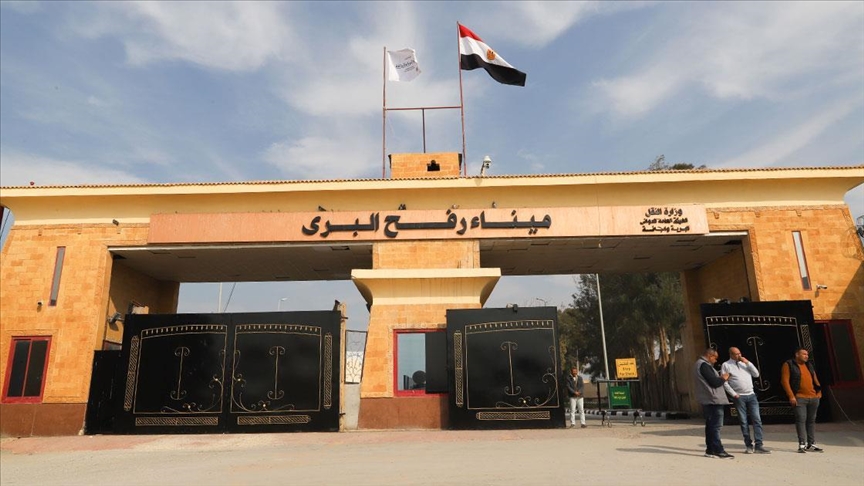
The Israeli army withdrew from the Rafah border crossing between Gaza and Egypt on Friday in accordance with the terms of the cease-fire agreement, which went into effect on January 19.
According to Israeli Army Radio, the army handed over the crossing to an international force from the European Union (EU) in preparation for its reopening later on Friday.
The radio, which quoted a security source without mentioning his name, noted that the Israeli army has redeployed its forces in an area along the Gaza-Egypt border.
Besides the EU mission, the source said Palestinians from the Ramallah-based Palestinian Authority will run the crossing from the Palestinian side, with the role being to stamp existing permits from Gaza.
The broadcaster’s correspondent, Doron Kadosh, said 50 wounded Palestinians will be allowed every day to travel in addition to three escorts to each injured, totaling 200 people every day.
He added that all names of wounded people and their escorts will be checked by the Israeli general security service Shin Bet, along with Egyptian approval on the names.
The EU on Friday resumed its Rafah border crossing mission connecting the southern Gaza Strip to Egypt, including for Palestinians needing medical care.
“Europe is here to help: the EU’s civilian border mission deploys today to the Rafah Crossing at the request of the Palestinians and the Israelis,” EU foreign policy chief Kaja Kallas announced on X.
The Palestinian Health Ministry also confirmed that the crossing would open on Saturday for the first batch of wounded people to leave Gaza.
It added that their travel is planned in collaboration with the World Health Organization.
The Rafah crossing, a vital route for humanitarian aid into Gaza, has been closed since May 2024 after Israel’s ground offensive in the southern city of Rafah.
On Jan. 19, a ceasefire agreement and prisoner exchange between Hamas and Israel went into effect, initially lasting 42 days, during which negotiations will continue for subsequent phases of the deal. The agreement is mediated by Egypt and Qatar, with support from the US.
Israel’s genocidal war has killed more than 47,400 Palestinians, most of them women and children, and injured more than 111,000 since Oct. 7, 2023.
The Israeli onslaught on Gaza has left more than 11,000 people missing, with widespread destruction and a humanitarian crisis that has claimed the lives of many elderly people and children in one of the worst global humanitarian disasters ever according to Anadolu.
The International Criminal Court issued arrest warrants in November last year for Israeli Prime Minister Benjamin Netanyahu and his former Defense Minister Yoav Gallant for war crimes and crimes against humanity in Gaza.
Israel also faces a genocide case at the International Court of Justice for its war on the enclave.
The Qassam Brigades handed over to the Red Cross, Thursday, the captive soldier Agam Berger, from the rubble of Jabalia camp in the northern Gaza Strip, as part of the third batch of prisoner exchange according to the ceasefire agreement. Meanwhile, the Al-Quds Brigades handed over the two prisoners it is holding, Arbel Yehud and Gadi Moses, to the Red Cross with their handover from in front of destroyed house of the late Yahya Sinwar’s in Khan Yunis.
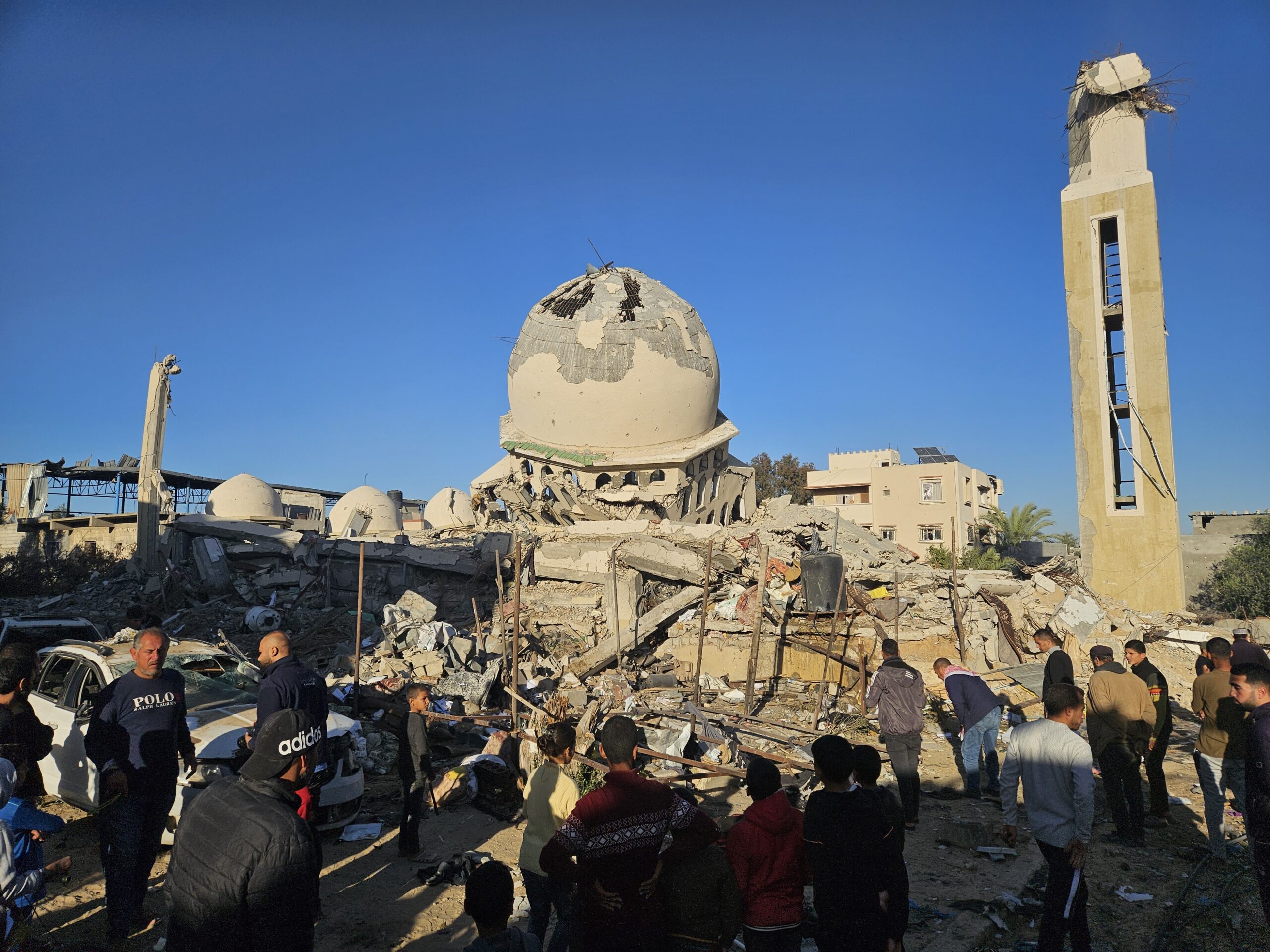
The Qassam Brigades released the captive soldier Berger from Al-Razan Square in Jabalia camp, which witnessed major Israeli bombing and destruction as part of the bloody military operation launched by the occupation army, during which a large number of Israeli soldiers were killed and wounded.
The Israeli army announced it received soldier Agam Berger, saying she had arrived at the initial reception point in the so-called Gaza envelope and met with her family members.
The Al-Quds Brigades fighters were deployed in Khan Yunis, south of the Gaza Strip, where the ceremony for the release of Yehud and Moses took place, while the Israeli occupation army radio said the Jihad movement was trying to “exploit the release of the two prisoners to show its strength in Khan Yunis.”
Hamas confirmed that “the large gathering of the masses of our Palestinian people in the two prisoner handover operations in the city of Khan Yunis and the Jabalia camp, amidst the rubble left by the Zionist fascism in the two areas, is a message of determination, strength and defiance that it raises in the face of this barbaric occupier, meaning that our people will remain on their land, and are determined to achieve their project of liberation, return and self-determination.”
The movement said in a press statement received by Quds Press, Thursday: “The Qassam Brigades and the Palestinian resistance prove once again their high ability to control the scene through organized handover operations that have dazzled the world, and after humiliating the criminal enemy army in the sands of Gaza.”
It pointed out “what happened today confirms the unity of the Qassam Brigades, the Al-Quds Brigades and the resistance forces in the field and in managing the exchange operation that took place in front of the house of the martyr leader Abu Ibrahim.”
It stressed “the diversity of the implementation of the release operations of Israeli prisoners from different areas of the Strip, in the steadfast Jabalia, in Khan Yunis and in front of the house of the martyr leader Yahya Sinwar, is a message to the world that our people will remain on their land, will continue the resistance, and are determined to liberate and return.”
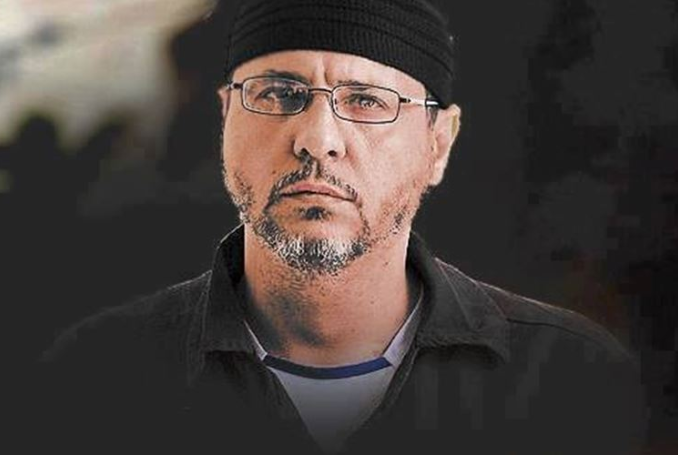
Nicknamed “the Prince of Shadows” Abdullah Barghouti is the Palestinian political prisoner with the most number of life sentences ever given to a single detainee.
A former leader of the Hamas’ al-Qassam brigade’s armed wing, in the West Bank, he now appears to be on the verge of release in the Hamas-Israel prisoner exchange.
Born in Kuwait in 1972, Abdullah Barghouti grew up outside of occupied Palestine, despite his family having originated from the village of Beit Rima, located near Ramallah. Barghouti attended school, up until high school in Kuwait.
Upon the eruption of the first Intifada in the occupied Palestinian territories, in 1987, Barghouti recounted in his memoir that the uprising had inspired him to seek revenge against the occupiers, especially after Israeli forces murdered one of his cousins and youngest uncle. “Simply put, they threw stones at the Zionist occupation forces that were wreaking havoc, so they were shot and martyred” he stated.
During the first Gulf War (1990-1991), Abdullah Barghouti was reportedly arrested for around a month after being accused of participating in the fight against US forces, later being released after the war. Prior to this, Barghouti had decided to pursue the combat sport of Judo and was trained by a man named Munir Samik who was also Palestinian.
Samik once asked Barghouti: “Aren’t you Palestinian? Don’t you want to liberate your country? If you use it against all those who occupied your homeland, there in Palestine, use what you learned here.” Inspired to make himself physically strong and capable of fighting Israel, he then began training in the use of firearms and explosives in the Kuwaiti desert. During the war, Barghouti’s family was forced to flee to Jordan.
When he traveled to live in Amman, Jordan, he would finish high school there but due to his family being too poor to afford University, so he would borrow money from a relative in order to open up a mechanic shop, continuing to practice Judo as a hobby. However, he wasn’t able to earn enough money to keep his business afloat and pay back his relatives and decided to move abroad in order to pursue higher education instead.
A friend of Barghouti had recommended he apply for a visa program to travel to South Korea, which ended up leading him there in pursuit of an education. When he arrived, he had no money and little but the clothes on his back.
Barghouti walked from the airport to a location that was supposed to help him secure an education; his journey would take three days during which he went without eating. He recalled that he drank water from public parks until reaching the address he had been given, finding out that it was a wood-cutting factory.
So, without any money or prospects, he ended up working at the factory for 45 days without having money to buy food, eating only from what the factory would supply him.
In 1991, after a few months in the wood-cutting factory, he moved to work in a mechanical factory and studied in parallel with his work at an engineering institute, specializing in electromechanics. This was also the time during which he would meet his wife, who was of Korean origin.
However, his passion for seeking the liberation of Palestine through armed struggle would not perish while he lived in South Korea, as he would routinely go deep into the forest and practice making improvised explosive devices and refining his craft. In 1998 he would then return to Amman with his wife, before deciding to divorce her due to his desire to have children.
Around this time he started becoming more religious, moved to Jerusalem and then the West Bank, married a Palestinian wife, and settled down in his family’s village of Beit Rima. He later had two daughters, Safaa and Tala, and a son called Osama.
It just so happened that in 2001, Beit Rima would be the first area in the West Bank that would experience a full-scale military invasion during the Second Intifada. Israeli forces deployed tanks, attack helicopters, and a huge military force to the village.
Abdullah Barghouti joined the Qassam Brigades in 2001, seeking out his cousin Bilal Barghouti in order to share his expertise in bomb-making.
After his cousin, who is currently serving 16 life sentences in Israeli military prison, witnessed how skilled he was at engineering explosives, he told his superiors in the Hamas military wing and Abdullah Barghouti would begin military training in the Nablus area, going on to become a commander of the Qassam Brigades in the West Bank.
This entire time, almost nobody close to him knew of his secret ambition to seek revenge against Israel and his bomb-making skills. He would later go on to participate in the manufacturing of explosives that killed 66 Israelis and injured over 500.
When he was eventually tracked down in 2003 and arrested by the Israeli occupation forces, he was interrogated and tortured for over five months, before being handed 67 life sentences, amounting to 5,200 years in prison. In later interviews recorded with Barghouti from inside an Israeli prison, he would confidently state that one day interviewers would come to meet him while he sits inside a hot tub in Ramallah.
If he is to be released during the upcoming Hamas-Israel prisoner exchange, it is likely that Israel will request his deportation outside of occupied Palestine. It is speculated that Barghouti could be useful to Hamas in developing its influence in the armed struggle inside the West Bank, which is currently dominated by Palestinian Islamic Jihad (PIJ) and Fatah-aligned fighters.
(The Palestine Chronicle)
– Robert Inlakesh is a journalist, writer, and documentary filmmaker. He focuses on the Middle East, specializing in Palestine. He contributed this article to The Palestine Chronicle.

 CrossFireArabia