‘7 Million Iranians Wait For US Troops’

Iranian leaders warn of mass mobilization, issue direct threats, and signal readiness for escalation amid ongoing US-Israeli attacks.

Key Developments

  • Ghalibaf says nearly 7 million Iranians have volunteered to take up arms in defense of the country.
  • Hatami warns that no enemy troops should survive any ground attack on Iranian territory.
  • IRGC commander Majid Mousavi issues direct threat to US leadership as tensions continue to escalate.

‘Bring It On’

Iranian officials on Thursday issued some of their strongest warnings yet since the start of the US-Israeli war, pairing threats of wider retaliation with declarations of mass popular readiness for battle.

The sharpest political message came from Parliament Speaker Mohammad Bagher Ghalibaf, who said a nationwide campaign had already drawn millions of volunteers prepared to defend the country.

“Right now, in less than a week, a powerful national campaign sweeping the country has brought forward around 7 million Iranians who have already stepped up and declared they’re ready to pick up arms and stand in defense of our nation,” Ghalibaf wrote on X.

He followed that with an even more direct warning: “You come for our home… you’re gonna meet the whole family. Locked, loaded, and standing tall. Bring it on.”

‘No Survivors’

Those remarks did not emerge in isolation. Just last week, Tasnim reported that more than one million Iranian combatants had already been organized for possible ground confrontation with US forces, while describing a wider influx of young volunteers to Basij, IRGC, and army centers.

That earlier report gives Ghalibaf’s new figure a clearer military and political backdrop: the Iranian leadership is presenting the current confrontation not simply as an exchange of strikes, but as a moment of national mobilization.

The military tone was reinforced by Army commander Amir Hatami, who ordered operational headquarters to monitor “enemy movements with utmost pessimism and accuracy” and remain ready to counter any method of attack.

Reuters, citing Iranian state media, reported Hatami’s warning in blunt terms: “No enemy troops should survive if adversaries attempt a ground operation.”

https://www.palestinechronicle.com/us-israel-bomb-irans-pasteur-institute-sudans-al-shifa-shadows-reawaken/embed/#?secret=yjszBpR7Fy#?secret=KvQhWOePC3

‘Hollywood Illusions’

That message was echoed in even harsher language by IRGC Aerospace Force commander Majid Mousavi.

In a post carried by Defa Press, Mousavi responded to recent US threats by writing: “You are the one who is taking your soldiers to the grave, not Iran, who wants to take it back to the Stone Age.”

He added: “Hollywood illusions have so contaminated your thinking that you are threatening a civilization that is more than 6,000 years old with a meager 250-year history.” Palestine Chronicle

Continue reading
IRGC: US, Israeli Universities Legitimate Targets

Iran’s Islamic Revolutionary Guard Corps (IRGC) Sunday warned that US- and Israeli-linked universities in the region are now “legitimate targets” in retaliation for attacks on Iranian educational facilities.

In a statement carried by the semi-official Fars news agency, the IRGC accused the US and Israel of repeatedly bombing Iranian universities, including Iran University of Science and Technology in Tehran.

“From now on, all universities of the occupying entity (Israel) and American universities in West Asia will be considered legitimate targets,” in response to the destruction of Iranian academic institutions, it said, calling on staff and students at US-linked universities in the region, as well as nearby residents, to stay at least one kilometer away from such facilities for their safety.

On Wednesday, the IRGC demanded that Washington condemn attacks on universities or face retaliatory attacks.

Iranian media reported several US and Israeli strikes on educational facilities, including Isfahan University of Technology and, Iran University of Science and Technology in Tehran.

The US and Israel have maintained airstrikes on Iran since Feb. 28, killing so far over 1,340 people, including then-Supreme Leader Ali Khamenei.

Iran has retaliated with drone and missile strikes targeting Israel, along with Jordan, Iraq, and Gulf countries hosting US military assets, causing casualties and damage to infrastructure while disrupting global markets and aviation. Anadolu

Continue reading
Iran Moves to Major Escalation

Iran’s Revolutionary Guard plans to increase drone attacks by 20 percent and double strategic missile operations amid escalating regional conflict.

Key Developments

  • Iran’s Islamic Revolutionary Guard Corps (IRGC) plans to increase drone operations by 20 percent and missile operations by 100 percent.
  • The escalation comes as part of Iran’s ongoing military response to US-Israeli attacks on Iranian territory.
  • Iranian forces launched the 28th wave of “Operation True Promise 4,” deploying new-generation missiles against Israeli targets.
  • Israeli media reported a missile carrying cluster munitions that dispersed over multiple locations in Tel Aviv.
  • Iranian commanders say military operations will expand further in the coming hours and days.

Planned Escalation

Iran’s Islamic Revolutionary Guard Corps (IRGC) is preparing to significantly expand its offensive operations, including a major increase in ballistic missile launches and drone deployments, according to informed sources cited by Iran’s Fars News Agency.

The sources said the escalation will begin overnight and is intended to intensify Iran’s military response to the ongoing US-Israeli war on the country.

According to the report, Iran will increase the scale of its drone operations by up to 20 percent while doubling the use of strategic missiles.

Iranian officials frame the move as part of what they describe as a broader confrontation with the administration of US President Donald Trump and the White House.

Sources quoted by Fars said the decision was taken in order to strengthen deterrence and ensure what they described as a decisive response to any military aggression targeting Iran’s interests or population.

The announcement comes as the Israeli-US agression on Iran continues to escalate, with repeated missile exchanges and attacks reported across several fronts in the region.

Iranian authorities say that since the start of the joint US-Israeli campaign on February 28, more than 1,200 people have been killed in Iran, including around 200 children and approximately 200 women, while more than 10,000 civilians have been injured.

Missile Operations

Iranian state television also confirmed that the country’s armed forces launched the 28th wave of missile strikes as part of the ongoing military campaign known as Operation True Promise 4.

According to the Islamic Revolutionary Guard Corps, the latest wave involved the deployment of new-generation missiles and targeted sites in the cities of Beersheba and Tel Aviv.

The IRGC said four heavy-warhead Kheibar missiles were used during the operation.

Iranian military officials stated that the strikes were part of continuing attacks against Israeli targets as well as sites connected to US forces in the region.

In addition to the missile strikes, Iranian forces reportedly targeted the infrastructure of Al-Azraq Air Base, which Iranian officials described as one of the largest offensive bases used by US-aligned forces.

The IRGC said the scale and depth of Iranian attacks would expand in the coming hours and days.

Iranian state media also reported that two waves of missiles were launched within minutes of each other during the latest round of attacks.

Tel Aviv Impact

Israeli media reported that one of the Iranian missiles carried a warhead containing more than 16 cluster munitions.

According to those reports, the missile fragmented into multiple explosive sub-munitions over the skies of Tel Aviv.

Fragments reportedly fell across at least sixteen different locations in the city.

Israeli reports said six people were injured after debris from the missile fell across the affected areas.

The missile strike triggered powerful explosions in Tel Aviv and activated air-raid sirens in multiple areas, including Jerusalem and northern regions near the Lebanese border.

Sirens were also reported in the towns of Dovev and Baram amid concerns that drones might infiltrate Israeli airspace.

The incidents were reported within minutes of each other as part of what Israeli media described as concentrated Iranian missile barrages.

Military Statements

Iranian military commanders have continued to signal that the country intends to sustain and expand its military operations.

Major General Ali Abdollahi, commander of Iran’s Khatam al-Anbiya Central Headquarters, said Iran would continue the war until its enemies were forced to retreat.

“Our weapons today are more advanced than before and have high precision and flexibility,” Abdollahi said.

He dismissed claims that foreign governments know the size of Iran’s missile arsenal.

“The enemies said they know the number of our missiles,” Abdollahi stated. “We tell them that they should count the missiles on the battlefield.”

The commander also said Iran had repaired vulnerabilities identified after earlier attacks.

“The armed forces have restored the gaps after the recent aggression,” he said, adding that Iranian forces are deployed across the battlefield with what he described as high morale.

Abdollahi accused US and Israeli forces of targeting civilians inside Iran.

“The malicious enemy targets innocent Iranians in their homes and students in their schools,” he said.

He added that Iran would focus its attacks on military centers and equipment.

Iran’s armed forces also reported targeting specific locations in Haifa and Tel Aviv as well as US military sites, including facilities at Camp Arifjan in Kuwait.

Iranian officials said the strikes were carried out using suicide drones as part of what they described as the country’s response to the ongoing US-Israeli aggression.

The war, which erupted after the US-Israeli attacks on Iran at the end of February, continues to expand across multiple fronts as both sides intensify military operations.

Palestine Chronicle

Continue reading
Iran Strikes Mossad Center

Iran’s Islamic Revolutionary Guard Corps (IRGC) announced, Tuesday it had directly targeted and struck two high-level intelligence facilities inside Israel, including the headquarters of Israel’s Military Intelligence Directorate (Aman) and a Mossad operational center.

The announcement came after a wave of Iranian ballistic missiles struck central areas of the occupied territories early Tuesday morning. 

Israeli media confirmed at least five missiles hit targets across the Tel Aviv metropolitan area, with one reportedly landing in Herzliya—a coastal city that hosts key Israeli security and intelligence infrastructure.

A separate strike targeted the Glilot area, a highly sensitive site believed to house core logistical operations for Aman. 

Military censorship was swiftly imposed on coverage of that location, though images published by Israeli outlets suggest a large warehouse or command center was hit.

The IRGC stated that the precision strikes were part of its ongoing Operation True Promise 3, which aims to deliver “precise and painful blows” to the Israeli occupation in retaliation for recent attacks on Iranian cities and infrastructure.

The broader missile barrage included the launch of 20 to 30 ballistic missiles from Iran toward central and southern areas of the occupied territories. 

Air raid sirens were heard across Tel Aviv, Gush Dan, and surrounding towns as Israeli air defenses attempted interception.

Despite those efforts, multiple explosions were recorded across the region. Israeli media reported loud blasts in Herzliya, Ramat HaSharon, and Ra’anana, with several buildings damaged and injuries reported. 

According to Magen David Adom, ten Israelis were injured while rushing to shelters.

Fires, Evacuations, and Structural Damage

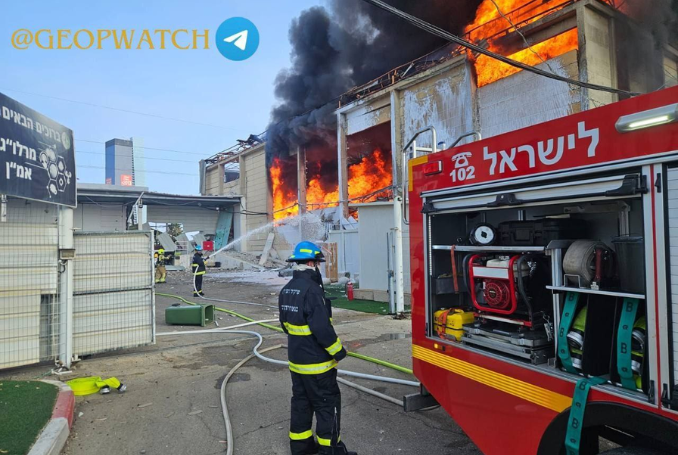
The Fire and Rescue Authority responded to at least eight incidents in the Hasharon region and greater Gush Dan. 

Over 20 firefighting teams were deployed to contain fires caused by falling debris and missile shrapnel. A blaze was also reported in Kfar Saba after Iranian projectiles impacted the area.

Three additional Iranian missiles reportedly struck targets in southern “Israel”, including near Beer al-Sabe’ (Beersheba) in the western Naqab.

Authorities are investigating reports that some Israelis may be trapped beneath rubble in the Tel Aviv area, though official casualty counts have not been released.

Israeli media reported a delay in the missile alert system, with detection occurring only two minutes before impact. Sirens were reportedly triggered just three minutes before the strikes, prompting criticism of the so-called Home Front Command.

Iran Responds

Iranian officials said the missile operation was a direct response to the Israeli occupation’s continued bombing of Iranian hospitals, media buildings, and residential neighborhoods. 

While Israeli authorities claim to be targeting “military sites,” the rising civilian death toll inside Iran has drawn international condemnation.

The missile strikes appear intended to demonstrate Iran’s capacity to hit deep inside the occupied territories with precision, targeting not only population centers but also high-value strategic and intelligence locations.

The IRGC confirmed the launch of the ninth wave of Operation True Promise 3 on Monday night, stating that strikes would continue through dawn on Tuesday. Iran’s Tasnim News Agency published footage showing missiles traversing the skies over the occupied West Bank.

Separately, the IRGC said it had struck the same base from which Israeli aircraft had launched an attack on Iran’s state broadcasting authority days earlier.

Air raid sirens were also activated across the north, from Nahariya to Caesarea and Haifa, as well as in the occupied Syrian Golan, amid fears of further drone or missile attacks according to the Palestine Chronicle.

Continue reading
Iran’s Army Calls on Israelis to Leave

Iran’s armed forces called on Sunday Israelis to leave their country, warning it may not be “inhabitable” in the days to come, state news agency IRNA reported, as military confrontation between the two regional rivals continues.

“Warnings for you in the coming days: Leave the occupied territories, because, certainly, they won’t be inhabitable in the future!” Reza Sayyad, spokesperson for the armed forces, said after a new wave of Iranian strikes began against Israel.

He cautioned that “taking shelter underground will not bring safety to the Israelis.”

“Therefore, we would like to emphasize: do not let the criminal regime use you as human shields,” Sayyad said.

Separately, Mohsen Rezaei, a senior IRGC commander who is also a member of Iran’s Expediency Council, said: “We may reach a point where we take major actions that will destabilize the entire region.”

Rezaei said “the wise people in the US and Europe must act quickly to pull their countries out of this war, otherwise we cannot stand by and watch their involvement without responding,” according to Anadolu.

Israel launched airstrikes on multiple sites across Iran, including military and nuclear facilities, on Friday, prompting Tehran to launch retaliatory strikes. The attacks and counterattacks have continued since.

US President Donald Trump said the two sides could achieve peace and that meetings and calls to this end were taking place.

Continue reading