Ben-Gvir Mocks Palestinian Prisoners in Their Cells

Far-right Israeli National Security Minister Itamar Ben-Gvir boasted that he is directly responsible for imposing harsher conditions on Palestinian prisoners in Israeli jails.

He made the remarks while storming the cells of Palestinian women prisoners, according to a video he posted on his X account on Sunday.

The footage shows a female prisoner describing the conditions of detention as extremely poor and saying that prisoners are being denied basic rights and personal necessities. “This is our third day without showering. We are not receiving medical treatment, and our clothes are not clean,” she said.

Ben-Gvir responded boastfully: “The good conditions in the prisons are over. This is the current situation, and I am directly responsible for everything. I am pleased with these conditions.”

This was not the first time Ben-Gvir has entered Palestinian prisoners’ cells to taunt or mock them. Earlier this month, he mocked a female prisoner who complained about harsh detention conditions and the lack of basic necessities.

Since taking office in late 2022, Ben-Gvir has pursued policies aimed at worsening detention conditions for Palestinian prisoners, including measures involving food deprivation, mistreatment, physical abuse and other forms of abuse, as well as restrictions that have contributed to the spread of disease, systematic deprivation, isolation from the outside world, and continued restrictions on family visits.

According to the Commission of Detainees and Ex-Detainees Affairs, around 9,400 Palestinian prisoners are currently held in Israeli prisons, including 88 women and more than 350 children. WAFA

Continue reading
Beware! Qusra and The Next Nakba
  • HebaHeba
  • August 26, 2026

By Ramzi Baroud

If you want to understand the bleak future awaiting the occupied West Bank, do not look away. Just pay attention to the events unfolding in the small Palestinian town of Qusra, south of Nablus.

The story of the future of the West Bank begins here.

While much of the media is treating reports emerging from the area as simply another episode of “settler violence,” it is not. Qusra represents something far more consequential: a glimpse into the new Plan Dalet that Israel has in store for Palestinians.

Plan Dalet was the military blueprint through which Zionist forces conquered much of historic Palestine, village by village, during the Nakba.

The plan did not suddenly emerge in 1948. It built on military schemes dating back to 1945, developing into a strategy for conquering Palestinian towns and villages, destroying communities and expelling their inhabitants.

The significance of this history today is not merely symbolic. The Nakba was a process, implemented in stages. So, too, is the annexation of the West Bank.

Nor is this merely an intellectual argument. Israeli officials have openly invoked a new Nakba as an intended outcome. In November 2023, Avi Dichter declared: “We are now rolling out the Gaza Nakba,” adding, “Gaza Nakba 2023. That’s how it’ll end.”

True to form, this new Nakba carries many of the characteristics of the old one: coordinated violence, massacres, ethnic cleansing, forced displacement and land confiscation.

The genocide in Gaza represents the zenith of this violence — a more devastating manifestation, but a continuation of the original sin upon which the Israeli state was established.

While all eyes were on Gaza beginning on October 7, 2023, the West Bank was largely ignored, allowing Israel the space to escalate violence in all its forms to levels unseen in decades.

The result has been staggering. Since October 7, 2023, Israeli forces and settlers have killed more than 1,100 Palestinians in the West Bank, including over 240 children, and wounded thousands more. Tens of thousands have been detained, while more than 33,000 Palestinians remain displaced from the Jenin, Tulkarem and Nur Shams refugee camps alone.

Now, back to Qusra.

Beginning on August 9, armed Israeli settlers surrounded three Palestinian homes in the Ras al-Ain area on the outskirts of the town.

They blocked access to the houses, erected tents outside them and cut water and electricity supplies. Families, including young children, were effectively trapped inside.

The Israeli military subsequently declared the surrounding area a closed military zone, restricting access by Palestinians, activists and journalists.

What emerged was not simply settler violence but a division of labor: settlers create the crisis; the army imposes the restrictions; Palestinian movement is curtailed; and the victims themselves are pressured to leave.

And the siege continued. As I write these words, the siege of the Qusra homes has concluded its second week.

Qusra is not incidental to this strategy. Israel has already confiscated its land for the settlement of Migdalim, while nearby outposts including Esh Kodesh have long been associated with attacks and attempts to seize Palestinian agricultural land.

Control of such areas is essential to the larger project of connecting settlement blocs, fragmenting Palestinian territory and transforming Palestinian communities into isolated enclaves.

A few years ago, the Israeli government behaved as though its plan to formally annex large swathes of the West Bank had been placed on hold. Yet, since October 7, annexation has moved from aspiration to obsession — in both words and action.

National Security Minister Itamar Ben-Gvir oversawthe mass distribution of weapons after October 7, arming thousands of civilian security-squad members with rifles amid an already heavily armed settler population.

Meanwhile, Finance Minister Bezalel Smotrich has systematically worked to transfer powers over the West Bank from military administration to Israeli civilian authorities — one of the clearest institutional mechanisms of annexation.

And now another piece is falling into place: Defense Minister Israel Katz has ordered preparations to transfer law-enforcement responsibility over Israeli settlers in the West Bank from the military to the Israeli police, another critical legal step toward annexation.

The picture is becoming complete: settler militias, government funding, weapons, the army, police, civilian bureaucracies, courts and political decisions originating at the highest levels of the Israeli state.

Seen in this wider context, Qusra becomes a microcosm — and potentially a testing ground — for the mechanisms through which larger-scale annexation can be implemented. These realities echo the past. The Nakba did not simply ‘happen,’ but followed years of planning and incremental military schemes. That is why Qusra matters.

Some governments are warning of accelerating annexation; others sanction individual settlers, as though targeting a few extremists could reverse a blueprint implemented by an entire state apparatus.

Palestinians in the West Bank are fully aware of the challenge awaiting them. Urging the Palestinian Authority, which maintains security coordination with Israel, to suddenly devise a ‘strategy’ is painfully redundant.

But for the rest of us who understand the horrors of the Nakba — and the reverberations of that catastrophe from Deir Yassin to the genocide in Gaza — recognition is no longer enough.

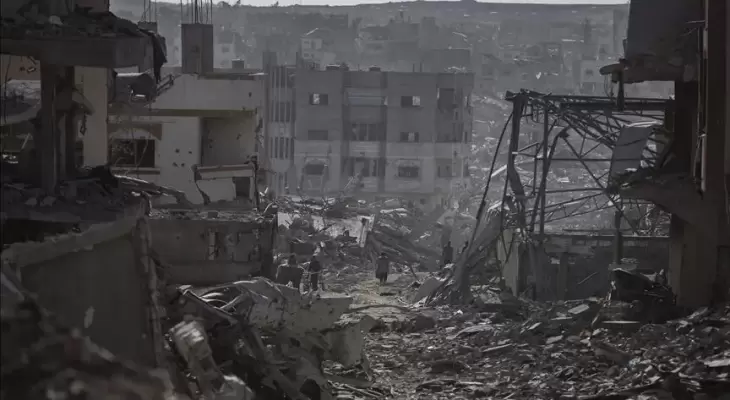
The price of silence is already being paid by every Gazan living among the ruins of the Strip and every Palestinian in the West Bank confronting the violence of settlers and their military partners.

It needs to end now, before Qusra becomes the blueprint for what comes next: today, Qusra; tomorrow, the whole of the West Bank.

Ramzy Baroud is a journalist, author and the Editor of The Palestine Chronicle. He is the author of eight books. His latest book, ‘Before the Flood,’ was published by Seven Stories Press. His other books include ‘Our Vision for Liberation’, ‘My Father was a Freedom Fighter’ and ‘The Last Earth’. Baroud is a Non-resident Senior Research Fellow at the Center for Islam and Global Affairs (CIGA). He contributed this article to The Jordan Times.


Continue reading
Netanyahu ‘Incapable of Governing’ as Far-Right Controls Him Says ex-PM

Former Israeli Prime Minister Naftali Bennett said Tuesday that Prime Minister Benjamin Netanyahu is “incapable of governing his own government” because far-right ministers Itamar Ben-Gvir and Bezalel Smotrich, and ultra-Orthodox groups have taken control of him.

“He is incapable of governing his own government, because Ben-Gvir and Smotrich and Haredim, they all control him,” Bennett said in an interview with broadcaster Mario Nawfal.

“I would not entertain in my government any idiots that talk about– just really stupid statements that people like Ben-Gvir and Smotrich say. I would not have allowed Ben-Gvir into my government to begin with. But if someone in my government said something like that, I would call them to order. Netanyahu can no longer do that because he depends upon them,” he said.

Bennett acknowledged that Israel’s international standing has deteriorated badly, stemming not from biased media or external propaganda, but from the government’s conduct — ministers inflicting “ongoing self-inflicted wounds” on Israel’s image while the country conducted “zero public diplomacy.”

The former prime minister argued that prolonged Israeli wars in the Gaza Strip, Lebanon and the Iran front were contrary to Israel’s military doctrine and were draining the country. “It’s not Israel’s doctrine,” he said.

“If we have to pursue war, do it quickly, intensively, win and move on to stabilize the region. When you drag it on for such a long time, it exhausts our economy, exhausts our reservists,” he added. Anadolu

Continue reading
Bomb Food Warehouses, Starve Them Says Extremist Israeli Minister

Israeli Heritage Minister Amichai Eliyahu late on Monday called for the bombing of Gaza food warehouses and for starving Palestinians in Gaza, in the latest Israeli inflammatory statements against Gaza which endures ongoing Israeli genocide.

“There is no problem in bombing Hamas’ food reserves,” the extremist minister told the Israeli Channel 7 during an interview.

“They need to starve. If there are civilians who fear for their lives, they should go through the emigration plan,” he also said.

“The moment it becomes hard for them, it will also be hard for Hamas. There is no problem bombing Hamas’s fuel and food reserves,” Eliyahu added, who belongs to the extremist Jewish Strength (Otzma Yehudit) party of hardline National Security Minister Itamar Ben-Gvir.

Eliyahu went on to say that entering aid into Gaza has no connection with “the Jewish ethics,” claiming that they must not “feed those who fight us.”

“When life becomes difficult for civilians, it will be too for Hamas,” he also said.

In November 2023, Eliyahu, who has extremist rhetoric against Palestinians, said dropping a “nuclear bomb” on the Gaza Strip is “an option.”

On Monday, Ben-Gvir reaffirmed his insistence on starving Palestinians in Gaza as part of the ongoing genocidal war.

According to Israel’s Channel 14, Ben-Gvir said “the only aid that should enter Gaza is for the purpose of voluntary migration,” a clear expression of a deportation agenda aimed at emptying the enclave of its indigenous population under the cover of the genocidal war.

US President Donald Trump has repeatedly called to “take over” Gaza and resettle its population to develop it into a tourist destination. His plan was rejected by the Arab world and many other nations, who say it amounts to ethnic cleansing.

Israeli estimates suggest that 59 captives remain in Gaza, with 24 believed alive. In contrast, more than 9,500 Palestinians remain imprisoned in Israel under harsh conditions, including reports of torture, starvation and medical neglect, according to Palestinian and Israeli rights organizations.

More than 52,500 Palestinians have been killed in Gaza in a brutal Israeli onslaught since October 2023, most of them women and children.

The International Criminal Court issued arrest warrants in November for Netanyahu and his former Defense Minister Yoav Gallant for war crimes and crimes against humanity in Gaza.​​​​​​​

Israel also faces a genocide case at the International Court of Justice for its war on the enclave according to Anadolu.

Continue reading
The Gaza Death Trap

While everyone waits for the full-blast war on Gaza which Israel promises to continue, Tel Aviv must know this will not be an easy matter not least of all by the Benjamin Netanyahu government whose ministers are split over allowing the army to resume its “fighting” position in Gaza.

Not everyone holds the view of extremist Finance Minister Bezalel Smotrich. He wants to resume, or continue, a large scale offensive on Gaza and reoccupy the enclave forever! For these opposing ministers as well as a large number of army soldiers and officers are not in favor of going back to fighting in Gaza because (a) of the bloody situation and danger soldiers were subjected to since 7 October, 2023, and because they want the rest of the remaining hostages – 59 and about 24 still thought to be alive – to be returned.

They fear – and reflecting major sections of society who have been demonstrating daily in Tel Aviv and other major Israeli cities under the of banner “bring them home,” – that increasing the wheels of war on Gaza would be signing the death warrants of the remaining hostages, originally marked at 250 and over 40 of them killed by indiscriminate Israeli bombing of the different areas of enclave over the past 17 months or so of fighting.

In the eyes of Smotrich, and he doesn’t mince his words, the return of the hostages is now secondary and what is crucial is to destroy Hamas and end its presence in the Gaza Strip.

But this is not happening. Since the resumption of the Israeli war on Gaza on 19 March, 2025 the resistance led by the Islamic organization and the other Palestinian factions have also resumed their fighting. While it is true, Hamas was slow in getting back to the war, preferring to give the ceasefire and peace talks a chance, and which led many to say the resistance are finished, this was far further from the truth.

Fighting again

Exactly one month later after 19 March, the Palestinian resistance led by Hamas and Islamic Jihad, re-started their fight against the Israeli army and the targeting of its soldiers; the Zionist army had maintained an active presence in the different areas of the Gaza Strip since the ceasefire took effect on 19 January, 2025 when the newly-elected US president was installed in the White House.

After much waiting and the gradual realization that Israel was no longer interested in the ceasefire nor in ongoing talks in Doha and Cairo, Hamas and Islamic Jihad reignited their war tactics on the Gaza battlefield. They realized Netanyahu, as prime minister of an extreme right-wing government, was no longer interested in maintaining a ceasefire.

Analysts maintained that Netanyahu was encouraged by Trump’s conflicting and dangerous stance on Gaza on top of which was the dramatic and subsequently abhorred idea of expelling the 2.1 million population of Gaza to build the Strip as the newly-plushed Middle East Riviera.

Although he quickly backed down due to Palestinian, Arab and even world pressure, Netanyahu interpreted this hugely-wrongful idea as greenlight to continue to hammer Gaza from the air and reimpose the starvation policy of its population.

Although the people got the backend of the Israeli willful mad firepower while shutting down the curtain on aid entering the 364-kilometer enclave, Hamas and the other Palestinian groups begun to regroup and re-started its military operations against the Israeli army in Biet Hanoon in the northern Gaza Strip to Gaza City in the center, Shujaiyia to the west, Khan Younis lower down and Refah, further south on the border with Egypt.

Like before, since 7 October, 2023, the resistance has now embarked on the increasing use of ambushes and booby-trap operations of luring Israeli soldiers and targeting Israeli tanks, armored vehicles and bulldozers while firing at them through locally-made, cheap but effective and deadly missiles that resulted in many of these soldiers being killed and badly-injured – numbers in the thousands – while many of the tanks and bulldozers either blown up and/or put out of action.

Towards the end of April onwards, this strategy was reactivated at full length and on different days sniping Israeli soldiers and targeting armoury would rise in multiple and different operations through the Gaza Strip. What is today of major worry to the Israeli army is that these geographical areas which were supposed to be “cleaned up” from Palestinian operatives are becoming active once again which means that for the Israeli army its back to square one.

The Israeli army had literally destroyed many of the major cities, towns, neighborhoods, villages of Gaza not once but many times. They entered places like Khan Younis, Jabalia, Shujaiyia, Nuseirat, Rafah and many more multiple times and declared them free from Palestinian resistance groups but these fighters just continue to emerge as seen recently and to the chagrin and frustration of the Israeli army.

Such frustration has led Israeli politicians like Netanyhu, and arch anti-Palestinian politicians like Itamar Ben-Gvir, Minister of National Security and hated by some Israelis for his extreme rightwing views to call for the re-occupation of Gaza, something that Netanyahu is actively contemplating. The prevailing view that once the army gets into Gaza once again, and on a mass scale, they can never leave! There are many in the army who have long rejected such an idea because they know of the “bloody situation” their soldiers would face.

However, the Israeli government and its army continues to operate under a set of illusions it is refusing to budge away from simply because Hamas and the Palestinian resistance presence is still operating in Gaza and in a robust mode to fight and kill Israeli soldiers and destroy their tanks and military hardware.

This is in addition to the fact the Israel and its army is getting nowhere near to freeing the rest of the hostages and who are likely to die if Israel embarks on a bigger war on Gaza and which Netanyahu and his extremist government are determined to do despite the warnings of the Israeli army which admits the rest of the hostages could die in any bigger military offensive.

Trump in region

Throughout this war there was always one external factor that played a permanent role in fuelling the Israeli genocide of Gaza and that was the United States through its provision of military support to Tel Aviv first under the Joe Biden administration and now under Trump.

If he could be persuaded to stop the supply of weapons to Israel, Netanyahu will finally stop the war on Gaza. Trump is on record, especially when he was running for the White House he would stop the war in Ukraine and Gaza. But will he? First of all, the Israeli lobby is entrenched in the US government.

However, there is one important factor that can pressure the Trump administration and that is the Arab countries. Trump is soon visiting Saudi Arabia and the Gulf countries including Qatar and the United Arab Emirates. If enough pressure can be applied from these quarters then surely the US president can move on the Gaza issue and halt any plans that Netanyahu is concocting for the enclave.

The Trump visit is being made in mid-May and its already played as a “bilateral” tour between the United States and these states whilest focusing on investment. And this is where their influence can be made with investment, economics and politics moving on one pedestal.

So the ball at the present time is in the hands of the Arab Gulf countries!

This comment is written by Dr Marwan Asmar, chief editor of the crossfirearabia.com website. 

Continue reading