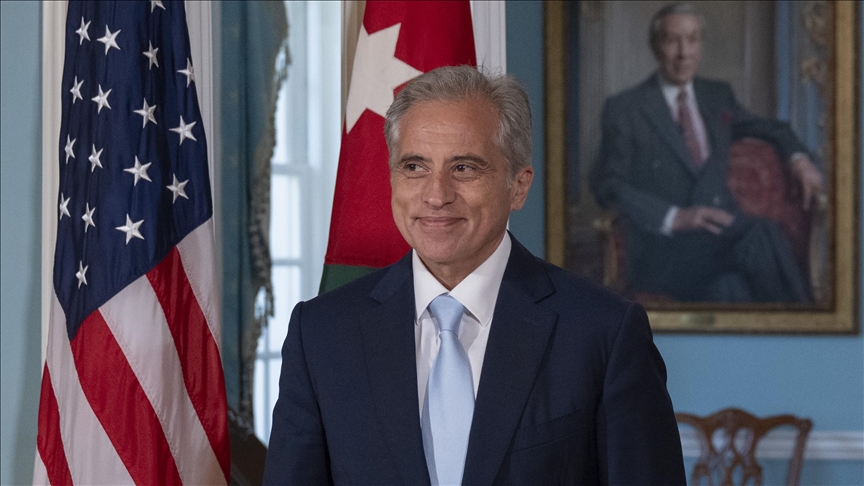
Youssef Heikal: Last Mayor of Yafa

From Palestinian Heritage:

Youssef Heikal was politician and a legal scholar who he was born in Yafa in 1907, called in English Jaffa. His father was a prominent figure and a nationalist.

He received his primary and preparatory education in Jaffa and completed his secondary education at the Arab College in Jerusalem and then traveled to France, earning a Bachelor of Law degree from Paris, a Postgraduate-diploma in Political Science and International Relations, a Postgraduate-diploma in Economics, and a Phd in Legal and Economic Sciences.

He traveled to Britain and received a doctorate in political science from the University of London. Due to his academic excellence, the university awarded him the Hutchinson Medal, which is given annually to the top graduate student at the university. Youssef Heikal was the only Arab to receive this medal since its inception. He began his career as the director of Islamic endowments and schools in Palestine from 1939 to 1943, and then served as a judge in the Central Court of Nablus from 1943 to 1945.

He completed postgraduate studies in law at the University of Montpellier in France and went on to study Criminology, Economics and Political Science at the Sorbonne, with honors. He then completed his doctorate in 1935. Until 1937, he studied at the London School of Economics. That year, he returned to Jaffa and published his book, “The Palestine Question.”

In 1938, he was appointed Director of Waqf (Islamic endowments) in the district of Lod. He was later promoted to Director of Waqf and Islamic Schools throughout Palestine and appointed to the Committee for the Supervision of Arab Education. In these positions, he traveled and spoke throughout the country about the need for Arab unity. In 1942, his book, based on his speeches, “Towards Arab Unity” (or “Towards Arab Unity”), was published. From 1943 to 1945, he served as a judge in the Magistrate’s Court in Nablus.

In 1945, he was elected Mayor of Jaffa. He served in this capacity until May 5, 1948, when he left for Jordan. In Jordan, he served on the Jordanian Armistice Commission and established the Palestinian Ministry to address the Palestinian refugee problem. He served for 16 years as his country’s ambassador to Washington (1959-1962), Paris, London, and Taipei. and United Nations institutions.

In 1969, he published his book “The June Defeat” (or “The June War”) about the Arab defeat in the Six-Day War. In 1971, his book “Palestine: Before and After” (or “Palestine: Before and After”) was published.

He died in Amman, Jordan in 1989.
Continue reading
Jordanian Statesman Obeidat Dies at 88

Jordan‘s Prime Minister Jafar Hassan offered profound condolences following the passing of former Prime Minister Ahmad Obeidat, Monday evening.

Reflecting on a life dedicated to the Hashemite leadership and the Jordanian people, the Prime Minister described Obeidat as a towering figure of the political establishment who served the nation with unwavering integrity during its most formative chapters.

Born in 1938 in Hartha, Irbid, Obeidat’s career was marked by his ascent to the highest echelons of government and security. He served as Prime Minister and Minister of Defense from 1984 to 1985, a tenure preceded by his leadership as Minister of Interior (1982–1984) and Director of the General Intelligence Directorate.

His legislative expertise was further utilized across multiple terms in the Senate, while his international standing was recognized through his role as a Goodwill Ambassador for the United Nations Environment Program.

Obeidat was a foundational architect of Jordan’s modern civil and judicial frameworks. He presided over the Royal Commission for Drafting the National Charter (1990 – 1991) and held vice-presidential roles on the Royal Commissions for Human Rights and Judicial Development in 2000.

From 2003 to 2008, he chaired the Board of Trustees of the National Center for Human Rights. A recipient of the Grand Cordon of the Order of the Renaissance (Wisam al-Nahda), First Class, his legacy remains a cornerstone of the Kingdom’s commitment to public service and institutional reform Petra News Agency

Continue reading
Jordan’s PM: ‘Greater Israel’ Illusion

Jordanian Prime Minister Jafar Hassan on Tuesday called the so-called “Greater Israel” vision an “illusion,” stressing that Tel Aviv is “isolated” due to its “extremist” policies.

“We hear about visions and proposals that imply a perpetual war with no end, such as the illusion of Greater Israel entertained by extremist politicians in Israel,” Hassan said during a meeting in Amman with his Lebanese counterpart, Nawaf Salam, who arrived in the Jordanian capital early Tuesday for an unannounced visit.

He said Israel is “isolated and besieged because of its extremist policies.”

“The entire reality points to (Israeli) policies that deepen hatred and resentment as a result of ongoing massacres, and the peoples of the world and the region will not forgive them,” he added in his comments carried by the official Petra news agency.

On Monday, Jordanian government spokesman Mohammad al-Momani accused the far-right in Israel of “threatening the region and undermining prospects for a two-state solution.”

“Greater Israel” is a Biblical term used in Israeli politics to refer to the expansion of Israel’s territory to include the West Bank, Gaza, Syria’s Golan Heights, Egypt’s Sinai Peninsula, and parts of Jordan.

Last week, Israeli Prime Minister Benjamin Netanyahu told a news channel that he feels “very attached” to the vision of a Greater Israel. He said he considers himself “on a historic and spiritual mission” which “generations of Jews that dreamt of coming here and generations of Jews who will come after us,” according to Anadolu.

Israel has killed more than 62,000 Palestinians in Gaza since October 2023. The military campaign has devastated the enclave and brought it to the verge of famine.

Last November, the International Criminal Court issued arrest warrants for Netanyahu and his former Defense Minister Yoav Gallant for war crimes and crimes against humanity in Gaza.

Israel also faces a genocide case at the International Court of Justice for its war on the enclave.

Continue reading