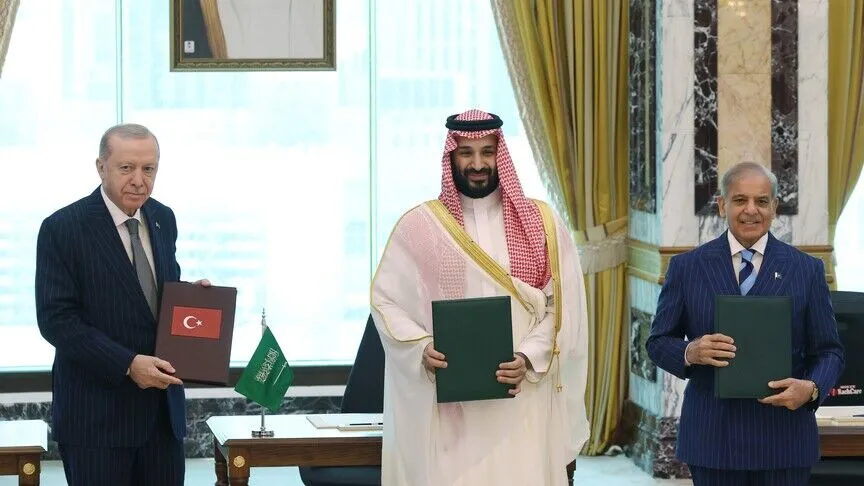
New Pact, New Strength – Turkey, Saudi and Pakistan

Yemen on Saturday welcomed the Mecca Joint Defense Agreement signed by Türkiye, Saudi Arabia and Pakistan, describing it as a strategic step to strengthen defense cooperation, collective deterrence and regional security.

In a statement, Yemen’s Foreign Ministry said the agreement marked “a strategic step and an important milestone” in defense cooperation among the three countries.

On Friday, Turkish President Recep Tayyip Erdogan, Saudi Crown Prince Mohammed bin Salman and Pakistani Prime Minister Shehbaz Sharif signed the agreement in Mecca.

The pact considers an armed attack against any of the three countries an attack against all of them and aims to strengthen collective deterrence and expand defense cooperation.

The Yemeni Foreign Ministry said the agreement reflected “the shared political will to unify efforts, strengthen collective security and deterrence, and confront challenges and threats affecting the region’s security and stability.”

“The agreement is of particular importance in light of the escalating challenges and threats facing the region, foremost among them terrorist attacks, arms smuggling, and threats targeting neighboring countries and international maritime routes,” the ministry added.

The agreement follows years of consultations among Riyadh, Ankara and Islamabad aimed at strengthening defense cooperation and coordinating responses to shared security challenges based on their strategic interests.

It came amid heightened tensions in the Strait of Hormuz following the conflict between Iran and the US, which has raised concerns over global energy supplies and maritime security despite ongoing diplomatic efforts to preserve freedom of navigation. Anadolu
Continue reading
Crown Prince: KSA Will Not Establish Relations With Israel Without a Palestinian State

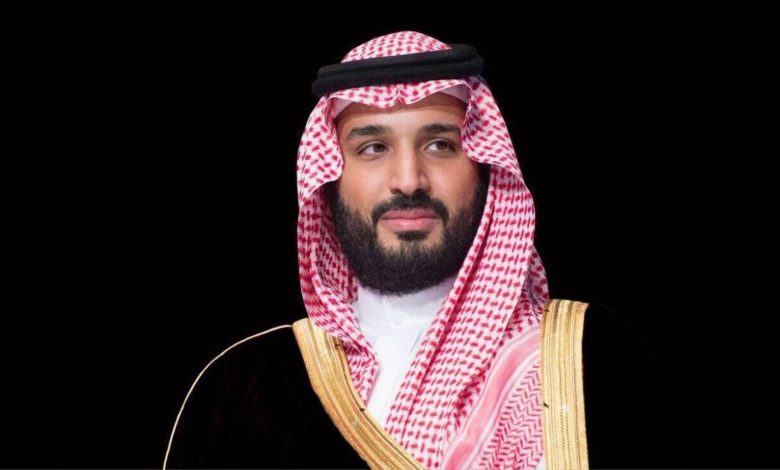
Saudi Crown Prince Mohammed bin Salman said, Wednesday, the Kingdom of Saudi Arabia will not establish diplomatic relations with Israel without the establishment of a Palestinian state with East Jerusalem as its capital.

The Saudi Crown Prince explained during the opening of the first year of the 9th session of the Shura Council. He told its members:

“The Palestinian issue is at the forefront of your country’s concerns, and we renew the Kingdom’s rejection and strong condemnation of the crimes of the Israeli occupation authority against the Palestinian people, ignoring international and humanitarian law in a new and bitter chapter of suffering.”

The Prince added: “The Saudi Kingdom will not stop its tireless work towards the establishment of an independent Palestinian state with East Jerusalem as its capital, and we affirm that the Kingdom will not establish diplomatic relations with Israel without that.”

He pointed out: “The Kingdom is keen to cooperate with all active countries in the international community, certain that what protects humanity and preserves its civilizational values ​​is the joint pursuit of a better future based on fruitful cooperation between countries and peoples, respecting the independence and values ​​of countries, adopting the principle of good neighborliness, non-interference in their internal affairs, and avoiding resorting to force in resolving disputes.”

Continue reading
Why Won’t Saudi MBS Normalize With Israel?

Saudi Arabia’s Crown Prince Mohammed bin Salman (MBS) has been telling US lawmakers that he is at risk of assassination due to his pursuit of a normalization agreement with the occupation state of Israel and the United States, drawing parallels to Egypt’s Anwar Sadat, who was assassinated after normalizing ties with Israel, according to the Politico.

MBS has reportedly emphasized that any agreement must include a credible path to Palestinian statehood, a demand he argues is crucial for regional stability and his own survival. He has pointed out that without addressing the Palestinian issue, the proposed benefits of the deal—such as security guarantees and economic investments—would be compromised according to the Quds News Network.

The ongoing genocide in Gaza has heightened Arab outrage against Israel, making the Palestinian cause even more central to MBS’s concerns.

Despite this, Israeli Prime Minister Benjamin Netanyahu and his far-right government remain opposed to the creation of a Palestinian state, complicating the path to a deal.

Continue reading