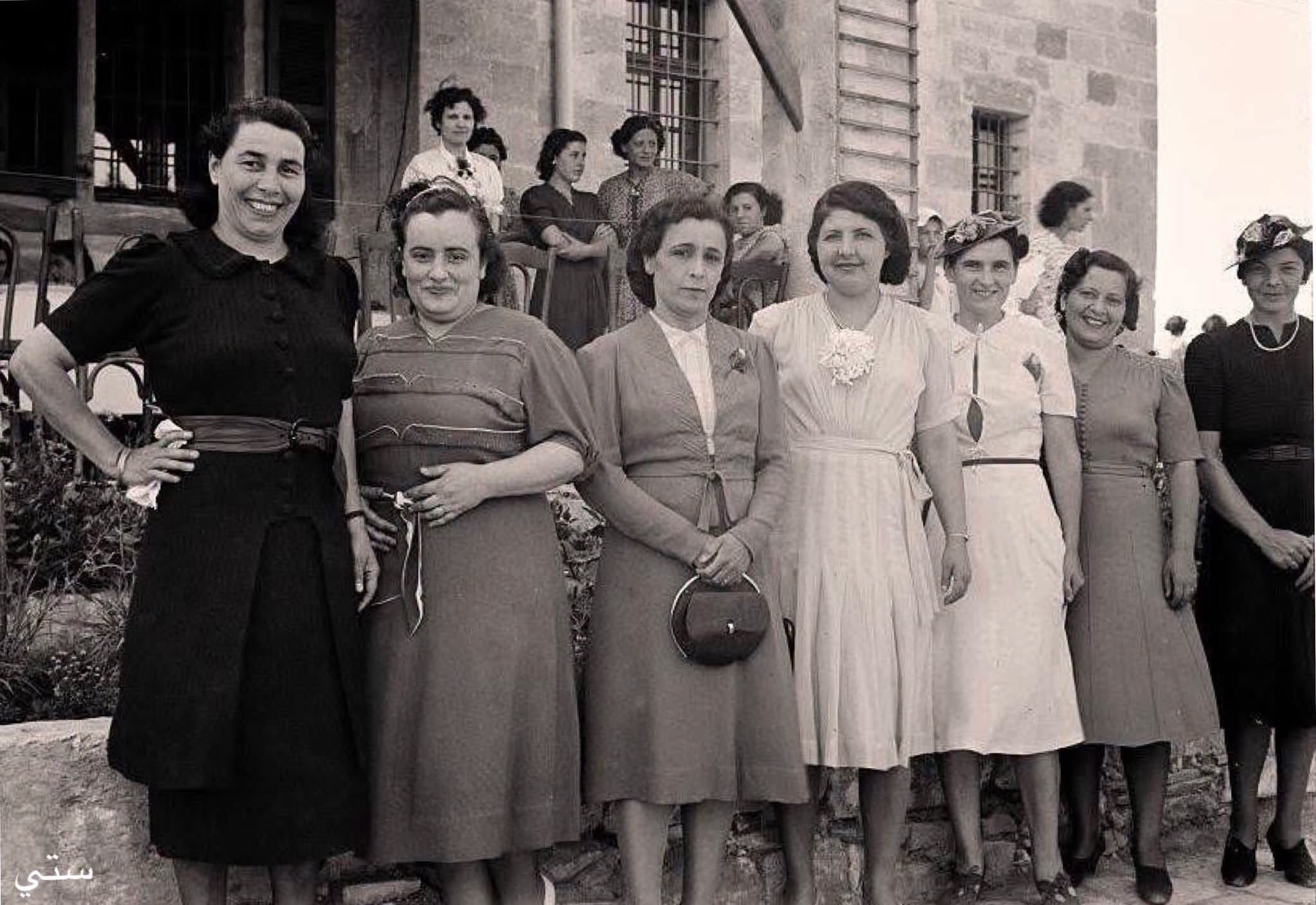
A memorial ceremony for the Red Cross Society, attended by prominent Palestinian women: Saba Al-Fahoum, Adele Azar, Raoufa Aounallah, Matil Kawar, and Matil Abboud, in Nazareth in 1940.
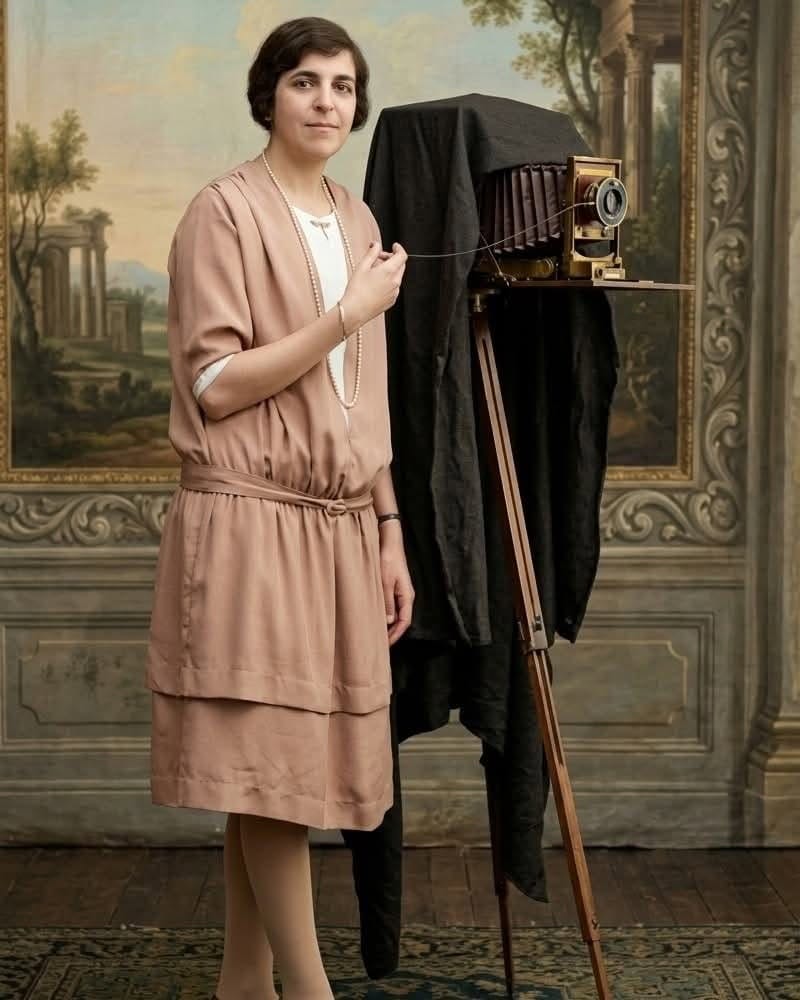
Margot Saba Abdo (1901 – 1974) was an exceptional female Palestinian photographer who worked in Jerusalem in the 1930s. Historian, sociologist Salim Tamari says she displayed a skill and mastery of the lens that surpassed Karimeh Abbud, another woman photographer from Nazareth at the time. Margot was born in Jerusalem to a Greek mother whose brother was the Meltiadis Savvides (Saba), a well-known photographer working there in his Savvides Studios. This is where Margot learned to take pictures in her youthful years.
However, after her education at the Greek Orthodox school where she learned Arabic, Greek, English and Russian she joined her brother’s studio, Daoud Abdo. When he went to work as the chief photographer at the Palestinian Museum, Margot managed the studio. This was from 1930 to 1948 where she worked at family portraits. After the 1948 Nakba, she moved first to Cairo and then to Beirut, again working with her brother in his studio.
Late Israeli prime minister Golda Meir once unashamedly said the Palestinians don’t exist and Israel was established on empty lands.
It was a view repeated time and again to justify the Israeli occupation of Palestinian lands and their subsequent grab of more Arab territories.
The photographs of Karimeh Abbud (1893-1940), the first Palestinian woman photographer, debunks that view and makes Israelis like Meir eat their words.
Google honoured her legacy by celebrating Abbud’s 123rd birthday with a Google doodle in 2016 two years before this article was first published.
“Abbud captured vast landscapes, many of which don’t exist today. Through her art, we’re able to experience the beauty of these regions as she saw them nearly 100 years ago,” said Google on November 18, 2016. “Thank you, Karimeh, for making art that endures.”
Only upon closer inspection it is clear that the tree is in fact painted on the negative, curving around her head and through her hands
Google also dwelled on her “photographs of family, friends and the surrounding landscape of Bethlehem, Palestine.”
Darat Al Funun of the Khaled Shoman Foundation in Amman presented the first comprehensive exhibition of photographs by Karimeh Abbud in late 2018 to continue January 11, 2019.
Documentary
The exhibition also included a short documentary on Karimeh’s life and work by Mahasen Nasser-Eldin.
Many art critics have commented on the impressive nature of her photography. In a tribute to Abbud Palestinian art critic Tammam Al Akhal said “she is friend of the light and sun… there is an artistic sense of the equilibrium inside her pictures. She was a true artist when taking a photograph.”
Al Akhal was giving a short presentation on the artistic poise in Abbud’s photographs as the Karimeh Abbud Photography Competition Prize was being launched by Dar Al Kalima University College of Arts and Culture in Bethlehem, Palestine, in 2016. The competition has since become an annual event designed to encourage young talent in art, culture and photography.
The Lady Photographer of Palestine
In her time, she established herself amongst the great photographers of the time with Al Akhal referring to her as standing as “tall as the skyscraper.”
Abbud was born in Bethlehem on November 18, 1893, in a Christian family which had settled in Palestine in the latter half of the 19th century. Her father was Said Abbud, an Anglican-Lutheran priest, who used to travel all over Palestine and take Abbud with him wherever he went.
Ivana Peric wrote that when Abbud was little she would accompany her father on his travels to distant places to serve his congregations in Jerusalem, Bethlehem, Haifa and Nazareth “and this constant travel to Palestinian cities and villages allowed [Abbud] to see the diverse landscape of her homeland first-hand. She wanted to see more and capture the beauty she encountered.”
Reverend Mitri Al Raheb — who became a sort of unofficial biographer of Karimeh Abbud and her family — said when he came to Palestine, her father travelled to many places from Gaza in the south to Shaffa Amer in the north and then finally settled in Bethlehem in 1890. However, the family finally put down roots in Nazareth and this is where Abbud grew up, going to primary school there, then to Jerusalem and later to the American University in Beirut where she studied Arabic literature.
However her true passion was photography. She was merely 17 when her father gave her a camera and she started clicking there and then and didn’t stop until her death. She was buried in the Bethlehem Church where her father preached from the early 1900s until 1947 when he retired and left Palestine in January 1948 because of the troubles in Palestine and returned to Marj Ayoun in southern Lebanon where he originally came from.
During this period, however, the second of his six children quickly established herself by becoming a highly competent photographer, competing in a man’s world alongside such old hacks as Khalil Raad, Hanna Safieh and Fadil Saba and a handful of Armenian photographers who dominated the profession.
Ahmad Mrowat, the director of the Nazareth Archive Project devoted to collecting the works of the “Lady Photographer”, said Saba, the local photographer, moved to Haifa in the early 1930s and this made the emerging photographer a household name. He was invited to cover events all over Palestine, including one celebration in Hebron.
Social revolution
Abbud created a social revolution in photography. Unlike the male photographers who worked out of their own studios, Abbud did much more. She had two studios, one in Nazareth where she also had a laboratory for processing the photos and keeping the negatives in a safe place and adding colour to some of them, and a studio in Haifa. However, she visited homes to take photographs of women and children which male photographers could not do.
Abbud went into the homes of well-to-do and middle class families as Al Raheb points out. Increasingly, these people wanted her to come to their homes because of prevailing social constraints that made it inappropriate for them to venture outside their houses, especially to be photographed in studios.
So Abbud photographed women and children at different social occasions, during parties and marriage ceremonies. Her reputation was quickly cemented in the 1920s and 1930s when she took up the profession full time. In Al Carmel, a local newspaper, she advertised herself as “the only national photographer in Palestine [who] learned this beautiful art by well-known photographic personalities and is specialist in the service of women at reasonable prices…”
There are two points here to consider that could actually be inter-related. Jinan Abdo stresses the national element in this advertisement. She states in a 2012 documentary on Abbud made by Mahasen Nasser-Eldin: “when she calls herself a national photographer that feeds into the national context that was present at the time. In the 1920s, after the British Mandate began, Muslim and Christian associations started to counter the idea that we are sectarian groups and not a nation and to support the idea of the unification of our nation, so the rational element was essential and I think we can look at Karimeh through this national context,” Abdo says.
Dr Issam Nassar, an academic at Illinois State University who teaches Middle East history, focuses on the “micro” element in her photography. “Taking portraits in studios at that time required preparations” whilst “in the clients’ homes… it was more relaxing because people felt at ease in their natural sorroundings.”
Hani Hourani, a social science researcher who studied art and photography, says: “If we look at the family and group photos [taken by Karimeh Abbud] the viewer doesn’t see the traditional style of the setting, the background décor and the fixed distribution of light but the onlooker sees such marked diversity in all these elements.
“The home was an opportunity for more improvisation and diversity in the styles captured by the photo leading many to suggest Karimeh Abbud was a non-traditional photographer calling for change in the way she clicked photos.”
Abbud’s photographs on show at Darat Al Funun were recently acquired accidentally after much cajoling.
Mrowat answered an advertisement placed in an Arab newspaper by an antiquarian Jewish collector named Boki Boazz calling for more information about Karimeh Abbud. That was in 2006.
Mrowat says at first the collector was not willing to divulge any information but after being pressed, it turned out that he had 4,000 photographs which he got hold of in one of the houses in the Qatamon district in Jerusalem after their owners fled in 1948; the photographs, he adds were of Karimeh Abbud because her name was initialled on each of the photographs — the first signed picture postcard belonging to her was dated October 1919.
Mrowat says his heart was set on obtaining the collection which he felt were a very important part of Palestinian heritage, finally persuading Boazz to give up his collection by offering him an old edition of the Torah printed in the Palestinian city of Safad in 1860.
The photos on show form only a part of the collection at Darat Al Funun and are only a fraction of the huge number of photographs said to number 9,000 still believed to be in the possession of the Israeli army as an article in the Haaretz newspaper stated.
The photos present a narrative of the Palestinian society and travel before 1948. Abbud took photos of cities and villages that flourished in the early part of the 20th century.
It was easy for Abbud to get around, Mrowat says, as she was probably the first woman to have an automobile and a driving licence in Palestine and the Arab world. She used to travel frequently to photograph Bethlehem, Jerusalem, Tiberias and Haifa. Many photos were taken of beaches, markets, mosques and churches, providing a unique glimpse of Palestinian life.
Mrowat, Dr Nassar and others suggest she would act, at times, as a tour guide, accompanying visitors to many tourist locations including the Jordan River and Yarmouk River as well as many other places. In between these, she was interested also in photographing the daily lives of Palestinian women, the different stitches they would make as they embroidered their garments which represented different villages, farming, women carrying water and wood as well as other scenes in both the countryside and in towns and cities.
Nassar puts it in another way when he says that Abbud was able to bring out the human aspects of the personalities she was photographing and this added value to her work and individuality because she succeeded in preserving the modesty and humanity of the Palestinian existence “through what professional photographers call the “aura” of the photograph and its phantasmical imagination.”
Al Akhal agrees, saying this is why Abbud’s photographs surpassed time. It was the “professionalism”, “creativity” and “high quality” that produced good negatives and in turn excellent photographs that “allowed her work to continue to be seen long after,” she says. “Through these pictures she [Karimeh Abbud] talks to us in silence, we build a dialogue with her, become friendly with her and construct strong relations with her.”
Through her images, Abbud provided a pictorial documentation of Palestinian life.
Nasser-Eldin, also coordinator of the the Karimeh Abbud Photograph Competition Prize, says “Abbud started what we can call ‘documentary photography’ documenting the lives of people through her studios and through her movement in the country carrying her bulky tripod and her camera wherever she went.
“Through her lens we got to know the forms of Palestinians living in Palestine before 1948. Her photos give us a change concept, a new picture of windows and images of Palestine and Palestinians, totally different from the pictures of orientalists who showed our country [Palestine] was empty of people and/or showed images of people spread out and not as an integrated community with civilisation and culture living in towns and cities and in modernity at that time,” Nasser Eldin added.
Her photos were well-taken and are a vital part of history, so at various times Israel has sought to adopt her as one of its own. This is what one book, published in 2011, titled Karimeh Abbud: Israeli Portrait and Wedding Photography by Monica Millian tried to do. Many have questioned its credibility as it is primarily sourced from Wikipedia and other online resources.
It can easily be understood why Israel would want to “cash in” on such an historic cultural figure, but Abbud is a Palestinian through and through as judged by historical evidence.
Marwan Asmar is a commentator based in Amman. He has long worked in journalism and has a Phd in Political Science from Leeds University in the UK. This article originally written for and appeared in Gulf News and is now reprinted in crossfirearabia.com.
The Orthodox Council in occupied Nazareth has canceled the public Christmas tree lighting originally scheduled for Sunday. The event, which typically draws thousands of participants, was called off due to Israeli security restrictions limiting attendance. The council said the limitations would prevent most of the community from joining and refused to issue a limited number of tickets, as this would exclude large sections of the public from the annual celebration.
The council held an emergency press conference on Friday evening and lit the tree during the event. The Christmas tree will remain in the main square for five weeks, as is customary, and the council encouraged residents to see it in the coming days.
The council had attempted to negotiate with Isreali police and security authorities to ease restrictions, including limiting the number of attendees and the forced closure of nearby businesses. They stressed that the festival also supports the local economy. Council officials emphasized that the restricted number of attendees would represent less than 8% of the community and that the celebration is meant to include the city’s entire social fabric.
Council head, Lawyer Basim Asfour, said the Israeli restrictions were “beyond reason.” He added, “We refuse to favor one group over another. We want the Nazareth Christmas tree, in all its colors and lights, to represent all residents of the city. Our duty is to protect this message, our dignity, the dignity of the people, and their right to joy and participation.”
Nazareth Municipality’s Director General, Nahida Mansour, expressed the city’s support for the council’s decision. She encouraged the public to visit the city during the holiday season, saying, “The tree is a light that must not be extinguished.”
The council confirmed that preparations for the Christmas market and other celebrations will continue in coordination with the municipality according to the Quds News Network.
Palestinian-American Najoud Al-Fahoum has entered the space world with a huge bang. Born in the United States to parents who once lived in Nazareth, she is today a spacecraft engineer and director of rocket and spacecraft flight operations.
The US space agency, NASA has announced that Al-Fahoum, head of the agency’s Exploration Mission Planning Office, has been appointed to lead the Artemis 1 mission, which aims to land the first woman and the first person of color on the moon.
Al-Fahoum posted on her Instagram account about her new role as a Palestinian space scientist, saying, “As a Palestinian-American, I am proud to lead this mission.”
Al-Fahoum’s family originates from Nazareth, and she was born in the United States. She has visited the Palestinian territories several times.
Prior to her current position, she worked as a spacecraft engineer at NASA in Houston, Texas.
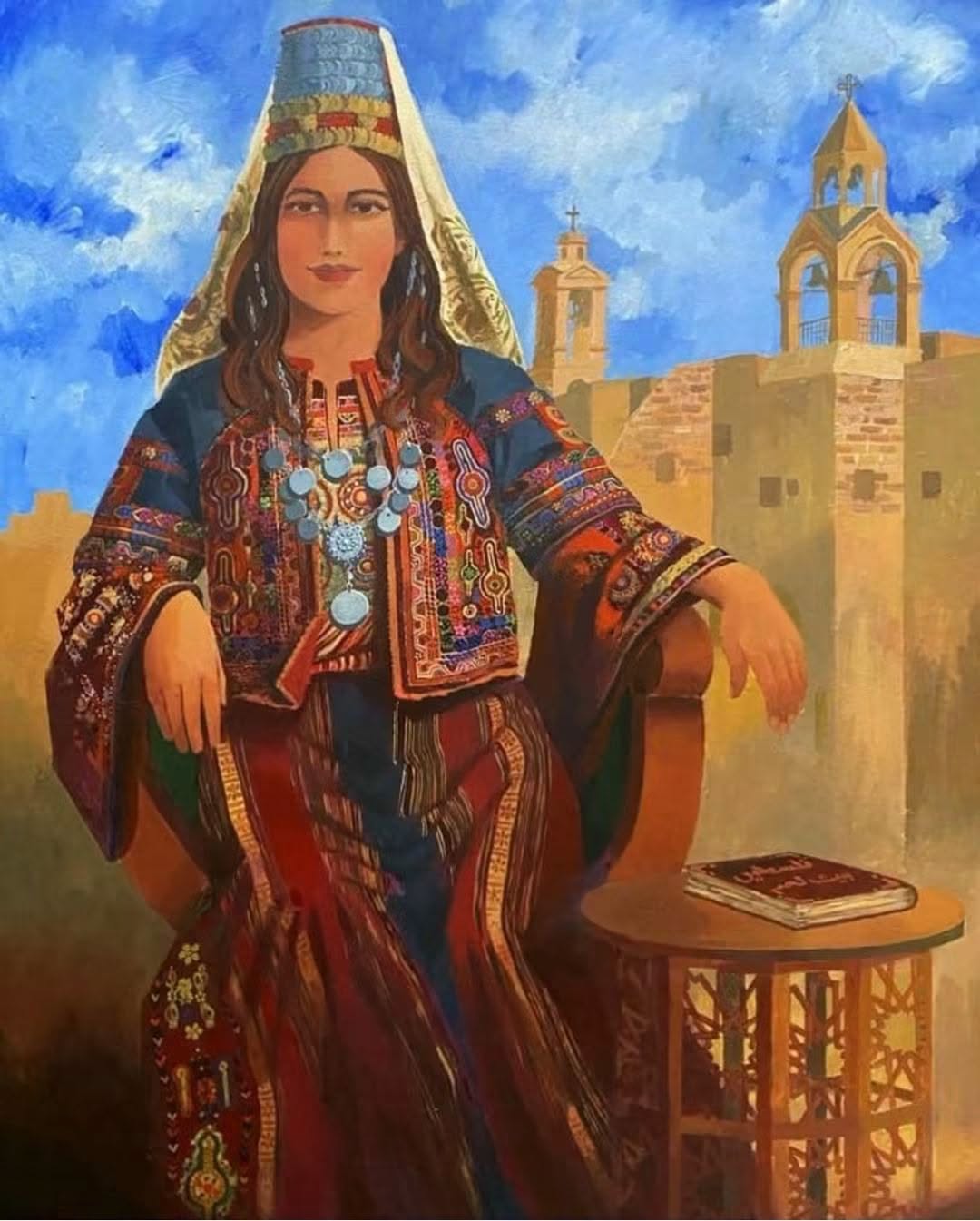
Al-Fahoum is proud of her Palestinian heritage and has previously worn traditional Palestinian dress at NASA headquarters for the first time in the agency’s history.

 CrossFireArabia
 marwan