Gaza: Only 3% of Land Safe to Grow Food

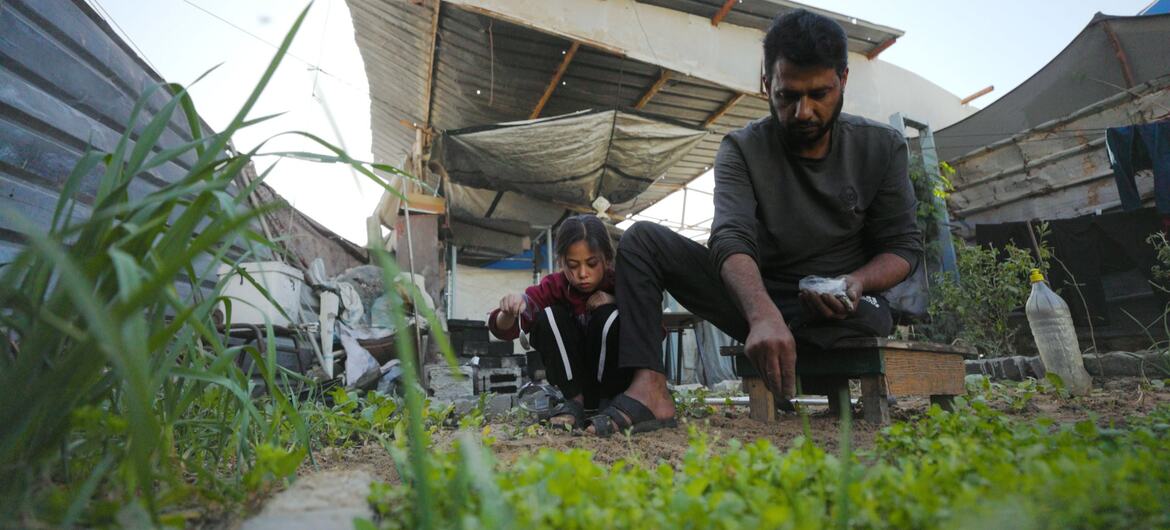
Amid ongoing deadly hostilities in Gaza, the enclave’s farmers face the increasingly difficult challenge of finding safe land to grow their crops.

Satellite images published last Tuesday in news analysis from the UN Food and Agriculture Organization (FAO) and UNOSAT, the UN Satellite Centre, indicate that just three per cent (448 hectares) of the shattered enclave’s farmland remains usable. 

In October 2025, only 601 hectares were accessible and undamaged.

This latest assessment paints a stark picture of the continued deterioration of Gaza’s agriculture sector,” said Rein Paulsen, Director of FAO’s Office of Emergencies and Resilience. “Without urgent action to restore safe access and provide farmers with the support they need, opportunities to restore local food production will continue to diminish.”

Bombed out

For cucumber and tomato grower Taysir Dahdouh, the war between Hamas fighters and Israel sparked by Hamas’s deadly attacks in October 2023 has been marked by overwhelming loss.

“I had a good income before the war,” he said. “Suddenly, we were left with nothing…Even the steel frames of the greenhouses disappeared, along with our homes, belongings, and irrigation pipes. Nothing was left.”

After returning from displacement, Mr. Dahdouh tried to restore the land using basic tools, working with his family. “We managed to rehabilitate about one dunum (about one-tenth of a hectare) of our land to bring it back to life,” he explained.

Another Gaza farmer, Wajiha Dahdouh, highlighted other equally serious problems: “We came back to support ourselves and return to farming so we could survive. Unfortunately, there is not enough water, there are no fertilizers, no seeds, and none of the basic necessities that would allow people to continue their lives.”

Squeezed out

The reduced growing space for Gaza’s farmers today is mainly the result of a lack of access, rather than additional damage from the war, which was already massive.

In June 2026, just over 4,000 hectares of cropland in Gaza – or 27 per cent – could be reached, but approximately 3,600 hectares of this was unfit for planting.

Farmers in Deir al-Balah and Khan Younis have seen the largest reductions in available land, FAO said. 

This is primarily because of the “westward expansion” of the so-called ‘Yellow Line’ that separates the ceasefire zone from the Israel Defense Forces’ military-controlled area.

Rafah in the far south of Gaza has the highest levels of inaccessible cropland and greenhouse growing areas, at 97.2 per cent and 98.4 per cent respectively.

“The most extensive physical damage remains concentrated in North Gaza and Gaza governorates,” the agency noted. Most damage is in North Gaza and Gaza, satellite images show.

An infographic showing a map of Gaza and a bar chart illustrating the percentage of cropland that is damaged or accessible in 2025 and projected for 2026.
Lucica Matei UN News infographic

The situation for Gazans remains dire. Just this weekend, UN partners reported multiple air strikes and incidents of shelling, gunfire and naval fire, primarily west of the Yellow Line, where most of Gaza’s 2.1 million people are now confined to an area less than half the size of the enclave. UN News
Continue reading
UN Experts Tell Israel: Stop Starving Gaza

“The humanitarian and human rights situation for Palestinian civilians across Gaza is catastrophic,” underscored Ilze Brands Kehris, Assistant Secretary-General for Human Rights, highlighting the Integrated Food Security Phase Classification’s recent alert that “there is a strong likelihood that famine is imminent” in the Strip’s northern areas, she told a 15-member body convened an emergency meeting in response to experts’ warnings that immediate action is required within “days, not weeks” to avert the scourge.

She appealed to the Council to take all steps within its powers to influence the parties to end violations, facilitate impartial humanitarian access and protect civilians. Israel’s destruction of Gaza’s civilian infrastructure “contributes directly to the famine risk being discussed today”, she noted, stressing that “the use of starvation of the civilian population as a method of warfare is strictly prohibited under international humanitarian law”.

Kheris added: “The manner in which the Israeli military is conducting operations in northern Gaza suggests not only that Israel’s actions are seeking to empty northern Gaza of Palestinians, by displacing survivors to the south, but points to further grave risks of atrocities of the most serious nature.” 

“Men, women, boys and girls are effectively starving as the conflict rages,” underscored Rein Paulsen, Director, Office for Emergencies and Resilience, Food and Agriculture Organization (FAO), via videoconference. Prior to 7 October 2023, Gaza was largely self-sufficient in vegetables, eggs, fresh milk, poultry and fish, and local agriculture also produced much of the red meat and fruits consumed inside Gaza, he said. Today, nearly 70 per cent of Gaza’s cropland has been damaged or destroyed, and almost 95 per cent of cattle, and more than half of sheep and goat herds, are now dead.

Also briefing the Council was Joyce Msuya, Acting Under-Secretary-General for Humanitarian Affairs and Acting Emergency Relief Coordinator, who declared: “As I brief you, Israeli authorities are blocking humanitarian assistance from entering North Gaza, where fighting continues, and around 75,000 people remain with dwindling water and food supplies.” Citing violent armed lootings of UN convoys, the closure of food assistance kitchens and the diminishing daily food distribution, she warned that, if implemented, the Israeli Knesset legislation to ban activities of the United Nations Relief and Works Agency for Palestine Refugees in the Near East (UNRWA), starting in January, will be “another devastating blow to efforts to provide life-saving aid and avert the threat of famine”.

That international aid cannot travel to reach civilians “is completely unacceptable”, stressed Ray Collins of Highbury, Parliamentary Under-Secretary of State for the Foreign, Commonwealth and Development Office of the United Kingdom, Council President for November, who spoke in his national capacity. Israel must heed and act on the “shocking and urgent” warning that a worst-case scenario is now playing out in areas of northern Gaza, he said, urging that country to flood Gaza with aid, protect civilians, meet all legal obligations as the occupying Power and avoid undermining UNRWA’s role.

“This is a clear use of starvation as a method of war, which constitutes a war crime,” stressed Algeria’s representative. Denial of civilians’ right to food in Gaza constitutes part of systematic collective punishment of the Palestinian population, stressed China’s speaker, urging Israel to remove obstacles to humanitarian access throughout Gaza and any restriction placed on UNRWA.

Continue reading