Wildfires, Tough Questions

By Ayoub Abu Dayyeh

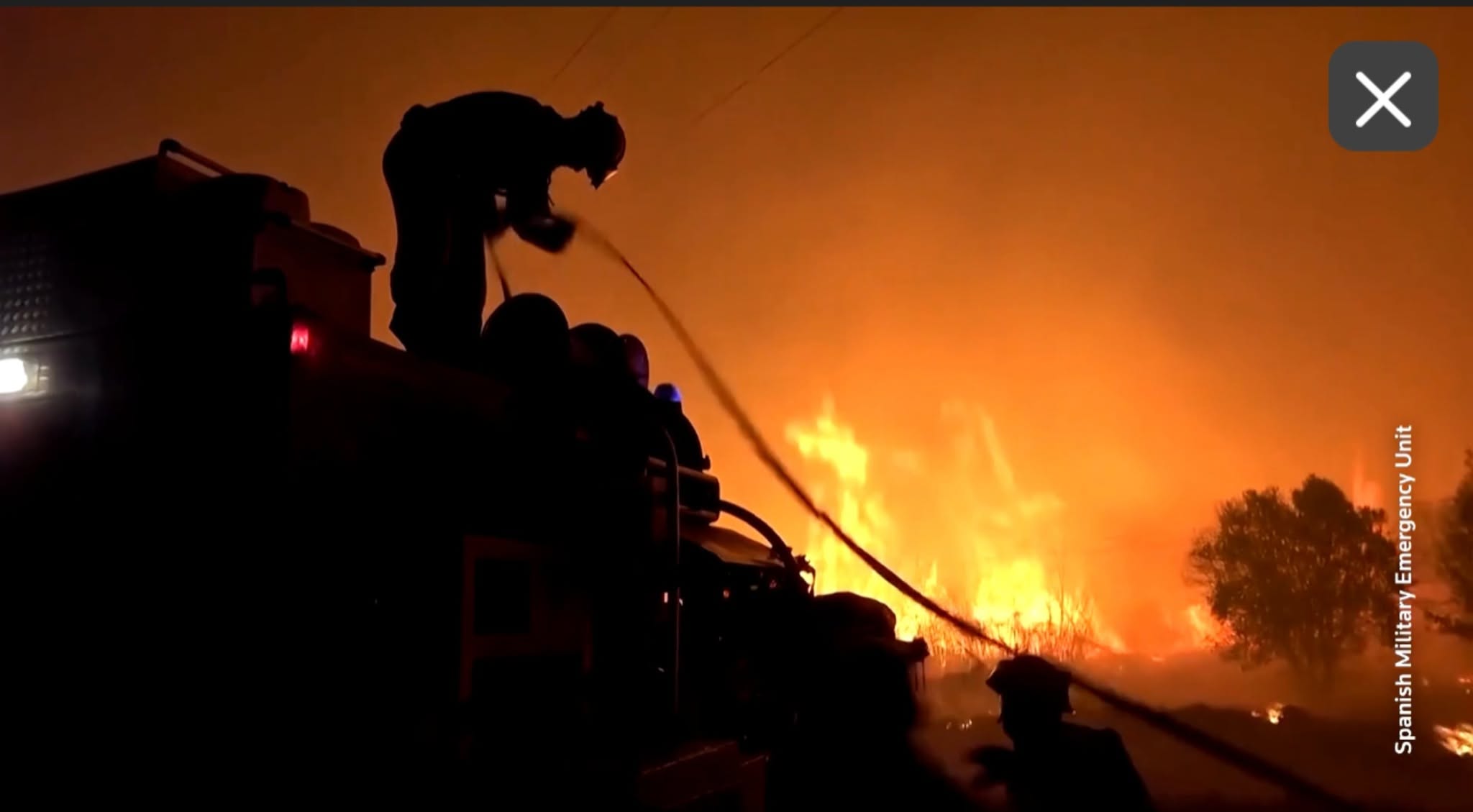
Every summer, southern Europe braces for another wildfire season. This year, large fires have swept across parts of Spain, Sicily and southwestern France, destroying forests, threatening villages, forcing evacuations, and leaving behind landscapes that may take generations to recover.

Firefighters have displayed extraordinary courage, often risking their lives against flames intensified by drought, heat waves, mulch and strong winds. Yet the repeated return of these disasters raises a question that extends beyond climate change and forest management. It is a political and moral question about priorities.

Spain and France are among Europe’s strongest economies and are both leading members of NATO. Together with their allies, they possess some of the most advanced military capabilities ever assembled. NATO can mobilise fleets of aircraft, satellites, drones, logistics networks, and highly trained personnel with remarkable speed when military operations are required. History has shown that the alliance has been able to sustain prolonged military campaigns in countries such as Afghanistan, Iraq, Iran and Libya, while individual member states have also participated in operations in Syria and against Iran-backed military targets in recent years. The financial and technological resources devoted to warfare are immense.

Against this backdrop, the struggle against wildfires appears strangely underpowered. Each summer, firefighters often speak of aircraft shortages, exhausted crews, and limited resources. Local authorities compete for specialized firefighting planes because demand exceeds supply. Countries request assistance from their neighbors through European cooperation mechanisms, yet devastating fires frequently continue burning for days before sufficient aerial support arrives. Even Jordan has participated in firefighting in Cyprus on many occasions.

This contrast invites reflection. If nations possess the industrial capacity to manufacture sophisticated fighter jets, cruise missiles, precision-guided weapons, and advanced drones and surveillance systems, why does the world still struggle to produce enough specialised firefighting aircraft? If military alliances can coordinate thousands of personnel across continents within hours, why is a similarly ambitious international system for combating natural disasters still so limited?

The question is not whether military forces should disappear. Every nation has legitimate security concerns and responsibilities to defend its citizens. Rather, the question concerns balance, justice and equity. Security today is no longer defined solely by armies confronting one another. Climate change, prolonged droughts, extreme heat, floods, and wildfires increasingly threaten lives, infrastructure, food security, biodiversity, and economic stability. A forest fire that destroys thousands of hectares, devastates tourism, and fills cities with smoke is not merely an environmental problem. It is a national security challenge.

Imagine if even a small fraction of global military expenditure were redirected toward environmental emergency preparedness. Hundreds of additional firefighting aircraft could be built and strategically stationed around the Mediterranean basin. Satellite systems already monitoring military movements could continuously detect new fires within minutes. Military logistics could rapidly deploy firefighters, engineers, medical teams, and equipment wherever flames emerge. Joint exercises could prepare nations not only for armed conflict but also for climate-related disasters.

Such an initiative would not require abandoning defense. It would simply recognise that the threats of the twenty-first century demand broader definitions of security. Protecting forests, preserving water resources, and safeguarding communities against climate-driven disasters deserve the same seriousness that governments devote to conventional military planning.

Some may argue that military aircraft cannot simply replace firefighting planes. They are correct. Different missions require different equipment, training, and tactics. Nevertheless, the comparison remains valid at the level of priorities. The capacity to invest, innovate, manufacture, and coordinate certainly exists. The real question is whether sufficient political will exists to treat environmental emergencies with equal urgency.

The forests burning across Spain, Sicily, Greece and France remind us that nature does not recognize national borders. Smoke drifts across countries and so pollution. Wildlife disappears without passports. Carbon released from burning forests contributes further to global warming, increasing the likelihood of future fires. Every delayed response makes the next disaster more probable.

History often celebrates technological achievements developed for war. Perhaps the coming decades should instead celebrate technologies developed for protecting life. Imagine an international alliance whose greatest strength lies not in the destructive power of its weapons but in its ability to extinguish fires, prevent famine, restore ecosystems, and save human lives before disaster spreads.

The smoke rising above the forests of Spain and France should therefore provoke more than sympathy. It should provoke a reassessment of our collective priorities. Humanity has demonstrated extraordinary ingenuity in designing machines capable of striking targets thousands of kilometers away with astonishing precision. Surely the same ingenuity can be directed toward extinguishing fires that threaten our shared natural heritage.

In the end, the measure of civilization is not only how effectively it wages war, but also how effectively it protects life. When future generations look back at our time, they may ask a simple question: Why was it easier to finance destruction than to prevent forests from burning? The answer will reveal far more about our values than about our technology.

Ayoub Abu Dayyeh wrote this piece for The Jordan Times.
Continue reading
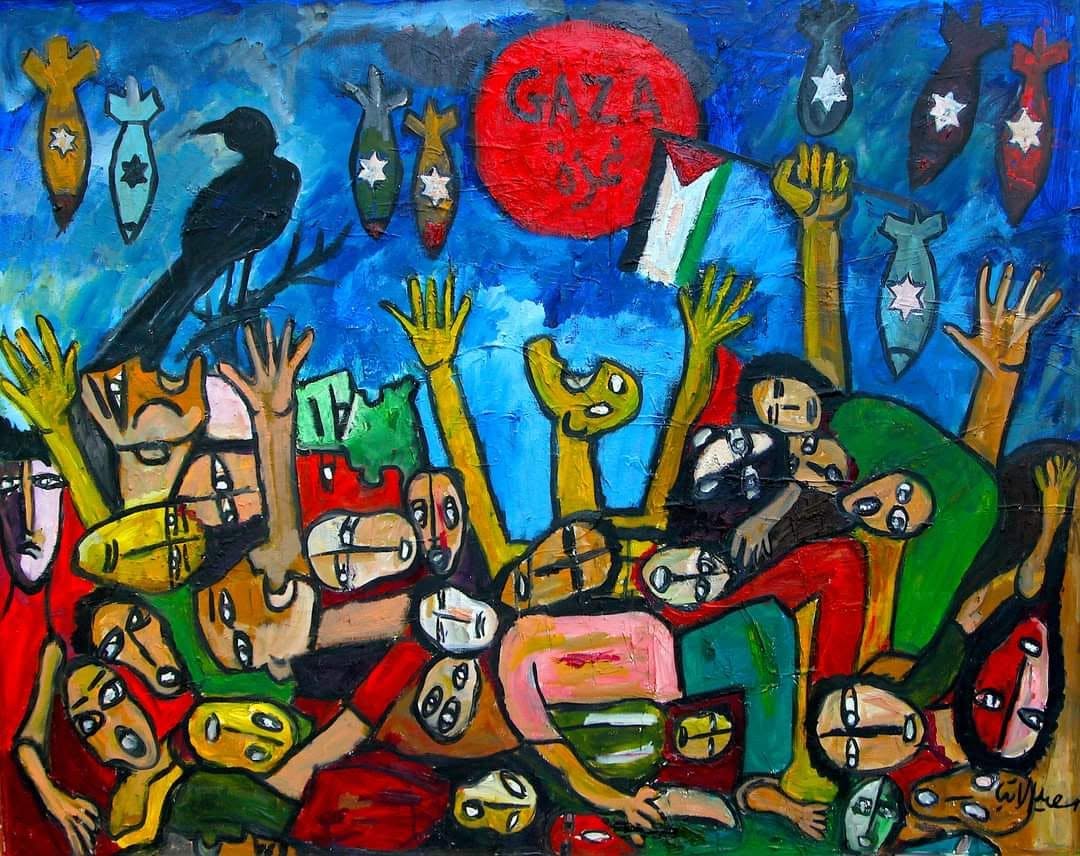
Guernica of Gaza

Said Elatab writes:

My painting, “Guernica of Gaza,” is inspired by Picasso’s Guernica. Picasso’s painting responded to the bombing of Guernica, Spain. In my view, the suffering, destruction, and human tragedy portrayed in Guernica are reflected in the war in Gaza today. Through my own abstract expressionist style, I express grief for civilians and call for humanity, justice, and peace.

Please share it

Continue reading
Netherlands Bans Products From Israeli Settlements

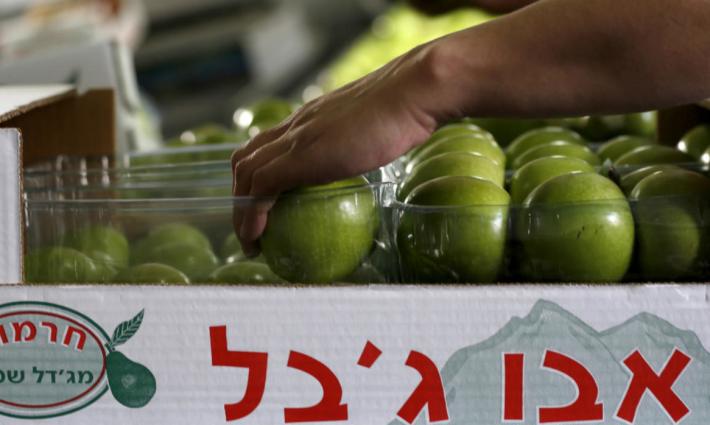
CROSSFIREARABIA – The Netherlands announced, Tuesday, the banning of the import of products into the country that come from Israeli settlements which exist on Palestinian lands in the occupied West Bank. The banning is to take effect from 22 September, 2026. In a statement the Dutch Foreign Ministry said the new procedures are line with the country’s international legal obligations. It further stated the ban applies to the import, buying and selling of all products whose source is from illegal Israeli settlements in the Palestinian territories. Through this decision, the Netherlands joins Ireland, Belgium and Spain in applying conditions on trading with Israeli settlements. Today, there are many voices in the European Union which comprises 27 countries that call for unified conditions restricting trading with Israeli settlements according to the Palestine Information Center.  

Continue reading
Is The West Turning Against Israel?

By Dr Ramzi Baroud

Is it finally happening? Is the West turning against Israel? Or are we, whether motivated by hope or driven by despair, simply engaging in wishful thinking? The matter is not so simple.

Last July, a significant number of countries and organizations signed the ‘New York Declaration,’ a strong statement that followed a high-level meeting titled, “Conference on the Peaceful Settlement of the Question of Palestine.”

The conference itself and its bold conclusion warrant a deeper conversation. What matters for now, however, is the identity of the countries involved. Aside from states that have traditionally advocated for international justice and law in Palestine, many of the signatories were countries that had previously supported Israel regardless of context or circumstance.

These mostly Western countries included Australia, Canada, and the United Kingdom, among others. Some of these nations are also expected to formally recognize the state of Palestine in September.

Of course, one has no illusions about the hypocrisy of supporting peace in Palestine while still arming the Israeli war machine that is carrying out a genocide in Gaza. That notwithstanding, the political change is too significant to ignore.

In the case of Ireland, Norway, Spain, Luxembourg, Malta, and Portugal, among others, one can explain the growing rift with Israel and the championing of Palestinian rights based on historical evidence. Indeed, most of these countries have historically teetered on the edge between the Western common denominator and a more humanistic approach to the Palestinian struggle. This shift had already begun years prior to the ongoing Israeli genocide.

But what is one to make of the positions of Australia and the Netherlands, two of the most adamantly pro-Israel governments anywhere?

In Australia’s case, media accounts argue that the friction began when the federal government denied an Israeli extremist lawmaker, Simcha Rothman, a visa for a speaking tour.

Israel quickly retaliated by ending visas for three Australian diplomats in occupied Palestine. This Israeli step was not just a mere tit-for-tat response but the start of a virulent campaign by Israeli Prime Minister Benjamin Netanyahu to wage a diplomatic war against Australia.

“History will remember Albanese for what he is: a weak politician who betrayed Israel and abandoned Australia’s Jews,” Netanyahu said, again infusing the same logic of lies and manipulation tactics.

Israel’s anger was not directly related to Rothman’s visa. The latter was a mere opportunity for Netanyahu to respond to Australia’s signature on the New York Declaration, its decision to recognize Palestine, and its growing criticism of Israel’s genocide in Gaza.

Though Albanese did not engage Netanyahu directly, his Home Affairs Minister, Tony Burke, did. He answered the accusations of weakness by boldly arguing that “strength is not measured by how many people you can blow up.”

This statement is both true and self-indicting, not only for Australia but for other Western governments. For years, and numerous times during the genocide, Australian leaders have argued that “Israel has the right to defend itself.” Since blowing people up hardly qualifies as self-defense, it follows that Canberra had known all along that Israel’s war is but an ongoing episode of war crimes. So, why the sudden, though still unconvincing, shift in position?

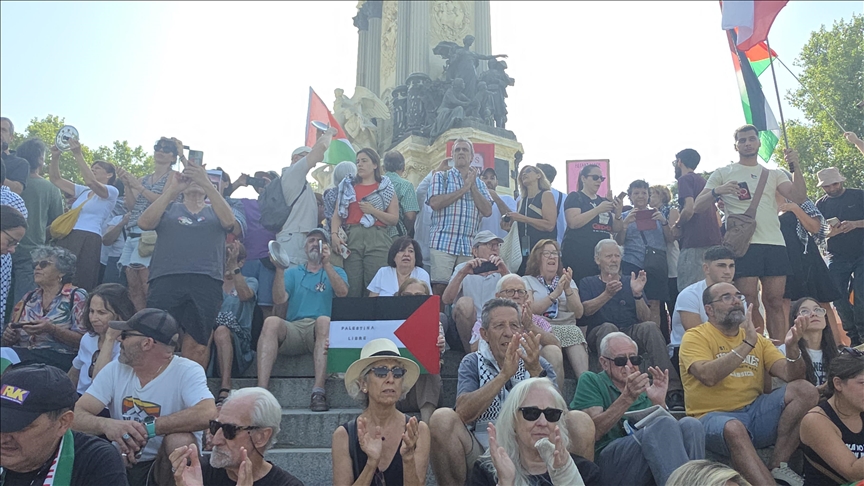
The answer to this question is directly related to the mass mobilization in Australia. On a single Sunday in August, hundreds of thousands of Australians took to the streets in what organizers described as the largest pro-Palestinian demonstrations in the country’s history. Marches were held in more than 40 cities and towns, including a massive rally in Sydney that drew a crowd of up to 300,000 people and brought the city’s Harbour Bridge to a standstill. These protests, which called for sanctions and an end to Australia’s arms trade with Israel, demonstrated the immense public pressure on the government.

In other words, it is the Australian people who have truly spoken, courageously standing up to Netanyahu and to their own government’s refusal to take any meaningful step to hold Israel accountable. If anyone should be congratulated on their strength and resolve, it would be the millions of Australians who relentlessly continue to rally for peace, justice, and an end to the genocide in Gaza.

Similarly, the political crisis in the Netherlands, starting with the resignation of Foreign Minister Caspar Veldkamp on August 22, 2025, is indicative of the unusually significant change in European politics toward Israel and Palestine.

“The Israeli government’s actions violate international treaties. A line must be drawn,” said Eddy van Hijum, the leader of the country’s New Social Contract Party and deputy prime minister.

The “line” was indeed drawn, and quickly so when Veldkamp resigned, ushering in mass resignations by other key ministers in the government. The idea of a major political crisis in the Netherlands sparked by Israeli war crimes in Palestine would have been unthinkable in the past.

The political shift in the Netherlands, much like in Australia, would not have happened without the massive public mobilization around the Gaza genocide that continues to grow worldwide. While pro-Palestine protests have occurred in the past, they have never before achieved the critical mass needed to compel governments to act.

Though these governmental actions remain timid and reluctant, the momentum is undeniable. People’s power is proving more than capable of swaying some governments to impose sanctions and sever diplomatic ties with Israel, not only through pressure in the streets but also through pressure at the ballot box.

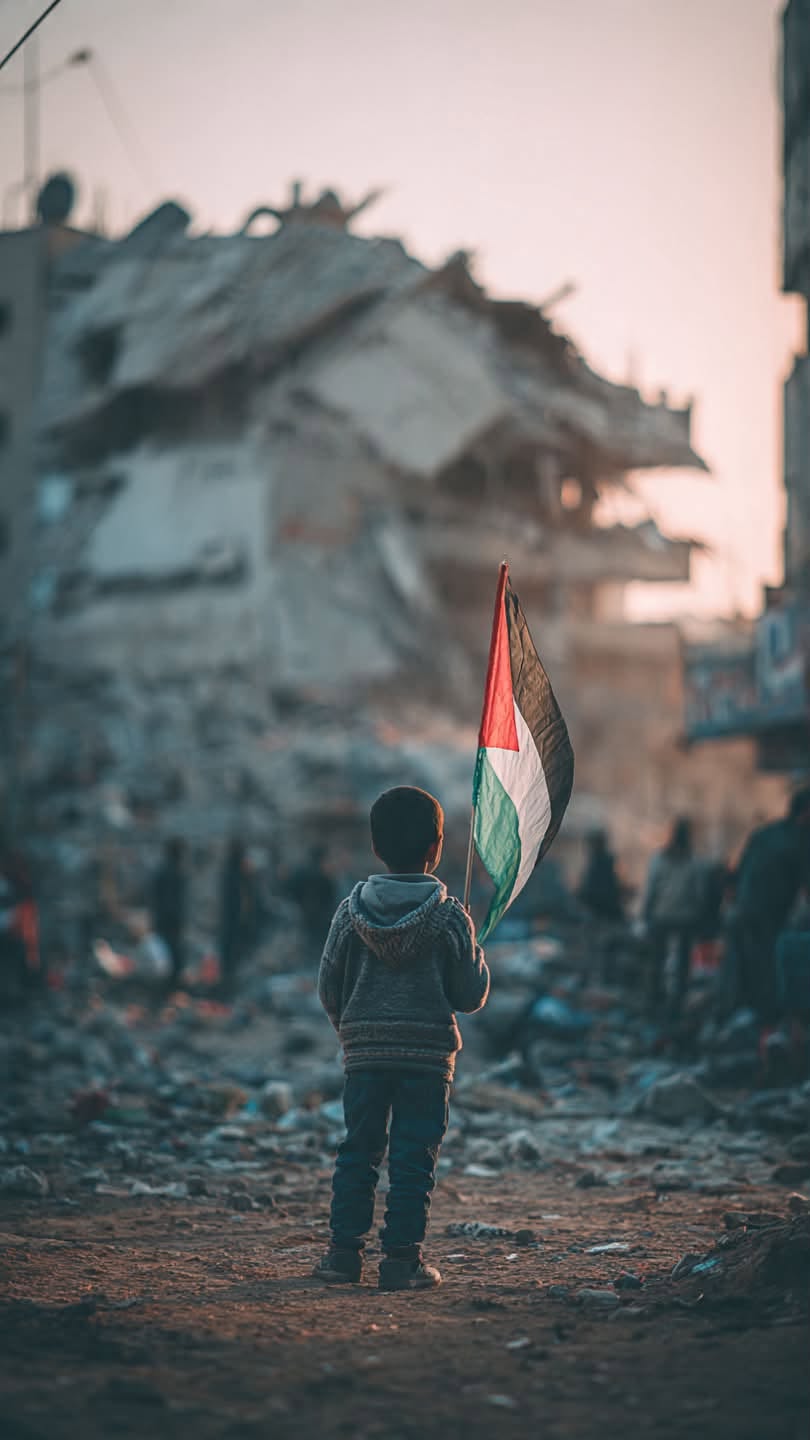
While the West has not yet fully turned against Israel, it may only be a matter of time. The precious blood of hundreds of thousands of innocent Palestinians in Gaza deserves for history to be finally altered. The children of Palestine deserve this global awakening of conscience.

Ramzy Baroud is a journalist, author and the Editor of The Palestine Chronicle. He is the author of six books. His forthcoming book, ‘Before the Flood,’ will be published by Seven Stories Press. His other books include ‘Our Vision for Liberation’, ‘My Father was a Freedom Fighter’ and ‘The Last Earth’. Baroud is a Non-resident Senior Research Fellow at the Center for Islam and Global Affairs (CIGA). He contributed this article to the Jordan Times.

Continue reading
Spanish Teachers Demand Arms Embargo of Israel

Dozens of teachers locked themselves inside a cultural center in Madrid on Tuesday, demanding that the Spanish government impose an arms embargo on Israel, local media reported.

The protest at the Circulo de Bellas Artes center, organized by the collective Greater Palestine: Education against Genocide, began with a teachers’ assembly and turned into a sit-in, according to El Diario.

“We’re not going to move from here,” said Carlos Diez, a 63-year-old secondary school teacher and member of the initiative, which brings together around 60 educators as well as figures from the cultural sector according to Anadolu.

The group called on Spain’s Cabinet to approve a long-announced decree halting arms sales to Israel.

The initiative seeks to mobilize the education community in support of Palestine amid Israel’s ongoing assault on Gaza.

The movement also plans to push teaching councils across Spain to adopt declarations in favor of an arms embargo and to demand the cutting of diplomatic and commercial relations with Israel.

The group announced further sit-ins in other cities and said it will hold a public reading of the names of the more than 18,500 children killed in Gaza.

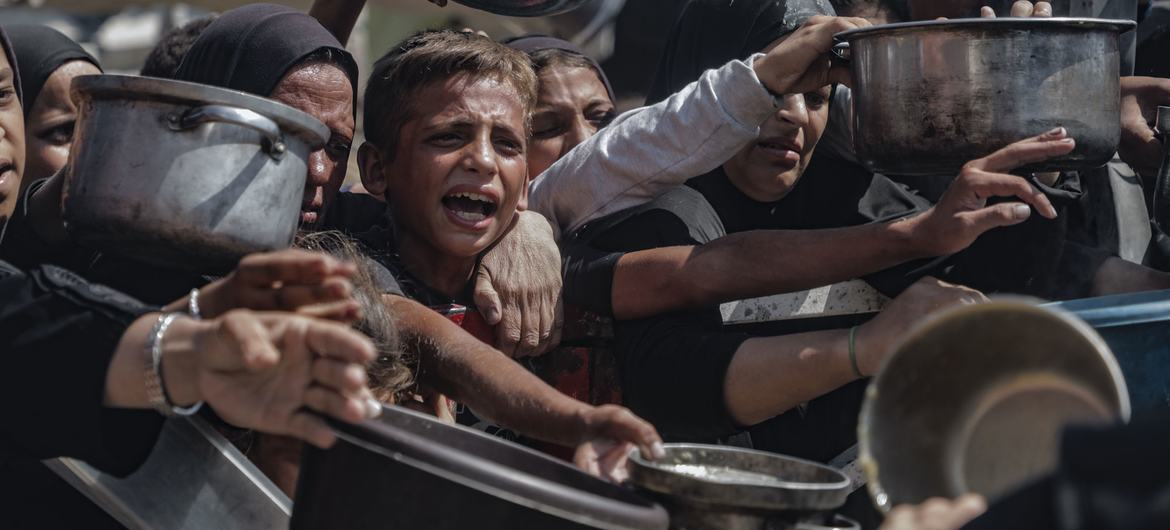
Israel has killed more than 63,600 Palestinians in Gaza since October 2023. The military campaign has devastated the enclave, which is facing famine.

Last November, the International Criminal Court issued arrest warrants for Netanyahu and his former Defense Minister Yoav Gallant for war crimes and crimes against humanity in Gaza.

Israel also faces a genocide case at the International Court of Justice for its war on the enclave.

Continue reading