How Will Trump Get Out of This War?

By Ismail Al Sharif

“We are in an advanced position, and we will decide when the war will end,” said Kazem Gharibabadi, Iranian Deputy Foreign Minister.

President Donald Trump, in coordination with the Zionist entity, is igniting a regional war with Iran which is an unprecedented event in the region. Analysis of the true motives behind this fateful decision vary. One school of thought believes the strategic objective lies in controlling Iranian oil wealth and containing growing Chinese influence. Another links this to the Epstein affair, based on claims of Zionist pressure threatening to expose him to sensitive information.

A third school believes that Trump is tied to political commitments made to Miriam Adelson, who generously funded his election campaign. Some go even further, alleging that Trump, known for his transactional negotiating style, received substantial financial compensation for engaging in this war. In a related context however, recent reports indicate that Trump himself has blamed his son-in-law, Jared Kushner, and several close advisors for instigating this latest military adventure.

Whatever the true motives behind igniting this war, one path seems almost certain to end it: Trump will hold a press conference declaring a unilateral and absolute victory. The precise timing of this declaration remains uncertain.

But the decision to cease hostilities does not rest with Trump alone; it is contingent upon the agreement of two other key parties: Tehran and Israel.

Israel shows no desire to end this war, as it is the primary beneficiary of its continuation. It systematically seeks to dismantle the structure of the Islamic Republic and sees no harm in the regime’s collapse leading to widespread chaos engulfing Iran and the entire region.

If Trump fails to restrain Netanyahu, the latter will not hesitate to continue his military operations even after any official American declaration of a ceasefire. This may explain why Trump declared that any settlement to end the conflict would only be possible with Netanyahu’s consent and explicit blessing.

However, the Zionist entity might feign acceptance of a ceasefire while its Mossad intelligence apparatus works behind the scenes to fuel separatist and rebellious sentiments among ethnic minorities within Iran, such as the Kurds and Balouchis, potentially threatening the cohesion of the Iranian state from within. In response, Tehran would have no choice but to continue targeting the entity, which would then retaliate swiftly, potentially drawing Trump back into a cycle of military confrontation.

Adding to Trump’s predicament is the possibility that he might ultimately declare a ceasefire unilaterally, without any fundamental change to the structure of the Iranian regime, and without extracting any genuine concessions from Tehran regarding halting uranium enrichment, dismantling its missile program, or severing its ties with regional allies—the very pretexts used to launch the war.

Even more dangerous is the fact that the Islamic Republic’s resilience and its emergence from this crisis with its system intact will make it a unique and exceptional model: The first country to challenge American hegemony and emerge unscathed. This could encourage other countries suffering under the weight of Trump’s policies or ambitions—such as Venezuela and Greenland—to adopt resistance as a path, even if they lack Iran’s military capabilities.

It seems to me that President Trump may be following in the footsteps of his predecessor, George W. Bush, when he famously declared victory in 2003 from the deck of the aircraft carrier USS Abraham Lincoln, which was then—as it is today—at the eye of the American military storm. It is worth recalling here that Bush’s speech was a highly symbolic and premature declaration, one that was quickly contradicted by events, as the war on Iraqi soil continued for nearly a decade afterward.

The war has exhausted Iran and burdened it with immense hardships, making it seriously seek a cessation of hostilities. However, it simultaneously finds itself in direct confrontation with American will. Iranian officials have made it clear that any agreement to a ceasefire and the resumption of negotiations is contingent upon receiving firm guarantees from Washington and Tel Aviv that the aggression will not be repeated. Should Tehran manage to withstand and overcome this phase, it is likely to add to its list of demands one of which is the lifting of some of the sanctions imposed upon it.

Therefore, it appears that the Iranian strategy is essentially based on a policy of systematic attrition; simultaneously exhausting the United States and Israel by driving oil prices to high levels and closing the Strait of Hormuz, the world’s vital energy artery. This would impose heavy economic burdens that might ultimately compel Washington to reconsider its calculations and agree to a ceasefire.

In short, Trump will not be in a position to deliver a victory speech in the next week or two, and any such declaration without genuine cooperation from Israel and Iran will amount to nothing more than empty rhetoric devoid of any real substance on the ground. There is no doubt that President Trump has put himself, his country, and the entire region in a very complex strategic predicament, from which the way out may not be as easy as those who made the decision to go to war imagine.

This analysis was originally written in Arabic and reprinted in crossfirearabia.com
Continue reading
Mideast on War Footing: Is US Strike on Iran Coming?

As US military assets continue to move into the Middle East, analysts warn that Washington is edging closer to a possible confrontation with Iran, weighing options that range from intensified economic pressure and a naval blockade to direct military action.

Recent developments have heightened fears that a US-led escalation could be imminent.

“It’s looking increasingly likely that with this buildup of military assets, President Donald Trump – and probably the Israelis – are preparing for a military escalation against the Iranians,” Ryan Bohl, a senior Middle East and North Africa analyst at the RANE Network, told Anadolu.

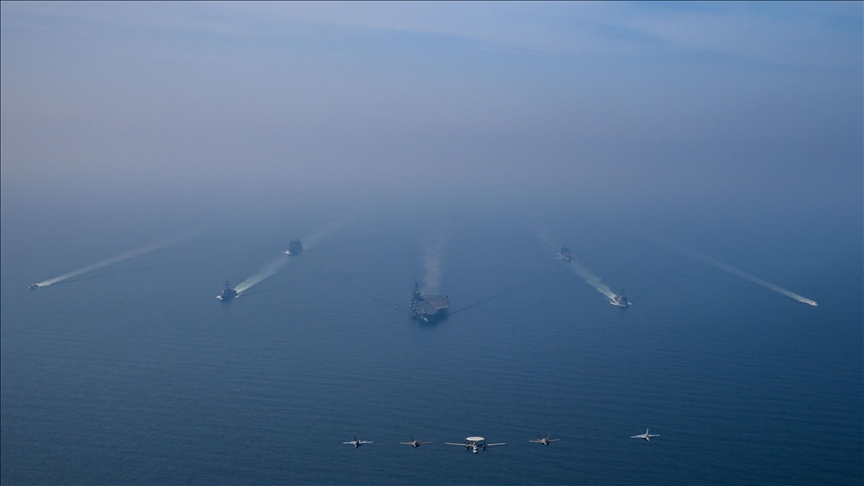
On Wednesday, Trump wrote on his social media platform Truth Social that a “massive armada” was heading toward Iran, expressing hope that Tehran would “come to the table” and negotiate with Washington. He warned that the fleet was prepared to “rapidly fulfill its mission with speed and violence, if necessary.”

Trump said the deployment was larger than the one previously sent toward Venezuela and confirmed that it is led by the USS Abraham Lincoln, one of the world’s largest aircraft carriers, which hosts electronic-warfare aircraft capable of disrupting Iranian radar systems.

The New York Times reported that the carrier strike group is accompanied by three warships equipped with Tomahawk cruise missiles, capable of long-range precision strikes. The US has also reportedly deployed around a dozen additional F-15E attack planes, along with Patriot and THAAD air-defense systems to protect against potential Iranian retaliation.

Steffan Watkins, a consultant specializing in tracking military ships and aircraft, said the US is also shipping supplies and deploying additional surveillance aircraft. “Preparations for operations targeting Iran appear to be underway,” he wrote Thursday on the American social media platform X.

“Time is running out,” Trump warned Iran, threatening that any future attack “will be far worse” than last year’s US strikes on Iranian nuclear facilities.

Although the rhetoric comes in the wake of Iran’s crackdown on protests, Bohl said Washington’s broader objective appears to be forcing changes in Iran’s foreign and security policies.

The goal is to see “if they can get Iran’s government to change its foreign policies, to give up on its missile program and its nuclear energy program,” he said.

Limited and targeted strikes

Analysts say one of the most likely military options under consideration is a campaign of limited, precision strikes targeting Iran’s military, missile and nuclear infrastructure.

“They could go after the missile program again – strike drones and missiles and manufacturing. They can try to destroy launchers, remains of Iran’s air force, some infrastructure related to the military-industrial complex,” Bohl told Anadolu.

During the 12-day war with Israel last June, the US struck three major Iranian nuclear facilities – Fordo, Natanz and Isfahan – using bunker-buster bombs, claiming the attacks crippled Iran’s nuclear program.

Bohl said it remains unclear whether Washington would allow Israel to initiate a new round of strikes or whether a joint US-Israeli campaign would unfold.

Another option, he added, would involve phased strikes rather than a single, overwhelming attack.

“We could be seeing a version of what we saw in Iraq back in the 1990s, where the US would strike Iraq, wait to see if that would create a concession process for the Iraqis and then strike again to try to again shift the Iraqis’ behavior,” he said. “And that could take weeks, even months to unfold.”

Blockade and attacks on infrastructure

Experts also suggested that the US might try to impose naval and aerial blockade on Iran.

“Imposing a new blockade on the Iranians and trying to seize their tankers like they did in Venezuela is escalatory,” Bohl said.

He added that Washington could also attempt to restrict Iranian airspace, limiting civilian flights in a bid to inflict economic damage.

“They could enhance their cyber campaign to try to cripple Iran’s infrastructure, particularly during this time where there’s still a lingering protest movement after those major crackdowns earlier this month,” he said. “So, disrupting infrastructure would also be a choice.”

The USS Abraham Lincoln Carrier Strike Group could also be used to intercept Iranian oil tankers leaving the Persian Gulf, he added.

However, Scott Lucas, a professor of international politics at the Clinton Institute at University College Dublin, cautioned that a blockade and seizure of Iranian vessels could be challenging.

“I think it would be very risky for the US to do what it’s done with Venezuela, which is to seize Iranian oil tankers,” he said.

“I think the prospect of that setting off a regional crisis is much greater, especially since Iran has the capacity to close off the Strait of Hormuz, and about 20% of the world’s oil supply goes through that waterway.”

Broad escalation and strikes on leadership

Analysts also warned that Washington could opt for a broader military campaign aimed at severely degrading Iran’s leadership and command structure.

“We are seeing reports that President Trump wants something ‘decisive,’ which is more of a major campaign to probably attack as many targets as possible and increasingly consider assassinations of top Revolutionary Guards and even some of the leadership like Supreme Leader Ali Khamenei,” said Bohl.

Such an approach could include attacks on senior commanders within the Islamic Revolutionary Guard Corps, political leadership nodes, and command-and-control infrastructure, analysts said.

Experts warned that efforts aimed at full regime change would almost certainly provoke retaliation against US forces and allies across the Middle East.

Bohl added that Trump believes Iran’s deterrence has comprehensively failed, as their missiles and drones have not stopped previous attacks.

“He (Trump) may believe that Iran isn’t able to carry out those sorts of comprehensive strikes on energy infrastructure,” he said. “That would encourage him to go on into a larger and more substantial campaign.”

Targeted assassinations and covert operations

A more limited alternative would involve targeted assassinations and covert operations rather than an overt large-scale war.

While analysts largely rule out a full US ground invasion of Iran, Bohl said Trump has demonstrated a preference for deploying special forces on high-risk missions.

“President Trump ran on a platform of avoiding another Iraq war, but he is very commando-happy and he likes to use his special forces,” said Bohl.

Such operations could include the destruction of high-value military targets or the assassination of individuals linked to Iran’s missile, drone or nuclear programs, analysts said.

“They have targeted Iranian leaders in the past. They assassinated the leader of the Quds Force … Gen. Qasem Soleimani at the start of 2020,” Lucas explained.

Bohl also pointed to US actions in Venezuela and North Korea as examples of attempts to apply pressure through targeted operations rather than regime-wide campaigns.

However, Bohl said that a repeat of Venezuela, where Washington reaches an understanding with the regime and takes out key leaders, does not appear to be a “viable option” in the case of Iran.

More economic pressure

Iran’s economy continues to be heavily constrained by sanctions. Earlier this month, the US announced an additional 25% tariff on countries trading with Tehran and imposed new sanctions on vessels and companies accused of transporting Iranian oil.

Bohl said Washington may seek to further destabilize Iran economically in hopes of forcing it back to negotiations.

The idea is to crack Iran’s politics by causing more economic damage and pushing them toward what are essentially surrender terms, he said.

Iran is already grappling with a severe economic crisis, marked by the rapid devaluation of the rial, which helped trigger nationwide protests late last December.

Lucas, however, argued that additional sanctions may have limited effect without broad international support.

“I think the Trump folks can bluster a bit, but they really can only tighten sanctions if they have international action on the sanctions,” he said, adding that countries such as Russia and China are unlikely to support further pressure.


What comes next

Analysts said several indicators could signal whether the US is moving closer to escalation.

Bohl said warning signs include commercial airlines avoiding Iranian airspace, the evacuation of foreign embassies, travel advisories urging civilians to leave Iran, and Israeli authorities placing the population on heightened alert.

He added that the arrival of the USS Abraham Lincoln in the US Central Command area of responsibility significantly shortens the timeline for potential action.

Given that Iran has already been struck in previous confrontations and that tensions remain extremely high, any move could rapidly spiral.

“Because it is kind of an undeclared war between the two sides already, it could really turn on a dime and begin sudden escalation,” Bohl warned.

Continue reading