Killing Gaza Slowly

By Tarek Bae  

OPINION - Slaughter dressed up as humanitarian aid: So-called Gaza Humanitarian FoundationFile Photo

“Gaza is on the verge of economic and humanitarian collapse. People live day to day, always at risk from hunger and disease,” notes a UN report. Yet these words were written not in 2025, but by the Independent UN Commission of Inquiry on Gaza in 2019.

Israel has enforced a blockade on the Gaza Strip since 2007. No one and nothing enters or leaves without Israeli permission, including at the crossing to Egypt. Every import and every exit requires an application to Israeli authorities. Human Rights Watch has repeatedly called Gaza the world’s largest open-air prison. Between 2017 and 2021, Israel blocked materials needed to maintain the water system. In 2017, the UN stated that 97% of Gaza’s water was undrinkable. Oxfam concluded the same year that Gaza was the most water-scarce place on earth.

From 2023 onward, Gaza became the target of genocide. From the first days, the blockade on essentials was radically expanded. On Oct. 8, 2023, then-Israeli Defense Minister Yoav Gallant announced there would be “no electricity, no food, no fuel,” because Israel was fighting “human animals.” The total blockade, combined with unprecedented bombardment, turned Gaza into the greatest humanitarian crisis of the 21st century.

During this genocide, international agencies, especially the UN, struggled to keep civilians alive. More than 400 distribution points tried to provide the bare minimum. Political pressure was needed again and again. There were 11 UN resolutions in all, 4 by the Security Council, 5 by the General Assembly and 2 by the Human Rights Council, calling on Israel to enable sufficient humanitarian aid. Israel dismantled every channel through which aid could be delivered. More than 900 humanitarian workers have been killed in Gaza since the genocide began. Never before in any war has the toll on aid workers been so high.

Netanyahu’s starvation strategy

By March 2025, the total blockade hardened into an open starvation strategy. “We have decided to stop all deliveries into Gaza, including food, water and aid,” Prime Minister Benjamin Netanyahu declared on March 2, 2025.

Barely two months later, in May, Israel and the US rolled out the so-called Gaza Humanitarian Foundation (GHF). This, Israeli officials said, would be the new and only route for humanitarian aid. Rumors of a new distribution mechanism had circulated since February, a design Israel was planning with US partners. Coverage of those plans was overshadowed by Donald Trump’s “Gaza Plan.” In a joint press conference with Prime Minister Netanyahu in Washington on Feb. 4, 2025, Trump publicly declared the intention of the US to “take over” the Gaza Strip. That the GHF sits inside this vision follows from statements by GHF officials. In June 2025, Executive Chairman Johnnie Moore Jr. said: “The United States will take full responsibility for the future of Gaza.”

It is not a purely American venture. Logistical coordination at the GHF is led by Israeli Brigadier General Yaakov Baruch. Despite its name, the GHF is not a foundation; it is a political-military organization. Alongside the Israeli military, mercenaries from the US are involved. According to The Times of Israel, Jared Kushner, son-in-law of Trump, is the chief architect of the idea. The US initially put €30 million ($35 million) into the project, with further pledges. In July 2025, Trump complained that no one had expressed gratitude. But what exactly should anyone thank the GHF, Israel, or the US for? GHF spokesperson Shahar Segal offers an answer. “It is frustrating to see people constantly blaming Israel, when in reality it is Israeli logistics that ensure humanitarian food reaches those who desperately need it. The GHF model is saving lives.”

Is that true? No. Among the familiar set of claims used to relativize the genocide is the allegation that allowing international aid only helps Hamas. Again and again, the line is that aid never reaches civilians. Another claim is that Hamas steals humanitarian supplies. The conclusion is clear: this is propaganda. Videos of armed guards on trucks or of lootings by armed gangs have been presented by Israel, in a misleading fashion, as Hamas seizures.

A review by the United States Agency for International Development examined 156 incidents of loss or theft of US-funded aid between October 2023 and May 2025. It found not a single piece of evidence that any of those incidents could be attributed to Hamas. In 44 cases, there were links to Israeli military activity. Reuters reported that Israeli military offices had produced no evidence of systematic theft by Hamas. The New York Times cited sources inside Israel’s government who acknowledged they had none either.

From 400 aid points to 4 militarized sites

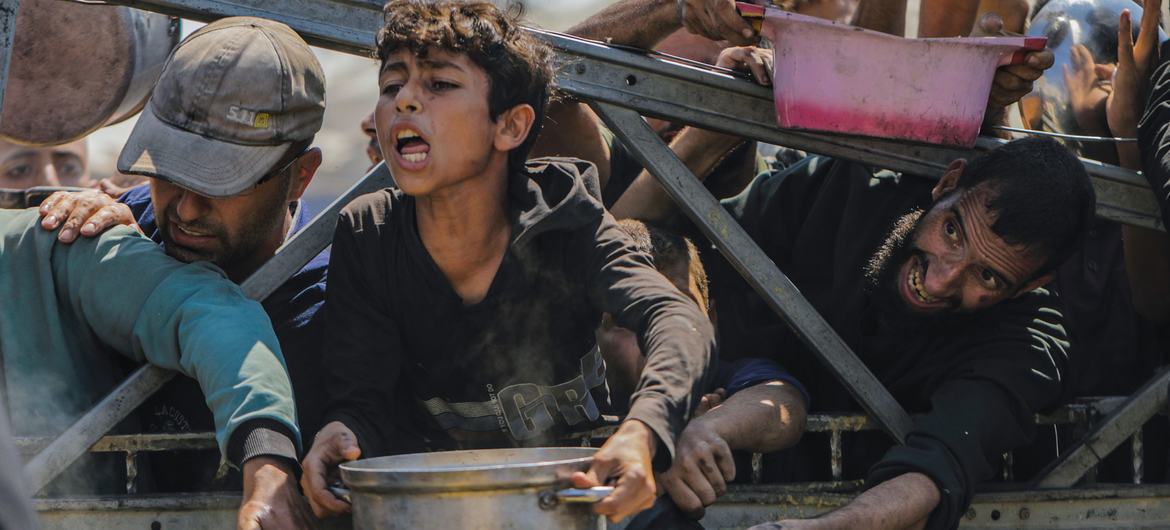
Is the GHF more effective at distributing aid? Not at all. Instead of the 400 international distribution points that once existed, Israel’s blockade and the imposition of the GHF have left only 4 highly militarized sites, with just 1 in the densely populated north. The UN calculates that Gaza’s basic humanitarian need amounts to around 600 truckloads a day. By its own account, the GHF moves at most 26 truckloads daily, roughly 4% of what is required. In a territory facing acute hunger, such an amount is not small—it is nothing.

According to the IPC Famine Review Committee, the whole of Gaza has been in IPC Phase 5 since July, the highest alert, a catastrophic food emergency. People in this phase are at immediate risk of starvation. More than 700,000 people have gone days without any food. The UN special rapporteur on the right to food, Michael Fakhri, was blunt: “Israel has made clear its intention to starve everyone in Gaza.”

What Israel and the US call a distribution mechanism and a foundation is, in the words of Doctors Without Borders, “slaughter dressed up as humanitarian aid.” Starving civilians are forced to walk up to 40 kilometers (25 miles) under the burning sun to reach GHF sites. Arrival does not guarantee help. More than 1,881 starving civilians have been killed at or near GHF distribution sites. The Israeli army regularly fires indiscriminately into the waiting crowd.

Philippe Lazzarini, Commissioner-General of UNRWA, calls the GHF “an alibi for the systematic starvation of Gaza.” For him, the logic is clear. Israel destroyed the humanitarian infrastructure in order to replace it with a facade organization under military control. OCHA spokesperson Jens Laerke sees in the GHF a “distraction.”

What does it distract from? Netanyahu has said the plan out loud. On May 11, according to the Israeli outlet Maariv, he tied aid to permanent expulsion. Those who receive aid at a given place should never see that place again and must evacuate. “The residents of Gaza whom we are expelling will not return. They will no longer be there. We will control the place. There is no other war aim. All other goals are mere eyewash.”

By the Israeli government’s own account, the GHF is a means to drive Palestinians out of Gaza or to let them die, by deliberately starving them, denying supplies, and cutting off humanitarian aid.

*The author is the editor-in-chief of the German journal itidal.de. The opinions expressed in this article are the author’s own and do not necessarily reflect Anadolu.
Continue reading
Israel Cannot Silence Palestinian Words

By Benay Blend

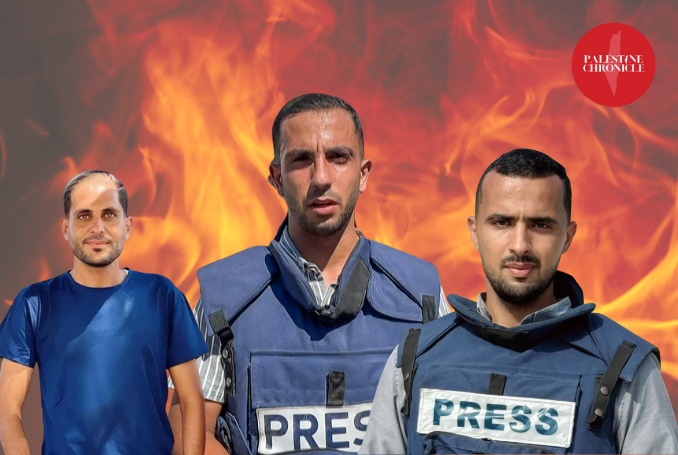
Palestinian journalists seek to document the truth about the Zionists’ brutal siege, while their detractors are working to erase all evidence of the crime scene.

Shortly after the news broke about the Israeli assassination of Palestinian journalist Anas al-Sharif and his five colleagues in Gaza City, a video appeared on my Facebook feed of chef Yotam Ottolenghi making baked haloumi cheese with fennel syrup.

In real time, the two events have nothing to do with each other. However, delving deeper into the realm of the imagination, both represent long-held Israeli efforts to erase the Palestinian presence on the land.

In a statement on the social media platform X, journalist Ramzy Baroud explained Israel’s motives for the murder of  at least 200 journalists in Gaza since October 7, 2023: “silence the truth by murdering those who report it.”

Afterward, they justify these deaths by claiming that the journalists were members of the resistance movement, a claim that is problematic for several reasons.

In a timely excerpt from Perfect Victims: And the Politics of Appeal (2025), Mohammed El-Kurd contends that allies often unwittingly refute the claim that victims, such as these journalists, were affiliated with Hamas. In this way, the characterization of the civilian as a “neutral figure” has depoliticized the Palestinian cause, rendering it a “humanitarian crisis” where “revolutionaries are not part and parcel of your nation.”

In the U.S., too, police shootings of Black, Brown and poor people are often justified by slandering the victim’s reputation post-mortem. This should come as no surprise, since the institution of policing harks back to its origin as slave catchers, along with its more present-day exchange of training with the Zionist state.

“It is not enough for a Palestinian to be a journalist to be deemed human,” concludes El-Kurd,  “they must be ‘unaffiliated.’”

For “Israelis,” this effort must prove difficult as they are taught to see Hamas everywhere, much like Americans were told to look for communists during the Second Red Scare in the 1950s. The latter were in our bathrooms, under our beds, and if we were not watchful, we might mistakenly marry one.

In “The Hamas are Coming: A View of the Violence from Inside Israel” (2021), Miko Peled writes of this phenomenon that has informed Israeli hasbara (propaganda) for years.

“There are never Palestinians, never people, only ‘The Hamas’ — and ‘The Hamas’ is, by the way, male and singular (in Hebrew),” Peled writes.  “’The Hamas thinks;’ ‘The Hamas believes;’ ‘The Hamas should know;’ ‘When the Hamas understands, he will stop;’ and finally, ‘When The Hamas is hit hard he will never dare to attack Israel again.’”

Not much has changed in Israeli hasbara since Peled wrote that piece nearly four years ago. Indeed, the New York Times, taking its cue, as usual, from Israeli sources, repeated that “Mr. al-Sharif,” whom the Israeli military accused of being a Hamas fighter posing as a reporter, but was really “the head of a terrorist cell,” thus the IDF “had taken steps to mitigate civilian harm,” though which civilians, Palestinians or “Israelis,” it does not say.

Barbs were then thrown back and forth. Al-Jazeera called the killing  “a desperate attempt to silence the voices exposing the impending seizure and occupation of Gaza” while the “Israeli Government” accused “Al Jazeera reporters of serving the interests of Hamas by presenting an exaggerated and distorted picture of conditions in Gaza.”

“The instinct of many defenders of Palestinians is to dispel the connection between the slain Palestinian media workers and their supposed political leanings, as if anywhere in the world these exist in isolation,” El-Kurd explains.

Just as El-Kurd implicates himself in this process, so do I. There have been times when I’ve distanced martyrs from supporting the armed resistance as if this gives us a more legitimate cause to mourn.

When we sanitize the dead in this way, however, “we are inadvertently reifying the colonial rationale that killed them and rendered them killable in the first place,” El-Kurd concludes, so perhaps it is better to just reply “So what?” Indeed, if Zionist soldiers and PR workers can find a place for themselves in global media, why do supporters of Palestine find the need to detach their heroes from armed resistance that occupies a legitimate role in the struggle?

There are many documented reasons as to why Israel targets journalists in the Gaza Strip. Significantly, Palestinian journalists seek to document the truth about the Zionists’ brutal siege, while their detractors are working to erase all evidence of the crime scene.

Moreover, for Western journalists, even those sympathetic to the cause, the only picture they can paint is that of victims who are barely surviving in the rubble.

In an interview with Beacon Press, historian Roxanne Dunbar-Ortiz describes a similar settler colonial narrative that pertains to Indigenous people in the Americas. Asked to explain the most enduring myth pertaining to Native Americans, Dunbar-Ortiz mentions the idea of “eliminationism,” a notion that does away with Native people.

Indeed, at the turn of the 20th century, the myth of the Vanishing Indian was at its zenith, thus allowing the mainstream population to view Native people as noble relics who exist only in the glory days of their past. These same people who at one time they had license to kill Native people are seen now as no longer a threat, subdued as they were in the last Indian massacre at Wounded Knee.

In reality, Native people have survived over 500 years of continual genocide, survival being an “active word,” Dunbar-Ortiz makes clear, involving  “an enormous amount of resistance and cultural continuity.”

On the other hand, “victimry” is a more common version, she concludes, because people can feel sorry about the state of Indian Country but without the requirement that they must do anything about it. “So they’re not really then dealing with the reality that Native people are here,” and like the Palestinians, “they’ve resisted, they’ve survived, they haven’t changed their mind about who they want to be and how they want the future to be.”

In “Sumoud: The Unyielding Heart of the Palestinian Cause in Palestine,” Ramzy Baroud describes a similar trajectory for Palestinians. “The profound and unrelenting struggles endured by Palestinians should, by any rational expectation, have irrevocably concluded the Palestinian cause. Yet, the struggle for freedom in Palestine is at its zenith.”

Like the experience of Native Americans, Zionist attempts to erase the presence of Palestinians goes back many decades. Nevertheless, the Palestinian resistance has endured, Baroud continues, due to the “concept of sumoud,” resilience that is akin to Dunbar-Ortiz’s explanation of “survival,” an active process that involves resistance and cultural endurance.

“Palestinian journalists in Gaza are themselves the story and the storytellers,” writes Ramzy Baroud. “Their success or failure to convey the story with all its factual and emotional details could make the difference between the continuation or the end of the Israeli genocide.”

From Refaat Alareer, the poet/teacher/ journalist who asked before his death that his life become a story to ensure that life goes on, to Anas Al-Sharif’s final testament written shortly before his death, Palestinian journalists have been responsible for conveying the truths of Gaza to the world, but they also leave a legacy that inspires future generations to carry on their work.

“Do not let chains silence you or borders restrain you. Be bridges toward the liberation of the land and its people, until the sun of dignity and freedom rises over our stolen homeland,” Al-Sharif wrote, shortly before his death.

With that last statement, Al-Sharif foretells his own assassination. His message is not one of victimhood, though, but rather a plea that others carry on his work.

On August 11, Dareen Tatour, the Palestinian poet who knew from experience the danger of rebellious words, posted a new poem written to honor the Al-Jazeera team murdered the day before.

Imprisoned for her verse “Resist, My People, Resist Them,” the poet is not so optimistic now that words can stop a bullet. Under the banner Martyrs of the Word and Image—They Left But the Word Remained, Tatour charged that their deaths were the consequence of a world gone silent to their pain.

“They are gone / but the truth remains,” she says, dependent on her to carry it, or “leave it to be bombed again” in the wake of her silence.

Unlike the person that she was ten years ago, Tatour knows now that “the road is longer and harsher,” yet still she is undeterred, for she continues “to write for them [the slain journalists], to be the echo of their voices,” because in this way, the Palestinian narrative will be triumphant.

– Benay Blend earned her doctorate in American Studies from the University of New Mexico. Her scholarly works include Douglas Vakoch and Sam Mickey, Eds. (2017), “’Neither Homeland Nor Exile are Words’: ‘Situated Knowledge’ in the Works of Palestinian and Native American Writers”. She contributed this article to The Palestine Chronicle.

Continue reading
Palestinian State Out of Gaza Horrors?

It is hoped that the appeals for more recognitions of the Palestine state in the UN General Assembly in New York will increase pressure on Israeli Prime Minister Benjamin Netanyahu and his coalition partners to drastically change course and make the Palestinian state a reality.

Notwithstanding the US neutrality recognition, at least as things stand now, coupled with the increased efforts from the European Union, Israel stands to be ostracized in the international community.

One point remains rather curious however, is UK’s Premier Keir Starmer’s condition being that Britain will recognize a Palestinian state if Israel refuses to accept a ceasefire on Gaza.

For all intents and purposes, it seems what Starmer is interested in, is basically a ceasefire and then Palestinian state, but then again this is for the British government to ponder on in the face of the rolling train of recognitions.

But what does this recognition entails in practical terms? It basically means the stalled Oslo negotiations since 1993 are to be revived again, and if need be on different terms than what was envisioned before. Here one says different terms because the Oslo agreements were guaranteed by the world powers and nothing came out of them.

Indeed much more must be done by the world community, especially that now, we have a more difficult and intransigent Israeli government which needs above all else to accept, at least in principle, the two-state solution.

But also and at the same time time, the recognition of a Palestinian state entails the recognition of a Palestinian leadership with the ability and responsibility to represent the Palestinian people.

One supposes there is a general consensus on that now since the current PNA has become defunct and its current leadership obsolete in front of the immense responsibilities and tasks ahead.

In brief, it would be a mere rhetorical smokescreen to call on recognizing a Palestinian state without actually paving the way for the creation of such a state by totally changing the current PNA leadership via honest elections supervised by the international community and which represent the will of the Palestinian people.

Of course one cannot but insist, that the Arab role in the newly envisaged peace process is crucial. One also cannot help but think that the role of Saudi Arabia will be crucial for the next phase. For  start, the precondition of Saudi for any form of dealings with Israel, is for the latter to accept the principle of two-state solution, and in fairness it must be clarified that the French-Saudi initiative which led Emmanuel Macron to recognize a Palestinian state was supposed to be declared in in Paris.

But now due to this effort, it has become an international case at the UN. Israel has failed with all of its endeavors to normalize relations with Saudi Arabia without giving any concessions, mainly the acceptance of the precondition of the recognition of the two-state solution, and now it is facing both the pressure of the international community and the condition of the Saudis, especially they shift their strategy from the UAE to India, and without the Saudis they will have nothing in the Gulf.

But still there is the bleeding wound of Gaza, the wound which can never start to heal without a collective Arab effort led by the Saudis which takes back to the conundrum of Israel’s acceptance of the principle of Palestinian state. Only then can Saudi Arabia lead the Arab effort, to first of all disarm Hamas, give an amnesty to Hamas members, and exile its leadership out of Gaza, in the hope of rehabilitating the strip and start in earnest the reconstruction efforts.

Continue reading
Trump, Netanyahu’s Shared Secret!

By Dr Hasan Al Dajah

Since his arrival on the American political scene, Donald Trump has been an exceptional case in the United States’ relationship with Israel. Historically described as a strategic alliance, this relationship has transformed under Trump into a personal partnership between him and Israeli Prime Minister Benjamin Netanyahu. This relationship has deepened to an unprecedented degree, with Trump becoming one of the most biased and supportive American presidents toward Netanyahu, not only in foreign policy decisions but also on issues of a purely Israeli domestic nature, such as the ongoing trials against Netanyahu or calls for early elections.

What drives Trump to this level of involvement in Israeli domestic affairs? And why does he insist on defending Netanyahu despite the criticism and accusations against him? In the current Israeli landscape, Netanyahu faces significant domestic challenges related to multiple corruption trials, in addition to escalating tensions within the ruling coalition, particularly with the religious parties, which have expressed on more than one occasion their desire to dissolve the Knesset and call for early elections. These parties, despite being partners in the government, view continuing under Netanyahu’s leadership as a political burden due to the corruption cases and poor performance in some cases. This recently prompted them to propose a vote within the Knesset to call for new elections.

In this context, Trump’s position was clearly supportive of Netanyahu, expressing his rejection of any attempt to remove Netanyahu from power and considering his continued rule essential to Israel’s stability and its security and political future. Even stranger are the reported interventions by Trump or his circle in the matter of Netanyahu’s trial. It has been reported—through both official and unofficial channels—that he called for a pardon or an end to the legal proceedings against him, arguing that these trials are politically motivated and that Netanyahu is being subjected to an unfair campaign by the Israeli judiciary. This intervention raises many questions, most importantly: What is Trump’s interest in Netanyahu’s survival? Why would he risk his political reputation for the sake of being a foreign leader facing criminal charges?

The answer to these questions requires examining the nature of the relationship between the two men. Since Trump assumed the presidency in 2017, he has pursued an unprecedented agenda in support of Israel, including moving the US embassy to Jerusalem, recognizing Israel’s sovereignty over the occupied Syrian Golan Heights, and supporting the “Deal of the Century,” considered the most biased in the history of US mediation.

All these measures were met with widespread acclaim and celebration by Netanyahu, who used them in his election campaign to bolster his domestic popularity, portraying himself as capable of bringing absolute US support to Israel.

In turn, Trump found in Netanyahu a reliable ally who reflects his vision for the Middle East and helps him win the support of a pivotal electoral base within the United States: evangelical Christians. People must realize that the true backbone of support for Israel in America is not the Jewish community, but evangelicals, who constitute approximately 25% of the population, compared to less than 2% of American Jews.

Therefore, Trump—as he has stated on more than one occasion—considers engaging with evangelicals more effective than appeasing the Jews, because they constitute a formidable lobbying force pushing for American policies aligned with the Israeli right-wing agenda, and view support for Israel as part of the Christian Zionist religious doctrine. These people see Netanyahu as the leader most qualified to preserve the “Jewishness of the state” and advance policies of expansion and hegemony.

Accordingly, Netanyahu’s downfall, or even his trial, represents a threat not only to Trump, but also to the political and ideological system he has meticulously crafted during his presidency. It is impossible to trust that potential Israeli alternatives will maintain the same level of loyalty or pursue the same confrontational approach toward Iran and the Palestinians.

Hence, for Trump, defending Netanyahu becomes a defense of a broader regional project that keeps Israel at the forefront of the confrontation with Tehran and strengthens right-wing populist alliances globally.

Moreover, Trump himself faces investigations and legal prosecutions in the United States, whether related to his attempt to overturn the election results, his retention of classified documents after leaving the White House, or various financial issues. Therefore, his defense of Netanyahu may be implicitly understood as self-defense. He seeks to establish the principle that the trial of political leaders is primarily a selective political process, not a fair judicial process. If Netanyahu is able to escape accountability or obtain a pardon, Trump will see this as a precedent that will strengthen his argument before the American judiciary and domestic public opinion.

Strategically, Trump does not view Israel merely as a traditional ally, but rather as an extension of his global political vision based on isolation from international institutions, undermining the liberal multilateral order, and strengthening bilateral alliances with strong leaders who share his political style and confrontational personality. For him, Netanyahu is the Israeli version of this model: a leader who clings to power despite internal and external pressures, fiercely confronts the media and the judiciary, and relies on a solid right-wing popular base fueled by a sense of existential danger and threat.

From this perspective, Trump’s support for Netanyahu is not limited to domestic issues but extends to regional security issues, most notably the open confrontation with Iran. Trump believes that an alliance with Netanyahu is necessary to sustain the escalation against Tehran and contain its influence in the region. Therefore, any weakening of Netanyahu, whether through elections or trials, is viewed as a direct blow to the axis of pressure on Iran and a threat to the deterrence strategy adopted by Trump during his presidency.

All of this explains why Trump supports Netanyahu and even intervenes in domestic issues, such as seeking a judicial pardon or rejecting early elections that could lead to Netanyahu’s removal from the political scene. It is a deeply mercenary relationship that transcends diplomatic protocol and extends to an ideological alliance between two leaders who each see the other as a mirror to their own selves and a first line of defense for their political and personal futures. Despite the criticism Trump faces for this involvement, he continues this approach without wavering, driven by an overwhelming desire to return to the White House and see a world shaped according to his own vision. In this world, there is no place for trials of political leaders, no room for elections that bring down allies, and only mutual loyalty, no matter the cost.

Dr Dajah is a professor of Strategic Studies at Al-Hussein Bin Talal University. He contributed this article to the Jordan Times.

Continue reading
Iran Emerges Strongest From This War

Dr. Salam al-Obeidi

In the finally analysis Iran still has about 600 kilograms – that is 60% enriched uranium – that it has hidden. Iran has nuclear physicists and it has technical capabilities. From a theoretical point of view, the amount of uranium ot still has could be enriched to 90%, fissile material that is needed for a nuclear bomb, within a few months. All that separates Iran from that is a fatwa made by its Supreme Leader Ali Khamenei.

We must remember that the conflict was imposed on Iran and therefore it was very important for Tehran to withdraw from it. And hence upon withdrawal, it symbolically bombed Israel again as a final show of force.

The world saw that the Iranians know how to fight and are ready for a major war (even though they don’t seek it). But Iran’s enemies are not ready for a major war. Realizing that the Iranian street would not revolt, they preferred to hold off. Netanyahu has so far been unable to drag the United States into a full-scale conflict with Iran. Without that, Israel can do nothing.

Israel has suffered heavy losses without achieving its primary goals. Netanyahu’s window of opportunity is about to close (unless he embarks on another adventure). Trump has emerged from the deadlock, as expected, similar to 2020. Now he’ll await the Nobel Prize.

At this point, it can be said that Israel has lost. It failed to drag the United States into a war aimed at destroying Iran, it did not eliminate the Iranian nuclear program, and did not change the regime in Iran.

Iran suffered damage, but it did not lose. In fact, it gained a lot.

The Iranians gained invaluable experience and learned many lessons. They saw all of Israel’s weaknesses, understood what to expect from whom in the region and the world. They tested their missiles in real combat against technologically-advanced powers.

Finally, the Iranians eliminated a huge number of internal enemies. Overall, they realized the magnitude of the disaster not before it was too late, but while they still had the time and strength to eliminate the threat. The purges in Iran will continue for a long time to come. This will strengthen the Supreme Leader’s authority.

As well, the positions of those in Iran who advocate for nuclear weapons have also been strengthened.

Dr al-Obeidi is an Iraqi writer and contributed this piece to Al Rai Al Youm.

Continue reading