900 Fires Caused by Israeli Settlers in The West Bank
  • HebaHeba
  • August 28, 2026

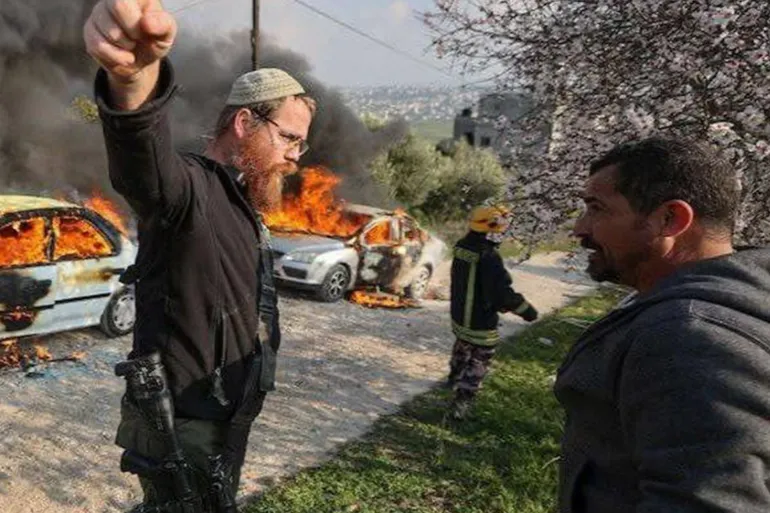
CROSSFIREARABIA – A Palestinian official report released Friday revealed a significant increase in arson attacks targeting Palestinian property in the West Bank. It documented nearly 900 fires ignited by settlers and the Israeli army between the beginning of 2023 and July 10, 2026. These attacks targeted homes, vehicles, and other structures, prompting warnings that they are part of a broader policy to displace Palestinians and impose new demographic and geographic realities. According to data from the Palestinian Authority’s Commission against the Wall and Settlements, the West Bank has witnessed a continuous increase in arson incidents over the past three years. 217 incidents were recorded in 2023, rising to 264 in 2024, and then reaching 307 fires in 2025. The Commission documented 112 fires during the first half of 2026. Quds Press

Continue reading
Gazans Protest The Bombing of Their Water Plant

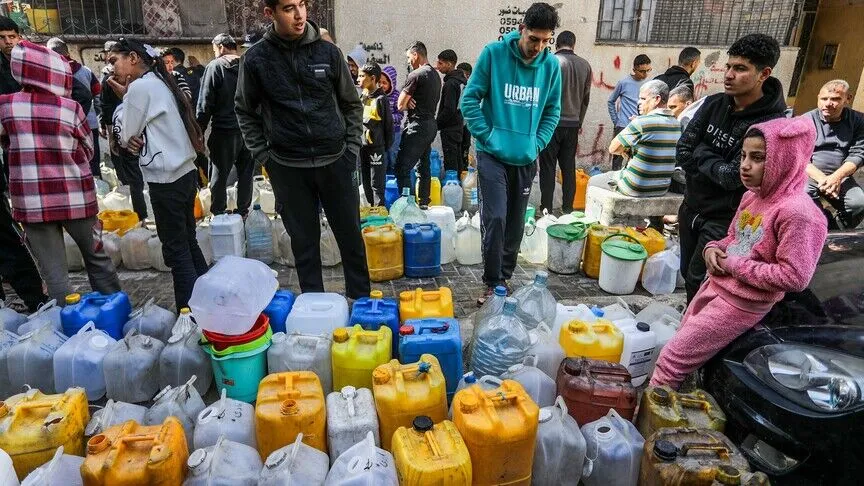
Dozens of Palestinians protested, Friday, in Gaza City against Israel’s destruction of a desalination plant that provided drinking water to residents of the Sheikh Radwan neighborhood and displaced people that came to the area; they are demanding it be reconstructed and made operational.

Children, women, and the elderly participated in the protest, some carrying empty water containers, while others held signs reading: “A drop of water equals life” and “Bring back the water.”

The protest comes amid a severe water crisis in the Gaza Strip. The United Nations Children’s Fund (UNICEF) stated, Friday, 70 percent of the water and sanitation infrastructure has been damaged, and 63 percent of Palestinians cannot access even six liters of drinking water per person per day.

The protest came four days after Israeli warplanes bombed the modern desalination plant in the Sheikh Radwan neighborhood, destroying it and damaging the surrounding tents of displaced people, according to an Anadolu Agency correspondent.

Despite the ceasefire agreement in effect since October 10, 2025, the Israeli army continues to launch attacks and fire operations in various parts of the Gaza Strip.

Displaced resident Abdul Hamid Mutawalli said the water station “gave life and hope,” after its construction and operation that took about two months to provide water to the area’s residents.

He told Anadolu that the area suffers from a severe water shortage despite its dense population of residents and displaced residents, and that the station’s operation gave them some hope for survival and resilience.

Mutawalli said that Israel bombed the station under the pretext that there was an arms depot underneath it, explaining the site was, according to him, “a furniture warehouse belonging to a company.”

He demanded the station be reconstructed again, saying: “This is a water desalination plant, not a missile or weapons depot. Let us live; we just want water.”

For his part, Imad Abu Na’ma, one of the organizers of the demonstration, said that the residents came out to demand “the most basic human right, which is access to water.”

He added that the station supplied water to hundreds of families before its destruction, warning of the worsening suffering of children due to the scarcity of drinking water.

The United Nations Office for the Coordination of Humanitarian Affairs (OCHA) reported on August 14 that 90 percent of the Gaza Strip’s population suffers from moderate to high levels of water insecurity, with the figure rising to 92 percent in Gaza City.

According to UN data as of the end of July, approximately 75 percent of Palestinians in the Gaza Strip rely on water tankers as their primary source of drinking water.

Continue reading
Palestinian Hassan Arar Freed After 22 Years in Jail

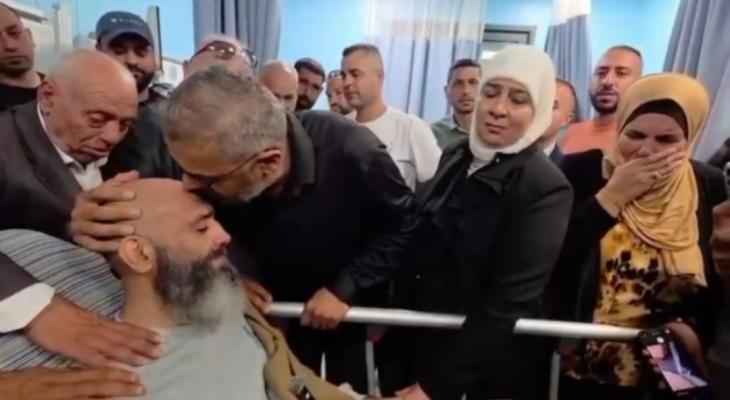
CROSSFIREARABIA – The Israel occupation has freed Palestinian prisoner Hassan Arar after spending 22 years in jail. He is from the village of Qarwa Bani Zaid in Ramallah.  The Palestinian Prisoner’s Club stated that Hassan Arar lost both his parents and two of his brothers during his detention and only just knew about the fact. It also stated Arar is just one of the many prisoner’s whose close relatives died while they are in jail and which they all knew about after they were freed as part of a strict and cruel Israeli policy.  Presently, Israel holds 9400 Palestinians in its prisons, including 92 females and 3324 who are in administrative detention.

Continue reading
‘My Curious Camera’

By Ibrahim Isam

I am not one of those who wear a press vest or a helmet simply to convince people outside Gaza that I am a journalist working under unbearable pressure and therefore in need of help. Nor am I someone who chases trends merely to increase the number of followers, or someone who uses photographs as a means to achieve personal ends.

Since I began photographing, I have had my own visual language, my own way of seeing. What has happened in Gaza has never made me abandon that language in order to follow the tragedy or turn it into a commodity.

I have never searched for the angle that would sell better, nor for the scene that would bring sympathy faster.

And I am certainly not one of those who see a photograph receiving attention today, only to return the next day with the same subject, the same tragedy, but with the latest camera model or the most expensive equipment—as if human suffering needs a technological upgrade before it becomes worthy of being photographed.

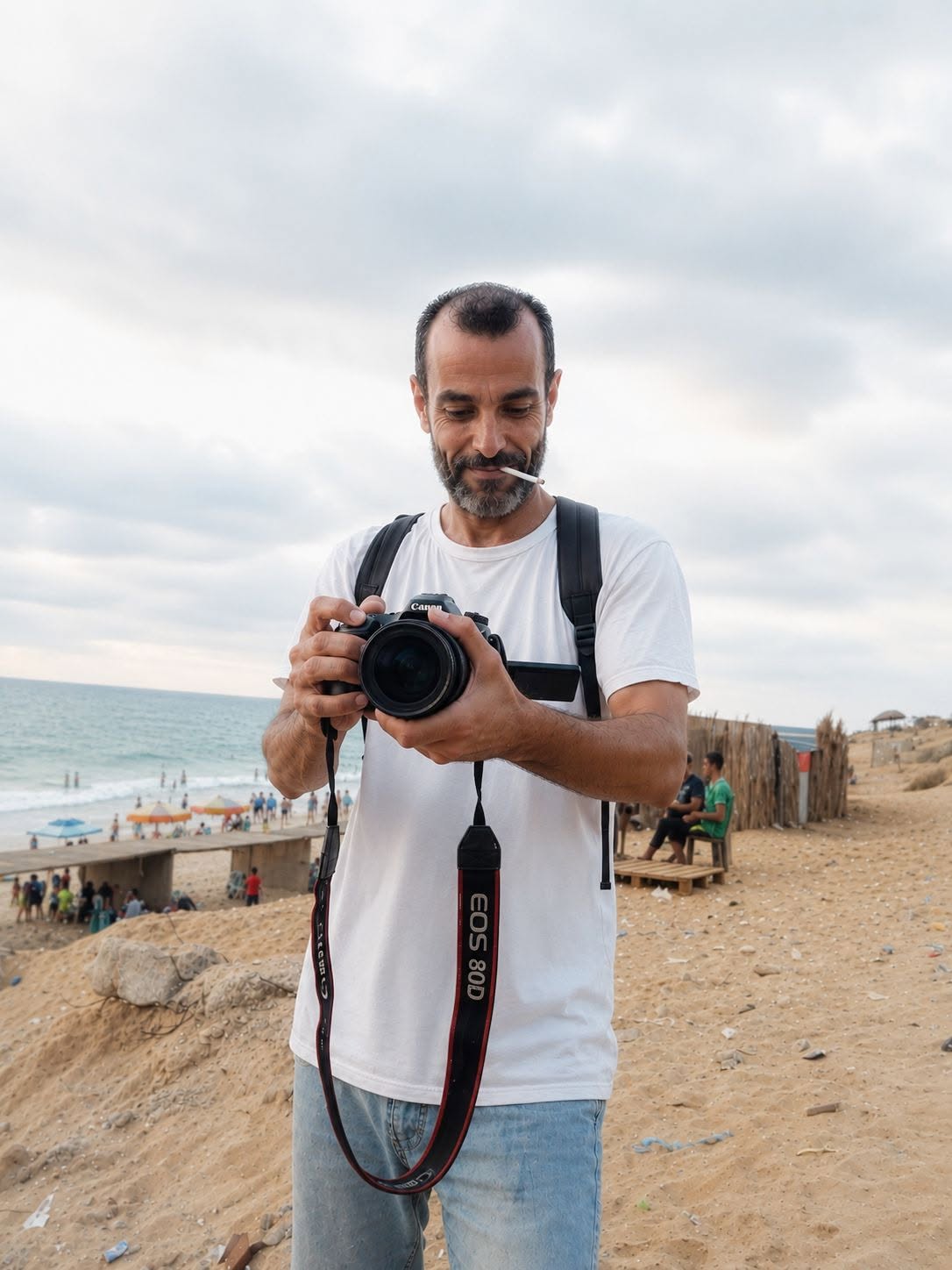
I am not ashamed of my modest cameras. Quite the opposite. I sometimes deliberately photograph myself with them and show exactly what kind of camera I am using.

Perhaps because I want to tell those who are just beginning to explore photography something simple:

The eye matters more than the camera.

A camera can be newer, more expensive, more sophisticated, and more impressive. But none of that makes its owner an artist.

And honestly, if cameras were capable of making artists, camera shops would have become art academies long ago.

I did not translate my texts into English because I wanted to flatter people outside Gaza, nor because I wanted to make myself more acceptable to an audience that does not know me.

I translated them because I want the photograph to travel.
I want the story to cross borders.
I want people to see what I see.

And the photographs I share today are not photographs I suddenly discovered after Gaza became a subject of global attention.

They are the same photographs I shared before, accompanied by Arabic texts, when they did not reach the same number of people, when they did not receive the same attention, and when hardly anyone seemed to notice them.

The photographs did not change.

The world simply began to look.

Nor am I seeking personal gain through these photographs.

I believe you all know that I am perhaps one of the few people in Gaza who continues to work voluntarily, without belonging to any institution or organization, using my own camera and whatever resources I can manage to provide myself.

But there is something even more important to me than all of that:

I do not impose a manufactured tragedy upon a child in order to create a powerful photograph.

I do not ask a child to cry at the right moment, to look into the lens in a way that makes the image more “tragic,” or to rearrange their pain so that it becomes more suitable for publication.

I believe that reality, when left to speak for itself, is far more painful than anything we could manufacture.

A child in a photograph may deserve all the compassion in the world. But when we place that child inside an artificial scene, or subject their reality to poor and exaggerated direction, we do not serve the child, and we do not serve the photograph.

We weaken its credibility.

And more important than anything else:

I respect the viewer.

I respect their eyes, their intelligence, and their right to see reality as it is—not as I want to stage it for them.

Some of you may wonder why I am writing all of this in English when I am, after all, speaking to you.

The answer is very simple:

Because I know you are curious.

And I have a feeling that, sooner or later, you will translate this into Arabic anyway.

So, in a small way, we have saved everyone the trouble.

In the end, I do not claim to possess the whole truth, nor do I believe I am better than anyone else.

I simply know why I hold a camera.

I know why I press the shutter.

And I know why, sometimes, I refuse to take the photograph that others believe would be “the best” one.

Because art, to me, is not a competition over who owns the biggest camera, the newest equipment, or the photograph that receives the most attention.

Art is knowing when to photograph, what to say, and when to step aside and allow reality to speak for
itself.

Continue reading