Israeli Planes Bomb Baby 50 Meters Into The Sky!

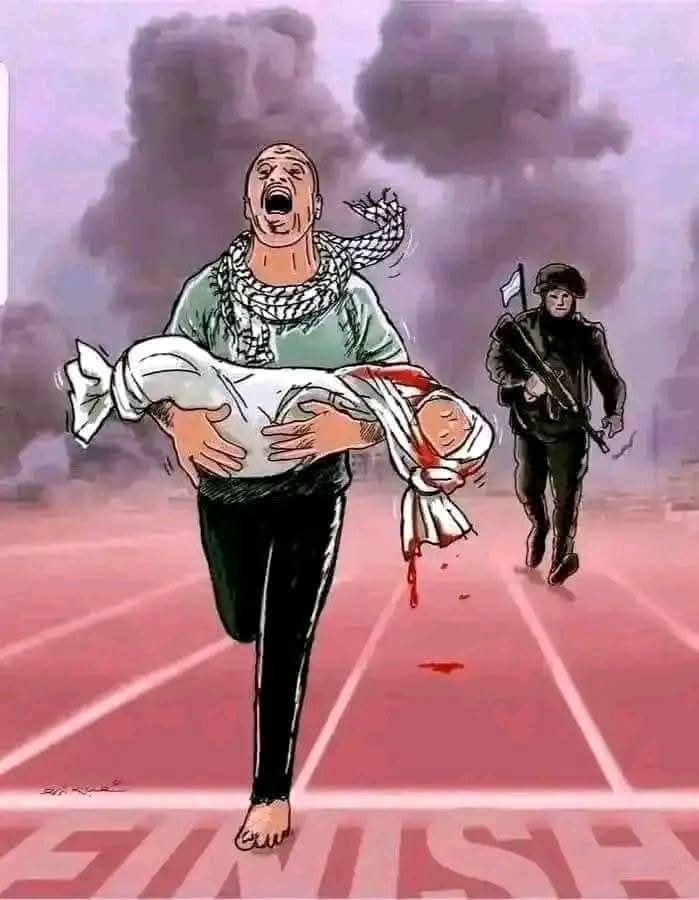
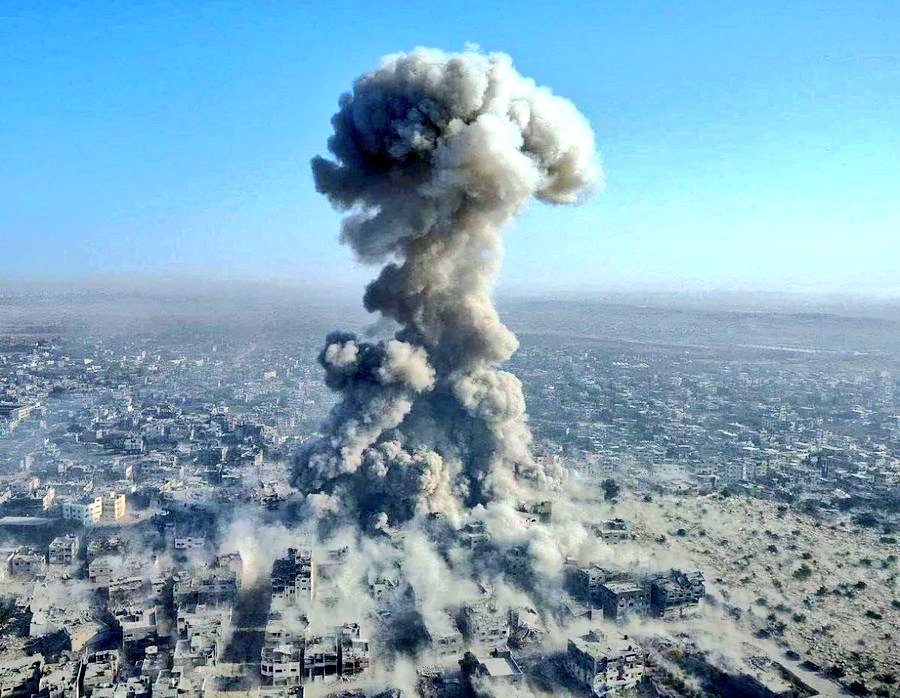
An Israeli missile suddenly hurls infant Enaam, 50 meters away from her home bombed by Israeli warplanes in the northern Gaza Strip writes Jihad Oweiss in Al Jazeera.

The baby flies up into the sky and miraculously lands on a nearby mattress, as if angels carried her and lowered her onto it, protecting her from certain death. She then sustains facial burns from the explosion of the first missile.

This scene is not a cinematic one: It is a true story that happened in early April and documented by Moroccan doctor Youssef Bouabdallah on his Instagram account. He is visiting Gaza to provide medical care to the wounded.

This bloody scenario is among dozens of scenes of ongoing slaughter, expertly orchestrated by Israel and supported by the United States, which has claimed the lives of more than 50,846 martyrs and injured 115,729 since 7 October, 2023.

Flying Bodies and Remains

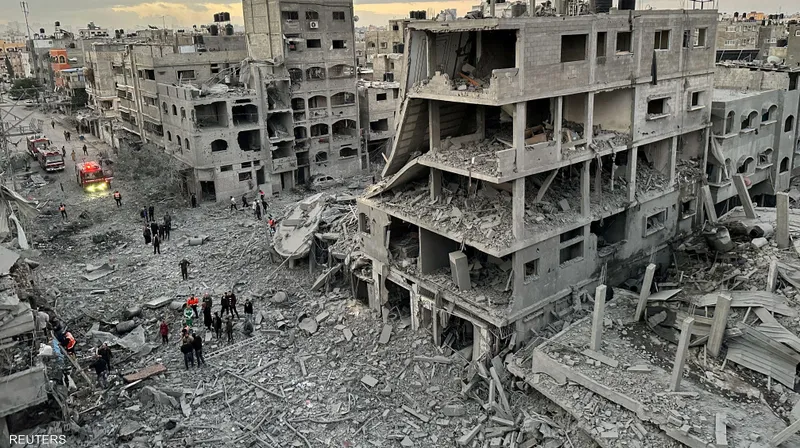
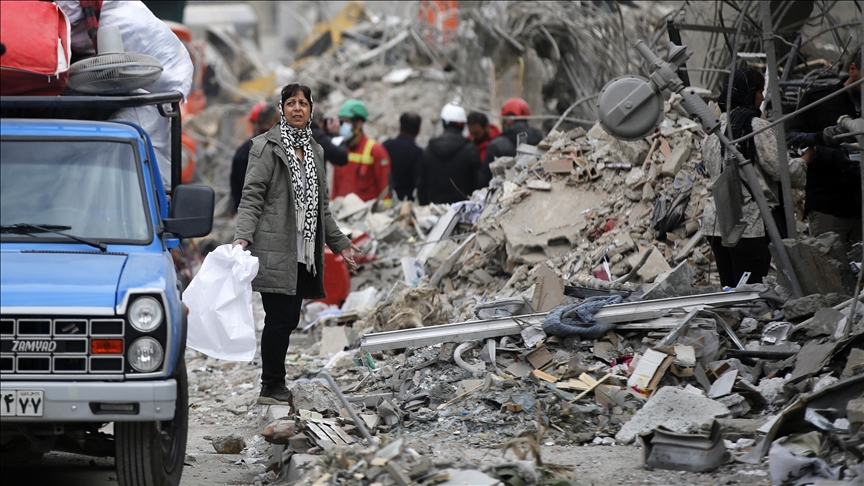
If the world’s ears cannot comprehend the murderous scenarios being tested by the Israeli occupation army on the residents of the besieged Gaza Strip, the Dar al-Arqam School massacre in Gaza City is proof of this, adding to the open record of genocidal crimes.

Palestinian platforms documented the horrific massacre committed by the occupation army on 3 April and what they said showed the moment the bodies of residents blown to pieces by the violent shelling of a school housing displaced persons.

The people of Gaza, especially, cannot get over the sight of bodies being blown apart by the bombing, asserting what they are experiencing is not a war, but “a slow annihilation in which the apocalypse is being perpetrated on earth, without accountability, scale, or justice. While bodies are being torn apart and souls are being scattered, the world is content to count and remain silent.”

To emphasize this, activist Ahmed Al-Khalidi addresses “the complacent” who are surprised by the evacuations of Gaza’s residents by the bombing. He recounts some of the stories of those whose bodies were blown to the top of nearby buildings, those whose remains disappeared and were scattered into the unknown, those who were completely annihilated, and those who were blown away but survived.

Al-Khalidi says in his post: “We found the remains of our neighbors in our house after their six-story home was bombed. The explosion scattered everything: bodies, rubble, and memories.”

He adds: “I once asked a friend who was rescued alive from under the rubble of his house, ‘How did it feel?’ He replied, ‘When the missile exploded, I felt like I’d fallen into a deep hole, spinning violently, but I emerged alive and well.'” He confirms that the same person was later martyred along with his wife and children in a separate bombing.

Psychologist Dr. Saeed Al-Kahlout adds to similar stories, saying: “My martyred sister’s body flew away in one bombing, passing over two buildings and a street, while her husband was found two days later in a nearby neighborhood.”

He continues in a Facebook post: “At the beginning of the war, following a bombing on our neighbors’ house, the neighborhood residents found the body of a martyr, still lying on her bed, on the fifth floor of a building adjacent to the blind martyr’s house. People explained the event by saying, ‘Angels carried her and fled with her to a safe place. She was sound asleep.'”

The new phase of the Israeli war, since its resumption on 18 March, appears to be more bloody and criminal. The occupation army has killed 1,482 Palestinians and injured 3,688, according to data from the Ministry of Health in Gaza.

Gaza residents are witnessing more intense bombardment and a more intense rate of killing, as if the Israeli occupation army is using the Strip as a testing ground for its lethal military weapons, following its violation of the ceasefire agreement concluded with the resistance last January.

Al-Kahlout links the scenes of bodies of martyrs flying to the violent bombardment, saying: “The force of the explosions we are witnessing in this war makes me say that bodies are trying to save themselves by fleeing, even if they fly outside the circle of fire, to escape the hell… The sound of the explosion is as if the sky has split open in its wrath, shaking the ground beneath our feet and deafening our ears until we hear nothing but the howling of fear inside our heads.”

Fear and Panic

Blogger Abu Ghaith Yaghi calls on the world to talk about “dying Gaza” and the difficult nights the residents are experiencing, while “Israel is testing new types of bombs and missiles.”

While activist Mohammed Al-Akashiya asks on his account, “What are they (the occupation) throwing at us?” due to the sounds of shelling reverberating throughout the area, another asserts that the wave of explosions and shelling is terrifying and unprecedented.

Activist Mohammed Haniyeh believes that most of the missiles used after the renewed genocide are different from those before, and have a massive blast wave. He adds: “We now hear the echo of the explosion for a longer period of time. It doesn’t stop instantly, but rather the sound seems to extend and spread, coinciding with earthquakes that last for seconds.”
Continue reading
Can Israel Change The Middle East?

By Mohammad Abu Rumman

In the short term, Israel is no longer in a hurry to normalise relations with Saudi Arabia, which it considers the grand prize in the Islamic world. Although its leaders view normalization as necessary, indeed inevitable, over the long run, what Netanyahu and his team currently see is an unprecedented historical opportunity that has not occurred since the founding of the State of Israel. They are thus pushing to implement sweeping and profound changes to the Palestinian situation, through displacement, expulsion, settlement expansion, annexation, and the Judaization of Jerusalem, from Gaza to Jerusalem and the West Bank. For the Israeli right, these policies take precedence over any other strategic interests.

It is not only about the Palestinians. The Israeli right’s ambitions today extend to constructing new and unprecedented spheres of regional influence and redefining Israeli security. This includes striking at any source of potential future threats and establishing Israel as the dominant regional power.

There are three key variables that must be taken into account when analyzing the current geopolitical shifts and the repercussions of Israel’s war on Gaza, not only in terms of the Palestinian issue, but also on a regional and global scale.

The first variable can be described as “Political Netanyahuism.” Today’s Israel is no longer the Israel of the past—this marks the era of Benjamin Netanyahu, especially post-Operation “Al-Aqsa Flood.” This era has unleashed the historical project of the Israeli right-wing in full force, with no intention of reversing course. The key features of this project include, first, a complete abandonment of the peace process, a rejection of the Oslo Accords and their consequences, and the annexation of large parts of the West Bank—effectively nullifying the Palestinian Authority’s political relevance and perhaps returning to a system of disconnected “cantons.” Additionally, this entails the Judaiztion of Jerusalem. Second, Netanyahuism is reflected in a complete structural shift of Israel toward the right, with the near-total erosion of the secular-leftist stream in Israeli politics. Third, it involves the deep penetration of religious ideology into Israel’s security and military institutions, leading to their full domination by religious-nationalist elements.

Even if Netanyahu were to exit the political scene, this would not alter the course of these policies or shift current events. Israel post-Netanyahuism will not be the same as it was before. The historical Zionist dream persists—ideologically, strategically, and religiously—even if tactical approaches differ. This new political reality is not merely shaped by individuals like Itamar Ben Gvir and Bezalel Smotrich; rather, they are products of a broader environment and not anomalies within it.

The second variable is the major Arab strategic collapse—a process that began decades ago but reached a far more dangerous stage in the past 15 years, especially after so called “the Arab Spring”. The resulting transformations led to the fragmentation and collapse of numerous Arab states and the weakening of the entire Arab geopolitical map—in Syria, Iraq, Yemen, Sudan, and Libya. It now seems as though the Arab geopolitical landscape, shaped after World War I, is disintegrating. This has created a strategic opportunity for Israel to expand, particularly following the recent decline in Iran’s regional influence over the past year in the wake of the war on Gaza.

The third variable is the return of Donald Trump to the White House—this time accompanied by a team that is more Zionist and ideologically aligned with the Israeli right than ever before. The unprecedented genocide unfolding in Gaza, the (implicit) green light granted to settlers and Netanyahu’s government in the West Bank and Jerusalem, and the statements made by Trump’s team concerning Palestine, Iran, Lebanon, and Syria all suggest an unprecedented alliance—perhaps even an organic one—between a hardline right-wing American administration and an extremist Israeli right. Although US policies have historically been biased in favor of Israel, the situation has never reached this level of alignment and support.

These three variables together shape a new political landscape, they significantly impact Jordan’s strategic perspective on national interests and security and necessitate a reevaluation by political elites who previously believed that there were multiple factions within Israel with whom one could engage, or that American influence could constrain the Israeli right, or that an effective Arab strategic space could be mobilized to counter such dangerous transformations.

The writer is a columnist in the Jordan Times

Continue reading
Netanyahu Has Irked Trump. Why?

What should one make of the recent White House meeting between US President Donald Trump and Israeli Prime Minister Benjamin Netanyahu?

Well, this time Netanyahu was almost summoned to the White House to be told few home truths. This meeting was not like the first time when Netanyahu came to the White House in early February when it was all glow to be unexpectedly told that Trump wants the USA to take over Gaza.

This time around, the meeting was more subdued, almost in a rush, like an after-thought on the part of Trump who keeps chopping and changing as he figures out how he wants to conduct America’s foreign policy in his second “robust” administration.

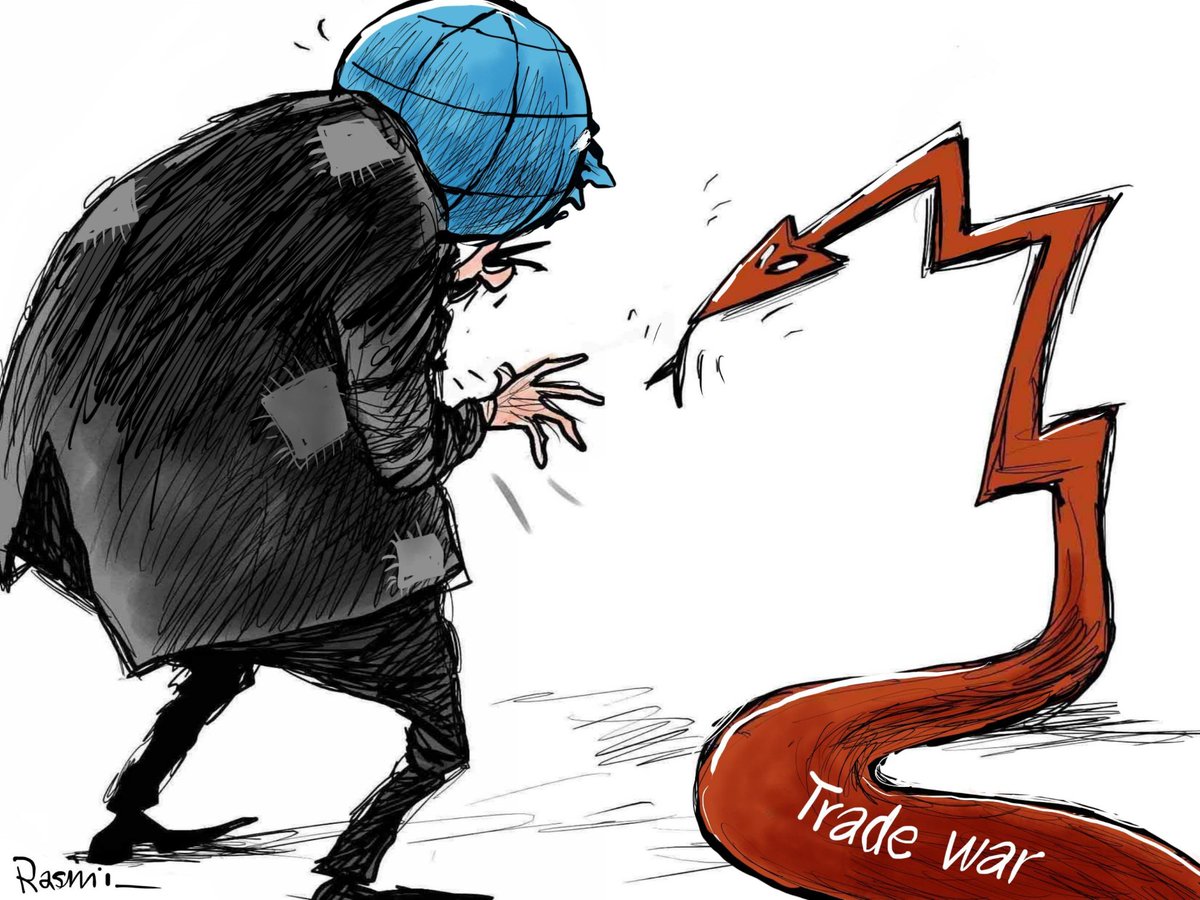
This time around, although Trump displayed the usual friendliness to Netanyahu, he was somewhat distant because of the tariffs the White House is set upon to start imposing on the rest of the world including best-friend Israel. Its leaders, businessmen are still in shock because Washington has slammed a 17 percent tariff on its products entering the United States.

Israeli industrialists continue to be up-in-arms. It was they who appealed to Netanyahu to seek Washington clarification because they argued that the new tariffs will cost them up to $3 billion in losses, reduce Israeli exports by 26 percent and increase unemployment by 26,000. They are already in a bad situation because of the war on Gaza but this latest step will surely cripple them.

At the White House meeting last Monday, with a chitchat in front of the cameras that looked as if it was a rehearsed meeting with Trump dominating the conversation and everyone taking their que to speak only when they are told, he pointed out to Netanyahu that he “may not” consider reversing tariffs on Israeli exports because “we give Israel $4 billion a year. That’s a lot.” He really sounded like lecturing to the Israelis.  

For a man considered to be greatly influenced by the Israeli lobby that seemed to be tough talking for in the immediate conversation Trump told Netanyahu that there would be and for the first time direct face-to-face talking with Iranians about their nuclear file.  

This seemed to be another unsuspecting blow. If there was a “shock” on his face, Netanyahu didn’t show it as he just nodded; the Israeli Prime Minister was looking for a tough military stance on Iran, possibly going to war and striking the country’s nuclear facilities. It was he, who persuaded Trump in 2018 to exit from the 2015 nuclear deal brokered by the UN with other world powers of Britain, France, Russia, China and Germany at the behest of the Barack Obama administration.

Now with Trump in the driving seat, and wanting a “tainted-Donald” deal, Netanyahu couldn’t but agree with an alluring American president. If he had any misgivings, he kept them to himself except to say Tel Aviv and Washington had an objective not to let Iran have nuclear weapons, but Tehran constantly said and throughout the past years that their nuclear program was for peaceful purposes unlike the clandestine extensive Israeli nuclear program.

Although he may not have outwardly shown it, Trump may have been a little irritated by Netanyahu in other ways. Take Gaza for example when Israel restarted its war on the enclave on 19 March exactly two months after a ceasefire took effect ending a 15-month genocide and which was brokered by Trump and his team lead Steve Witkoff.

The recent talks in the White House, and shown in front of the cameras suggest Trump would have like more time for the Doha negotiations to take hold between Hamas and Israel to see the release of the 59 remaining hostages – which include one American who is still deemed to be alive – hidden in the Gaza enclave.

The relaunching of the war, and so quickly, and with the breaking of the 19 January ceasefire is adding to the tension between Washington and Tel Aviv and is sending signals that Netanyahu wants to continue the war in Gaza and doesn’t particularly care about the remaining hostages, and whether they come out of their nightmare dead or alive.

Trump, and as shown by the White House meeting, is showing a diversion from thoughts projected by Netanyahu. As well as Iran, he has told Netanyahu, he favors Turkish President Recep Tayyip Erdogan and that he has a ‘very, very good relationship with Turkey and with their leader…”, adding that “I happen to like him, and we never had a problem” and he offered to mediate between Israel on any problem between the two countries.

Such words may have suddenly added to the glum mood of the Israeli PM who fears that Turkish influence in Syria despite the fact it is Israel that is today bombarding different Syrian cities and occupying parts of their territory, a situation that increased after the toppling of the Bashar Al Assad regime on 9 December, 2024 by a new government in Damascus, and which is seen as a threat to Israeli security by Tel Aviv.

What is worrying Netanyahu is the fact Trump recognizes Turkish influence and Syria and Ankara’s relationship with the new government in Damascus, and apparenty the man in the White House, is “ok” with it.

With all this going on, Netanyahu is not sure anymore of the way the White House is going despite the fact that Washington continues to be the main supplier of weapons to Tel Aviv. But with Trump as “fickle-minded” as he is, all cards are on the table for a new and changing relationship between the USA and the rest of the world with the strong possibility of including Israel in the new international set of thinking.

This comment is written by Dr Marwan Asmar, chief editor of the crossfirearabia.com website. 

Continue reading
Guterres: ‘…Time to End the Gaza Dehumanization’

With no aid allowed into Gaza for more than a month, the UN Secretary-General appealed on Tuesday for guaranteed humanitarian access to the enclave. 

Speaking to journalists at UN Headquarters, António Guterres also repeated his call for a renewed ceasefire between Israel and Hamas, and the release of all hostages still being held inside the shattered enclave.

No food, fuel, medicine and commercial items have entered Gaza since 2 March following the Israeli blockade, and supplies are piling up at crossing points.

Meanwhile, the ceasefire announced in January following 15 months of war has collapsed, amid airstrikes, renewed ground operations and rocket launches into Israel by Palestinian militants. 

‘An endless death loop’

“As aid has dried up, the floodgates of horror have re-opened,” Mr. Guterres said.

Gaza is a killing field – and civilians are in an endless death loop.”

He noted that “certain truths are clear since the atrocious October 7 attacks by Hamas,” chiefly that ceasefires work.

The truce allowed for the release of hostages, as well as the distribution of lifesaving aid, and proved that the humanitarian community can deliver.

Shattered hope

He recalled that “for weeks, guns fell silent, obstacles were removed, looting ended – and we were able to deliver lifesaving supplies to virtually every part of the Gaza Strip,” which ended with the “shattering” of the deal.  

Hope sank for Palestinian families in Gaza and families of hostages in Israel – as I was reminded when I met again with hostage families yesterday,” he added.

For this reason, the Secretary-General has consistently been pushing for the immediate and unconditional release of all hostages, a permanent ceasefire, and full humanitarian access to the territory.

“In times like this, we must be crystal clear,” he said, noting that with crossing points shut and aid blockaded, there is no effective security and the ability to deliver assistance has been strangled.

He also cited a joint statement by UN humanitarian chiefs, issued on Monday, which refuted assertions that there is enough food in Gaza to feed everyone there.  

International obligations 

“We must also be clear about the obligations,” Mr. Guterres continued, emphasizing the “unequivocal obligations” of Israel, as the occupying power, in line with international law.

He pointed to the Fourth Geneva Convention, which outlines the duty to ensure food and medical supplies for the population, as well as ensuring and maintaining medical and hospital establishments and services, public health and hygiene.

Additionally, medical personnel shall be allowed to carry out their duties.

“And Article 59, paragraph 1, of the Fourth Geneva Convention provides that ‘if the whole or part of the population of an occupied territory is inadequately supplied, the Occupying Power shall agree to relief schemes on behalf of the said population, and shall facilitate them by all means at its disposal,’” he quoted.

International humanitarian law also includes the obligation to respect humanitarian relief personnel, he added, paying tribute to the “humanitarian heroes” under fire in Gaza. 

Against new ‘authorization mechanisms’ 

While UN agencies and partners stand ready and determined to deliver, “the Israeli authorities newly proposed ‘authorization mechanisms’ for aid delivery risk further controlling and callously limiting aid down to the last calorie and grain of flour,” the Secretary-General said. 

“Let me be clear: We will not participate in any arrangement that does not fully respect the humanitarian principles: humanity, impartiality, independence and neutrality.”  

Mr. Guterres said unimpeded humanitarian access must be guaranteed, and humanitarian personnel must be given protection, in line with international law.  

He stressed that “the inviolability of United Nations premises and assets must be respected,” and again called for an independent investigation into the killing of humanitarians, including UN personnel.

Dead end ahead 

The Secretary-General concluded the briefing by underlining the need to stick to core principles. He urged UN Member States to adhere to their obligations, adding that there must be justice and accountability when they do not

The world may be running out of words to describe the situation in Gaza, but we will never run away from the truth,” he said. 

He warned that “the current path is a dead end – totally intolerable in the eyes of international law and history,” while the risk of the occupied West Bank transforming into another Gaza makes the situation even worse.

“It is time to end the dehumanization, protect civilians, release the hostages, ensure lifesaving aid, and renew the ceasefire,” he said.

UN News

Continue reading
10 British Citizens Face Gaza War Crimes – Guardian Newspaper

The Guardian newspaper revealed, Monday, that 10 British citizens who served in the Israeli occupation army face charges of committing war crimes in the Gaza Strip, based on an extensive human rights report prepared for submission to the British Metropolitan Police.

The 240-page report is based on investigations conducted by human rights lawyers, in collaboration with the Palestinian Centre for Human Rights in Gaza and the London-based Public Interest Law Centre. The report covers serious violations committed between October 2023 and May 2024.

According to the document, the accused soldiers—including Israeli army officers—are suspected of involvement in launching indiscriminate attacks on civilian areas in the Gaza Strip, including hospitals, in addition to causing mass displacement and targeting sites protected under international law.

The report also accuses these individuals of deliberately targeting civilians and aid workers, which may amount to crimes against humanity.

Although the full report includes the names of the accused soldiers, it will not be made public for legal reasons. It was prepared by a team of British lawyers in collaboration with researchers in The Hague according to Qudspress.

Continue reading