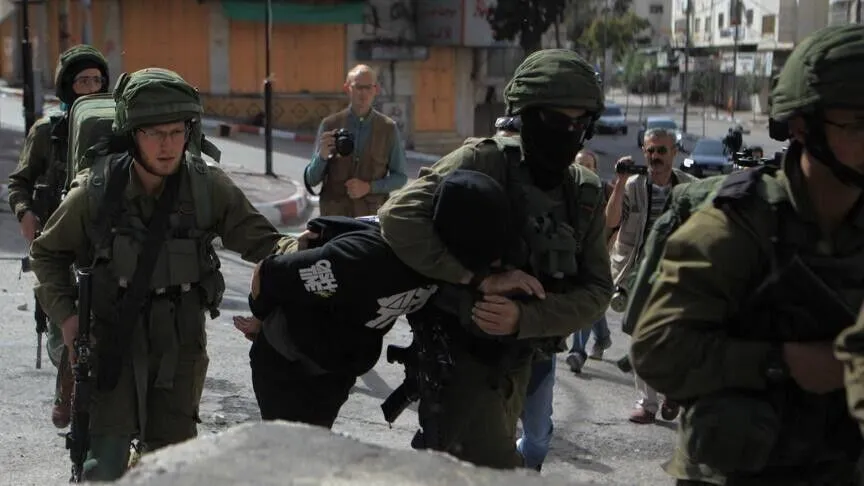
The official Voice of Palestine radio said Israeli forces arrested more than 40 young Palestinian men in an ongoing raid on the town of Tell, west of Nablus in the northern part of the occupied territory.
Israeli troops seized a house in the town and converted it into a field interrogation center, the broadcaster said.
It added that Israeli forces were carrying out extensive raids on homes across the town while surrounding it from all directions.
On Friday, Israeli Premier Benjamin Netanyahu and Defense Minister Israel Katz ordered a “wide-scale military operation” in Palestinian villages across the West Bank following an attack near the illegal Havat Gilad settlement that killed two Israeli soldiers and wounded three others.
According to sources and witnesses, Israeli occupiers later attacked several Palestinian communities in the Nablus governorate, setting fire to Palestinian homes and other property.
Four Palestinians were killed on Friday in an attack by Israeli occupiers and Israeli forces on the town of Tell, according to the Palestinian Health Ministry.
Meanwhile, the official Palestinian news agency WAFA reported that Israeli forces launched widespread raids before dawn in the city of Jenin and several towns and villages across the governorate.
Troops also searched a number of homes and detained five Palestinians, while military operations continued in several parts of the governorate, according to local sources cited by the agency. Separately, Israeli forces detained three Palestinians in the Bethlehem governorate.
In another incident, the Palestinian Red Crescent Society said eight Palestinians were injured, including six who were shot with live fire, in an attack by Israeli occupiers on the village of Farata, east of Qalqilya in northwestern West Bank. The organization did not immediately provide further details on the attack or the condition of the injured. Anadolu
On Friday morning, 24 July, the town of Tell, southwest of Nablus, witnessed not just a passing raid, but a legendary tale embodied by the heroism of an unarmed young Palestinian man.
Amidst the smoke and gunfire targeting Palestinians, the young man, Farouq Adnan Ali Ramadan, bravely stepped forward, creating an extraordinary scene in the history of popular resistance in the West Bank.
Clash at point-blank range:
The events began when groups of settlers attacked the eastern part of Tell. Residents confronted them and forced them to retreat. Just half an hour later, the settlers returned, supported by Israeli military vehicles, and stormed the western area near the Havat Gilad settlement outpost. Clashes and hand-to-hand combat erupted between unarmed residents and armed settlers.
At that critical moment, amidst the indiscriminate gunfire directed at the residents, Farouq Ramadan advanced steadily and without hesitation, breaking through the wall of fire to directly confront one of the settlers’ security personnel and guards at the outpost. In a swift and direct physical confrontation, Farouq managed to forcibly seize the automatic weapon from the guard’s hand.
Not content with disarming the assailant, Farouq immediately shifted from a defensive position to confront the source of the fire, directly firing at the settlers and occupation officers in defense of the town of Tell and its inhabitants. This confrontation resulted in the death of an Israeli officer with the rank of major and a soldier from the Jerusalem Brigade, and the wounding of others, completely disorienting the attacking force.
Four Martyrs from One Family
In response to this operation, which shook the occupation’s security apparatus and led to the closure of Nablus and the imposition of a curfew, the occupation forces brought in massive reinforcements and opened fire indiscriminately, resulting in the martyrdom of Farouq Ramadan.
Farouk Ramadan’s heroism was not an individual act, but rather one etched in the blood of four members of the same family who stood firm against the massacre. Alongside Farouk, three of his relatives and cousins—Imran Ahmed Ali Ramadan, Ibrahim Hussein Ali Ramadan, and Jawad Hussein Ali Ramadan—were martyred defending their home.
Impact of the Operation and the Occupation’s Panic
Farouk Ramadan’s bravery sparked panic within the Israeli political and security establishment. Prime Minister Benjamin Netanyahu and several ministers in his government convened emergency meetings, while the Israeli army announced the deployment of additional battalions, imposing a complete security cordon around Nablus and Tell, and storming the Nablus Specialized Hospital.
The Israeli army announced that its forces were preparing to carry out a large-scale operational activity in the West Bank, adding that soldiers’ leave had been canceled and troop deployments throughout the West Bank had been reinforced.
Farouk Adnan Ramadan and his cousins departed, leaving behind an extraordinary scene that will remain in the memory of Tell and the West Bank, and one that the occupation will also long remember. Aljazeera
As a part of its broader policy push to increase Israeli settlement presence in the occupied West Bank, Israel has approved recently the construction of more than 2,000 new housing units distributed across several strategic locations.
Pushing to annex more and more of the Palestinian territory Far-right Israeli Finance Minister Bezalel Smotrich has announced a major expansion of illegal settlements in the occupied West Bank.
Smotrich, who holds authority over parts of Israel’s civilian administration in the West Bank, said on 3 June that a planning committee had approved the construction of 2,162 new Jewish homes, of which 1,006 units will be in a new illegal settlement near Jerusalem, 922 near the city of Nablus and 234 near Hebron.
“We are continuing to build the Land of Israel in practice,” Smotrich said in a statement.
The new homes would “strengthen our hold on the land, reinforce Israel’s security, and establish clear facts on the ground that prevent the creation of an Arab terror state in the heart of the country”, he added.
Smotrich has been sanctioned by the United Kingdom, France, and other states, which accuse him of inciting violence against Palestinians.
The minister has denounced the sanctions and said they would not change Israeli policy.
Besides, on June 4, Israeli forces had delivered demolition notices to a number of shops at the intersection of the town of Bazariya, northwest of Nablus, to make way for a colonial road.
Meanwhile, some settlers stormed the village of Deir Sudan, northwest of Ramallah, accompanied by bulldozers, to seize it.
The developments come months after the Israeli government approved a land registration process in February that allowed Israel to take territory as “state property” if Palestinians could not prove ownership.
Palestinians seek the West Bank, including East Jerusalem and Gaza, as part of a future independent state.
Israel, meanwhile, maintains military and administrative control over large parts of the territory, while expanding illegal settlements in several areas.
The settlement expansion comes amid ongoing debate within Israel’s political leadership over the future of the occupied territories.
The Israeli Knesset gave on June 4 final approval to legislation granting tax exemptions to dozens of illegal settlements in the occupied West Bank.
In a statement, the Knesset said lawmakers approved the bill on its final reading, granting tax benefits to illegal settlements located in what it called the “eastern confrontation line zone.”
The legislation was sponsored by Knesset members Zvi Sukkot, from the Religious Zionism party led by Finance Minister
Bezalel Smotrich, and Limor Son Har-Melech, from the far-right Jewish Power party led by National Security Minister Itamar Ben-Gvir, along with other lawmakers.
The bill passed by 32-23 votes. Under the law, occupants will be entitled to tax exemptions throughout the tax year and may choose among available tax benefits if they qualify for more than one exemption.
The legislation is set to take effect in January 2027 and remain in force through Dec. 31, 2027. It also authorizes the finance minister, with approval from the Knesset Finance Committee, to extend its validity for additional periods of up to two years each.
In a report published at the end of May, the Israeli anti-settlement group Peace Now said the law would classify dozens of illegal settlements as areas whose residents are eligible for substantial tax benefits.
The group noted that the original bill sought to extend tax benefits to all settlements but was narrowed due to its high cost and professional objections, ultimately applying to 58 illegal settlements.
According to Peace Now, the updated version primarily includes illegal settlements where support for the Religious Zionism party is particularly strong.
The international community considers settlements built in the occupied Palestinian territory illegal under international law and a major obstacle to a two-state solution.
Netanyahu’s government has openly championed a significant expansion of illegal settlement activity since taking office at the end of 2022. According to Peace Now estimates, more than 750,000 Israeli occupiers live in the occupied West Bank including East Jerusalem.
While some international actors have warned against further annexation or expansion, enforcement measures remain limited.
The United States has historically expressed opposition to settlement expansion, although its positions have varied in intensity depending on administration policy.
On its part US President Donald Trump ‘s administration has been far less critical of the fast-expanding Israeli settlements.
The approval of thousands of new settlement homes further entrenches Israeli presence in the West Bank and complicates already fragile prospects for a negotiated political settlement.
Additionally, settlement expansion changes demographic and geographic realities on the ground, making territorial compromise increasingly difficult and it reinforces perceptions that a viable independent state is becoming harder to achieve.
For Israel, supporters of settlement growth argue it strengthens security and consolidates control over strategically important areas while critics, , say it increases friction with Palestinian communities and fuels long term instability.
However, with diplomatic efforts largely stalled, continued expansion is likely to remain a central flashpoint in the conflict and a key issue in deepening regional tensions.
Najla M. Shahwan is a Palestinian author, researcher and freelance journalistand published this article in the Jordan Times
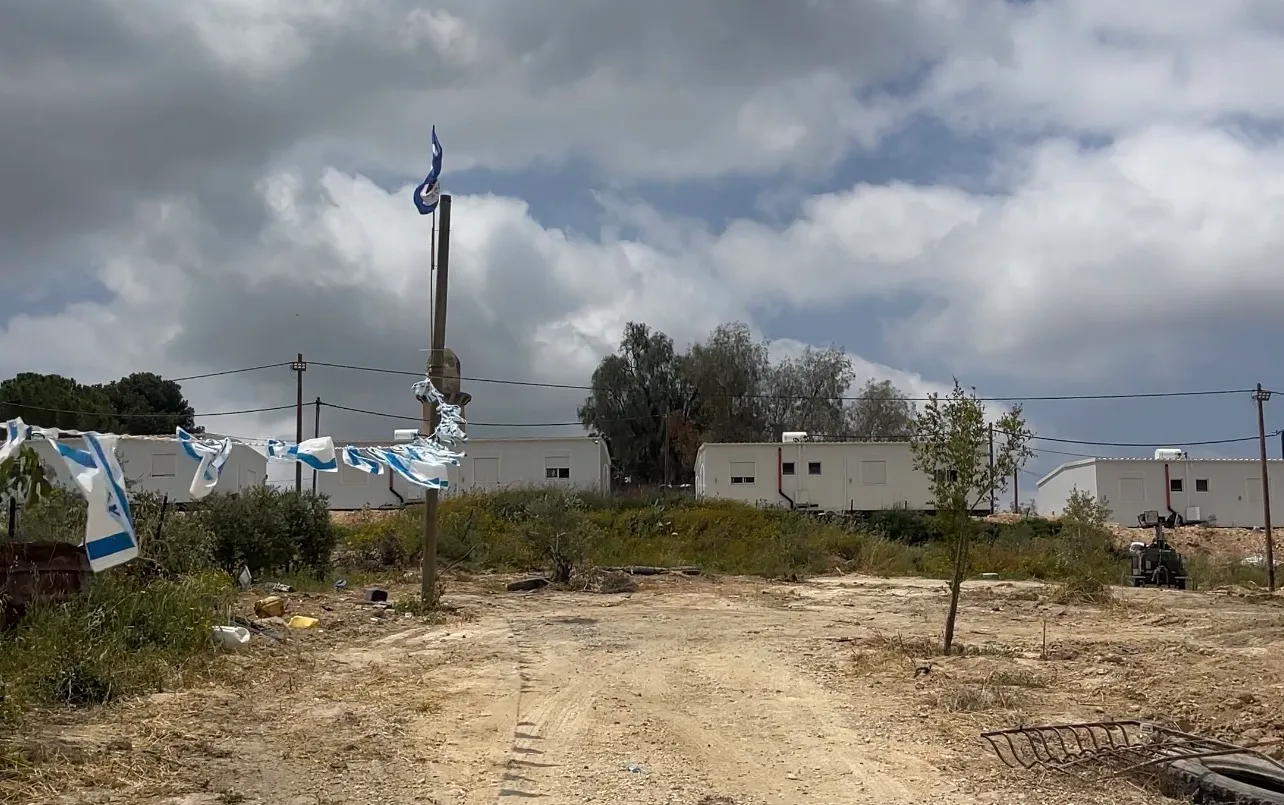
DEIR AMMAR, Occupied West Bank—Mustafa Badaha drove along the edge of his land, past rows of olive trees he could no longer access. A red string put up by Israeli settlers demarcated the border of what was stolen from him in Deir Ammar, a Palestinian town around 17 kilometers northwest of Ramallah in the occupied West Bank. The settlers had recently established a new outpost in the area named Ramataim Zofim.
“Everything is legal—I have permits—but it makes no difference. A settler comes and simply says, ‘This is my land. You have no place here,’” Badaha told Drop Site. For years, he cultivated the land, building a small summer home where his family would gather. “Now, no one can go there—if we try, we are attacked,” he said. “What was once my joy is now my greatest fear.”
A red string put up by Israeli settlers on Mustafa Badaha’s land in Deir Ammar in the occupied West Bank demarcating the land they took over. April 30, 2026. Photo by Naqaa Hamed.
Settlers began routinely attacking Palestinians in the area back in August 2025. “They came here armed, created problems with the youth and the families, and even fired live ammunition,” Badaha said. He contacted the Palestinian Authority, who reached out to Israeli authorities. “The attacks kept increasing day after day. At first, the settlers were about 500 meters away, then gradually they kept getting closer until they reached the houses,” he said. “Every day there are provocations. They block the road, and with the youth we reopened it several times. Recently, there was another major attack and they blocked the road again.” After contacting the Israeli police, the Israeli military eventually arrived and detained Palestinians from the community instead of the settlers.
“The youth were insulted, detained for over an hour, searched, and had their IDs checked. I asked the officer, ‘What are we supposed to do? You tell us not to react, but settlers are the ones attacking,’” Badaha exclaimed. “We are living under constant attacks. This is our home, our land—we have water, electricity, internet—everything. Yet there is no safety.”
Ramataim Zofim is one of 34 settlements secretly approved by the Israeli security cabinet in late March, a decision that was only revealed in Israeli news reports last month. It marked the largest number of settlements approved by any Israeli government at one time. The decision to officially approve new settlements or to legalize outposts allows for the establishment of water and electricity infrastructure, further entrenching their presence on Palestinian land.
The 34 new settlements established by the Israeli security cabinet join 68 settlements the current government has approved since its formation a little over three years ago. By comparison, only six new settlements were formally approved by Israel in the 30 years between the signing of the Oslo Accords in 1993 and the establishment of the current government. Over the past three decades, thousands of additional housing units have been approved within existing settlements, like Ma’ale Adumim which lies just east of Jerusalem and is home to up to 40,000 Israeli settlers.
“This represents an unprecedented pace and scale of expansion,” Amir Daoud, director of Publishing and Documentation at the Colonization and Wall Resistance Commission, told Drop Site. Until the establishment of the current Israeli government there were 127 official settlements in the West Bank, according to the Israeli group Peace Now. Adding over 100 new official settlements represents an increase of nearly 80%.
“These new sites are distributed across the West Bank in what can be described as a fragmented but comprehensive pattern, effectively targeting the entire territory,” Daoud said. “Overall, this wave of approvals reflects a clear race against time to impose as many facts on the ground as possible, in order to achieve long-standing strategic goals.”
A map of the 34 newly approved Israeli settlements approved in March 2026. Credit: Peace Now.
All 34 of the new settlements are located in Area C, a technical designation established under the Oslo Accords that divided the West Bank into three sections. Area A is technically under Palestinian civil administration and security control; Area B is under Palestinian civil administration but shares security control with Israel; and Area C is under full Israeli control.
The International Court of Justice, UN Security Council resolutions, and international law experts agree that all Israeli settlements in the occupied West Bank are illegal under international law.
“Consistent with long-standing settlement policy, these new sites contribute to the fragmentation of Palestinian areas while simultaneously creating territorial continuity between settlements,” Daoud said. “This is especially evident in central parts of the West Bank, where settlement placement further disrupts Palestinian geographic cohesion.”
Five of the newly approved settlements are in the governorate of Al-Khalil (Hebron) in the south of the territory and home to the largest Palestinian city in the West Bank. One of the settlements, which lies southwest of the city of Al-Khalil, named Meged, has affected land that Fahed Qawasmi and his family have cultivated for generations.
“My sister and I lost about three dunams [about 0.75 acres] of our land,” Qawasmi told Drop Site. “We only realized what was happening from neighbors—they had already taken around 300 to 400 dunams [about 74 to 100 acres] before reaching our land…We rushed there, but settlers attacked my brother on the land.”
The establishment of a new settlement has geographical ripple effects far beyond the actual settlement itself. “If a settlement is built, it won’t just take the land it stands on. It will expand around it, turning the surrounding areas into closed military zones,” Qawasmi said. “That means more land lost, more restrictions, and no access—not just for us, but for nearby homes and fields as well.”
Qawasmi said that grapevines more than 100 years old and police trees planted by his father were all uprooted. “This land is extremely valuable to us—not in money, but because it was passed down through generations. My father inherited it from his father, and so on. We were even offered to sell it before, but we always refused. This land is not for sale,” he said. “To lose it like this, without any right, is devastating. It destroys you emotionally.”
In the north of the West Bank, six of the newly approved settlements form a semi circle around Jenin, surrounding the Palestinian city from the west, south, and east.
“The land involved here is around 500 dunams [around 123 acres], and what’s happening now—through road construction and gradual takeover—means this entire area could effectively be confiscated,” Mohammad Arqawi, the head of the village council of Al-Arqah village in Jenin, told Drop Site. “And when 500 dunams are affected, it doesn’t just impact one group. It affects farmers, traders, workers, shepherds—the entire local community.”
A staggering 40,000 Palestinians have been displaced across the West Bank since the beginning of 2025 by demolitions, settler attacks, and access restrictions, according to a statement by the Deputy Spokesman for the UN Secretary-General Farhan Haq. Meanwhile, violence by Israeli settlers and soldiers against Palestinians in the West Bank and East Jerusalem has skyrocketed to unprecedented levels. According to the United Nations, between October 7, 2023 and April 23, 2026, at least 1,088 Palestinians—including 238 children— have been killed. Forty-two of them have been killed since the beginning of 2026. The UN said that the first four months of 2026 have seen the most violent start to a year since monitoring of settler violence and harassment began in 2013.
“This is just the beginning—the impact will grow,” Arqawi said. “Every time settlers attack, the army is present. The situation has become almost routine—settlers and army operating together on a daily basis.”
* Sharif Abdel Kouddous contributed to this report which is published in the Drop Site website
So long as the fringe remains a fringe, it can be managed, controlled and probably defeated. But the problem arises when the fringe starts to be defined as a wider being and acting as mainstream.
Case in mind, a fringe political and philosophical movement emerged in the West calling itself as the Dark Renaissance, in other words, a movement attacking the concepts of the Renaissance as the cause of the ills of European civilization.
It says that democracy, equality and human rights concepts should be totally erased, and equal opportunities should not be the norm of ruling societies, rather technology governed by a group of technocrats should be ruling the world.
Moreover, all countries and nations are not equal, therefore strong countries and stronger nations should tell the weaker ones what to do and how to behave.
Now as one said from the start, this was a fringe movement, but unfortunately, the fringe has become the mainstream in international power politics.
The Israeli government has started talking about the question of “greater Israel” but indeed, one thinks as many others do, that this is nothing but an illusion. At the same time, and from the perspective of the western dark renaissance, one wonders to what extent Israel will have support for this illusion in the worst case scenario, and total indifference in the best case scenario.
The current Israeli government is resorting to the rhetoric of the pre-creation Israel, and acting as if the peace treaties and normalisation with Arab countries are nothing but a stepping stone to its dreams of conquest.
Now, how will the world power brokers react to the Israeli Magaly ideas, as in fact they were the guarantors of Arab-Israeli peace agreements and normalisation processes is to be fowned upon. More interestingly, one wonders how the main world power brokers would have reacted, had the Arab countries facing up to Israeli delusions, using the same rhetoric it was using before the creation of its state of Israel prior to 1948.
From what it seems, Israel can say what it likes, and dream as it wishes, but the Arabs can neither talk nor even dare of dreaming.
One wonders about the objectives of this “greater Israel” talk by the Israeli government. The only thing that one concludes is that the Israeli government is trying to throw around big plans and projects in order to cover up other plans involving the West Bank and Gaza, so that at the end of the day, it can say I am giving concessions regarding my greater Israel plans, but each concession Israel gives, is a slap in Arab faces.
Dr Janbek is a Jordanian writer based in Paris. France

 CrossFireArabia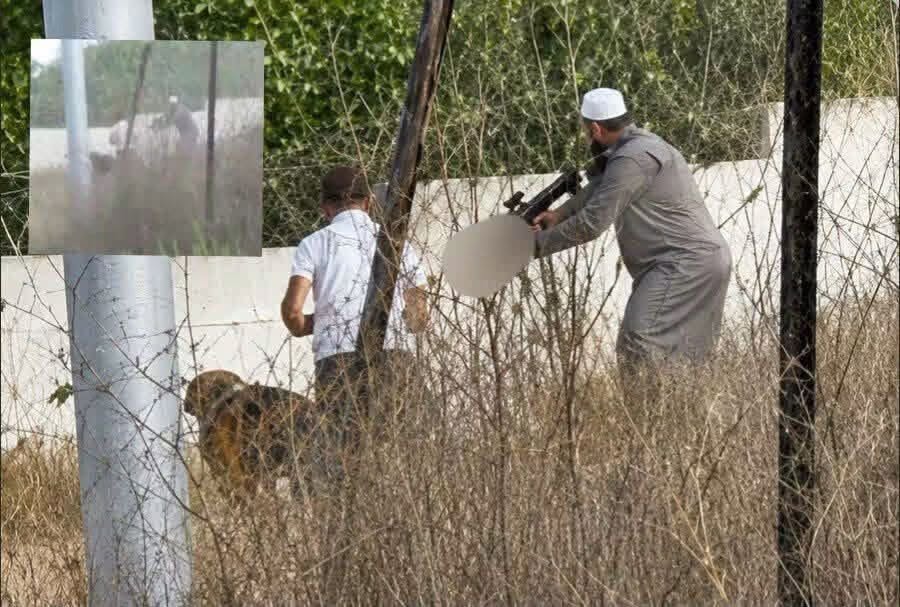
 marwan


 Dr Khairi Janbek




