Is Eyal Zamir ‘Restricting’ Raids on Gaza?

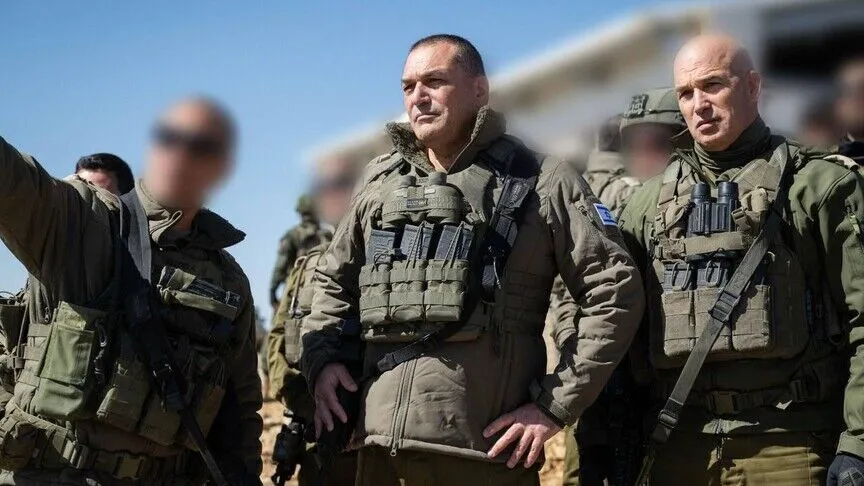
Israel’s official Broadcasting Corporation (Kan) claimed, Tuesday, that Israeli Chief of Staff Eyal Zamir ordered a restriction on airstrikes in the Gaza Strip. It stated he is now stipulating his prior approval for targeted assassinations of specific Palestinians.

However, it is also thought that the latest directive does not mean a halt to the military strikes, allowing the current Israeli forces in Gaza to continue them to stop any “immediate threats,” according to unnamed sources in the Israeli army’s Southern Command.

This comes as a result of pressure exerted by the “Council for Peace” for Israel to stop its attacks, with the aim of seeking ways to implement the roadmap of the next phase of the ceasefire agreement.

On Monday, the High Representative of the Council for Peace, Nikolay Mladenov, and the Council’s advisor, US official Aryeh Lightstone, asked Israeli Prime Minister Benjamin Netanyahu to halt the airstrikes on Gaza, in accordance with plan put forwards by US President Donald Trump last year.

As a result Kan reported that Zamir has “directed, in recent days, a restriction in attacks on the Strip.”

It quoted an unnamed security source as saying: “The forces operating in the Gaza Strip will be able to continue thwarting any immediate threat should danger be perceived.”

The source claimed that assassinating Palestinians whom Israel alleges were involved in the 7 October, 2023 attacks, but who do not pose an immediate threat, would require prior approval from Zamir.

The agency also quoted an unnamed military source as saying that the Israeli army “implements decisions at the political level.”

However, and contrary to talk of restricting airstrikes, the Israeli army killed two Palestinians, Monday evening, in an airstrike that targeted their vehicle in the Sheikh Ajlin area, southwest of Gaza City.

The bombing came hours after Mladenov and his team called on Netanyahu to stop the attacks, marking the first Israeli airstrike following the request.

Israel also killed 18 Palestinians in separate airstrikes on the Gaza Strip on Sunday, one of the deadliest days since the ceasefire agreement came into effect.

On Monday, Egypt, Qatar, and Turkey affirmed that the continuation of Israeli attacks constitutes a violation of the agreement and undermines efforts to implement its second phase.

Trump announced, Thursday, that an understanding had been reached regarding the implementation of the next phase of the agreement, while the “Peace Council” published the text of the roadmap on Friday.

The roadmap stipulates Israel cease its military operations, followed by the deployment of the Palestinian National Authority’s Gaza Administration and the international stabilization force, and the commencement of a phased process for dismantling and storing heavy weapons and dismantling tunnels, concurrent with a phased Israeli withdrawal.

It also stipulates that the weapons be placed under the responsibility of the Palestinian Authority and not be handed over to Israel or any non-Palestinian entity.

However, the Middle East Peace Council stated in a statement issued after the meeting between Mladenov and Netanyahu, Monday, that a complete Israeli withdrawal beyond the “yellow line” will only occur after the dismantling of light and heavy weapons and tunnels is completed.

This differs from the text of the roadmap published on Friday, which links the dismantling of weapons to a phased Israeli withdrawal and requires Israel to first fulfill its obligations under the ceasefire agreement, primarily the cessation of military operations.

In its response, Hamas stated that it adheres to what was agreed upon regarding the implementation of the second phase, including the obligations of all parties, and that it awaits a clear and official response from Mladenov and the mediators.

Two days ago, the Israeli newspaper Haaretz quoted an unnamed Israeli source as saying that Tel Aviv had informed the “Peace Council” of its rejection of three points in the Road Map.

These points relate to the non-destruction of weapons collected from Hamas, the participation of Qatar and Turkey in verifying the implementation of the Road Map, and the denial of freedom of action to the Israeli army in areas whose responsibility would be transferred to the international stabilization force.

Israel insists on not withdrawing completely before the dismantling of all weapons and tunnels, while it continues to occupy 70 percent of the Gaza Strip, amidst ongoing airstrikes and the killing of Palestinians.

Since the ceasefire agreement came into effect on 10 October, 2025, Israeli military attacks killed 1,252 Palestinians and injured 4,120 others, according to the Gaza Ministry of Health.

The agreement came after two years of a war of genocide launched by Israel on 8 October, 2023, which left more than 73,000 Palestinians dead and 174,000 wounded, most of them children and women, in addition to widespread destruction of civilian infrastructure according to Anadolu.

Continue reading
Gaza Pays Tribute to Late Arab Prince

Sheikh Hamad bin Khalifa Al Thani, the ex-Emir of Qatar, was not only associated with the transformation and modernization of the country, but also with the political and humanitarian stances he took on the Palestinian cause, and particularly the Gaza Strip. During his reign, he took steps to support the residents of Gaza and contribute to reconstruction and development projects, amidst the difficult humanitarian and economic conditions imposed by the blockade Israel imposed on the Strip and its repeated attacks.

Prominent Stances in the 2009 War on Gaza

Sheikh Hamad bin Khalifa Al Thani’s position became prominent during the Israeli war on the Gaza Strip in 2008-2009, when the emergency Arab summit called for by Qatar in Doha failed to convene due to a lack of quorum.

In a speech he delivered at the time, the Emir of Qatar expressed his displeasure at the absence of some Arab states from the summit, at a time when Gaza was under bombardment. His well-known phrase, “No sooner is the quorum for the Arab summit reached than it is lost. God is sufficient for us, and He is the best disposer of affairs,” will be best remembered.

The speech at the time represented a significant political stance, reflecting Qatar’s call for Arab action regarding the situation in the Gaza Strip, amidst escalating Arab and international criticism of the Israeli aggression.

A Historic Visit and Gaza Reconstruction Projects

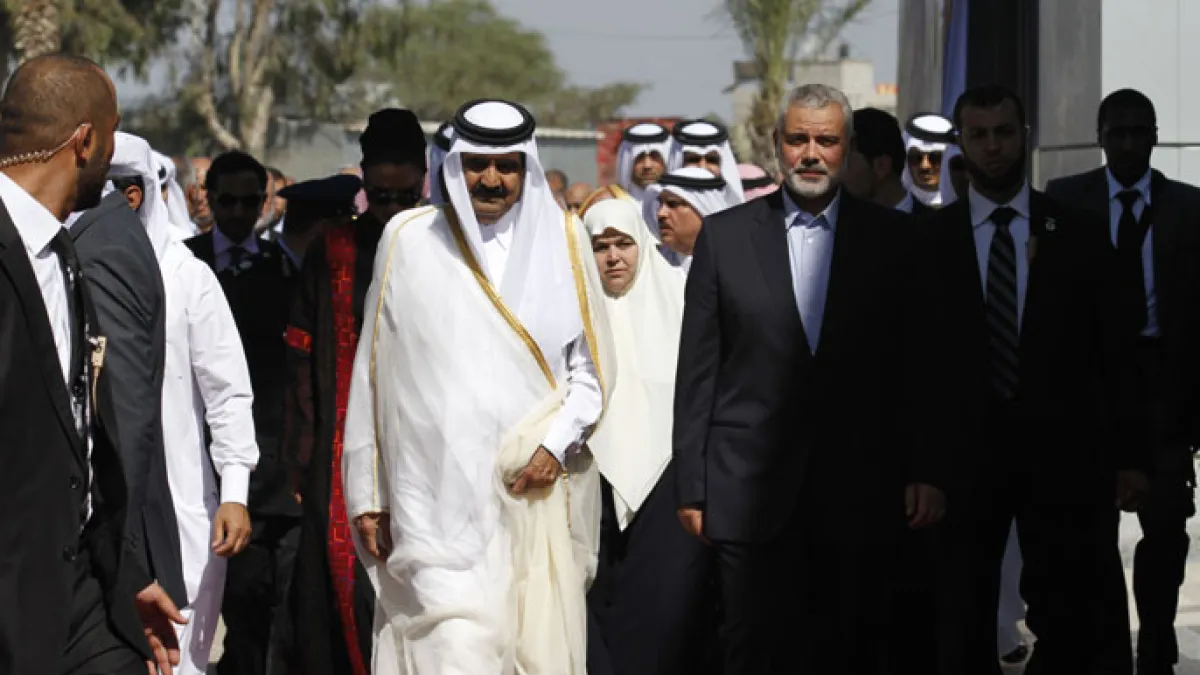
Sheikh Hamad bin Khalifa Al Thani gained a special place among Palestinians, particularly in the Gaza Strip, following his historic visit to the Strip in October 2012. He was the first Arab leader to visit Gaza since the imposition of the Israeli blockade.

Sheikh Hamad arrived in the Strip at the head of a high-level Qatari delegation that included the then Prime Minister and Foreign Minister, Sheikh Hamad bin Jassim bin Jaber Al Thani. He was greeted by a wide-ranging official and popular Palestinian reception, including the then Prime Minister of Gaza, Ismail Haniyeh, and a number of officials and leaders of Palestinian factions.

During the visit, Sheikh Hamad called for the implementation of Arab and international resolutions concerning the reconstruction of Gaza, emphasizing that the continued blockade and settlement activity were preventing a just solution to the Palestinian issue.

The visit witnessed the inauguration of several Qatari projects, part of a program to rebuild the Gaza Strip after the devastation caused by the 2008 Israeli war. The most prominent of these was the Sheikh Hamad Housing City in Khan Younis, which provided thousands of housing units for Palestinian families.

The Qatari grant for Gaza’s reconstruction at that time amounted to approximately $254 million, of which about $140 million was allocated to road and infrastructure projects, and $62 million to the construction of the Sheikh Hamad Housing City. The grant also funded health and agricultural projects, including the establishment of a hospital for prosthetics and rehabilitation.

The projects also included paving roads, developing infrastructure, and establishing health facilities, all aimed at supporting vital sectors and alleviating the burdens faced by the residents of the Gaza Strip.

A Legacy Emerging in Palestinian Memory

Following the announcement of the death of Sheikh Hamad bin Khalifa Al Thani on Sunday, many Palestinians recalled his stances toward Gaza, emphasizing that his support for the Strip and the reconstruction projects he launched had a profound impact on the population.

Researcher Ali Abu Rizq wrote on his X-linked account: “May God have mercy on the only Arab prince who visited Gaza, supported its people, and stood with its cause during the most difficult years of its siege. May God have mercy on the owner of Hamad City, which was a generous refuge for thousands in Gaza.”

Researcher Adham Abu Salmiya also wrote on his X-linked account that Sheikh Hamad “loved Palestine, and Palestine loved him in return. He championed its cause and stood with Gaza during the height of the siege. His honorable stances will never be forgotten.”

Journalist Mohammed Haniyeh noted on his X-linked account that Sheikh Hamad had a firm stance regarding Gaza during difficult times, recalling his call for an Arab summit during the 2009 war and his supportive positions towards the Strip under the siege as reported by Quds Press.

Continue reading
Youngest Palestinian Doctor Gets Guinness

Palestinian doctor Iqbal Al-Asaad has entered the Guinness World Records after graduating from medical school, earning her second world record after being named the youngest university student. At the age of 13, she enrolled at Weill Cornell Medical College in Qatar, completing her previous studies in the Bekaa Valley with distinction, thus rightfully earning the title of the world’s youngest doctor.

Continue reading
Israel Cannot Annex West Bank Says VP Vance

US Vice President JD Vance rejected Israel’s proposed annexation of the West Bank as a “stupid political stunt,” reaffirming Washington’s opposition to unilateral actions and commitment to the Gaza ceasefire.

US Vice President JD Vance delivered a sharp rebuke to Israeli lawmakers on Thursday, explicitly rejecting any annexation of the West Bank and characterizing the recent Knesset vote on the matter as “a stupid political stunt.” 

Speaking to reporters in Tel Aviv, Vance left no ambiguity about the Trump administration’s position regarding the occupied Palestinian territory.

Clear US Policy Statement

“If it was a political stunt, it was a very stupid political stunt, and I personally take some insult to it,” Vance said regarding the Knesset’s preliminary approval of a bill to impose Israeli sovereignty over the occupied West Bank.

https://www.palestinechronicle.com/israeli-knesset-approves-preliminary-reading-of-bill-to-annex-west-bank/embed/#?secret=OBbWh2L4xb#?secret=TLEUEm5JV2

He then delivered the administration’s definitive position: “The West Bank is not going to be annexed by Israel. The policy of the Trump administration is that the West Bank will not be annexed by Israel. That will continue to be our policy.”

Vance’s remarks came a day after the Knesset approved, by a vote of 25 to 24, a bill to impose Israeli sovereignty over the occupied West Bank.

Israeli National Security Minister Itamar Ben-Gvir welcomed the vote, saying: “The time to impose sovereignty over the West Bank has come now.” 

Meanwhile, the Likud party, which leads the ruling coalition, described the bill as “showy” and damaging to relations with Washington.

The US Vice President said that such unilateral steps “contradict Israel’s commitments to the peace process and international agreements,” and reiterated that Washington’s message to Israel was clear: The need to maintain the Gaza ceasefire and avoid any action that could reignite tensions.

‘Despite Exceptions’

Vance also addressed the situation in Gaza, affirming that both Hamas and Israel are respecting the ceasefire “despite some exceptions.”

He made clear that “the United States would not deploy American soldiers in the Gaza Strip,” reaffirming Washington’s commitment to maintaining the ceasefire and advancing reconstruction.

According to Vance, reconstruction efforts would begin in areas “free of Hamas,” but he cautioned that it was still too early to launch large-scale rebuilding. He added that the United States hoped to see the reconstruction of Rafah “within two or three years.”

On October 9, Hamas and Israel agreed to a ceasefire and prisoner exchange following indirect negotiations in Sharm El-Sheikh under US sponsorship and mediation by Qatar, Egypt, and Turkiye according to The Palestine Chronicle.

Continue reading