The Lebanese Health Ministry announced the total death toll from the Israeli military offensive, from 2 March to 17 June, 2026, rose to 3,884 martyrs and 11,856 people injured.
The Health Ministry stated, Thursday, these figures are the documented cumulative toll of victims from 2 March to 17 June, 2026, amidst the ongoing Israeli military operations and airstrikes on different Lebanese regions.
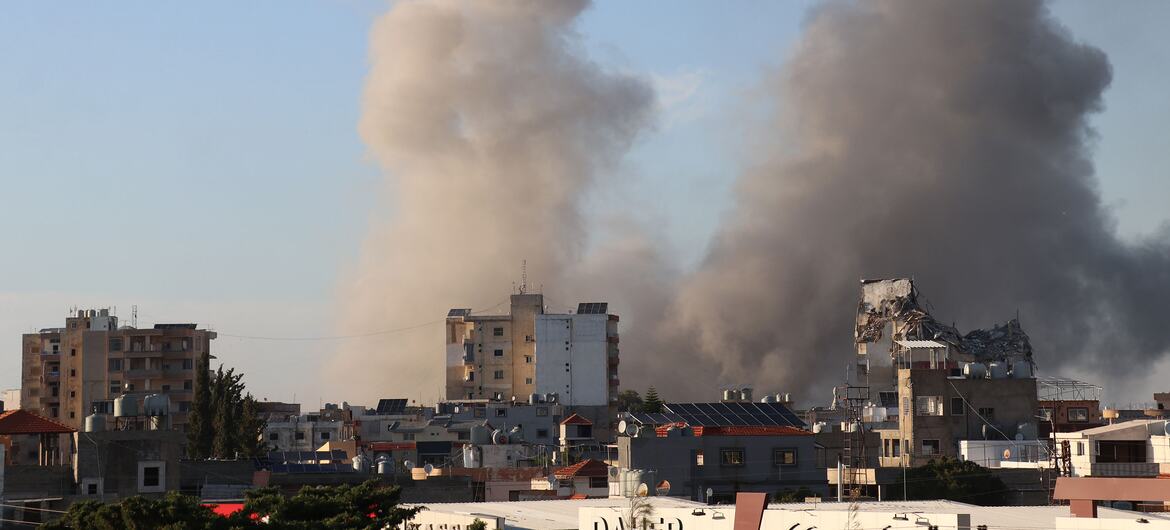
Israeli airstrikes and shelling are targeting towns and villages in southern Lebanon. This is whilst there are direct attacks on civilian vehicles, including the targeting of a car in the southern town of Zifta.
On the humanitarian front, reports issued by UNICEF indicate that the Israeli offensive is causing, on average, the death and injury of 11 children every day.
These developments coincide with intensive diplomatic and regional efforts aimed at reaching understandings to halt the fighting and end the military escalation on the Lebanese front.
Diplomatic circles have circulated information about anticipated meetings and negotiations between Lebanon and Israel, directly or indirectly, in Washington between 23-25 June, to discuss withdrawal and the cessation of military operations.
This escalation coincides with discussions and leaks regarding a non-binding memorandum of understanding between the United States and Iran, with Tehran asserting that any progress in the negotiation process requires a complete end to the war in Lebanon.
In the international context, diplomatic sources spoke of American pressure on Israel to adhere to the ceasefire, while France called for the immediate implementation of agreements related to de-escalation and respect for Lebanese sovereignty.
On the other hand, Hezbollah Secretary General Sheikh Naim Qassem affirmed the party’s adherence to its positions and stressing his rejection of the disarmament of the group.
Airstrikes, drone attacks and hypothermia continue in Gaza despite the ceasefire, with more than 100 youngsters killed since early October, the UN Children’s Fund (UNICEF) said on Tuesday.
“That’s roughly a girl or a boy killed here every day during a ceasefire,” UNICEF spokesperson James Elder told reporters in Geneva.
“These children are killed from airstrikes, drone strikes, including suicide drones,” he said, speaking from Gaza City. “They’re killed from tank shelling, they’re killed from live ammunition, they’re killed from [remote-controlled] quadcopters.”
Mr. Elder pointed out that more children have also died of hypothermia in the last few days, as harsh winter conditions expose the most vulnerable Gazans.
Sheer cold kills six children
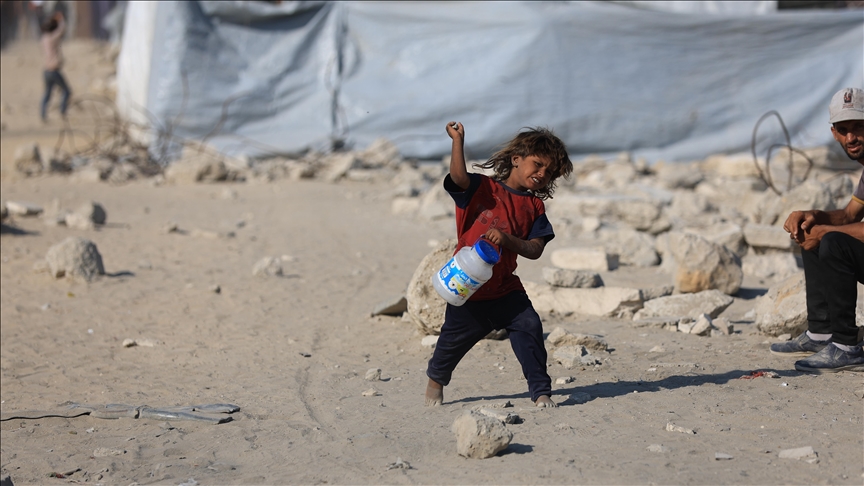
“We’ve now gone to six children who died of hypothermia just this winter,” he said. “I wish I could take a camera and show you 30, 40-kilometre [per hour] winds ripping through tents on the beach. It’s bitterly cold, it’s bitterly wet.”
The UNICEF spokesperson stressed that the ceasefire has allowed “genuine progress” in primary healthcare, with UNICEF and partners setting up the first health clinics in the north of the Strip and expanding immunization services.
But desperately needed medical evacuations of children remain at a standstill.
Mr. Elder noted “no noticeable improvement” both on approvals to get children with life-threatening injuries out of Gaza and in convincing more host countries take in the young patients.
He said that in his latest mission to the enclave, he spoke to many children and families denied evacuation despite completing an arduous, formal process.
These included a nine-year-old with shrapnel lodged in his eye who “will lose sight in an eye, maybe both”, a girl in Al Shifa hospital in Gaza City who “may well die” and another child whose leg needs amputating. “All three of those are absolute candidates for medical evacuation; all three of those have so far been denied,” Mr. Elder explained.
Before war erupted in Gaza following Hamas-led attacks in Israel on 7 October 2023, between 50 and 100 patients were evacuated from the enclave every day, according to the UN World Health Organization (WHO).
In an alert on Tuesday, the agency warned that extensive clearance procedures by the Israeli authorities continue to cause delays to deliveries of medicine and food.
“Some essential medical items are classified as ‘dual-use’ and denied entry,” WHO said in a post on X, in reference to goods that are primarily intended for civilian use but which the Israeli authorities believe could be diverted by Hamas or other militant groups for military purposes.
International NGO ban looms
The UNICEF spokesperson also highlighted the dangers of a recent Israeli ban on international NGOs, which will come into effect in the coming month and mean “blocking life-saving assistance”, he alleged. Mr. Elder also stressed the importance of allowing international media into the enclave, which has not been granted despite the ceasefire.
“There needs to be a lot more pressure on allowing international journalists to come in,” he said. “This is my seventh mission [to Gaza] and every time I see the 360-degree devastation, flattening of homes, my jaw drops.”
“It is absolutely as staggering yesterday as it was the first time I saw it more than two years ago,” he insisted.
Mr. Elder warned that two years of war have “left life for Gaza’s children unimaginably hard,” explaining that “the psychological damage remains untreated, and it’s becoming deeper and harder to heal, the longer this goes on”.
“A ceasefire that slows the bombs is progress, but one that still buries children is not enough,” he concluded as reported in UN News.
At least 82 children have reportedly been killed in Gaza since a ceasefire took effect in October, UNICEF said on Friday, warning of what it described as a “staggering pattern” of violence.
Speaking to reporters in Geneva, UNICEF spokesperson Ricardo Pires said: “UNICEF knows that reportedly, now, 82 children have been killed in Gaza since the 10th of October, which, again, is a staggering pattern, and it needs to stop.”
According to Gaza’s media office, at least 386 people have been killed and 980 others injured by Israeli army fire since the truce according to Anadolu.
The UN human rights office also reported more than 350 attacks since the ceasefire took effect, saying: “They were all in the vicinity of the so-called ‘yellow line,’ with at least 121 Palestinians killed, including seven women, 30 children and many other injuries.”
Although a ceasefire took effect on Oct. 10, living conditions in Gaza have not improved, as Israel continues to impose strict restrictions on the entry of aid trucks, violating the humanitarian protocol of the agreement.
Israel has killed more than 70,000 people, mostly women and children, and injured over 171,000 others in attacks in Gaza since October 2023, which have continued despite the truce.
Around $70 billion will be needed to reconstruct Gaza and make it safe after two years of war, UN development experts said on Tuesday, while aid agencies reported that far too little aid is getting in to meet the needs of desperate Palestinians.
At just 41 kilometres long (25.4 miles) and two to five kilometres wide (1.2 to 3.1 miles), few places in the Gaza Strip had been left unscathed by the constant Israeli bombardment before the latest ceasefire came into effect haltingly last Friday.
According to the UN Development Programme Special Representative for the Palestinians, Jaco Cilliers, destruction across the enclave “is now in the region of 84 per cent. In certain parts of Gaza, like in Gaza City, it’s even up to 92 per cent.”
$20 billion needed now
Speaking from Jerusalem, the UNDP’s Mr. Cilliers highlighted the findings of the latest Interim Rapid Damage and Needs Assessment (IRDNA) on Gaza by the UN, the European Union and the World Bank, which estimated the damage at $70 billion.
To kickstart the massive operation, some $20 billion will be required in the next three years alone, he told journalists in Geneva.
The UN development agency is present in Gaza alongside humanitarian partners to provide immediate support to the enclave’s 2.1 million people.
This includes providing clean water, emergency employment, medical supplies, solid waste removal and making homes and public spaces safe by clearing rubble potentially hiding unexploded ordnance or the many thousands of missing Palestinians.
“We’ve already removed about 81,000 tonnes. That is about…3,100 truckloads,” Mr. Cilliers explained. “The majority of the debris removal is to provide access to humanitarian actors so that they can provide the much-needed aid and support to the people in Gaza. But we also help with hospitals and other social services that need to be cleared of debris.”
The UNDP official pointed to “very good indications” from potential donors in support of reconstruction from Arab States, but also from European nations and the United States “which has also indicated that they are going to be coming in supporting some of the early recovery efforts”.
Immediate aid essential
Important as reconstruction is for Gaza’s long-term future, UN humanitarians once again clamoured for the Israeli authorities to open all access points into Gaza, after the remaining 20 living Israeli hostages were freed on Monday and Palestinian prisoners were released from Israel.
The development followed the signing of a ceasefire deal between Hamas and Israel signed on Monday evening in Sharm El-Sheikh by US President Donald Trump, and the leaders of Egypt, Qatar and Turkïye.
Earlier on Monday, UN Secretary-General António Guterres welcomed the release of all living hostages from Gaza, two years since they were among some 250 taken during Hamas-led terror attacks in Israel on 7 October 2023.
Gaza City testimony
Speaking to UN News from Gaza, UN Children’s Fund (UNICEF) aid worker Tess Ingram described the story of one family displaced five times by the war:
“I met a family today, Mustafa and Syeda and their children, and they told me that they were among the lucky ones because while Mustafa was pulling rubble out from the building, that is their home, at least he said, we have a home.”
The family was relieved on Monday at the appearance of a water truck, Ms. Imgram told us: “But they live in fear that truck might not turn up today or tomorrow. She also can’t get the medicine she needs and her sons had to walk a really long way today just to buy the basics that she needed to make some bread.
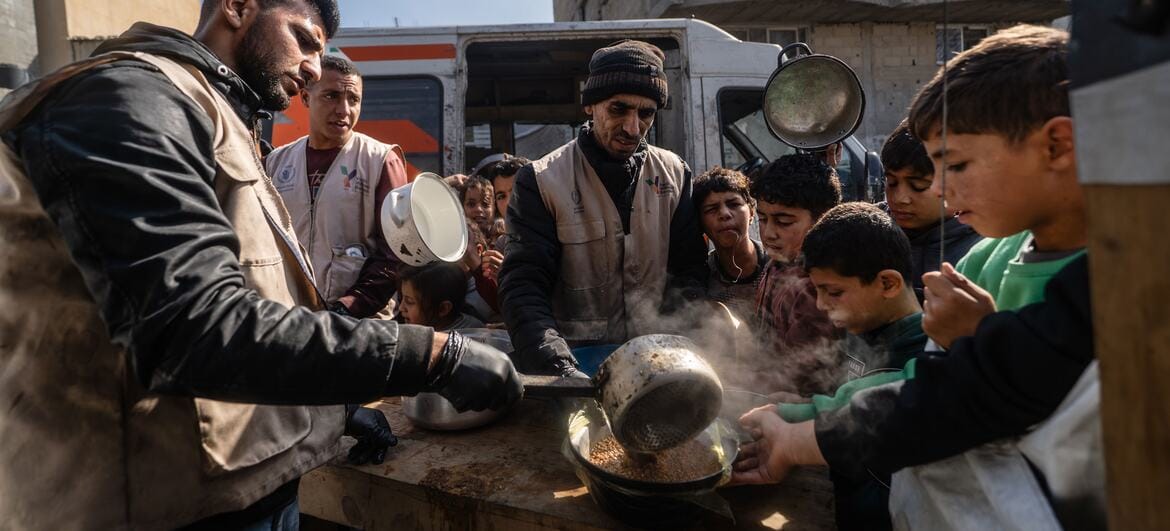
“Families need absolutely everything right now. We need the hundreds of trucks a day that were promised to get into the Gaza Strip.”
On Tuesday, the focus shifted to the transfer from Gaza of all deceased hostages, an extremely difficult process overseen by the International Committee of the Red Cross (ICRC). It remains unclear how many deceased hostages will be transferred by Hamas.
“When it comes to the living hostages or Palestinian detainees – and believe me that’s a big issue for us – we actually don’t know, we know that we have to be ready,” said ICRC spokesperson Christian Cardon, adding that the complex search is getting underway today.
In the meantime, needs in Gaza remain enormous and “fluid”, aid teams report, with more than 300,000 Palestinians heading north to Gaza City since Friday, as the ceasefire agreement seemed to hold.
“The enthusiasm that came from the international community, from people on the ground that this was the beginning of the end of all the suffering and things would change rapidly, is just not being reflected on the ground, day in and day out. We are not getting enough aid in,” said UN Children’s Fund (UNICEF) spokesperson Ricardo Pires.
The Israeli authorities have agreed to allow 190,000 tonnes of relief supplies into Gaza and UN agencies and their partners are scaling up operations rapidly, but a far greater amount is needed overall, humanitarian agencies including the UN aid office, OCHA, have said repeatedly.
“Of course, we are advocating with everyone, and we were there in Sharm El- Sheikh yesterday as well, with 22 heads of state of government, who we are asking to help us push all buttons you can to get this up and running as soon as possible,” said OCHA spokesperson Jens Laerke.
Aid hub carnage
Aid teams continue to insist that there needs to be a move away from handing out lifesaving supplies from remote areas including non-UN aid hubs that are difficult to reach and where hundreds of Palestinians have been shot or injured.
“Most of the actors – ICRC included – were not able to organize sufficient distribution of aid inside Gaza,” said Mr. Cardon. “And what we’ve seen instead, it’s people coming back from distribution sites being wounded, if not killed, in many instances…It’s about aid coming to the people and not any more people going to the aid,” as reported by UN News.
An average of over 540 children have been killed every month in Gaza since the resumption of Israeli attacks on the enclave in March, the UN Children’s Fund (UNICEF) said Tuesday, as the UN agency for Palestinian refugees (UNRWA) warned that its shelters have become “places of death” for civilians.
“In Gaza, UNRWA schools have become shelters for hundreds of thousands of people,” UNRWA said in a statement on the US social media company X according to Anadolu.
“People sought protection under the UN flag only for these shelters to become a place for death, including for too many children.”
“No place is safe for children in Gaza,” the statement added, calling for an immediate ceasefire.
UN agencies have warned of the devastating impact of Israel’s ongoing military campaign on Gaza’s children, as schools, hospitals, and homes are being relentlessly targeted.
According to Gaza’s Health Ministry, famine has killed at least 266 Palestinians, including 112 children, since October 2023, amid a worsening blockade and severe aid shortages.
Israel has killed more than 62,000 Palestinians in Gaza since October 2023. The military campaign has devastated the enclave, which is facing famine.
Last November, the International Criminal Court issued arrest warrants for Israeli Prime Minister Benjamin Netanyahu and his former Defense Minister Yoav Gallant for war crimes and crimes against humanity in Gaza. Israel also faces a genocide case at the International Court of Justice for its war on the enclave.

 CrossFireArabia