Keeping Israel’s Secret in The Closet

Israel continues, in a deliberate and institutionalised manner, to implement a systematic policy aimed at erasing physical evidence of genocide, war crimes, and crimes against humanity committed over the past two years in the Gaza Strip. This policy is carried out through a series of field and administrative measures, including the prevention of international journalists and independent investigation committees from entering Gaza, in an attempt to obstruct any criminal investigation or field documentation that could establish the truth and confirm Israel’s legal responsibility.

The recent decision by the Israeli Supreme Court granting the government an additional delay regarding the entry of independent journalists into Gaza reflects the institutional complicity within the Israeli state apparatus in concealing crimes and protecting their perpetrators. The judiciary thus provides a legal cover for government policies designed to suppress transparency and erase field evidence of crimes committed in Gaza.

The continued prevention of international journalists and investigators from entering Gaza forms part of a consistent and coordinated policy exercised by Israeli authorities through their executive, security, and judicial arms to keep the crimes beyond international scrutiny and obstruct any independent accountability or investigation into the grave violations committed.

The ongoing ban on independent journalists entering Gaza represents a long-standing Israeli policy since the beginning of the military assault on the Strip. It aims to deprive the world of witnessing the reality on the ground by imposing a complete media blackout and preventing all documentation and international monitoring tools from accessing the crime scenes.

Despite the enforcement of the ceasefire agreement on 11 October, Israel continues to deny entry to international journalists, except for limited tours organised under the supervision and escort of the Israeli army. As a result, all scenes shown from the field remain under military censorship and devoid of the independent coverage guaranteed by international standards of press freedom.

The killing of 254 Palestinian journalists and the ban on the entry of international media workers exemplify an integrated Israeli policy aimed at concealing the truth and monopolising the narrative by maintaining tight control over the media scene and preventing any independent oversight or field documentation. This policy not only withholds information but also strips victims of their right to tell their story to the world, turning their tragedy into a one-sided account narrated by the very perpetrator of the crime.

Israel’s actions to erase evidence of genocide include continuing to prevent the entry of the UN-mandated Independent International Commission of Inquiry on the Occupied Palestinian Territory, the investigation team of the International Criminal Court, as well as fact-finding missions and other international mechanisms specialised in investigating grave crimes. This deliberate obstruction of international justice constitutes a violation of Israel’s obligations under international humanitarian law.

Israeli authorities also block the entry of forensic teams and forensic anthropology experts who should secure crime scenes, examine human remains, and document biological and physical evidence proving mass killings, genocide, and the use of prohibited weapons and projectiles. This obstruction undermines a fundamental pillar of international criminal investigation, aiming to destroy material evidence before examination, deny victims and their families the ability to identify their loved ones, and prevent the international community from verifying the nature and scale of the crimes committed.

Israel further refuses to allow the entry of essential equipment and materials needed for exhuming bodies and identifying victims, including laboratory tools, autopsy instruments, and DNA analysis kits. This has left hundreds of bodies unidentified and deprived families of their basic human right to know the fate of their loved ones and bid them farewell with dignity.

Among these are around 195 bodies that Israel handed over without any details about their identities or circumstances of death, many of which showed clear signs of torture and summary execution. These findings indicate extrajudicial killings and inhumane treatment of Palestinian detainees and prisoners, including those subjected to enforced disappearance.

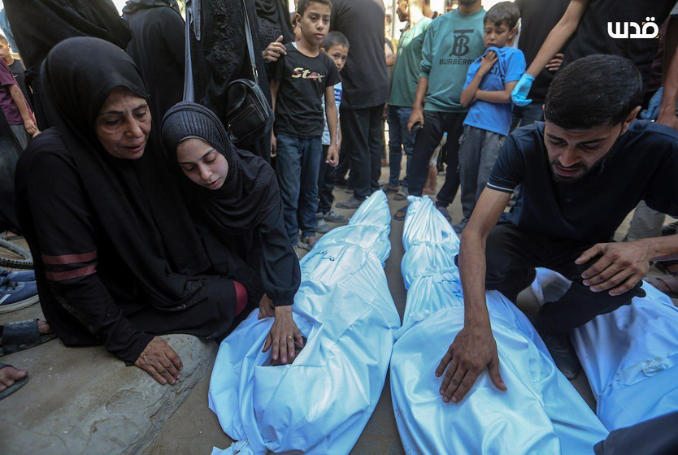
The continued retention of bodies and prevention of independent investigations constitute an additional form of collective punishment against Palestinian families, denying victims their basic human right to be identified and buried with dignity.

Israel has also carried out the total erasure of several cities, towns, villages, camps, and residential blocks where horrific mass killings occurred. Satellite images and field testimonies documented show that Israeli forces removed the surface layers of the ground, levelled targeted areas, destroyed rubble, and transferred it to unknown locations, effectively erasing potential physical evidence such as munitions remnants, bodies, original patterns of destruction, and explosion traces.

Israel continues to exercise full, unlawful military control over roughly 50 per cent of the Gaza Strip, reshaping the geography entirely through demolitions, bombardments, and bulldozing, and establishing new military routes and bases atop the ruins of destroyed buildings and farmland. This goes beyond military occupation, amounting to an engineered redesign of the field landscape to erase material evidence and prevent future verification of the crimes committed.

Israeli military deployment in these areas, coupled with the targeting of anyone approaching what it calls the “yellow line”, effectively isolates half of the Strip and turns it into a no-go zone, blocking journalists, researchers, and humanitarian teams from entering and preventing any genuine field documentation of the mass killings and widespread destruction that took place there.

Such acts constitute a flagrant violation of fundamental principles of international humanitarian law, which obligate parties to a conflict to preserve crime scenes until independent investigations are completed and to ensure that evidence is not tampered with. They also contravene the International Court of Justice’s ruling obligating Israel to take all necessary measures to prevent genocide, including preserving evidence and preventing its destruction.

Israel continues to withhold hundreds, possibly thousands, of bodies, including those of Palestinian prisoners and detainees killed under unclear circumstances, preventing autopsies and forensic examinations that could verify causes of death. This is a blatant violation of Article 130 of the Third Geneva Convention, which obliges occupying powers to respect the remains of the deceased and return them to their families without delay.

Denying victims justice and preventing the world from knowing the truth are not merely additional violations but an extension of the crime of genocide itself. Through these actions, Israel seeks to erase the traces of its crimes, obliterate collective memory, and strip Palestinians of their right to narrate their story and existence, attempting to eliminate both the victim and the evidence of their existence.

The international community and relevant United Nations bodies must ensure the immediate entry of international journalists and correspondents into the Gaza Strip and enable them to work freely and independently, without military oversight or escort. This is essential to guarantee transparency, expose the truth about the crimes committed, and allow urgent international access for forensic experts and specialists in forensic anthropology and explosives to secure crime scenes and collect physical and biological evidence before it is lost or tampered with.

Reconstruction and debris removal in areas where massacres occurred must be carried out with full consideration of evidence preservation and documentation, as any reconstruction effort that fails to do so will effectively serve as a tool to erase the truth and destroy the forensic memory of the crimes committed.

The international community and UN agencies are urged to support the establishment of a specialised framework for managing Gaza’s debris that links reconstruction and dismantling processes to the preservation and documentation of evidence—making adherence to this framework a prerequisite for any construction or debris removal activity.

There is also an urgent need to disclose the lists of the forcibly disappeared, missing persons, and bodies, reveal burial locations, return remains to their families, and allow international and UN mechanisms to conduct independent investigations into the crimes committed. Perpetrators must be brought to justice before international courts to ensure accountability, compensation, and redress for victims and their families.

The UN Human Rights Council should act swiftly to activate and reinforce existing monitoring and investigation mechanisms, enabling them full access to the Gaza Strip to protect crime scenes and ensure that evidence is not destroyed or altered. These mechanisms must be provided with the necessary technical and logistical support to operate independently and effectively.

The International Criminal Court must expand its ongoing investigation into the situation in Palestine to include the ongoing genocide and the systematic erasure of evidence, and take practical measures to protect crime scenes and related evidence. This includes establishing a dedicated field office for Palestine, similar to the one created for Ukraine, to coordinate on-site investigations, collect forensic evidence, and ensure continuous international oversight over the investigation process.

Any delay in such intervention will grant Israel more time to complete the destruction of evidence and the physical traces of its crimes, undermining the international community’s duty to protect truth and uphold justice. Saving the truth in Gaza is no longer merely a moral obligation, but a legal and humanitarian imperative that cannot be delayed.

EuroMed Human Rights Monitor

Continue reading
Thirty Minutes in a Gaza Hospital

By Daniel Johnson

 Peace and Security

UN aid teams on Friday highlighted the disturbing situation in Gaza’s makeshift hospitals, where premature babies cry for scant oxygen and medics attempt to save child survivors targeted by airstrikes in their tents and quadcopter victims reportedly shot while fetching bread. 

Speaking from the war-shattered enclave amid the ongoing Israeli military push to take full control of Gaza City, UNICEF spokesperson James Elder described one short visit to a hospital where youngsters were either suffering or dying everywhere he looked.

As we’re talking to the surgeon there, she dies on the bed in front of us

One victim at Al Aqsa Hospital in Deir Al-Balah, central Gaza, was six-year-old Aya, injured by an airstrike. “I’m really noticing not just the wound, but the attention that the bobs in her hair, the care that a parent’s given before the airstrike,” he said. “As we’re talking to the surgeon there, she dies on the bed in front of us. That’s 30 minutes in a hospital.” 

No space to move

At the same hospital, Mr. Elder reported seeing three children “all shot by quadcopters” – an attack drone with four propellers.

It’s a war zone, children … bleeding out on the floor with others wounded by shooting, shrapnel or burns.

The UNICEF spokesperson underscored reports that 1,000 infants have been killed in the last two years in Gaza since Hamas-led terror attacks in Israel triggered the war. “We have no idea how many more have died from preventable illnesses,” he continued.

With only around 14 of Gaza’s 36 hospitals still open and partially functional after almost two years of war, they are often “absolutely packed” with people needing help, Mr. Elder stressed.

Rescued, terrified

“I turn around and there’s a little girl, Sham, who has just been pulled from the rubble; so, she’s covered in that dust and smoke with that terrified expression on her face, being held by an aunt or an uncle… Now Sham didn’t have any broken bones nor internal injury, [she] was not told though, that her mother and her sister were both killed in that attack.”

Turning to Gaza City, the veteran UN aid worker stressed that many thousands of people remain there unable to leave, amid continuing Israeli evacuation orders airstrikes that have left children “shuddering” and gazing skywards “to track the fire” from helicopters and quadcopters.

You’ve got shoeless children who push grandparents around the rubble, amputee children are struggling through the dust, mothers are carrying exhausted children – literally their skin is bleeding because of the severity of rashes,” Mr. Elder continued, before warning about “continued indiscriminate attacks in densely populated civilian areas despite official statements”.

Another aid worker killed

On Thursday, the NGO Médecins Sans Frontières (MSF) confirmed the killing in Gaza of its fourteenth medical worker, occupational therapist Omar Hayek, in an attack that also injured four of his colleagues in Deir Al-Balah.

Until 13 September he had worked at an MSF clinic in Gaza City before finally evacuating amid “relentless attacks and forced displacement from Israeli forces”, the NGO maintained.

“People are scared and rightly so…“If you ask me now, can we do our work? I say no, of course we cannot do our work in the north,” said Dr Rik Peeperkorn, UN World Health Organization (WHO) Representative in the Occupied Palestinian Territory.

The level of violence in Gaza is such that nowhere is safe, including field hospitals, which offer no protection from stray bullets, said Christian Cardon from the International Committee of the Red Cross (ICRC).

“We had several occasions of people being injured, brought to the hospital and while they were being treated, were wounded again because of stray bullets coming in the hospital,” he said, noting another such incident on Thursday according to UN News.

Continue reading
Day in The Life of a Displaced Person

By Shaimaa Eid

Al-Mawasi was no refuge, just another stop in a long journey of suffering, where life is not truly lived, but merely endured.”

Once again, we were forced to leave northern Gaza under a relentless storm of shelling, fear, and destruction—beginning yet another displacement heavy with exhaustion and loss, this time toward Al-Mawasi in Khan Yunis.

There, in the place the occupation claimed was “safe,” with access to water, medicine, and basic humanitarian needs, we found only land overwhelmed with displaced families, weary faces, and recurring pain. Al-Mawasi was no refuge, only another stop in a long journey of suffering, where life is not truly lived, but merely endured.

Our joy at touching the walls of our home again did not last long. It was the same home that had been struck by Israeli shells during the ceasefire. We returned carrying hope, trying with our tired hands and hearts to clear the rubble, to wipe the dust off memories, to bring back a trace of the home’s old heartbeat.

https://www.palestinechronicle.com/zikim-where-gazas-starving-risk-death-for-a-bag-of-flour/embed/#?secret=hkQtHyPQMx#?secret=JUrIg7YhuK

We believed that love would be enough to stay—that holding on to our home, even with all its wounds, was the least we could do. As a family, we made a promise: we would not leave, we would stay as long as we had breath in our bodies.

But the occupation, with its violence and arrogance, stripped us of even that right. And once again, we were left with nothing but the bitterness of forced departure.

In the Sheikh Radwan neighborhood, we were trapped under fire from quadcopter drones. They shelled and chased every movement, making it impossible to open the door or even glance through a window. We lived through endless nights of terror, listening to the constant buzzing above our heads, counting the seconds until the next missile would strike.

Then the occupation installed a crane-mounted sniper position to the east of the neighborhood, targeting anyone who moved through the streets. It felt as though they had surrounded us with a fence of fire, suffocating our lives, tightening the noose around us, and forcing us once more toward displacement.

https://www.palestinechronicle.com/he-loved-dabke-the-sea-and-his-neighbors-why-did-israel-kill-ahmeds-smile/embed/#?secret=eeZQnIwQGb#?secret=U9loLLPZkp

The final days before our departure felt like the horrors of Judgment Day. Many of our neighbors received evacuation warnings, followed by devastating shells. The smell of gunpowder and smoke still lingers in my nose to this day, and I continue to struggle with breathing from the intensity of what we endured. We were cut off from water and food; markets were closed; even street stalls became targets for bombs dropped by planes at night. We had no choice but to flee southward to escape certain death.

The journey of displacement was harsh in every detail. My elderly parents, burdened by chronic illness, could not endure the long road. We carried their worries in our hearts before carrying them in our arms. Our trip from the north to the south took nearly six hours under a blazing sun, along the Rashid Road, which the occupation designated as the evacuation route.

On the way, we witnessed a scene that will never be erased from memory: a tent on the beach shelled right before our eyes, with bodies scattered across the sand. We were only meters away, yet that distance was enough to rob us of sleep forever. Even now, whenever I close my eyes, that scene returns to wake me.

After the exhausting journey, we arrived at the Khan Yunis displacement camp. The place was unbearably overcrowded. Services were scarce, far too few for everyone. People were forced to go down to the sea under the scorching sun to collect salty water, which led to the spread of skin diseases among both adults and children. Watching people fill bottles from the sea felt like a scene from an apocalyptic novel. Everything here is difficult: sleeping, eating, getting medicine—even finding a small patch of shade to rest beneath has become a challenge.

https://www.palestinechronicle.com/when-i-slept-hungry-my-testimony-on-the-exhausting-hunger-in-gaza/embed/#?secret=uplV36BtBi#?secret=1GUEWWdOJK

Today, we live in a whirlwind of anxiety and fear. Every day, we watch the news of new residential towers collapsing in Gaza. We go to sleep wondering: will our home still be standing, or will it too become rubble? My parents need ongoing medical care and medications that we cannot find.

I feel powerless and frustrated at my inability to secure their medicine, and at our family’s helplessness in the face of this relentless tragedy.

And yet, despite all this, there is an inner voice that refuses to give in. It whispers to me that Gaza will endure, and that one day we will return to the north to rebuild, stone by stone, raising our homes again with our own hands. That voice tells me this land will remain free and proud, no matter how long the destruction lasts, and that all this pain is but a chapter in the story of resilience.

Gaza is bleeding today, but it will not break. The Gaza I bid farewell to—with hope of return—will always remain in my heart a symbol of dignity and pride, until every displaced person comes home, every child returns to school, and every family reunites with its memories.

(The Palestine Chronicle)

– Shaimaa Eid is a Gaza-based writer. She contributed this article to the Palestine Chronicle.

Continue reading
Voices From Gaza: 700 Days of ‘Hell’

The Israeli genocide starting on 27 October, 2023 through mass bombs and missiles dropped on the Gaza Strip is being discribed as hell-on-earth. After 700 days of slaughter in which the enclave was reduced to ruin, debris and mass killings, Gazans speak of the “hell” they are going through between multiple and countless displacements, starvation and waiting in limbo for what is going to happen next. Their lives have been turned upside down and live in limbo of fog.

All the above interviews were conducted by Al Jazeera satellite channel on the 700 days of horrors the Israeli army has subjected the Palestinian civilians of Gaza to.

“700 days and the killings are still going on with the war taking everything from us,” said one man. “The blood of martyrs is still hemorrhaging,” he continued.

“I now envy the people who have died in this slaughter,” said another. “In this past 700 days, journalists were killed, civil defense men gone, hospitals bombed, children murdered and many other things disappeared…”

After 700 days there is nothing left, there is no children left, no food,  no drink, starvation everywhere, life has become extremely difficult. I have started to say to myself I wish I was long dead and have left this sorry place,” said another woman.

What about the handicapped

‘“I have three teenager sons who are handicapped and the process of displacement with them is very difficult…we were forced to move by the Israeli army more than 15 times – I walked them, I sometimes carried them would you believe, there is no transport and walked under bombs and missiles, sometimes they’d fall very near us, the danger of being killed is real,” the father of the three said.

“There is no food, no drink, there is no place to live, the sewerage is bad, we can’t do anything.”

He added on this 700 day of living like this, the Israeli army has just called on us to keep moving. “They want to displace us yet again from the north to the south, what is next we don’t know. 

We don’t have food, we don’t have water, we don’t have tents, we don’t have anything. On the 700 day, the world is just sitting and looking at us while we move from one place to another.

Another 30-year-old who lost her husband and five children and just stares into the void: “Now they are gone I feel life is empty and meaningless. I force myself to work just to forget but its like living in a distant memory and suddenly wake up to this nightmare. 

Another man with five small children moving around him said: “I have a handicapped son – a grown up, as you can see and I have to carry him across my shoulder blades whenever we are ordered to keep moving.

We are at the end of our tethers after 700 days of devastation, we see death in front of our eyes, there is no let up, the kids keep screaming at all hours of the day and night. We don’t know what is going to happen to us and now we are called upon to keep moving.”

The same is true of another lady. Her plight is the same as many others. “We are being displaced from one place to another. After 700 days we are not able to settle down to establish a tent we can live in, being displaced is like losing one’s soul and I don’t know when this will end or how.

We are living in devastation, death, slow death. Today I envy the people who have died and become martyrs.” 

Another man in crutches said: “Our savings have now ended, we are on aid to say alive, my son used to go to Zakim to get some stuff but they shot at him and now sit by me unable to move.

Blood on the streets

“The past 700 days were the deadliest, killings, bombing, starvation, you see blood seething on the streets, laying bodies of martyrs, people with no legs or arms”.

It has been an extremely difficult 700 days for a woman with the responsibility of looking after three children. “How do I cope, how do I make ends meet. My husband went before my eyes, in front of his kids, I saw, my kids saw an incredible sight of their father spluttering on the wall and now that image never leaves me nor them.

In this 700 days you lost a brother, a relative, a friend as you were forced to move from one place to another in between charities, water queues, cutting wood and all the rest of it. I just can’t describe it,” said one young man.

Sullen future

“For me, my future has perished, gone up in flames, I could have been working by now, having just finished university, but I live in a 4 by 6 tent with nothing to look forward, searching for morsels of food and hewing water, carrying buckets of water not just today but everyday, said a young lady.

Nothing is for certain. The people of Gaza, as of yet, have nothing to look forward to but more slaughter. There is a nagging fleeing, frequently made by Israeli ministers, that the aim is to push these people dubbed at around two million to other countries.

But the Gazans, still after two years of slaughter and going to the third, say they are not leaving Gaza except as dead bodies.

Continue reading
Explosive Robots: Destroying A City

The Israeli army is destroying about 300 residential units daily in Gaza City and Jabalia, using around 15 robots carrying nearly 100 tonnes of explosives.

These bombings are taking place at an unprecedented pace, aimed at destroying Gaza City and displacing its residents, as part of a dangerous escalation of the ongoing genocide against Palestinians in the Gaza Strip for nearly 23 months.

Euro-Med Monitor’s field team documented the Israeli army’s intensified use of armoured, explosive-laden robots to demolish residential areas at an accelerating pace. Most homes and infrastructure in Jabalia al-Balad and Jabalia al-Nazla have already been destroyed, while the army advances with comprehensive destruction toward the heart of Gaza City from the south, east, and north.

Since the Israeli army announced last Friday, the end of what it called a “temporary humanitarian ceasefire” in Gaza City, which it claimed applied during daylight hours, Euro-Med Monitor’s field team has documented a doubling in the number of explosive-laden robots detonated, from about seven to nearly 15 per day.

Each of these robots is loaded with highly explosive materials, sometimes weighing up to seven tonnes, and is directed to detonate in Jabalia al-Balad and Jabalia al-Nazla north of Gaza City; the Zeitoun, al-Sabra, al-Shuja’iyya, and al-Tuffah neighbourhoods south and east of Gaza City; as well as the al-Saftawi and Abu Iskandar areas northwest of Gaza City.

The unprecedented pace of destruction of residential neighbourhoods in Gaza City using explosive-laden robots indicates Israel’s determination to wipe the city off the map. At the current rate, the rest of the city could be destroyed within two months, a timeline that may shorten further given the Israeli army’s massive firepower and the absence of any pressure to halt its crimes against Palestinians.

After preliminary assessments of the robot attacks, Euro-Med Monitor estimates that each robot can completely or partially destroy around 20 housing units. This will soon leave hundreds of thousands of people without homes or shelters, forcing them to flee once again in deadly conditions, without even the bare minimum for survival.

The robots used in the bombing are essentially Israeli military vehicles, such as outdated M113 armoured personnel carriers, loaded with tonnes of explosives and remotely piloted through civilian neighbourhoods. They are directed to explode in carefully selected locations to maximise destruction. In some cases, the robot is not rigged to detonate but is fitted with large boxes of explosives that are unloaded at the target site, after which the vehicle is returned to base for reuse in other operations. This reflects an organised military strategy aimed at systematically destroying residential neighbourhoods and maximising the scale of devastation.

The catastrophic impact of explosive-laden robots extends beyond the physical destruction of residential neighbourhoods to the systematic use of psychological terror against civilians. The Israeli army deliberately detonates most of these robots late at night or at dawn to spread fear and panic and force residents to flee. The explosions produce deafening sounds that shake Gaza City, while the remaining buildings shudder under the violent blast waves, deepening the population’s suffering and turning daily life into a constant state of terror and insecurity.

The sound of explosions from these robots often carries beyond the entire Gaza Strip, heard at distances of over 40 km from the blast site. This demonstrates the immense destructive force of such weaponry, which Israel employs to wipe out cities in the enclave.

The international community’s blatant inaction and complicity, together with the refusal of influential states and relevant UN and international bodies to hold Israel accountable, have enabled it to carry out the destruction of Gaza City openly, without even attempting to invoke legal justifications to legitimise the crime.

Such blatancy was illustrated by Israeli Defence Minister Israel Katz’s statement on 22 August, when he declared: “If they [Hamas] do not agree to Israel’s terms, Gaza will become Rafah and Beit Hanoun. Just as I promised – so it will be.”

The first documented use of robots by the Israeli army to destroy residential areas occurred during the two campaigns against the Jabalia refugee camp in the northern Gaza Strip in May and October 2024, before their deployment expanded to other areas across the Strip.

Israel’s use of explosive-laden robots is explicitly prohibited under international humanitarian law, as they are inherently indiscriminate weapons incapable of accurately targeting military objectives. Their wide-area explosive effect directly and indiscriminately impacts civilians and civilian objects, in blatant violation of the principles of distinction and proportionality, which form fundamental pillars of international humanitarian law.

These weapons fall under the category of prohibited arms, and their use in populated areas constitutes both a war crime and a crime against humanity, as they cause widespread killing, forced displacement, and deprivation of basic living conditions as part of a systematic or widespread attack on the civilian population.

Moreover, the systematic use of such robots, as currently practised to destroy residential neighbourhoods and strip residents of their homes and livelihoods, makes them a direct tool for committing genocide. This pattern of destruction clearly falls within the acts defined in the Genocide Convention, specifically the intentional infliction of conditions of life calculated to bring about the destruction of the group, in whole or in part.

The use of these destructive methods, primarily robots, not only causes loss of life and forces residents into deadly displacement but also seeks to obliterate residential neighbourhoods and infrastructure entirely, erasing any possibility of life in Gaza City and undermining Palestinians’ future, along with their inherent right to remain on their land and return to their homes.

Explosive-laden robots are only one of the methods used by the Israeli army to wipe out cities in the Gaza Strip. They form part of a broader arsenal of destructive tools, including aerial bombardment with missiles and heavy bombs, continuous artillery shelling, the dropping of bombs and explosive packages from drones, the deliberate booby-trapping and detonation of buildings, and the use of military and civilian bulldozers to raze structures or what remains of them.

More than one million Palestinians in Gaza City face an existential threat as Israeli destruction, starvation policies, and forced displacement persist, amid the international community’s unjustifiable silence on this unprecedented crime.

The UN General Assembly must urgently act under Resolution 377 (V) “Uniting for Peace”, which authorises it to address situations where the Security Council fails to act due to a lack of unanimity among its five permanent members. Under this resolution, the General Assembly may issue recommendations to UN member states for collective measures to ensure the restoration of international peace and security.

The General Assembly must urgently act under the aforementioned resolution to establish and deploy an international peacekeeping force in the Gaza Strip. This step is necessary to end crimes against civilians, guarantee their protection, secure unhindered access to humanitarian aid, safeguard medical and relief facilities, and stop the systematic targeting of such facilities. Activating this mechanism is both a legal and moral duty of the international community to protect over two million people in Gaza from ongoing genocide and grave violations.

All states, individually and collectively, must fulfil their legal obligations and act urgently to stop this genocide in Gaza, taking every feasible measure to protect Palestinian civilians there. They must enforce Israel’s adherence to international law and the rulings of the International Court of Justice and hold Israel accountable for its crimes against Palestinians.

Israel must be held accountable for its crimes against Palestinians before both international and national courts. This includes, without waiver, enforcing the arrest warrants issued by the International Criminal Court for the Israeli Prime Minister and former Minister of Defence at the earliest opportunity and surrendering them to international justice to stand trial for crimes against humanity and war crimes committed against Palestinians in the Gaza Strip, including killing, persecution, other inhumane acts, and the use of starvation as a method of warfare.

The international community must also impose economic, diplomatic, and military sanctions on Israel in response to its systematic and grave violations of international law. This includes banning weapons exports to Israel and halting arms purchases from it; suspending all forms of political, financial, and military support and cooperation; freezing the assets of officials involved in crimes against Palestinians or inciting such acts; and imposing travel bans on them. Moreover, trade privileges and bilateral agreements that grant Israel economic advantages, enabling it to commit crimes, must be suspended.

Continue reading