Released Captive Edan Alexander Rejoins Israeli Army

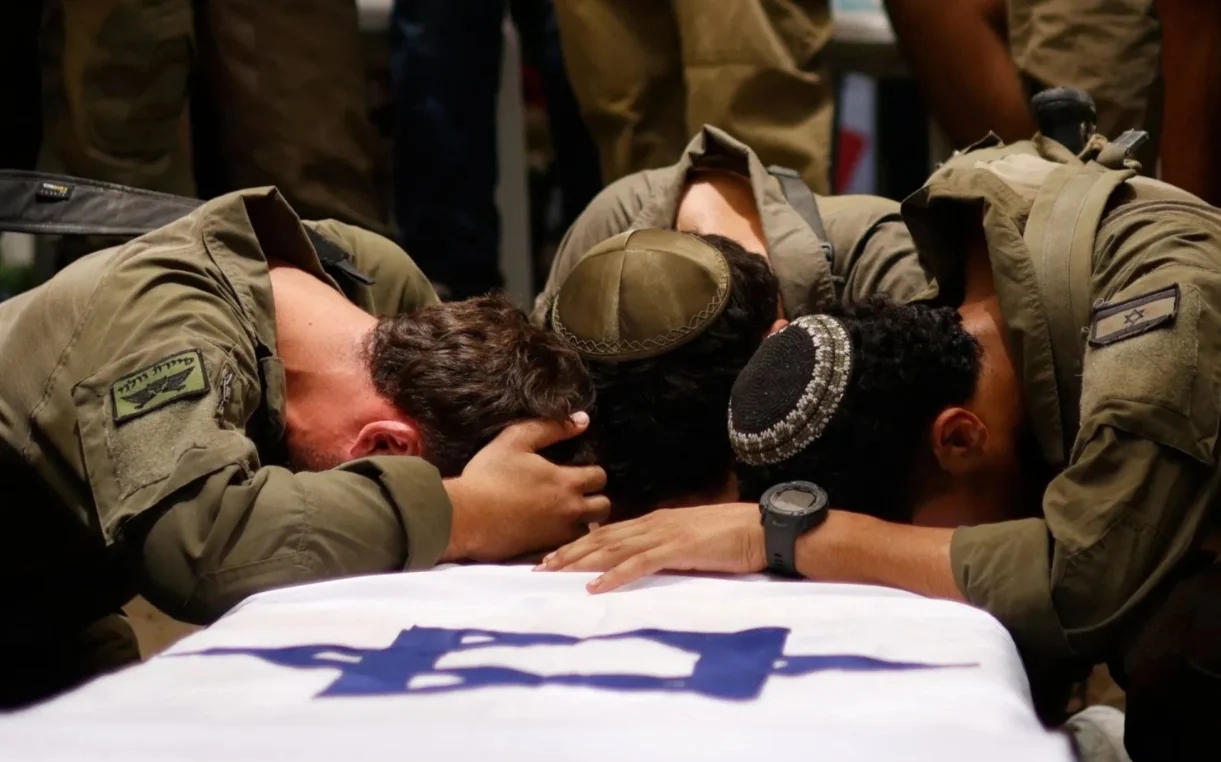
Edan Alexander, an Israeli-American soldier released from imprisonment, announced he will return to Israel next month to rejoin the Israeli military as it continues its genocide in Gaza.

Alexander spent 584 days in inprisonment, which he called “the hardest period of my life.” At a press conference, he said, “My story does not end with survival, it continues in service until victory!”

He added, “Next month, God willing, I will return to Israel and once again wear the IDF uniform, and I will proudly serve alongside my brothers.”

Alexander’s release came as part of mediation efforts to reach a ceasefire, open Gaza’s crossings, and allow humanitarian aid into the besieged territory. Hamas resistance movement had described the release as a gesture of “positivity and high flexibility” and urged international actors, including the US, to build on it to secure a full agreement.

Alexander grew up in the United States and joined the Israeli military at 18. He volunteered as a colonizer and served in the Golani Brigade out of ideological commitment according to the Quds News Network.

Continue reading
Israel’s Mideast Message

By Dr Maisa Al Masri

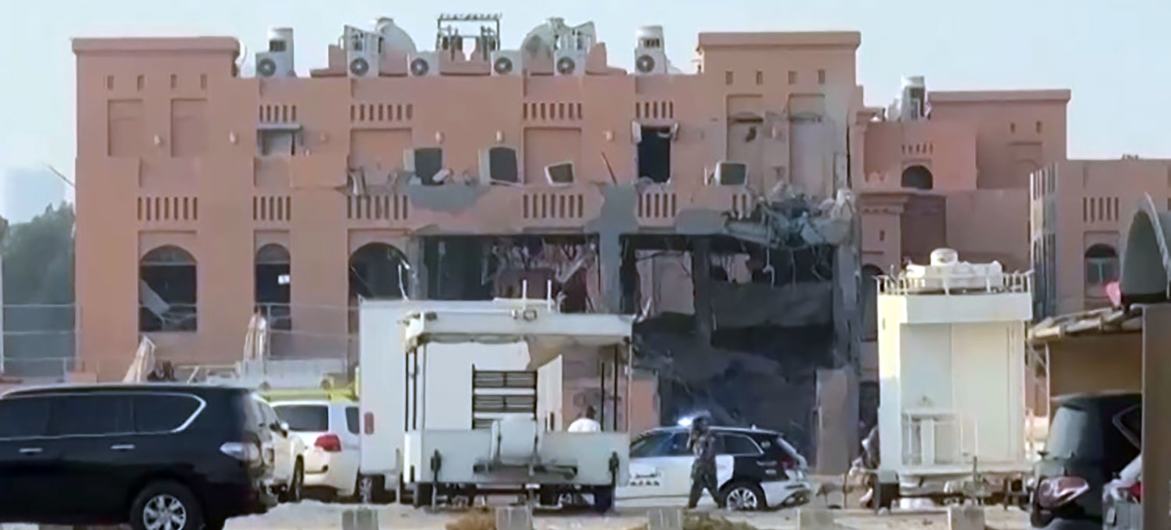
“This is a message to the entire Middle East,” Israeli Knesset Speaker Amir Ohana said in response to the Israeli airstrike that targeted Hamas leaders in the heart of the Qatari capital, Doha.

However, this statement is not merely a comment on the military operation strike into a declared strategic message, telling the entire region, and primarily the Gulf, that Israel, in partnership with Washington, has become the master of the decision-making process in the region.

Ohana’s statement is an explicit and direct threat that leaves no room for interpretation,  reflecting the new deterrence doctrine adopted by Tel Aviv: No red lines, no geographical immunities, and no Western allies outside the confines of Israeli dictates. Simply put, anyone who disagrees with us becomes a legitimate target, even if they are in the heart of a friendly capital that hosts the largest American military base.

This makes for a dangerous conclusion: Israel no longer views the Gulf states as partners in stability, but rather as “open arenas for fiery messages.” Washington is blessing the silence, participating in complicity, and mocking the Arabs.

Naked dominance

And don’t forget the Israeli crime in the heart of the Gulf marks the beginning of a new era of naked dominance. It’s not a traditional security operation, but a pivotal turning point in the rules of regional engagement, in which Qatar has been embarrassed both on the Arab level and internationally.

Israel has now publicly placed itself in a circle (no longer concealing its intentions) – through bombing and military strikes – that it no longer sees a distinction between political geography and the theater of operations. More dangerously, the heart of the Gulf today has become openly subject to Tel Aviv’s fire. And who can challenge it?

The strike wasn’t an intelligence leak or a silent targeting, but a direct airstrike in an area teeming with embassies, schools, and residential buildings, in a country that is a major ally of Washington and a pillar of American security in the Middle East.

Thus the message has become clear to everyone: No one is above attack… no state, no sovereignty, no partnership.

The US administration, led by Donald Trump, evaded with a series of conflicting statements about its prior knowledge of the operation. But whether it knew and blessed it, knew and remained silent, knew too late, or did not know at all, the outcome is the same: The American cover was removed, Gulf confidence eroded, and billions perished. The statements of the US embassy in Doha did not go beyond expressions of caution to American citizens, while White House statements swayed between “regret over the location” to “understanding the goal of eliminating terrorism.”

I believe the opposite message was conveyed to the Gulf capitals: Your security is not a priority, and your sovereignty does not equate to a clear position from Washington. The question that now arises however is: Why Qatar? Why now? Why was the strike carried out in Qatar and not in Turkey, or Iran for example? This is despite the fact that the Hamas leaders that were targeted had just returned from Istanbul, suggesting Tel Aviv chose the location not arbitrarily but with deep political awareness. Tel Aviv did not pull the trigger in Istanbul, even though the targeted leaders passed through it only hours earlier.

Turkey, with all its military, political, and international complexity, is not a testing ground for Israeli madness. There are red lines that even Tel Aviv dares not cross… and Turkey is one of them. The potential Turkish military response, the internal Turkish explosion during a highly sensitive election season, and the delicate balance of power within NATO rendered Turkish territory “operationally closed” even to the most violent wings of Israeli decision-making. But when the targeted figures left Istanbul for Doha, everything changed.

Qatar, like other threatened Arab states, in the Israeli security and intelligence mindset, is merely an intermediate gray area, neither neutral nor classified as an “enemy,” potentially a shocking target at a low cost. This is something all Arab decision-makers should be aware of.

From Tel Aviv’s perspective, Qatar is balancing contradictory roles, managing mediation, funding aid, and hosting parties that anger Israel without possessing a genuine deterrent umbrella. There are no international calculations that could prevent a surgical strike carried out within hours. Merely hosting an American base does not make Doha “immune,” but may even further tempt Tel Aviv, proving that decision-making in the region is no longer solely in Washington’s hands but in Tel Aviv as well.

In short, Israel needed a platform to send the biggest message since the Gaza war… so it chose the weakest link, amid the silence of its strongest ally.

Here, we can pause a moment at the Knesset member’s statement that the operation was “a message to the Middle East.” This is not a slip of the tongue, but a strategic doctrine upon which future decisions are based. Israel is telling all countries in the region that whoever harbors Hamas, or even engages in dialogue with it, will be next.

If the Arab states fail to take a firm political stand, the Doha precedent will be repeated elsewhere. It may not be Hamas’s mediation that stands accuse but rather the concepts of neutrality, balance, and even dialogue with parties Tel Aviv disapproves of and which then could become sufficient justification for a strike. It’s a policy of punishment.

This scene is posing existential questions for Arab capitals. If Qatar, Washington’s most important ally, is being bombed over the heads of its own people, after Syria, Lebanon, and Gaza… should we wait for Iraq’s turn? Riyadh? Abu Dhabi? Kuwait? And others? Does the American umbrella truly protect us, or is it used only when our interests intersect with Israel’s?

And what is the point of hosting American bases if they do not prevent airspace violations? Or provide protection?

What happened in Doha is pushing the region to crossroads: Either continuing its position of dependency and timid mediation, or repositioning strategically and developing independent air defenses, which is logistically difficult, or seeking alternative alliances (Ankara, Beijing, Moscow, Tehran?), and establishing red lines that Tel Aviv will not cross.

Qatar now faces difficult choices: Will it withdraw from the Hamas mediation? Will it demand real security guarantees? Will it go further, toward symbolic deterrence or unconventional partnerships? Or will it pay the price of protection once again?

Beware: A war of wills is beginning now. The Israeli airstrike in Doha was not just a blow to Hamas, but also a slap in the face to the sovereignty of the Gulf and the region, an undermining of the prestige of international law and its signed, ratified, and binding agreements, and an insult to the concept of the alleged strategic partnership with America.

This is the beginning of a new era, one in which Israel and Washington declare that the security of the region is no longer an Arab decision. The question now is: Will the Arabs as a whole wake up before “Ohana’s message” reaches other capitals? Perhaps.

The author is a political writer based in Amman Jordan and contributed this article to the Al Rai Alyoum Arabic website

Continue reading
Killing Gaza Slowly

By Tarek Bae  

OPINION - Slaughter dressed up as humanitarian aid: So-called Gaza Humanitarian FoundationFile Photo

“Gaza is on the verge of economic and humanitarian collapse. People live day to day, always at risk from hunger and disease,” notes a UN report. Yet these words were written not in 2025, but by the Independent UN Commission of Inquiry on Gaza in 2019.

Israel has enforced a blockade on the Gaza Strip since 2007. No one and nothing enters or leaves without Israeli permission, including at the crossing to Egypt. Every import and every exit requires an application to Israeli authorities. Human Rights Watch has repeatedly called Gaza the world’s largest open-air prison. Between 2017 and 2021, Israel blocked materials needed to maintain the water system. In 2017, the UN stated that 97% of Gaza’s water was undrinkable. Oxfam concluded the same year that Gaza was the most water-scarce place on earth.

From 2023 onward, Gaza became the target of genocide. From the first days, the blockade on essentials was radically expanded. On Oct. 8, 2023, then-Israeli Defense Minister Yoav Gallant announced there would be “no electricity, no food, no fuel,” because Israel was fighting “human animals.” The total blockade, combined with unprecedented bombardment, turned Gaza into the greatest humanitarian crisis of the 21st century.

During this genocide, international agencies, especially the UN, struggled to keep civilians alive. More than 400 distribution points tried to provide the bare minimum. Political pressure was needed again and again. There were 11 UN resolutions in all, 4 by the Security Council, 5 by the General Assembly and 2 by the Human Rights Council, calling on Israel to enable sufficient humanitarian aid. Israel dismantled every channel through which aid could be delivered. More than 900 humanitarian workers have been killed in Gaza since the genocide began. Never before in any war has the toll on aid workers been so high.

Netanyahu’s starvation strategy

By March 2025, the total blockade hardened into an open starvation strategy. “We have decided to stop all deliveries into Gaza, including food, water and aid,” Prime Minister Benjamin Netanyahu declared on March 2, 2025.

Barely two months later, in May, Israel and the US rolled out the so-called Gaza Humanitarian Foundation (GHF). This, Israeli officials said, would be the new and only route for humanitarian aid. Rumors of a new distribution mechanism had circulated since February, a design Israel was planning with US partners. Coverage of those plans was overshadowed by Donald Trump’s “Gaza Plan.” In a joint press conference with Prime Minister Netanyahu in Washington on Feb. 4, 2025, Trump publicly declared the intention of the US to “take over” the Gaza Strip. That the GHF sits inside this vision follows from statements by GHF officials. In June 2025, Executive Chairman Johnnie Moore Jr. said: “The United States will take full responsibility for the future of Gaza.”

It is not a purely American venture. Logistical coordination at the GHF is led by Israeli Brigadier General Yaakov Baruch. Despite its name, the GHF is not a foundation; it is a political-military organization. Alongside the Israeli military, mercenaries from the US are involved. According to The Times of Israel, Jared Kushner, son-in-law of Trump, is the chief architect of the idea. The US initially put €30 million ($35 million) into the project, with further pledges. In July 2025, Trump complained that no one had expressed gratitude. But what exactly should anyone thank the GHF, Israel, or the US for? GHF spokesperson Shahar Segal offers an answer. “It is frustrating to see people constantly blaming Israel, when in reality it is Israeli logistics that ensure humanitarian food reaches those who desperately need it. The GHF model is saving lives.”

Is that true? No. Among the familiar set of claims used to relativize the genocide is the allegation that allowing international aid only helps Hamas. Again and again, the line is that aid never reaches civilians. Another claim is that Hamas steals humanitarian supplies. The conclusion is clear: this is propaganda. Videos of armed guards on trucks or of lootings by armed gangs have been presented by Israel, in a misleading fashion, as Hamas seizures.

A review by the United States Agency for International Development examined 156 incidents of loss or theft of US-funded aid between October 2023 and May 2025. It found not a single piece of evidence that any of those incidents could be attributed to Hamas. In 44 cases, there were links to Israeli military activity. Reuters reported that Israeli military offices had produced no evidence of systematic theft by Hamas. The New York Times cited sources inside Israel’s government who acknowledged they had none either.

From 400 aid points to 4 militarized sites

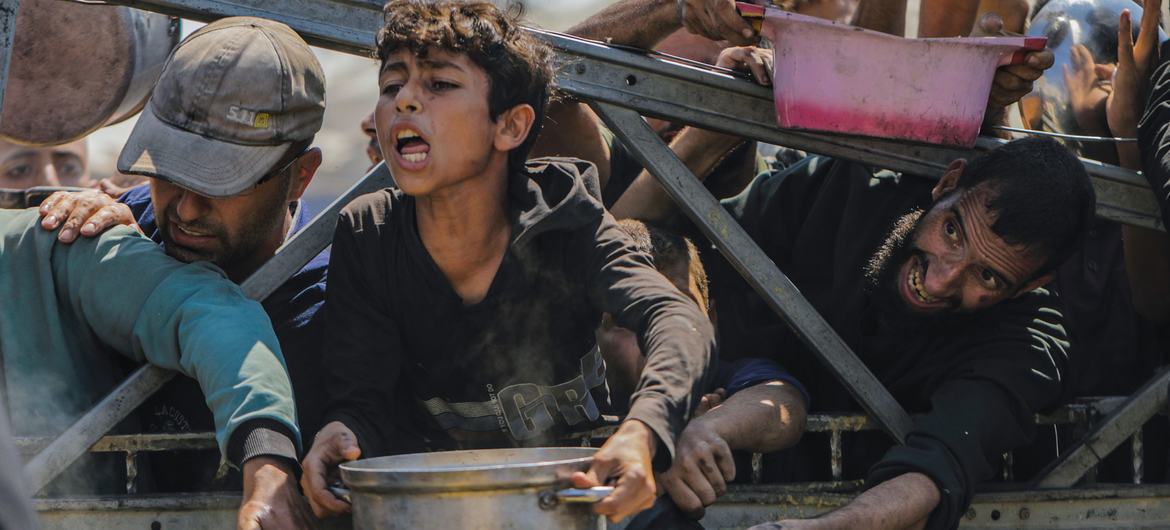
Is the GHF more effective at distributing aid? Not at all. Instead of the 400 international distribution points that once existed, Israel’s blockade and the imposition of the GHF have left only 4 highly militarized sites, with just 1 in the densely populated north. The UN calculates that Gaza’s basic humanitarian need amounts to around 600 truckloads a day. By its own account, the GHF moves at most 26 truckloads daily, roughly 4% of what is required. In a territory facing acute hunger, such an amount is not small—it is nothing.

According to the IPC Famine Review Committee, the whole of Gaza has been in IPC Phase 5 since July, the highest alert, a catastrophic food emergency. People in this phase are at immediate risk of starvation. More than 700,000 people have gone days without any food. The UN special rapporteur on the right to food, Michael Fakhri, was blunt: “Israel has made clear its intention to starve everyone in Gaza.”

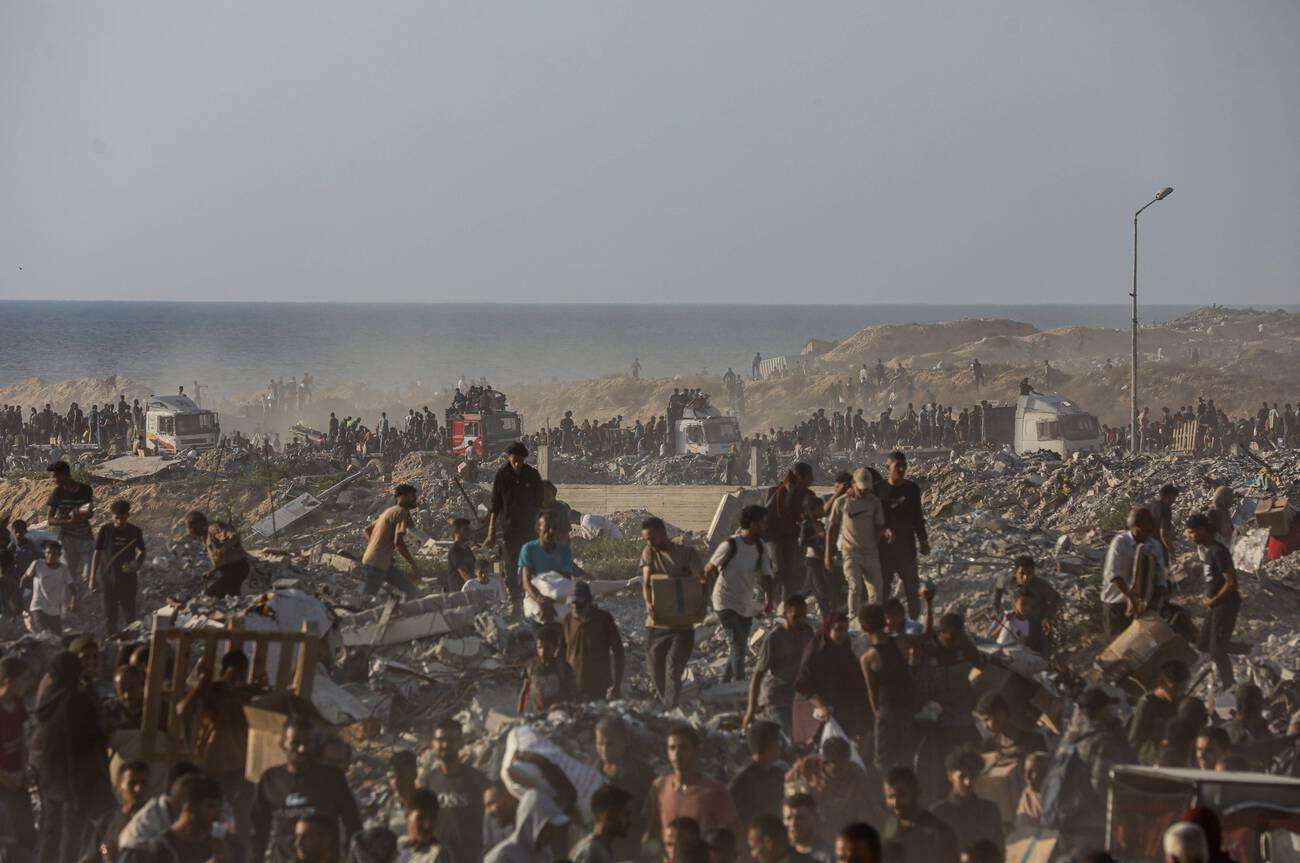
What Israel and the US call a distribution mechanism and a foundation is, in the words of Doctors Without Borders, “slaughter dressed up as humanitarian aid.” Starving civilians are forced to walk up to 40 kilometers (25 miles) under the burning sun to reach GHF sites. Arrival does not guarantee help. More than 1,881 starving civilians have been killed at or near GHF distribution sites. The Israeli army regularly fires indiscriminately into the waiting crowd.

Philippe Lazzarini, Commissioner-General of UNRWA, calls the GHF “an alibi for the systematic starvation of Gaza.” For him, the logic is clear. Israel destroyed the humanitarian infrastructure in order to replace it with a facade organization under military control. OCHA spokesperson Jens Laerke sees in the GHF a “distraction.”

What does it distract from? Netanyahu has said the plan out loud. On May 11, according to the Israeli outlet Maariv, he tied aid to permanent expulsion. Those who receive aid at a given place should never see that place again and must evacuate. “The residents of Gaza whom we are expelling will not return. They will no longer be there. We will control the place. There is no other war aim. All other goals are mere eyewash.”

By the Israeli government’s own account, the GHF is a means to drive Palestinians out of Gaza or to let them die, by deliberately starving them, denying supplies, and cutting off humanitarian aid.

*The author is the editor-in-chief of the German journal itidal.de. The opinions expressed in this article are the author’s own and do not necessarily reflect Anadolu.

Continue reading
Gaza, Surrealism and Empty Stomachs

By Michael Jansen

“Let them eat cake” is a careless remark traditionally but falsely attributed to France’s Queen Marie Antoinette at a time peasants had no bread and were starving. She and her husband King Louis the 16th were beheaded in 1793 during the French Revolution which overthrew the monarchy.

This past week Donald Trump spent five days in Scotland playing golf at two courses which he owns while 2.3 million Palestinians faced famine and starvation due to a four-and-a-half-month Israeli blockade of Gaza. During a press conference with British Prime Minister Keir Starmer, Trump finally acknowledged there is “real starvation” in Gaza. Later in the day, he claimed he had “told Israel maybe they have to do it a different way.” This suggested by adopting a new, less punitive policy. He was speaking after Egyptian and Qatari-mediated negotiations on a 60-day ceasefire had broken down, the US and Israel blamed Hamas and left Doha, delaying a full resumption of aid.

Hamas had demanded a return to UN and international agency deliveries of water, food, medicine, and fuel which have been blocked by Israel since March 2nd, Israeli withdrawal from areas of Gaza occupied since Israel broke the ceasefire on March 18th, and an end to Israel’s war on Gaza once the ceasefire expired.

Israeli Prime Minister Binyamin Netanyahu had refused all these demands and was backed up by his good friend Donald Trump. Instead of thinking of starving Gazans, Trump stated, “Hamas didn’t really want to make a deal. I think they want to die, and it’s very bad. It got to the point where you [Israel] have to finish the job.” He did at that time admit that images of starving children in Gaza were “terrible” but added, “They’re stealing the food,” echoing the Israeli accusation that Hamas is guilty of depriving Gazans of food. This has been denied by the World Food Programme and the UN agency looking after Palestinian refugees, UNRWA.

Israel has been fighting Hamas since October 7th, 2023, when it killed 1,200 and abducted 250, but Israel’s armed forces have failed to “finish the job.” Trump has given Israel permission to fight on indefinitely without totatally ending the blockade.

Alarmed by the “humanitarian catastrophe” in Gaza, Germany, France and Britian have called on Israel to end the conflict, “immediately lift restrictions on the flow of aid and urgently allow UN and humanitarian NGOs to resume operations. “Israel must uphold its obligations under international humanitarian law.”

Pressure from these three countries, the UN, and international humanitarian agencies has compelled Israel to declare 10-hour tactical pauses in the fighting in three areas of Gaza. During these pauses which could last a week or so, Israel is to allow air drops of supplies by Jordan, the Emirates and Israel, permit scores of lorries laden with aid to enter the strip, and create “humanitarian corridors” for aid deliveries. These “concessions” are far from a ceasefire and the reopening of all crossings into Gaza for between 500-600 lorries a day. Furthermore, this number must be greatly increased to compensate for Israel’s blockade which has deprived Gazans of sustenance as well as water, electricity and fuel.

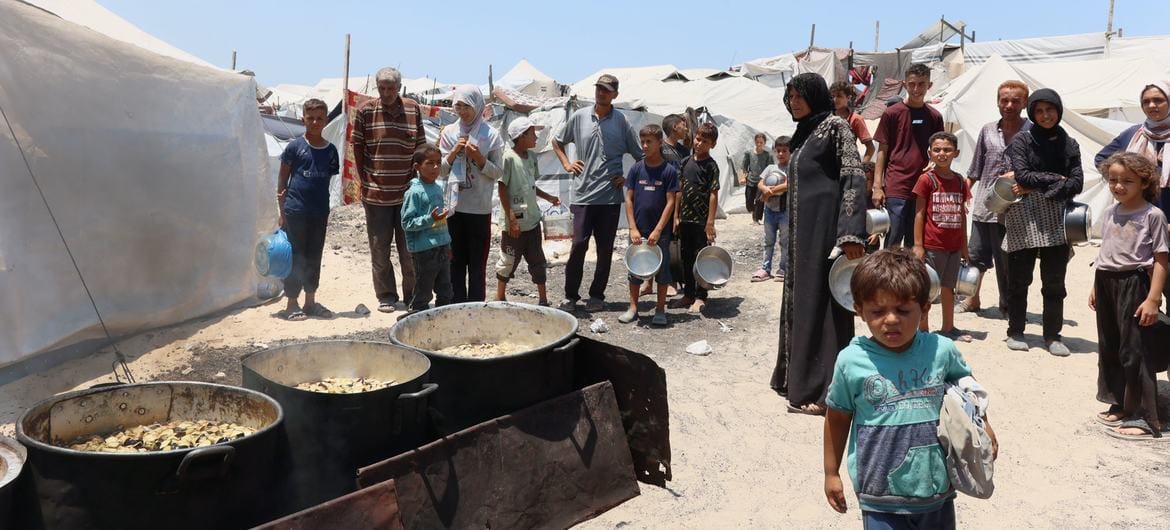
Specialised food to treat malnutrition must be included as starving people cannot absorb normal food. Parcels being delivered contain rice, lentils, and beans which cannot be cooked by many of the 90 per cent of Palestinians who have been displaced from their homes and live in tents in crowded camps. There is no wood in Gaza for fires and Palestinians rely on rubbish and plastic which pollute the environment. Palestinians cannot survive on the other items the parcels: sugar, salt, and flour. The latter they can exchange at bakeries for bread.

If ever the previous flow of humanitarian aid is restored, Gazans will need fresh vegetables, fruit, meat and chicken to revert to a nutritious diet. They used to be raised on Gaza’s farms or brought into Gaza by commercial firms from Egypt, Israel, and the West Bank.

In Sunday’s New York Times, World Central Kitchen (WCK) founder Jose Andres proposed a programme which could help resolve Gaza’s hunger crisis. He called for the reopening by Israel of humanitarian corridors to all aid groups working in Gaza and permission to operate multiple communal kitchens. While WCK has been providing hot meals in Gaza since the war began in 2023, he proposed an increase in the production from thousands to one million hot meals a day and to feed families where they dwell. He said five large cooking facilities would have to be built in safe zones “where bulk supplies can be delivered, prepared and distributed without risk of violence.” These kitchens “would supply hundreds of smaller community kitchens “at the neighbourhood level throughout Gaza, empowering communities as essential partners.”

This project depends on obtaining the agreement of Israel and equipment, raw food and fuel supplies which could be provided by aid agencies and concerned governments.

The author is a columnist for the Jordan Times

Continue reading
Starvation Centers, Death Traps

The deaths of 21 Palestinian civilians by suffocation, crowd crush, and live fire from US security forces operating in coordination with the Israeli army at an aid distribution centre in Rafah expose the Gaza Humanitarian Foundation (GHF) as an active instrument of the systematic mass killing and starvation policies imposed on Gaza.

These centres are no longer relief sites but death traps, deliberately used to lure starving crowds in scenes marked by humiliation and genocide, which constitutes a grave violation of international law and requires the immediate suspension of GHF’s operations, an urgent investigation, and full criminal accountability.

Documentation by Euro-Med Monitor’s field team revealed that the attack on Wednesday, 16 July 2025, occurred in two phases. The first happened around 4:00 a.m., when Israeli forces opened fire on thousands of civilians gathered on al-Tina Street, north of Rafah, as food aid trucks were being unloaded, resulting in multiple deaths and injuries. Despite the gunfire and casualties, thousands remained. They had no choice but to wait or starve, especially after a GHF worker told them distribution would begin at 6:00 a.m.

    Those who fell to the ground could not get up and were trampled. I saw women and children among the victims, and we only managed to escape by stepping over the dead bodies lying there   

Abdul Rahman B., one of the survivors

The second phase happened at 6:20 a.m., when crowds surged toward the outer gate of the distribution centre amid severe overcrowding and the closure of the inner gate. This led to a deadly crowd crush, with no safety measures or immediate intervention to prevent or contain the disaster.

Instead of organising the crowds and ensuring their safety, US special forces used pepper spray and fired sound bombs and tear gas at civilians trapped between the outer and inner gates, triggering panic and chaos. Thousands tried to escape, while some attempted to jump into the distribution centre to avoid overcrowding and certain death, only to be met with live fire as well.

The open fire and the resulting violent crowd crush caused the deaths of at least 21 Palestinians, including seven killed by live ammunition and 15 from tear gas inhalation and the crush, according to the Ministry of Health in Gaza.

A review by Euro-Med Monitor of several casualties found no signs of bullet wounds, supporting the conclusion that most victims died from suffocation or being trampled in a closed, overcrowded space with no protective measures in place.

Abdul Rahman B., one of the survivors, told Euro-Med Monitor’s team: “At around 6:15 a.m., a quadcopter arrived and announced that the distribution centre had been opened and required that we head to the gates.”

“People rushed frantically toward the entrances, and when we reached the front gate, we found the inner gate closed and a heavy presence of US forces accompanied by employees speaking Arabic,” said Abdul Rahman. “They asked us to step back 50 metres and enter in groups of no more than 100, but the crowding was so intense that stepping back was impossible.”

He continued: “Minutes later, they began firing sound bombs, followed by tear gas and pepper spray. People were disoriented and suffocating. Some tried to climb the fences to escape, but snipers shot them. Those who fell to the ground could not get up and were trampled. I saw women and children among the victims, and we only managed to escape by stepping over the dead bodies lying there.”

This incident demonstrates that aid distribution centres were deliberately placed in dangerous locations, designed with narrow paths enclosed by barbed-wire fences that can be easily sealed. These routes cannot accommodate the vast numbers of people in need and are fully controlled by the Israeli army, making them resemble elaborate traps for killing and humiliation rather than corridors for humanitarian aid.

GHF, established by Israel to manage its starvation policy, issued a brief statement claiming to have opened an investigation into the incident. This follows a familiar propaganda pattern: whenever starving civilians are killed, an internal investigation is announced, its results are never released, no one is held accountable, and the same crime is repeated without consequence.

An investigation by an organisation established within a framework designed to perpetuate starvation can hardly be considered credible. Given its direct role in managing starvation, GHF must be immediately dismantled and its mandate withdrawn. It operates under the guise of humanitarian work, failing as a neutral intermediary for aid delivery.

GHF functions as a field instrument of blockade, starvation, and killing by operating distribution centres designed to humiliate civilians and gather them in tightly controlled locations under the pretext of “organising” crowds. Rather than protecting those in need, it facilitates the implementation of engineered starvation and creates a closed environment where civilians are killed in the name of humanitarian aid.

Even when a threat is alleged, international law requires security forces to apply force in a proportionate and graduated manner, using lethal force only as a last resort and in response to an imminent and real threat to life. This standard was not met in the documented cases, making the killings a grave and flagrant violation of international law.

The deliberate targeting of Palestinian civilians as they seek food, along with the use of starvation as a weapon, is a clear violation of international humanitarian and criminal law. These acts constitute war crimes under the Rome Statute, including wilful killing, targeting civilians, and using starvation as a method of warfare, all of which are strictly prohibited in armed conflicts.

The widespread and systematic nature of these violations against the civilian population fulfils the elements of crimes against humanity, particularly killing, persecution, and inhumane acts causing severe suffering or serious physical or mental harm, when committed as part of a systematic attack targeting civilians.

Placing these crimes in their broader context, including the systematic destruction of means of survival, the denial of aid access, and the imposition of deadly living conditions on the civilian population, along with public incitement by Israeli political and military figures, reveals a clear and deliberate intent to destroy the Palestinian population in the Gaza Strip. According to Article II of the Genocide Convention, these acts constitute genocide, specifically through the intentional killing of members of the group and the imposition of living conditions calculated to bring about its physical destruction, in whole or in part.

The international community and complicit governments bear responsibility for the continued crimes against starving civilians at GHF-run aid distribution centres in the Gaza Strip. An immediate halt to GHF operations is essential, along with the launch of an independent international investigation leading to the prosecution of its officials before international and national courts for their involvement in systematic mass killings at distribution sites imposed by the Israeli army as a replacement for the UN mechanism that had operated in the enclave for nearly a year and a half.

International and national judicial bodies must move to hold US President Donald Trump criminally accountable for his complicity in the genocide in the Gaza Strip. This includes his adoption and direct support of the Israeli aid distribution mechanism, imposed by force and transformed into arenas of mass slaughter against starving civilians, as well as his administration’s full-scale provision of military, financial, political, and diplomatic backing that enabled Israel to commit and expand the crime for over 21 months.

The United States, through this organisation and other instruments, continues to provide political, logistical, financial, and military cover for Israel’s crimes, rendering current and former American officials, foremost among them President Donald Trump, subject to international criminal accountability.

Euro-Med Monitor calls for holding all state leaders involved in the genocide committed in the Gaza Strip accountable, whether through direct or indirect participation, by providing political, military, or financial support, or by facilitating its commission in any form. Such acts constitute criminal complicity under Article 25 of the Rome Statute. It holds states that failed to take serious measures to prevent or stop the crime legally responsible under their international obligations, particularly under the Genocide Convention.

A comprehensive and independent international investigation must be launched into the role of the Gaza Humanitarian Foundation in facilitating and executing serious crimes committed against Palestinian civilians. These investigations should address the individual responsibility of the organisation’s founders, directors, logistics coordinators, team leaders, and any other staff members, whether through planning, facilitating, directly contributing, or knowingly failing to prevent the commission of crimes.

We urge all states with territorial or universal jurisdiction to open immediate criminal investigations against all individuals affiliated with the GHF and its contracted private security firms, in order to hold them accountable for their role in crimes committed against Palestinians in the Gaza Strip, particularly including wilful killings, starvation, and cruel or degrading treatment.

All states, both individually and collectively, must fulfil their legal responsibilities by taking urgent action to stop the genocide in the Gaza Strip, through implementing effective measures to protect Palestinian civilians; ensuring Israel’s compliance with international law and the decisions of the International Court of Justice; preventing the implementation of the US-Israeli forced displacement plan; and holding Israel and its more powerful allies accountable for all crimes against the Palestinians in the Strip. The International Criminal Court must implement the arrest warrants for the Israeli Prime Minister and Minister of Defence at the earliest opportunity, in accordance with the principle that there is no immunity for international crimes.

The international community must also impose economic, diplomatic, and military sanctions on Israel for its systematic and grave violations of international law. These sanctions should include an arms embargo; an end to all political, financial, and military support; freezing the assets of officials involved in crimes against Palestinians; imposing travel ban on these officials; suspending the operations of Israeli military and security industries companies in international markets; banning involved companies’ access to banking services; and suspending trade privileges and bilateral agreements that provide Israel with economic benefits that enable its continued crimes.

Continue reading