Wildfires, Tough Questions

By Ayoub Abu Dayyeh

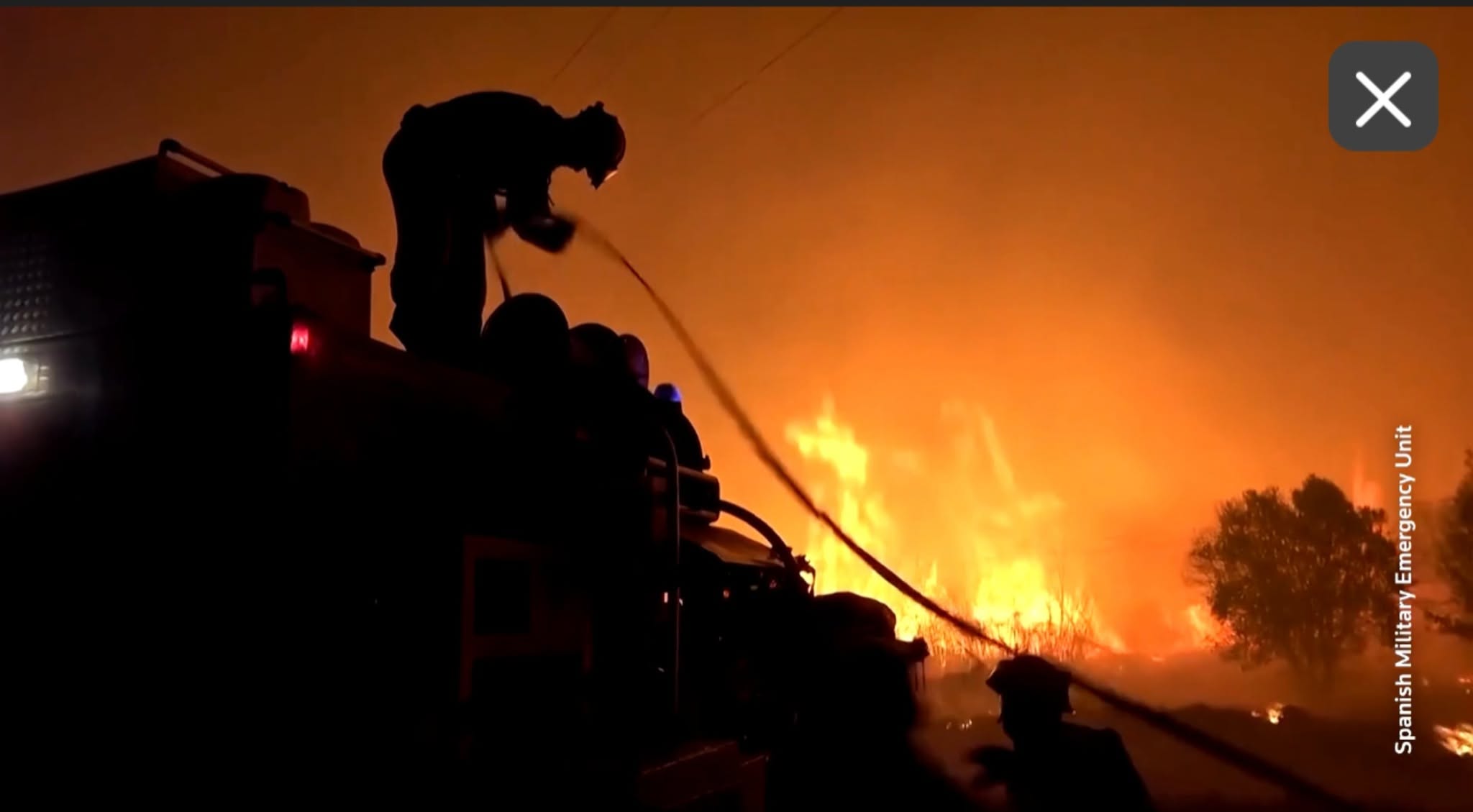
Every summer, southern Europe braces for another wildfire season. This year, large fires have swept across parts of Spain, Sicily and southwestern France, destroying forests, threatening villages, forcing evacuations, and leaving behind landscapes that may take generations to recover.

Firefighters have displayed extraordinary courage, often risking their lives against flames intensified by drought, heat waves, mulch and strong winds. Yet the repeated return of these disasters raises a question that extends beyond climate change and forest management. It is a political and moral question about priorities.

Spain and France are among Europe’s strongest economies and are both leading members of NATO. Together with their allies, they possess some of the most advanced military capabilities ever assembled. NATO can mobilise fleets of aircraft, satellites, drones, logistics networks, and highly trained personnel with remarkable speed when military operations are required. History has shown that the alliance has been able to sustain prolonged military campaigns in countries such as Afghanistan, Iraq, Iran and Libya, while individual member states have also participated in operations in Syria and against Iran-backed military targets in recent years. The financial and technological resources devoted to warfare are immense.

Against this backdrop, the struggle against wildfires appears strangely underpowered. Each summer, firefighters often speak of aircraft shortages, exhausted crews, and limited resources. Local authorities compete for specialized firefighting planes because demand exceeds supply. Countries request assistance from their neighbors through European cooperation mechanisms, yet devastating fires frequently continue burning for days before sufficient aerial support arrives. Even Jordan has participated in firefighting in Cyprus on many occasions.

This contrast invites reflection. If nations possess the industrial capacity to manufacture sophisticated fighter jets, cruise missiles, precision-guided weapons, and advanced drones and surveillance systems, why does the world still struggle to produce enough specialised firefighting aircraft? If military alliances can coordinate thousands of personnel across continents within hours, why is a similarly ambitious international system for combating natural disasters still so limited?

The question is not whether military forces should disappear. Every nation has legitimate security concerns and responsibilities to defend its citizens. Rather, the question concerns balance, justice and equity. Security today is no longer defined solely by armies confronting one another. Climate change, prolonged droughts, extreme heat, floods, and wildfires increasingly threaten lives, infrastructure, food security, biodiversity, and economic stability. A forest fire that destroys thousands of hectares, devastates tourism, and fills cities with smoke is not merely an environmental problem. It is a national security challenge.

Imagine if even a small fraction of global military expenditure were redirected toward environmental emergency preparedness. Hundreds of additional firefighting aircraft could be built and strategically stationed around the Mediterranean basin. Satellite systems already monitoring military movements could continuously detect new fires within minutes. Military logistics could rapidly deploy firefighters, engineers, medical teams, and equipment wherever flames emerge. Joint exercises could prepare nations not only for armed conflict but also for climate-related disasters.

Such an initiative would not require abandoning defense. It would simply recognise that the threats of the twenty-first century demand broader definitions of security. Protecting forests, preserving water resources, and safeguarding communities against climate-driven disasters deserve the same seriousness that governments devote to conventional military planning.

Some may argue that military aircraft cannot simply replace firefighting planes. They are correct. Different missions require different equipment, training, and tactics. Nevertheless, the comparison remains valid at the level of priorities. The capacity to invest, innovate, manufacture, and coordinate certainly exists. The real question is whether sufficient political will exists to treat environmental emergencies with equal urgency.

The forests burning across Spain, Sicily, Greece and France remind us that nature does not recognize national borders. Smoke drifts across countries and so pollution. Wildlife disappears without passports. Carbon released from burning forests contributes further to global warming, increasing the likelihood of future fires. Every delayed response makes the next disaster more probable.

History often celebrates technological achievements developed for war. Perhaps the coming decades should instead celebrate technologies developed for protecting life. Imagine an international alliance whose greatest strength lies not in the destructive power of its weapons but in its ability to extinguish fires, prevent famine, restore ecosystems, and save human lives before disaster spreads.

The smoke rising above the forests of Spain and France should therefore provoke more than sympathy. It should provoke a reassessment of our collective priorities. Humanity has demonstrated extraordinary ingenuity in designing machines capable of striking targets thousands of kilometers away with astonishing precision. Surely the same ingenuity can be directed toward extinguishing fires that threaten our shared natural heritage.

In the end, the measure of civilization is not only how effectively it wages war, but also how effectively it protects life. When future generations look back at our time, they may ask a simple question: Why was it easier to finance destruction than to prevent forests from burning? The answer will reveal far more about our values than about our technology.

Ayoub Abu Dayyeh wrote this piece for The Jordan Times.
Continue reading
Israel and The Lunatic Fringe

By Dr Khairi Janbek

So long as the fringe remains a fringe, it can be managed, controlled and probably defeated. But the problem arises when the fringe starts to be defined as a wider being and acting as mainstream.

Case in mind, a fringe political and philosophical movement emerged in the West calling itself as the Dark Renaissance, in other words, a movement attacking the concepts of the Renaissance as the cause of the ills of European civilization.

It says that democracy, equality and human rights concepts should be totally erased, and equal opportunities should not be the norm of ruling societies, rather technology governed by a group of technocrats should be ruling the world.

Moreover, all countries and nations are not equal, therefore strong countries and stronger nations should tell the weaker ones what to do and how to behave.

Now as one said from the start, this was a fringe movement, but unfortunately, the fringe has become the mainstream in international power politics.

The Israeli government has started talking about the question of “greater Israel” but indeed, one thinks as many others do, that this is nothing but an illusion. At the same time, and from the perspective of the western dark renaissance, one wonders to what extent Israel will have support for this illusion in the worst case scenario, and total indifference in the best case scenario.

The current Israeli government is resorting to the rhetoric of the pre-creation Israel, and acting as if the peace treaties and normalisation with Arab countries are nothing but a stepping stone to its dreams of conquest.

Now, how will the world power brokers react to the Israeli Magaly ideas, as in fact they were the guarantors of Arab-Israeli peace agreements and normalisation processes is to be fowned upon. More interestingly, one wonders how the main world power brokers would have reacted, had the Arab countries facing up to Israeli delusions, using the same rhetoric it was using before the creation of its state of Israel prior to 1948.

From what it seems, Israel can say what it likes, and dream as it wishes, but the Arabs can neither talk nor even dare of dreaming.

One wonders about the objectives of this “greater Israel” talk by the Israeli government. The only thing that one concludes is that the Israeli government is trying to throw around big plans and projects in order to cover up other plans involving the West Bank and Gaza, so that at the end of the day, it can say I am giving concessions regarding my greater Israel plans, but each concession Israel gives, is a slap in Arab faces.

Dr Janbek is a Jordanian writer based in Paris. France

Continue reading
Seismic Shift Across The Atlantic

By Dr Khairi Janbek

Even before Trump’s coming of age, which is a long way away, or  more accurately so, coming to power, one often wondered about the status of the European Union (EU) in the world of changing circumstances and the existential meaning of its presence on the world power map among the increasing differences among its member states.

Although and frankly, differences always existed within the Union, the Russian invasion of Ukraine made those differences more acute, sharper and penchant materializing between those Europeans fearing being next on the Russian menu, those who want an assertive position against Moscow, those reluctant either way, and those who are out rightly pro-Russia.

Evidently, having unity among the 27 European countries which are not necessarily different in their political structures, yet having necessarily different strategic interests end up with infighting, recriminations and threats.

As well what makes things near-impossible, is that the EU does not have a mechanism to expel a fellow-member from the Union, so one is always beleiving that there is hope that an obtrusive member of the Union would walk out voluntarily in the manner made by the British Brexit.

Now it is more complicated. Not only the EU is having to deal with a possible Russian threat, but also a looming trade war with the US that is compounded with the distinct possibility that America may be withdrawing its protection umbrella from Europe.

Of course, this legitimately raises the question about the future of NATO; a question which was raised before especially after the demise of the Soviet Union in the early 1990s. This ultimately means a new form of a military alliance will be required for the EU.

Ideally, one would have thought a smaller EU entity, leaner and meaner, with incorporation of Britain in it, would the best option, while the rest of Europe, from its center to its eastern side, hitched by accords with Russia and the USA.

This would be far better instead of the current large European crippled Levathian with Britain running like a headless chicken proposing to be the bridge between the USA and EU, a link both sides of the Atlantic believe it’s too far a gap for any meaningful effect.

Having said all that, there is a window of opportunity now with the new government in Germany, showing more courageous initiatives in wanting to see a reset of the Atlantic relationship, which falls well with President Macron of France, the other core member of the EU which has the idea of creating a single European army to protect the EU and its interests.

When it comes to transnational trade, the absurdity of the war of tariffs will hurt all including the American economy, though European companies whose main market is in the USA will go and invest in America, but those US companies whose main market is Europe, will invest in the EU.

Essentially, the seismic shift in relations across the Atlantic is set to commence with most probably less profits but more fairness.

Dr Khairi Janbek is a Jordanian writer based in ParisFrance

Continue reading
Jordan’s Fight Against Displacement

By Dr Amer Al Sabaileh

With the conclusion of the first meeting between President Donald Trump and His Majesty King Abdullah, Jordan finds itself facing a real political test. The strategy of buying time with an administration that has been in office for only a few weeks may not offer much room for maneuvering, making it increasingly difficult to navigate the direction of US policy. Jordan has sought to carve out a space for itself by engaging with the American president and promoting an alternative that has broader Arab support. However, this approach requires swift action and the presentation of practical alternatives that could gradually shape Trump’s perspective.

Jordan now needs to build strong alliances to manage the next phase and counter the looming threat of forced displacement of Gaza’s population—a proposal that Trump has openly suggested as the only solution. Regionally, Jordan finds itself alongside Egypt as both countries face direct pressure from the US displacement plan. This shared challenge has reinforced their cooperation on various regional issues over the years, yet expanding the Arab alliance has now become an urgent necessity. The multiple forms of US pressure on Egypt make it crucial to establish a stronger, more resilient Arab coalition, with Saudi Arabia playing a central role.

Trump views Saudi Arabia as a gateway to regional peace and a key economic partner, not only for the United States, but also for a major strategic project aimed at linking India to Europe through the Arabian Peninsula, the Mediterranean, and Italy. This highlights the importance of Saudi Arabia’s role in Trump’s vision. At the same time, Jordan’s southern geography is closely tied to Saudi Arabia within this ambitious economic corridor, which strengthens shared economic interests between the two countries. This growing economic partnership could lay the groundwork for deeper political coordination, including a potential Jordanian-Saudi understanding regarding the proposed displacement policy.

On the international level, Jordan can work to rally support for its political stance, which enjoys broad consensus among key global actors. However, at this stage, prioritising Arab alliances and maintaining effective communication channels with the US administration is far more critical than merely seeking international backing.

Domestically, Jordan’s internal front remains the most crucial. The current climate presents an opportunity for the state to reinforce national unity, as growing regional instability has heightened public awareness of external threats. This requires decisive steps to foster genuine political participation and address long-standing grievances of exclusion and marginalization. A shift in political discourse, engagement strategies, and governance methods is necessary to strengthen national cohesion. Uniting Jordanians under an inclusive and representative state framework will be vital in shaping a new phase in the country’s history.

What remains striking is how Jordan was suddenly thrust into the equation of resolving the Gaza crisis. From the outset of the war, discussions primarily centered around Egypt due to its direct geographical connection to Gaza. However, Trump’s unexpected move to involve Jordan has now exposed the country to two major risks: the potential displacement of Gaza’s population and, more alarmingly, the forced displacement of West Bank residents. The push to make Jordan part of the US plan for Gaza raises concerns that this could lead to an imposed reality in which Jordan is expected to absorb West Bank residents as well.

Categorically rejecting forced displacement must be Jordan’s top priority. However, achieving this requires a high level of political agility and the ability to engage in direct negotiations with all relevant stakeholders. This approach would strengthen Jordan’s regional role at a time when further Israeli escalation across multiple fronts, including Gaza and the West Bank, seems increasingly likely. Such an escalation could be used by the Israeli government to block political maneuvering and impose new realities on the ground. A military confrontation could shift the issue of displacement from a political debate to an unavoidable reality, forcing all parties to confront its consequences.

The author is an academic writing for The Jordan Times.

Continue reading
First in EU: Brussels Calls For Sanctions Against Israel

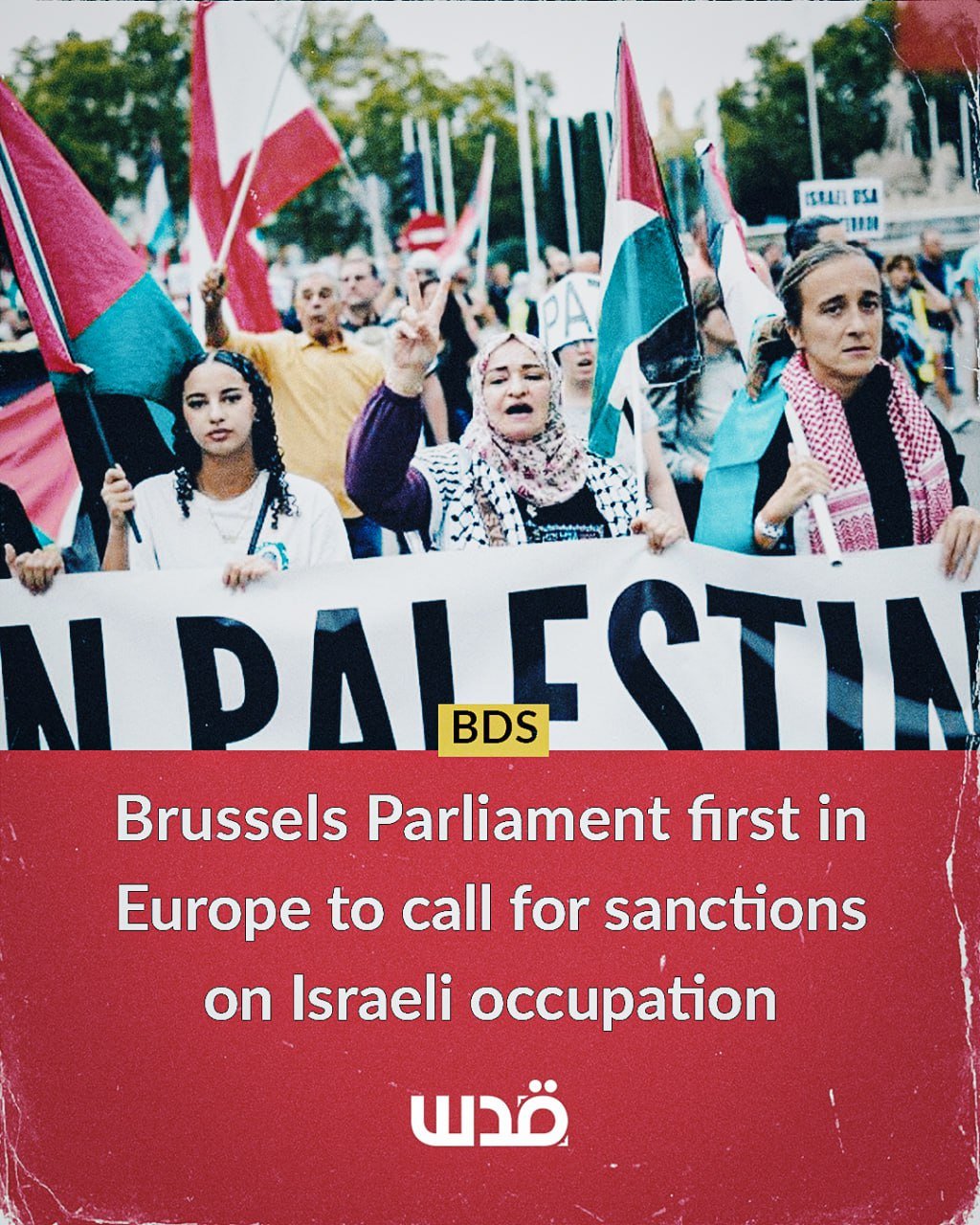
The Brussels-Capital Region Parliament made history as the first in Belgium and Europe to pass a resolution calling for sanctions on the Israeli occupation, according to the BDS movement. The resolution urges the Brussels government to withhold weapon licenses to Israel, stop supporting companies linked to its military, and sever cooperation with firms listed in the UN database.

Continue reading