‘Israel Will Not be Able to Defeat Hezbollah’ – Military Expert

Israel will not succeed in achieving the goals it set in Lebanon and will not be able to defeat Hezbollah said military expert Retired Maj-Gen Mamoun Abu Nawar.

He pointed out Israel is still unable to cross the border into southern Lebanon due to the heavy losses and after seven failed attempts to do so by its soldiers.

He stressed Israel does not have the ability to defeat Hezbollah despite the losses and assassinations it carried out through its air strikes on southern Lebanon and Beirut’s southern district in the last two weeks.

Abu Nawar added to Jordan 24 the Israeli occupation army is trying to get out of the Gaza impasse and its inability to achieve the goals it announced there by opening the Lebanese front and is trying to cross the border and establish a foothold there to start extensive military operations later.

But he pointed out it is failing to do so after the heavy losses inflicted on its invading soldiers.

Abu Nawar explained opening a third front with Iran will not be easy and Israel does not have the ability to confront the strikes and ballistic and hypersonic missiles, which are considered among Iran’s most powerful weapons.

Abu Nawar pointed out that the air strike on Iran requires the approval of four countries for the aircraft to cross, namely Jordan, Saudi Arabia, Iraq and Syria. He noted Jordan has already refused for its airspace to be used by both parties and the other countries will not allow the use of their airspace because they will be partners in the operation and this is not easy either.

Abu Nawar continued that there are also technical, technological and logistical reasons for Israel’s inability to strike Iran by air, including because the lack of aircrafts available to refuel after they were taken out of service; and in this case it needs the intervention of the USA to supply it with them or use its military bases in the Middle East, and this is not possible at the present time.

Continue reading
Mashhad Library: 500 Years of Learning

The Central Library of Astan Quds Razavi in Mashhad, Iran, stands as a beacon of knowledge, offering the world of science a priceless collection of rare and ancient manuscripts.

Speaking to Anadolu, the library’s Director Ebulfazl Hasanabadi said: “The Astan Quds Manuscript Library has a 500-year history.”

Describing the library as Iran’s largest manuscript center, Hasanabadi said: “What sets this place apart from other libraries is that the books are either written here or donated and endowed to this institution. Generations have donated books here.”

Hasanabadi explained that, according to their records, three generations from the same family have donated books to the library.

He said that the library preserves over 90,000 manuscripts and more than 50,000 lithographic works.

Including works from other sections in the complex, the number of manuscripts exceeds 120,000, and the lithographic works surpass 68,000, Hasanabadi noted.

Hasanabadi explained that the library houses works dating from the end of the first century of the Islamic calendar to the Qajar period (until 1925).

Works in library

Hasanabadi highlighted that the library contains thousands of copies, sections, and pages of the Quran, making it one of the largest centers of handwritten Qurans in the world.

Underlining that researchers could access the library’s works through its website, he said: “We have more than 20,000 copies of the Quran and sections from the first century of the Islamic calendar until the end of the Qajar period (1925). Including individual Quran pages, this number exceeds 30,000.”

Hasanabadi also said that the “Senan Mushaf” in their collection dates back to the 40s and 50s of the Islamic calendar and is known as one of the oldest Quran copies in the world.

While introducing another copy of the Quran in the library, Hasanabadi said: “The world’s oldest complete Quran, believed to be from the years 80 to 110 in the Islamic calendar, is attributed to Hazrat Ali, the fourth Rashidun caliph who ruled from 656 CE to 661.”

“It is in good condition. The two-volume manuscript, written in the Hijazi (Kufic) script, includes a donation inscription on the first page. Its printed version (facsimile) will be introduced soon,” Hasanabadi noted.

He also noted the library contains thousands of works on literature, medicine, pharmacy, and similar fields.

“There are manuscripts from poets and scholars such as Ferdowsi, Hakim Nizami Ganjavi, Razi, Hafez, Saadi Shirazi, Ibn Sina, and poets from the Qajar period,” he added.

Hasanabadi further explained that the library holds works not only on Islam, medicine, and literature but also on other religions.

“For instance, we have very valuable resources on Zoroastrianism, such as the Avesta and Kata. Torah and Bible are also preserved here,” he said.

“After examinations, it is likely that the Torah manuscripts are from the 4th century (Islamic calendar) and are considered among the finest copies in the library,” he added.

Continue reading
Israel Admits Iran Strikes Damaged Its Airbases

The Israeli military acknowledged, Wednesday, the Iranian missile strike on Tuesday evening caused damage to its air bases, but downplayed its significance and did not disclose their locations.

Israeli Army Radio said several air force bases were damaged in the Iranian attack, but “there was no damage to their infrastructure.”

Israeli news platforms also quoted the military as saying that there were no injuries to aircraft or weapons, and the military denied Iran had fired supersonic missiles in its attack on Israel.

Anadolu Agency quoted an Israeli military source as saying that the missiles “caused damage to administrative buildings (inside the air bases)… in the shell, not in the core.”

The source refused to disclose the damaged sites, saying: “There is no damage to continuity or follow-up plans, and the evidence is that the aircraft landed and took off from all the bases.”

The same source also denied that any Israelis were injured in the Iranian attack.

Targeting Mossad Headquarters

Earlier, the American website Axios quoted an Israeli military official as saying that dozens of Iranian missiles were fired at the headquarters of the Foreign Intelligence Service (Mossad) in Tel Aviv, but he said none of them fell inside the complex.

Also, CNN said that an analysis of video clips showed that an Iranian missile exploded less than one kilometer from the Mossad headquarters.

Iran launched a barrage of missiles at Israel, Tuesday evening, in an attack it said was in response to the assassination of the head of the Hamas political bureau  Ismail Haniyeh, Secretary-General of Hezbollah, Hassan Nasrallah, and commander of the Iranian Revolutionary Guards, Abbas Nilforoushan.

Following the strike Iranian President Masoud Pezeshkian warned: “if the Zionists make any mistakes, they will receive a stronger and more destructive response.”

Iranian Chief of Staff General Mohammad Bagheri revealed that the strike targeted three main air bases and a Mossad headquarters.

He said among them were the Nevatim base, which houses F-35 fighter jets, and the Hatzerim base, which he said was responsible for the assassination of Nasrallah, adding that the attack targeted radars and a gathering of tanks and armored personnel carriers in the Gaza Strip.

Israel imposes strict media censorship on what is published about its losses, in light of its war on Gaza, which has been ongoing for about a year, and its current attack on Lebanon, which is the largest since the 2006 war according to Al Jazeera.

Continue reading
Al Duwairi: Attack Shows Strong Iran, Israel’s Intelligence Failure

Military expert Major-General Fayez Al-Duwairi said the latest Iranian attack reflects a new intelligence failure for Israel, stressing it was different from its True Promise attack that took place last April, and reflects seriousness in its response.

The recent attack was carried out from several areas in Iran which reflects good preparation, especially since each batch of the trajectories headed towards specific targets. He noted the missiles used were hypersonic, which reflects Tehran’s seriousness in its response, Al-Duwairi said on Al Jazeera.

The military expert stressed the call by Israeli army spokesman Daniel Hagari for people to leave the underground shelters a few minutes before the Iranian Revolutionary Guard announced the launch of another wave of missiles represents a major intelligence failure on the part of Israel.

Al-Duwairi added this latest attack reflects great coordination for Iran, adding the great silence that preceded the launch is a credit to Tehran as it was different from the attack last April.

Although the results of the strike and its losses are not yet known, Al-Duwairi said the at least 250 missiles cannot but cause losses.

Possibilities of others entering

Israel said it will respond to this attack regardless of the repercussions, while Iran’s UN mission warned any Israeli response to this attack will be met with a devastating response.

The strategic expert pointed out Iran is still committed not to strike any US military bases in Middle East region, and that the Ain al-Assad base was targeted by the Islamic Resistance in Iraq. He said this puts us in a state of great confusion.

He said this latest attack on Israel will lead to the erosion of the strategic gains Prime Minister Benjamin Netanyahu keeps boasting about and in saying he will change the shape of the Middle East.

He pointed out Iran has already sent a clear message that any counterattack to this one will be met with a devastating response, indicating Israel may be subjected to strikes from the Houthi Ansar Allah group in Yemen and from the Lebanese Hezbollah.

Continue reading
Iran Attacks Israel With Ballistic Missiles

CROSSFIREARABIA – Iran has attacked Israel with ballistic missiles, Tuesday, evening. It was a massive attack coming from different locations in Iran launching missiles that hit Israel at point-blank.

The ballistic missiles argued to be made in two rounds, no more than five minutes within each other, amounted up to 250, although different media sources like Al Jazeera settled on 180 ballistic missiles that directly came across from Iran.

In a preliminary statement, the Islamic Revolutionary Guard Corps (IRCG) said the attack was in response to the assassination of Hamas leader Ismail Haniyeh, Hezbollah leader Hassan Nasrallah, and IRGC Commander Abbas Nilforoshan according to Anadolu.

The social media has been going crazy with commentary and images of the missiles coming in droves over Israel in a first-time development and hit different cities and strategic locations in Israel like Tel Aviv, Ashkelon and the Negev desert.

The Israeli army has been telling its citizens, all-day Tuesday, to stay in or near underground shelters because of the missiles, namely Fadi 4 rockets that were being fired by Hezbollah operatives from across the border.

Just before the blasts media outlets were saying that US intelligence sources were conveying to the Israelis than an attack from Iran was imminent and to be prepared for.

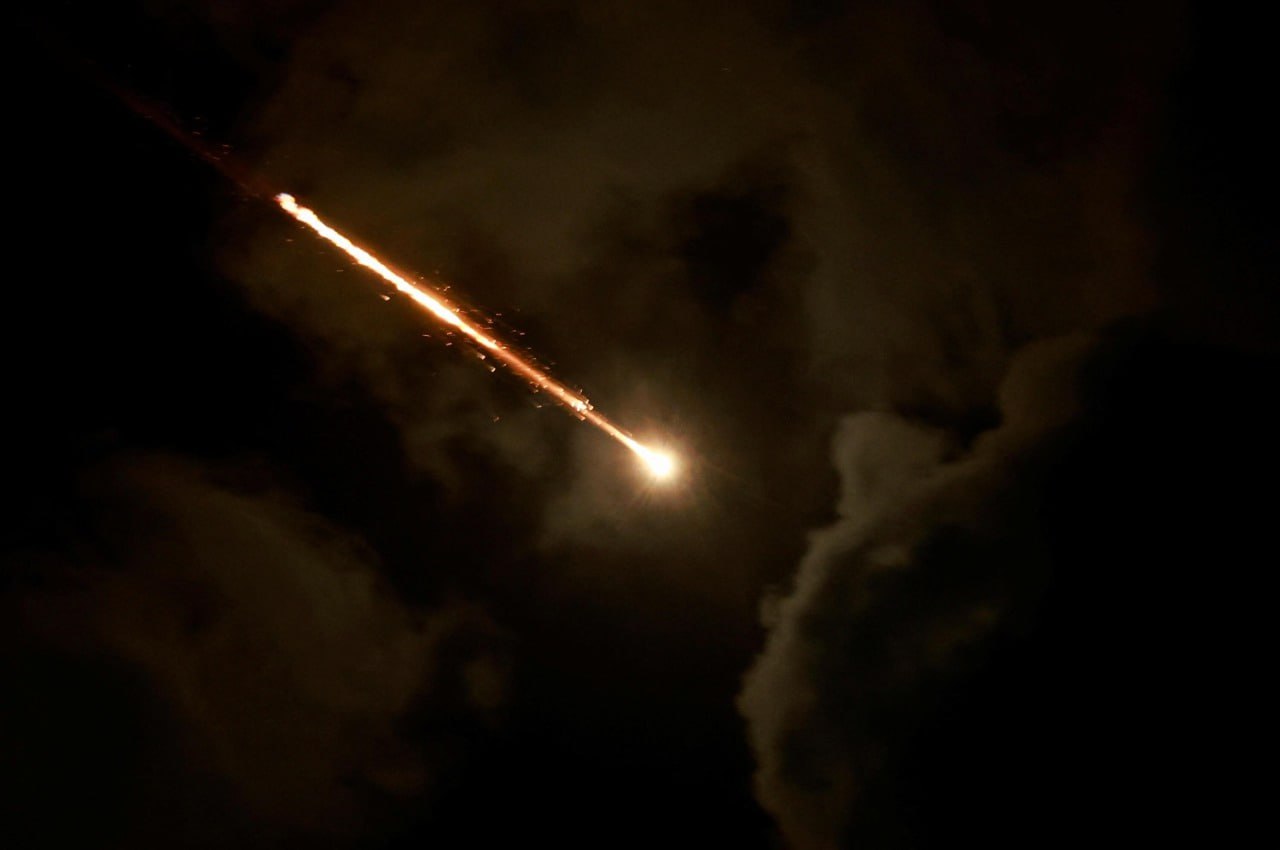
When the massive attack happened however, it was surprise jolts, coming over the Jordan night skies where it was visibly seen and heard.

“This operation is our legal right to defend ourselves,” the Revolutionary Guard pointed out in its statement. Iran’s mission to the United Nations stated that “If Israel dares to retaliate or commits malicious acts, our response will be devastating,” as reported by the Quds News Network.

Continue reading