Israeli Planes Bomb Baby 50 Meters Into The Sky!

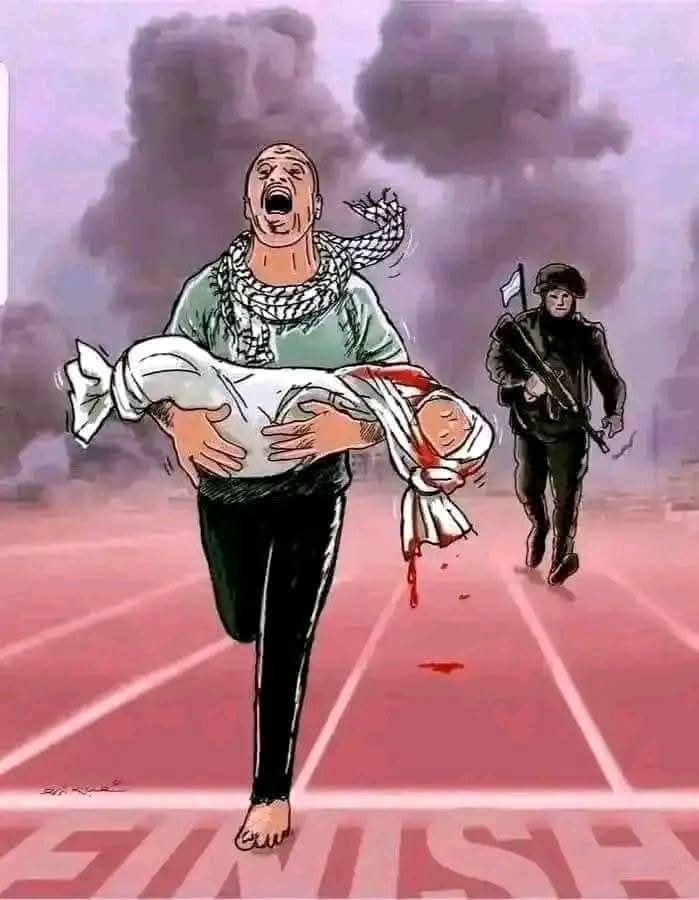
An Israeli missile suddenly hurls infant Enaam, 50 meters away from her home bombed by Israeli warplanes in the northern Gaza Strip writes Jihad Oweiss in Al Jazeera.

The baby flies up into the sky and miraculously lands on a nearby mattress, as if angels carried her and lowered her onto it, protecting her from certain death. She then sustains facial burns from the explosion of the first missile.

This scene is not a cinematic one: It is a true story that happened in early April and documented by Moroccan doctor Youssef Bouabdallah on his Instagram account. He is visiting Gaza to provide medical care to the wounded.

This bloody scenario is among dozens of scenes of ongoing slaughter, expertly orchestrated by Israel and supported by the United States, which has claimed the lives of more than 50,846 martyrs and injured 115,729 since 7 October, 2023.

Flying Bodies and Remains

If the world’s ears cannot comprehend the murderous scenarios being tested by the Israeli occupation army on the residents of the besieged Gaza Strip, the Dar al-Arqam School massacre in Gaza City is proof of this, adding to the open record of genocidal crimes.

Palestinian platforms documented the horrific massacre committed by the occupation army on 3 April and what they said showed the moment the bodies of residents blown to pieces by the violent shelling of a school housing displaced persons.

The people of Gaza, especially, cannot get over the sight of bodies being blown apart by the bombing, asserting what they are experiencing is not a war, but “a slow annihilation in which the apocalypse is being perpetrated on earth, without accountability, scale, or justice. While bodies are being torn apart and souls are being scattered, the world is content to count and remain silent.”

To emphasize this, activist Ahmed Al-Khalidi addresses “the complacent” who are surprised by the evacuations of Gaza’s residents by the bombing. He recounts some of the stories of those whose bodies were blown to the top of nearby buildings, those whose remains disappeared and were scattered into the unknown, those who were completely annihilated, and those who were blown away but survived.

Al-Khalidi says in his post: “We found the remains of our neighbors in our house after their six-story home was bombed. The explosion scattered everything: bodies, rubble, and memories.”

He adds: “I once asked a friend who was rescued alive from under the rubble of his house, ‘How did it feel?’ He replied, ‘When the missile exploded, I felt like I’d fallen into a deep hole, spinning violently, but I emerged alive and well.'” He confirms that the same person was later martyred along with his wife and children in a separate bombing.

Psychologist Dr. Saeed Al-Kahlout adds to similar stories, saying: “My martyred sister’s body flew away in one bombing, passing over two buildings and a street, while her husband was found two days later in a nearby neighborhood.”

He continues in a Facebook post: “At the beginning of the war, following a bombing on our neighbors’ house, the neighborhood residents found the body of a martyr, still lying on her bed, on the fifth floor of a building adjacent to the blind martyr’s house. People explained the event by saying, ‘Angels carried her and fled with her to a safe place. She was sound asleep.'”

The new phase of the Israeli war, since its resumption on 18 March, appears to be more bloody and criminal. The occupation army has killed 1,482 Palestinians and injured 3,688, according to data from the Ministry of Health in Gaza.

Gaza residents are witnessing more intense bombardment and a more intense rate of killing, as if the Israeli occupation army is using the Strip as a testing ground for its lethal military weapons, following its violation of the ceasefire agreement concluded with the resistance last January.

Al-Kahlout links the scenes of bodies of martyrs flying to the violent bombardment, saying: “The force of the explosions we are witnessing in this war makes me say that bodies are trying to save themselves by fleeing, even if they fly outside the circle of fire, to escape the hell… The sound of the explosion is as if the sky has split open in its wrath, shaking the ground beneath our feet and deafening our ears until we hear nothing but the howling of fear inside our heads.”

Fear and Panic

Blogger Abu Ghaith Yaghi calls on the world to talk about “dying Gaza” and the difficult nights the residents are experiencing, while “Israel is testing new types of bombs and missiles.”

While activist Mohammed Al-Akashiya asks on his account, “What are they (the occupation) throwing at us?” due to the sounds of shelling reverberating throughout the area, another asserts that the wave of explosions and shelling is terrifying and unprecedented.

Activist Mohammed Haniyeh believes that most of the missiles used after the renewed genocide are different from those before, and have a massive blast wave. He adds: “We now hear the echo of the explosion for a longer period of time. It doesn’t stop instantly, but rather the sound seems to extend and spread, coinciding with earthquakes that last for seconds.”

Continue reading
Middle East Psychosis

By Dr Khairi Janbek

As far as one is concerned, the Middle East has been for a long time a matter of balance of power overlapping with strategic reluctance to change its status quo. But the advent of US President Donald Trump is ushering a new era with all sorts of possibilities.

On the microcosm level for instance, Arafat’s Fateh movement in the PLO was checked in a formula of a balance of power by the leftists organizations as well as the Palestinian organizations sponsored by some Arab countries, the affiliation of all in the PLO created the sense of a balance of power.

However, with the emergance of the PNA and the affiliation of the Palestinian groups in it, albeit with variable influence, created a unit which under the balance of power notion, necessitated the creation of a check and balance on its power.

Consequently Hamas was created, and what seemingly appeared as contradiction between them, turned out to be a symbiotic relationship between them. Now, one cannot say with certainity what will happen next, however, if the objective is to maintain the balance of power by just weakening Hamas, this will require symbiotically weakening the PNA as well, but if the objective is to eleminate Hamas, the next step will be to eleminate the PNA.

As for the macro level, and as one often repeats, the Middle East, has at least for the last five decades was strategically governed by the famous triangle, Iran-Israel-Turkey, with the Arab world having little say in their own affairs , if at all.

However, since the fall of the Shah regime in Iran, the search started for a third angle to replace Iran in governing the Middle East, considering the open hostility of Iran towards West. Consequently some Arab countries jumped into the frey as possible candidates, like Egypt, then Qatar, UAE and Saudi Arabia. But as it seems, a preference for the old triangle was decided upon by the world powers, accepting the inconvenience of having to negotiate with Iran.

Now, we can see a new development that breaks the taboo of the old balance of power in the region.

Starting mid-way from the Biden administration, and with the start of the second Trump administration, the notion of balance of power by the usual triangle has turned into a balance of aggressiveness in the region, as Israel and Iran “bombard” each other, Turkey’s involvement in toppling Assad, and now the distinct possibility of confrontation with Israel in Syria, while being threatened itself by Iran if it cooperates in any possible American attack on Persia. Thus the stability which this triangle had sustained itself, is no more.

From appearances, at least how things look like: It seems Israel is being supported by Trump explicitly and by many other international parties implicitly, to be either the major power that has a say in Middle Eastern affairs. This means that Iran’s grip on the region will be curtailed through negotiations at least if not war; and here the symbiotic issue appears again, with Turkey’s role curtailed through pressures and/or and economic threats.

Here, as well, the aim is to designate Israel as only point of compass on the map of the Middle East, which Arabs are expected to flock to and normalise with.

In this case events will inevitably take a nasty symbiotic turn, meaning Iran will have to be attacked and taken out altogether with its surrogates from the power relations of the Middle East, and Turkey forced to take a more insular step from the affairs of the region, even with a regime change if required.

But we will have to wait and see what lies in store!

Dr Janbek is a Jordanian writer based in Paris, France.

Continue reading
The Middle East Octopus

By Dr Khairi Janbek

When we think of contemporary Iran, one always believes that the Arab Middle East had always been dominated by three Non-Arab American allies: Iran of the Shah, Turkey and Israel. One thinks that those “neighborhood police stations” were the guarantors of stability through their convergence, and at times contradictions in the age of Cold War and oil. However, the Shah of Iran was deposed and the anti-communist Cold War ended, but that didn’t mean that oil stopped becoming important nor that both Russia and China were no longer threats.

One would say, that the rehabilitation of Iran and possibly turning it into a negotiations partner aims at keeping the third angle of the police stations triangle going, because non of the Arab countries, no matter how much they tried, could never replace Iran, because no “Arab police station” is permitted to emerge as a third angle.

Having said that, it would be beyond naive to think that the expansion of Iran’s power and influence happened by stealth or escaped the notice of the US and NATO. After all, Iran grew to become a Red Sea country through its influence on the Houthis in Yemen, a Mediterranean country through its influence in Syria as well Lebanon through Hezbollah, and the major Gulf country through its supporters in Iraq. In fact this Iranian domination of space is what has created a common space between all its long arm organizations in the region.

Essentially, if we compare Iran to an octopus, all those various groups are its tentacles, and they all serve the purpose of Iran’s strategic interests, albeit not through a push-button approach, but through not taking any action which would not please their master Iran. Of course, this puts Iran in a strong position to be a major player in the region and an inescapable negotiations partner for the US, which is also convenient for the Americans, in order to remind their Arab allies who is their protector in a region policed by Turkey, Israel and Iran.

Of course, this takes us to the point of saying that, for all intents and purposes, for the Americans a trusted adversary is more important than distrusted friends, and that it would be absurd to think that all those long arms of Iran in the Arab world can be amputated by military means; they certainly can be weakened, but without the consent of Iran and without the right price, so long as it remains behind them, nothing much can change.

At this point, from what one can only see, is that no one in their right mind or otherwise, will permit a war to emerge in which Israel is pitted against Iran and the US as well as NATO putting all their weight behind Israel and forcing the Arabs to choose their camp. That would be the scenario of the end of the world as we know it , or with major civil wars in the Arab countries controlled by the tentacles of Iran, and no one wants that.

Dr Janbek is a Jordanian writer based in Paris

Continue reading
Houthi Missiles, Trump and The Israeli depth

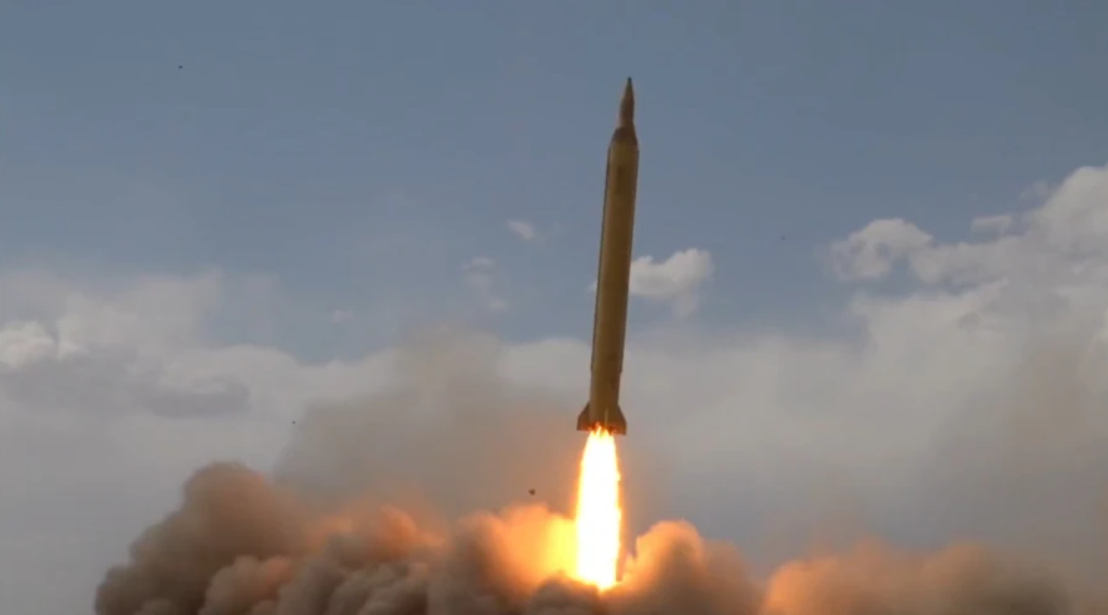
The Houthis are back firing at the heart of the Israeli depth. The military escalation is increasing despite US President Donald Trump’s warning that the Yemeni group, also called Ansar Allah, are set to be destroyed. But there is no proof of that as yet!

Ever since Israel restarted its military campaign on Gaza on 19 March, exactly two months after it ceased its military operations on the enclave, the Houthis reinitiated its trajectories, drones and hypersonic missiles on Israel. It adopted an eye-for-eye point of view — that is as long as Israel stops humanitarian aid to Gaza, Houthi missiles would continue on the Zionist state. 

The latest Houthi ballistic missiles were fired Wednesday during the day, a first-time shocker for these trajectories are delivered in the middle of the night. It was reported by the Hebrew media that millions hurried to underground shelters where sirens went off in 250 cities, towns, and settlements to the chagrin of many Israelis whose lives were turned upside down in the war on Gaza.

Wednesday will be remembered as a hard day for many as the ballistic missiles, which according to the Israeli army were intercepted and shot down from the air by counter trajectories. Such a series of Israeli military actions sent an intense amount of debris hurling down across a wide area of central and southern Israel including in Jewish settlements in the occupied West Bank.

Analysts are saying it’s back to the old days of attempting to readdress the strategic equilibrium of Houthis and Hezbollah missiles targeting the Israeli depth. While Hezbollah is on the border with Lebanon, the Houthi missiles, and their success in reaching their targets, were fired all the way from Yemen, 2000 kilometers away into Israel.

This time, and like before during the course of 2024 where hundreds of trajectories were fired on the Zionist entity, the hypersonic missile was meant for the Ben-Gurion Airport, a busy hub for international travelers. Because of the timing of the trajectories it was reported that a significant number of the incoming planes had to be diverted and re-routed to Larnaca in Cyprus as a stopover and wait for the calm to set in.

Again this is a first-time development because the disruption usually lasted for no more than 30 minutes whilst this time around it paralyzed the airport and its aviation systems and meant to send a Houthi signal to the Israelis and their American allies especially, that this would be the status quo from now on unless the onslaught on Gaza is stopped and humanitarian aid allowed in the enclave.

Today, the incoming missiles on the different parts of Israel have been almost daily, at least for the last one week. This is seen as a signal that a new and forceful strategic approach is being adopted by the Houthis who are daring the Americans despite their daily military strikes on Yemen that Israel would continue to be a legitimate target.

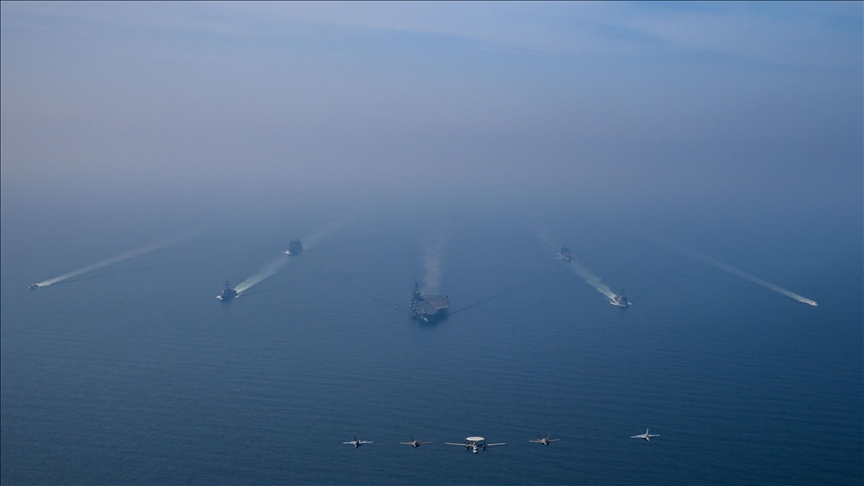
The American navy through its USS Harry Truman destroyer in the Red Sea is striking Yemen with such force and vehemence whilst assuring the Israelis that they will do the job and end the Houthi presence.

But this is not having the military effect the Americans would like it to have for Yemen is a big country with its harsh setting and difficult geographical terrain that makes such strikes seem like ‘bee stings” rather than painful blows. On Tuesday, the US struck different locations in Yemen 17 times and before that the strikes were carried out with the same level of intensity.

But the Houthis are not being brought to their knees, a proving fact that has cost the preceding Biden administration an estimated $2 billion to attempt to rein in the Houthis but with no apparent success despite the level of destruction inside the country for Yemenis, across-the-board, and not just the Houthis, have proven to be a formidable force over the years.

It’s still too early to see for how long Trump will follow in the footsteps made by former US president Joe Biden. This is bearing in mind that the new man in the White House doesn’t like to spend US money and therefore will likely lose steam as the days pass bye and especially because the Houthis started to target the US destroyer and any other ships going to Israel with the group determined to continue to upset the international trading system unless their is a reprieve on Gaza.

The above-analysis is written by Dr Marwan Asmar, chief editor of the crossfirearabia.com website.

Continue reading
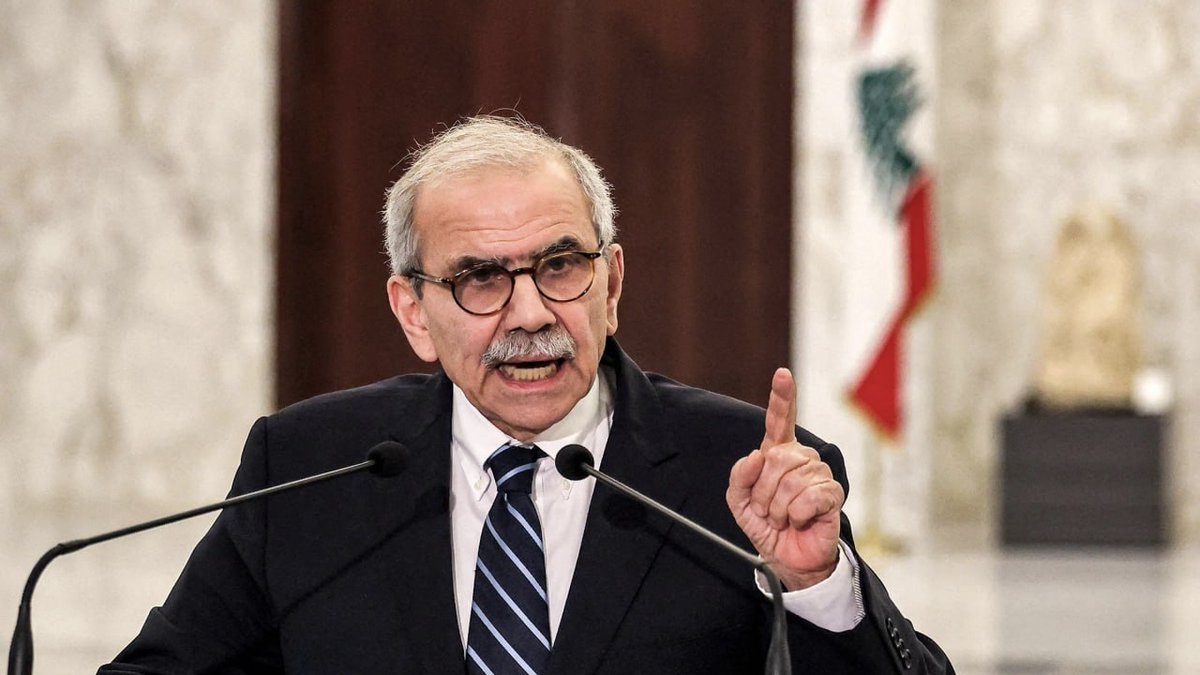
‘No One in Lebanon Wants to Normalize with Israel,’ says PM Nawaf Salam

Lebanon doesn’t want to normalize with Israel, pure and simple. Despite increasing pressure from the US administration, the government in Beirut is against any normalization moves with Israel.

“No one in Lebanon wants normalization with Israel,” says Lebanese Prime Minister Nawaf Salam. “It is rejected by all Lebanese people,” he added.

The comments of the newly-elected Lebanese Prime Minister, made Wednesday, to a delegation from the Lebanese Press Editors Association, are trending on the social media.

“International and Arab diplomatic pressure on Israel to halt its attacks has not been exhausted,” noting that “no one wants normalization with Israel in Lebanon, which is rejected by all Lebanese,” as carried by the naharnet website.

Salam said Lebanon would not establish ties with Israel even though the latter still controls five border posts in Lebanon and which have “have no military or security value, but Israel holds them to keep pressure on Lebanon.”

Local media reports have emerged about US pressure on Lebanon to reach “an agreement that is less than normalization and more than an armistice” with Israel according to Anadolu.

A ceasefire was reached by the two countries at the end of last November after a fully-fledged war that began in September following months of cross-border fire.  

Israel has repeatedly violated the terms of the ceasefire since then with 1,250 violations, 100 deaths and 330 injuries as reported by the Lebanese authorities.

Israel was supposed to withdraw from Lebanon by 26 January, 2025, extended the deadline to 18 February and still refuses to comply maintaining a outposts at five border-points.

Continue reading