US-Israeli Conspiracy on Iran?

By Jamal Kanj

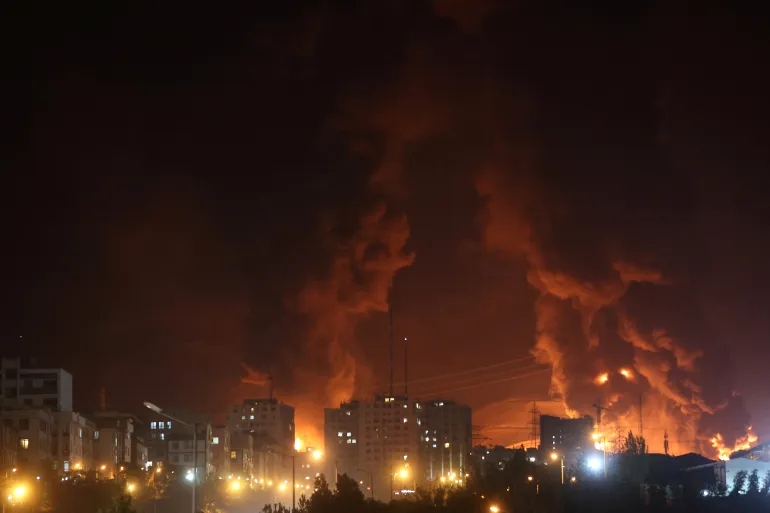
Israel’s latest strike on Iran had nothing to do with dismantling the Iranian (civilian) nuclear program. Despite Prime Minister Benjamin Netanyahu’s assertion that “the timing was fixed back in November 2024,” the real zero hour was designated only to undercut possible diplomatic framework that could have legitimized Iran’s nuclear development under international, verifiable, supervision.

This war is not a preemptive blow against Iran —it is a preemptive strike against diplomacy itself. The Trump administration made a grave error by keeping Israeli officials closely informed of the sensitive progress in the secret negotiations. This privileged access allowed Israel to strategically time its military strike to sabotage diplomatic efforts at a critical juncture—undermining further progress just as it was beginning to take shape, and before any agreement could fully mature.

Multiple independent leaks had pointed to progress in the Oman brokered negotiation between the U.S. and Iran, inclusive of intrusive International Atomic Energy Agency (IAEA) inspections, capped enrichment, and restart of oil exports under strict monitoring. An agreement of that sort would have undercut Israel’s decades-long doctrine that only isolation and coercion can keep Iran “in its box.”

Rather than accepting a rules-based diplomatic framework that Netanyahu could not control or veto, he chose to hinder the potential agreement—with F-35s and cruise missiles.

This war is also part of Israel’s long-standing obsession with maintaining its monopoly on nuclear technology in the Middle East. Far from a purely defensive measure, Israel’s broader strategy has consistently aimed at preventing any regional power from acquiring—not only the infrastructure required to develop nuclear capabilities—but even the scientific expertise and human capital necessary to pursue such knowledge.

Hours after the first explosions, U.S. officials solemnly declared, “America did not take part.” But the denial was tactical, not principled. By remaining officially aloof, the Trump White House hoped to keep a seat at any revived negotiating table while still wielding the Israeli strike as leverage. Donald Trump’s own split-screen rhetoric—calling the raid “excellent,” threatening Iran with “more to come,” yet urging Tehran to “make a deal”—spelled out the gambit: let Israel be the cudgel while the United States courts concessions.

On the other hand, and in response to American Secretary of State, Marco Rubio, claim that the U.S. is “not involved in strikes against Iran,” Israel declared that every phase of the attack had been “closely coordinated” with the Pentagon and that that US provided “exquisite intelligence” to attack Iran.

The yawning gap between the two narratives served both capitals. In Washington, it allowed officials to reassure anxious allies that the U.S. was not actively escalating another Middle East war. In Tel Aviv, Netanyahu exploited the ambiguity to provoke Iran into retaliating against U.S. forces—potentially drawing Washington deeper into Israel’s war. At the same time, he sent a calculated message to domestic hawks and regional adversaries: that Israel still enjoys unwavering American backing.

Netanyahu’s sinister calculus was familiar and transparent from Israel’s book to drag the US into its endless wars: derail the diplomatic channel, then dare Washington to pick up the pieces while Israel enjoys another round of strategic impunity.

Even in a region where Israel uses starvation as a weapon of war and genocide in Gaza, Israel’s choice to strike residential neighborhoods—ostensibly targeting senior officers, civilian leaders, and nuclear scientists—crosses a perilous line. The laws of armed conflict draw a bright red distinction between combatants and civilians; by erasing it, Israel has handed Iran moral and legal grounds to retaliate in kind. If Tehran targets the private homes of Israeli leaders and commanders, Tel Aviv cannot plausibly cry victim after setting that precedent.

The first wave of Iranian retaliation—targeting the Israeli Ministry of Defense headquarters in Tel Aviv, among other sites—marks the beginning of a new kind of war, one unlike anything Israelis have faced in previous conflicts. For the first time, a state with advanced missile capabilities has shown both the resilience to absorb the initial strike and the capacity to hit back ] deep inside Israel—an experience unprecedented in Israel’s 77 years of existence.

Unlike the sporadic and largely asymmetrical conflicts with non-state actors like the Resistance in Lebanon and occupied Gaza, this confrontation introduces a level of state-to-state warfare that challenges Israel’s long-held military superiority and assumptions of deterrence. What has unfolded so far with the Iranian retaliation is a harbinger of a more symmetrical and likely prolonged confrontation—one in which Israel’s own centers of power may be within range, and where the frontlines are no longer confined to Gaza, the West Bank, or southern Lebanon, but centered into the very core of Tel Aviv.

In the coming days, Washington’s true measure will be taken after the smoke clears. If U.S. Aegis destroyers in the Gulf or antimissile batteries in the region are activated to shoot down Iranian missiles and drones, America will cease to be an observer and become a co-belligerent.

Such presumably “defensive” steps quickly metastasize: one intercept invites another, and each exchange digs the United States deeper into a conflict created by a foreign country. History offers bleak guidance. Once American troops engage, momentum overrides strategy and the dynamics of war supplant planning. Political leaders feel compelled to “finish the job,” costs spiral, U.S. interests go unsecured, and the chief beneficiary is almost always the Israeli security establishment that triggered the crisis.

At the end of the day, Netanyahu’s success will not be measured by how many centrifuges he cripples or how many Iranian scientists he murders. It will be measured by whether he can lock the United States into yet another made-for-Israel Middle East war, paid for—strategically, financially, life, and morally—by Americans.

If Washington truly opposes escalation, it must say no—publicly and unequivocally—to any role in shielding Israel from the blowback it just invited. Anything less is complicity disguised as caution, and it will once again confirm that Israeli impunity is underwritten in Washington, even when it torpedoes America’s own diplomacy and ignites yet another Israeli-engineered war.

– Jamal Kanj is the author of “Children of Catastrophe,” Journey from a Palestinian Refugee Camp to America, and other books. He writes frequently on Arab world issues for various national and international commentaries. He contributed this article to The Palestine Chronicle

Continue reading
US Embassy Says it Cannot Evacuate Americans in Israel

The US Embassy in Israel says it cannot evacuate or directly assist American citizens in leaving the occupation state. The announcement comes amid a regional war sparked by US-backed Israeli attacks on Iran.

“The U.S. Embassy is not in a position at this time to evacuate or directly assist Americans in departing Israel,” it said in a statement.

Despite US-Israeli coordination in launching the surprising attack on Iran, the Trump administration failed to issue advance warnings to American settlers in Israel reports the Quds News Network.

Citing security concerns, the US Embassy in the occupation state will remain closed on Monday. All US government employees and their families have been told to shelter in place until further notice.

The Israeli government has ordered airlines not to allow Israeli citizens inside the country to board rescue flights. These flights are only for Israelis currently abroad, reported The Marker.

Officials claim the move aims to prevent overcrowding and reduce the risk of mass casualties. But in practice, the policy means settlers and civilians still in Israel cannot leave, even as tensions with Iran escalate.

Last month, US Ambassador to Israel Mike Huckabee said that 700,000 American citizens live in Israeli settlements across occupied Palestine. He was referring to settlers, who hold Israeli citizenship and serve in the Israeli military.

Critics argue that these settlers are being used as human shields. Entire communities, including women and children, are placed deep inside conflict zones. Their presence serves both as a military buffer and a justification for expansion.

In contrast to its silence in Israel, the US State Department issued a clear warning to citizens in Iran, urging them to leave immediately.

“U.S. citizens should not travel to Iran for any reason and should depart Iran immediately if you are there,” said the statement.

Continue reading
Iranian Missiles Extend to ALL Israel

On the fourth day of the war between Tehran and Tel Aviv, Iran has launched a barrage of more missile on the Zionist entity early Monday morning.

The Israeli Home Front Command reported that the Iranian ballistic missiles have extended from the touristic city of Eilat in the south to Al Naqoura in the north.

It added that air raid sirens blasted in Tel Aviv and other areas after detecting the incoming missile that are the latest to have been launched from Iran.

Israeli media reported that Iranian missiles landed in Haifa and that a large explosion was heard. They also reported hearing explosions in eastern Tel Aviv, western Jerusalem, and the Ben Gurion Airport area.

The Hebrew media also confirmed that direct hits were recorded in areas of Tel Aviv as a result of the Iranian missile attack carried out through the early hours of Monday morning.

Continue reading
Iran’s Army Calls on Israelis to Leave

Iran’s armed forces called on Sunday Israelis to leave their country, warning it may not be “inhabitable” in the days to come, state news agency IRNA reported, as military confrontation between the two regional rivals continues.

“Warnings for you in the coming days: Leave the occupied territories, because, certainly, they won’t be inhabitable in the future!” Reza Sayyad, spokesperson for the armed forces, said after a new wave of Iranian strikes began against Israel.

He cautioned that “taking shelter underground will not bring safety to the Israelis.”

“Therefore, we would like to emphasize: do not let the criminal regime use you as human shields,” Sayyad said.

Separately, Mohsen Rezaei, a senior IRGC commander who is also a member of Iran’s Expediency Council, said: “We may reach a point where we take major actions that will destabilize the entire region.”

Rezaei said “the wise people in the US and Europe must act quickly to pull their countries out of this war, otherwise we cannot stand by and watch their involvement without responding,” according to Anadolu.

Israel launched airstrikes on multiple sites across Iran, including military and nuclear facilities, on Friday, prompting Tehran to launch retaliatory strikes. The attacks and counterattacks have continued since.

US President Donald Trump said the two sides could achieve peace and that meetings and calls to this end were taking place.

Continue reading
The Devil You Know!

By Dr Khairi Janbek

One wonders what more can be said about the tragic war in Gaza, more than the outpouring of words in the East, West and the Arab world with the habitual accusations and counter-accusations which have reduced the question of Gaza, after many other things to a mere question of semantics with the same words and same policies, while the habitual loser, the hostages and their families, and the Gazan people continue to suffer relentlessly.

Delegations keep going and coming, ceasefires agreed then broken given the impression that all what is being attempted is to keep the war going without the pangs of guilty conscience or more pragmatically, pending how public opinion shifts in western countries.

For all intents and purposes, can Israel destroy Hamas or at least break its military structure, if indeed this is the intention of Israel? If it is not, what would be the point of this war?

This is because all of what is being done is mere destruction of lives of innocent civilians who have no say when it came to “Hamas terrorism” and the subsequent Israeli retaliation. The tragi-comedy of the situation, is that Israel is fighting Hamas in order to keep a smaller version of Hamas, in the manner possibly of the devil you know is better than the one you don’t.

As for the other side of the divide, one doesn’t believe that Hamas cares about the innocent Gazans more than Israel, of course their aim is to survive, and rule for another day, because as it appears they seem to believe that Israel has no wish to occupy Gaza, and they stand a good chance to rule a diminished territory compatible with their diminished organizational size.

One wouldn’t actually be surprised knowing only too well than in the Middle East nothing is meant to be resolved; neither with peace nor with war.

Then comes the international community, President Trump’s policy towards the region fits very well with all what is going on, and it reflects this inconsistency with its own inconsistency. At one point, he wants the destruction of Hamas, then he wants a ceasefire and wants the war to stop, with the only logical demand of wanting what everyone else wants, the release of the hostages.

But even on this path one wonders for how long he will be able to keep his attention span on the question. The EU has its twists and turns, apart from’Ireland and Spain, the governments of Europe have their own contradictions with each other and subject to the fluctuations of public opinion, nevertheless, there will be plenty of rhetoric but the same policies will continue.

Ironically, the only side which is not counted on, and the only side which seems reluctant to get involved actively, save for holding hostage release negotiations, is the Arab side.

One firmly believes, against common wisdom, that only the Arabs can convince Hamas to surrender its weapons, and manage a post-Hamas Gaza, guaranteeing security for Israel and start the reconstruction efforts for Gaza. It is only after that, a permanent solution can be thought of.

Dr Janbek is a Jordanian writer based in Paris, France.

Continue reading