Is America Abandoning Europe?

In 2007, Russia’s President Putin gave a now-infamous speech at the Munich Security Conference (MSC), announcing Russia’s new posture of hostility towards the US and Europe. In 2022, when Russia invaded Ukraine, many looked back at Putin’s 2007 Munich speech as a revealing moment of his intentions.

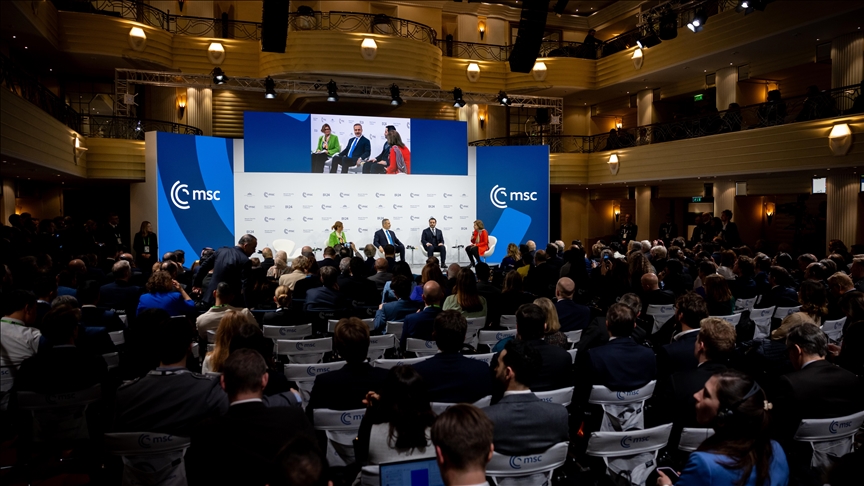
This year’s MSC could be a similar watershed. This time, the warning bells ring from across the Atlantic. US Vice President JD Vance delivered one of the most hostile speeches by a US official to Europe in decades. Rather than addressing the Russian or Chinese threats, Vance argued that Europe faced a “threat from within,” accusing the EU and national governments of censorship and ignoring popular demands on issues like illegal migration.

Meanwhile, away from Munich, US President Donald Trump held a phone call with Putin, setting the stage for negotiations between the US and Russia for a peace agreement in Ukraine – without involving European counterparts in the discussions. The day before, Defence Secretary Pete Hegseth announced some of the US expectations from this deal: Ukraine should drop its NATO membership bid, European countries would need to provide the forces to enforce the agreement, and these forces would not be covered by NATO’s Article 5 guarantees.

The transatlantic picture in which the MSC took place was even bleaker. Since Trump’s inauguration one month ago, the new president had promised (and now imposed) tariffs against countries across the world, including Europe. He has threatened to annex the territory of allies like Canada and Denmark.

Normally, the MSC is an opportunity for the United States to reaffirm its commitment to Europe and the Atlantic alliance. This year, it could be remembered as the time when the US started the process of abandoning Europe – or even going aggressively after it.   

An attack on Europe

Vance’s speech and the reactions to it have dominated the discussions at the MSC. Although the conference theme was “multilateralization”, the real topic on everyone’s mind was: how would Trump’s second administration approach Europe?

As the pre-conference report argued: “Donald Trump’s presidential victory has buried the US post–Cold War foreign policy consensus that a grand strategy of liberal internationalism would best serve US interests.” That this consensus was gone was clearly visible in the conference. Despite perfunctory references to shared values, Vance’s speech did not talk about the alliance between Europe and North America, nor about the common threats and how to face them.

And he has voiced support for anti-EU parties. Vance pronounced his speech in Germany, just weeks before federal elections, and argued that there should not be “firewalls” in government – a clear reference to the far-right Alternative für Deutschland (AfD) which has so far been kept out of governing coalitions. After the speech, Vance met with the AfD leader.

Additionally, Vance criticized Romania for canceling its 2024 elections and accused the EU of censoring free speech. But Vance failed to acknowledge that the very election that brought Trump and him to power in November was the subject of major foreign interference by Russia, China, and Iran. Rather than sitting idly by, US agencies took active measures to counter these malign actions and prevent disruptions – like raising awareness, coordinating with the media, and keeping politics out of the fight. With his speech, Vance seems to be arguing for the exact opposite approach.

All these issues did not touch on security and defense, the core of the MSC’s discussions. But they did lure in the background of Vance’s speech. A few months ago, Vance argued that the EU should not regulate tech companies owned by Elon Musk. If the Europeans did so, he argued, the US should reduce its security commitments to NATO. Hence, American assurances could become bargaining chips to resolve other issues.   

How will the EU respond?

Vance’s Munich speech marks a new era in US relations with Europe. While the themes are not new – Trump has never been a fan of NATO, and enjoys courting Europe’s far-right – the extent of the rhetorical change cannot be understated. Ukraine’s President Zelensky, speaking in Munich the day after Vance, spelled out the challenge in clear terms: “We can’t rule out the possibility that America might say ‘no’ to Europe on issues that threaten it.”

The reaction from European leaders has been strong so far. EU Commission President Von der Leyen called for an emergency clause in the EU treaties to allow member states to boost defense spending [8]. French President Macron called for a summit of European leaders in Paris on Monday, February 17 – to sketch out a common position on the upcoming negotiations over Ukraine, and on making up for US security guarantees from Europe.

The greatest challenge, however, will be transforming outrage into meaningful action. Europeans have long ignored calls to take charge of their own security. Domestic constraints over spending, divisions and the continued belief that Uncle Sam will have their back have stood in the way of ambitious choices. Will this time be different?  

This opinion was written by Giuseppe Spatafora for the Anadolu news website.

Continue reading
A World Without America?

By Dr Khairi Janbek

Away from the condom politics which seems to be just an obsession of a Washington administration suffering from erectile dysfunction, on thought it would be intriguing to imagine a world without America, which means deep cultural, economic as well as political implications. It’s a thought experiment which forces one to imagine how the world would look like without the specific influence, history and power dynamics that the USA has shaped.

On the geopolitical and global power level, other nations would have to step in into the void, vying for influence. Europe, China, Russia and India would probably play a central role on global politics, in addition, the Security Council of the UN will start looking very different, Europe would become the dominant force strengthening its collective military and political capabilities.

In terms of culture and society, American has played a central role in shaping global pop culture, Hollywood, music, fashion and hi-tech, indeed other nations would have come in, in Asia South Korea, Japan and India would take a central role in shaping global culture, with Europe asserting itself in the arts and literature.

In technology and innovation, the US has produced Silicon Valley and leading corporations in software, hardware and AI, however without, China and Europe would fill the hitech leadership role which probably would accelerate their breakthroughs.

As for the economy, without America, the world economy would be real different, the US dollar would not be the world reserve currency, with the Euro and the Yuan, being the global standard. Trade dynamics would be rearranged and institutions like the World Bank and the IMF would have other substitutes.

Regarding military and defense, American power is unmatched , without it global security dynamics would shift drastically, NATO might not exist, while regions powers like Russia, China and India, would become more aggressive in asserting their influence.

In terms of the environment and social movements, the US has been at the forefront of global debates on climate change, social Justice and human rights; taking note of course, with mixed results, but without it, certainly others would take the lead, for a start, Europe has been a leader in pushing for climate action , and in social action, countries like Brazil, South Africa, would fill in the gap with most probably leading to different outcomes. But , the USA has been a major donor for global and humanitarian aid, and their contribution would have to be substituted by other coalitions, which one assumes would be limited only to crisis.

Essentially, a world system without America, the international system would be less centered around one dominant great power, as power would be more diffuse with multiple centers of influence and more regional power struggles, but at the end of the day, the purpose for the use of condoms would be much clearer.

Dr Janbek is an opinion writer based in Paris

Continue reading
Domination Space For Common Space

By Dr Khairi Janbek

When we think of contemporary Iran, one always believes that the Arab Middle East had always been dominated by the three Non-Arab American allies; Iran under of the Shah, Turkey and Israel.

One thinks that those “neighborhood police stations’ were the guarantors of stability through their convergence, and at times contradictions, in the age of Cold War and oil. However, the Shah of Iran was deposed and the Anti-communist Cold War ended, but that didn’t mean that oil stopped becoming important nor that Russia and China were no longer threats.

One would say, that the rehabilitation of Iran and possibly turning it into a negotiations partner aims at keeping the third angle of the police stations triangle going, because non of the Arab countries, no matter how much they tried, could never replace Iran, because no Arab police station is permitted to emerge as a third angle.

Having said that, it would be beyond naive to think that the expansion of Iran’s power and influence happened by stealth or escaped the notice of the US and NATO.

After after all Iran grew to become a Red Sea country through its influence on the Houthis in Yemen, a Mediterranean country through its influence in Syria as well Lebanon through Hezbullah and the major Gulf country through its supporters in Iraq. 

In fact this Iranian domination of space is what has created a common space between all its long-arm organisations in the region.

Essentially, if we compare Iran to an octopus, all those various groups are its tentacles, and they all serve the purpose of Iran’s strategic interests, albeit not through a push-button approach, but through not taking any action which would not please their Persian master.  

Of course, this puts Iran in a strong position to be a major player in the region and an inescapable negotiations partner for the US, which is also convenient for the Americans, in order to remind their Arab allies who is their protector in a region policed by Turkey, Israel and Iran.

Of course this takes us to the point of saying that, for all intents and purposes, for the Americans a trusted adversary is more important than distrusted friends, and that it would be absurd to think that all those long arms of Iran in the Arab world can be amputated by military means; they certainly can be weakened, but without the consent of Iran and without the right price, so long as it remains behind them, nothing much can change.

At this point, from what one can only see, is that no one in their right mind or otherwise, will permit a war to emerge in which Israel is pitted against Iran and the US as well as NATO putting all their weight behind Israel and forcing the Arabs to choose their camp.  

That would be the scenario of the end of the world as we know it, or with major civil wars in the Arab countries controlled by the tentacles of Iran, and which no one wants.

Dr Khairi Janbek is a Jordanian writer based in ParisFrance

Continue reading