Trump Threatens to Leave NATO But Can He?

US President Donald Trump on Thursday urged the members of NATO to gather the courage to send naval vessels to the Strait of Hormuz, again disparaging the longtime military alliance.

Asked why he had not mentioned NATO in his Wednesday night address to the nation, Trump said it was not a NATO speech but that he had referenced the strait and those who were absent. “They gotta get guts and go in and just send your ships up there and enjoy it,” he told Politico.

Pressed on whether he was frustrated with the alliance, Trump said: “I couldn’t care less. I didn’t need them.”

He added: “But if I ever did need them, they wouldn’t be there.”

NATO has invoked Article 5 – its collective defense clause – just once in its history, after the 2001 terrorist attacks on the United States. NATO allies have criticized Trump for starting the war on Iran without consulting them.

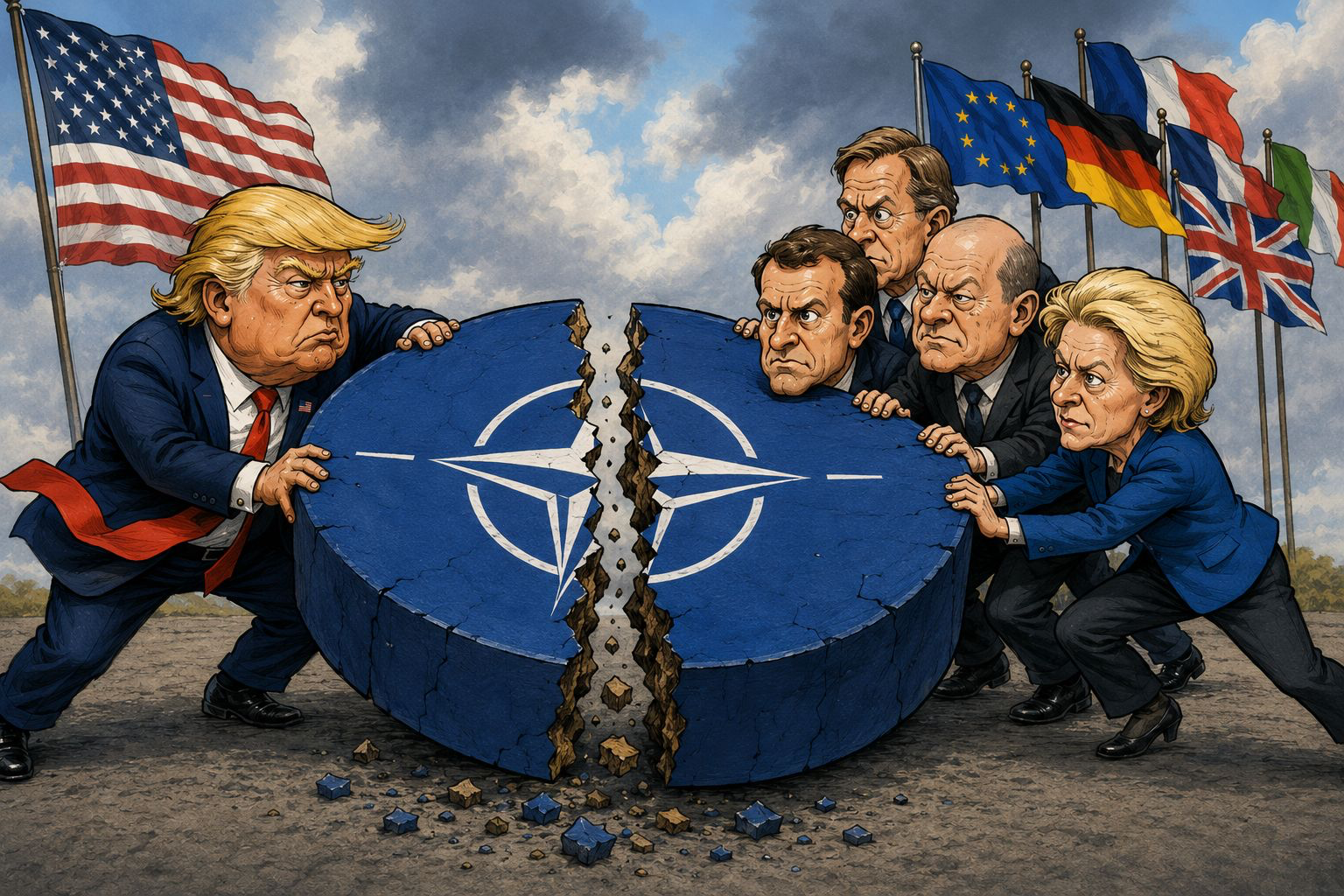
The remarks are the latest in a string of pointed criticisms Trump has directed at NATO over its response to the Strait of Hormuz crisis. He has previously called alliance members “cowards” and, in a separate interview with British daily The Telegraph, described NATO as a “paper tiger” and said leaving the alliance was “beyond reconsideration.”

Leaving NATO unilaterally – a move Trump has hinted at since his first term – would face significant legal hurdles. A 2023 law bars any US president from withdrawing from the alliance without the backing of a two-thirds majority in the US Senate.

The strait, through which roughly 20 million barrels of oil pass daily, has been effectively disrupted since early March following Iranian measures taken in retaliation for the US-Israeli offensive on Iran that began on Feb. 28.

Trump has repeatedly urged European allies and Gulf states to take a more active role in securing the strait, arguing that countries dependent on its oil should bear responsibility for reopening it.

Trump will meet with NATO chief Mark Rutte in Washington next week, according to The Wall Street Journal. Anadolu

Continue reading
The Middle East Octopus

By Dr Khairi Janbek

When we think of contemporary Iran, one always believes that the Arab Middle East had always been dominated by three Non-Arab American allies: Iran of the Shah, Turkey and Israel. One thinks that those “neighborhood police stations” were the guarantors of stability through their convergence, and at times contradictions in the age of Cold War and oil. However, the Shah of Iran was deposed and the anti-communist Cold War ended, but that didn’t mean that oil stopped becoming important nor that both Russia and China were no longer threats.

One would say, that the rehabilitation of Iran and possibly turning it into a negotiations partner aims at keeping the third angle of the police stations triangle going, because non of the Arab countries, no matter how much they tried, could never replace Iran, because no “Arab police station” is permitted to emerge as a third angle.

Having said that, it would be beyond naive to think that the expansion of Iran’s power and influence happened by stealth or escaped the notice of the US and NATO. After all, Iran grew to become a Red Sea country through its influence on the Houthis in Yemen, a Mediterranean country through its influence in Syria as well Lebanon through Hezbollah, and the major Gulf country through its supporters in Iraq. In fact this Iranian domination of space is what has created a common space between all its long arm organizations in the region.

Essentially, if we compare Iran to an octopus, all those various groups are its tentacles, and they all serve the purpose of Iran’s strategic interests, albeit not through a push-button approach, but through not taking any action which would not please their master Iran. Of course, this puts Iran in a strong position to be a major player in the region and an inescapable negotiations partner for the US, which is also convenient for the Americans, in order to remind their Arab allies who is their protector in a region policed by Turkey, Israel and Iran.

Of course, this takes us to the point of saying that, for all intents and purposes, for the Americans a trusted adversary is more important than distrusted friends, and that it would be absurd to think that all those long arms of Iran in the Arab world can be amputated by military means; they certainly can be weakened, but without the consent of Iran and without the right price, so long as it remains behind them, nothing much can change.

At this point, from what one can only see, is that no one in their right mind or otherwise, will permit a war to emerge in which Israel is pitted against Iran and the US as well as NATO putting all their weight behind Israel and forcing the Arabs to choose their camp. That would be the scenario of the end of the world as we know it , or with major civil wars in the Arab countries controlled by the tentacles of Iran, and no one wants that.

Dr Janbek is a Jordanian writer based in Paris

Continue reading
Mad President and Street Brawl

By Dr Khairi Janbek

People from my generation remember a pop group which used to sing a song called the lunatics have taken over the asylum. Now, they were not themselves lunatics but merely performing for their audience and their fans, in the same manner. Neither Trump nor his band wagon are necessarily a bunch of thugs, but they are merely performing for their fans and audience.

However one cannot find any reason for world leaders to go to the Oval Office in order to provide US president Donald Trump with the material to entertain his fans and audience.

He ambushed King Abdullah of Jordan with the entry of journalists when that was not supposed to happen in order to market his absurd Gaza plan, president Emmanuel Macron of France provided him with the opportunity of posturing as an antagonist to the EU, prime minister Keir Starmer provided him with the opportunity of showing what Britain was groveling for – a free trade agreement and a role of being a bridge between the US and EU.

Ironically however, the worst of the Trump performance was left for Volodymr Zelensky, though his trip was the only one that made sense.

Zelensky for all intents and purposes, went to sign an agreement to hand the resources of Ukraine to America, but suddenly the situation deteriorated to almost a street brawl. Why? The whole thing was agreed upon by both sides from the start.

Of course, Zelensky expected a protection commitment from the USA in exchange for the mineral resources, but in fairness, without an explicit US commitment protection would have been implicitly there since supposedly, American companies and workers would be working in Ukraine, so what has actually happened to derail the whole agreement?

Of course, any such agreement with potential implicit US protection of Ukraine, is totally against Russian interests, especially according to some speculation, Putin has the intention to occupy the whole of Ukraine, therefore the talk in the corridors, is that Putin has offered Trump the exploitation of Ukrainian resources in the occupied territories of Russia, which in effect sabotaged the minerals agreement between US and Ukraine, and rescued Trump from having to give security guarantees; albeit implicit to Ukraine.

Now, at the peril of repeating the usual cliche of the EU facing a crossroad on its path, something which had happened frequently, this time it’s in fact different. The truth is that the US has been distancing itself from the EU at least from the days of president Obama, but the difference now is that the EU is being attacked by both the US and Russia, and finds itself as the large leviathan with clay feet unable to move.

The dilemma of differences within the EU are prominent, with full support for Ukraine, with some having lukewarm support, while some with no support at all, moreover the NATO future is hanging in the balance, to keep or not to keep that is the question, but what is the alternative? A European army which is yet to crystallize as an idea, or just drop all the effort?

What it boils down to now, is the idea of leadership of the “Free World”, certainly this notion has always been a nebulous idea, still, the US stood by it and projected its image accordingly, but now, it seems the US is not interested in world affairs except in what it can exploit and use and abuse for its own interests, which means, who will be the new leader of the Free World?

In fact, is there a need for a leader of the free world assuming that there is such a world? If the EU has any such pretensions, then big changes are necessary within its membership as it must be realized the road is very long for such an objective. But in the mean time, we have to settle for the theory of the mad president, ie. Trump would do anything, and peace by force with an oxymoron.

Dr Janbek is a Jordanian writer based in Paris.

Continue reading
Seismic Shift Across The Atlantic

By Dr Khairi Janbek

Even before Trump’s coming of age, which is a long way away, or  more accurately so, coming to power, one often wondered about the status of the European Union (EU) in the world of changing circumstances and the existential meaning of its presence on the world power map among the increasing differences among its member states.

Although and frankly, differences always existed within the Union, the Russian invasion of Ukraine made those differences more acute, sharper and penchant materializing between those Europeans fearing being next on the Russian menu, those who want an assertive position against Moscow, those reluctant either way, and those who are out rightly pro-Russia.

Evidently, having unity among the 27 European countries which are not necessarily different in their political structures, yet having necessarily different strategic interests end up with infighting, recriminations and threats.

As well what makes things near-impossible, is that the EU does not have a mechanism to expel a fellow-member from the Union, so one is always beleiving that there is hope that an obtrusive member of the Union would walk out voluntarily in the manner made by the British Brexit.

Now it is more complicated. Not only the EU is having to deal with a possible Russian threat, but also a looming trade war with the US that is compounded with the distinct possibility that America may be withdrawing its protection umbrella from Europe.

Of course, this legitimately raises the question about the future of NATO; a question which was raised before especially after the demise of the Soviet Union in the early 1990s. This ultimately means a new form of a military alliance will be required for the EU.

Ideally, one would have thought a smaller EU entity, leaner and meaner, with incorporation of Britain in it, would the best option, while the rest of Europe, from its center to its eastern side, hitched by accords with Russia and the USA.

This would be far better instead of the current large European crippled Levathian with Britain running like a headless chicken proposing to be the bridge between the USA and EU, a link both sides of the Atlantic believe it’s too far a gap for any meaningful effect.

Having said all that, there is a window of opportunity now with the new government in Germany, showing more courageous initiatives in wanting to see a reset of the Atlantic relationship, which falls well with President Macron of France, the other core member of the EU which has the idea of creating a single European army to protect the EU and its interests.

When it comes to transnational trade, the absurdity of the war of tariffs will hurt all including the American economy, though European companies whose main market is in the USA will go and invest in America, but those US companies whose main market is Europe, will invest in the EU.

Essentially, the seismic shift in relations across the Atlantic is set to commence with most probably less profits but more fairness.

Dr Khairi Janbek is a Jordanian writer based in ParisFrance

Continue reading
Saudi Arabia Plays Host to Superpower Politics

By Maksym Skrypchenko 

Diplomatic efforts to end the Russia-Ukraine War are once again in the spotlight, as US and Russian officials meet in Saudi Arabia on Tuesday. In a sharp contrast to the previous administration’s strictly defined red-line policy, representatives from the newly formed US President Donald Trump-aligned diplomatic team—Secretary of State Marco Rubio, National Security Advisor Mike Waltz, and Middle East envoy Steve Witkoff—are set to engage with their Russian counterparts in discussions that many fear may sideline Ukraine’s own interests.

The stakes in this conflict extend far beyond territorial disputes. For Ukraine, the war is an existential struggle against an enemy with centuries of imperial ambition. Every defensive maneuver is a stand for sovereignty and self-determination. Yet recent diplomatic moves suggest that Ukraine’s central role in negotiations may be diminished. Ukrainian President Volodymyr Zelenskyy’s absence from the Saudi meeting underscores the deep-seated concern in Kyiv that their security concerns might be marginalized in a process dominated by transactional interests.

https://twitter.com/canon75gaz81/status/1891836717696450562

Under the previous administration, Washington’s policy was driven by a clear set of red lines designed to deter any actions that could provoke a nuclear-armed adversary. That approach was predicated on a belief that excessive support for Ukraine might lead to a dangerous escalation. However, the new strategy, as signaled by Trump’s team, appears less encumbered by these constraints. Instead, the focus seems to have shifted toward a pragmatic resolution—a process that prioritizes ending the war at the expense of Ukraine’s moral imperatives underpinning their fight for survival. This shift represents not only a departure in tone but also in substance. While the previous policy imposed strict limitations to avoid provoking Moscow, the current approach appears more willing to concede Ukraine’s positions if it serves the broader goal of ending the fighting.

Trump’s affiliation with Saudis


The decision to hold talks in Saudi Arabia is far from arbitrary. The Saudi Kingdom provides a neutral venue and a longstanding trusted mediator especially for figures like Steve Witkoff and Donald Trump, whose longstanding business and diplomatic ties in the region are well known. This credibility is further reinforced by Saudi Arabia’s recent announcement of a $600 billion package with the US, comprising investments and procurement agreements from both public and private sectors.

Moreover, Saudi Arabia’s position outside NATO shields it from the obligations that compel Western allies to enforce international legal mandates, including the ICC arrest warrants issued against top Russian officials, notably Putin. In such an environment, Saudi Arabia offers a secure venue for direct negotiations with Moscow, free from the pressures of external legal mandates.

Meanwhile, high-ranking European officials express growing concern over their exclusion from the process. UK Prime Minister Keir Starmer has even suggested the possibility of deploying British troops to enforce any resulting peace deal, a move that underscores the importance European leaders give to Ukraine’s future. The concerns are not merely about the cessation of hostilities, but about the long-term security guarantees that Ukraine desperately needs. European officials argue that a peace process that excludes Kyiv from the initial stages could lead to an agreement lacking the robust assurances necessary to prevent future Russian aggression.

Russian approach

Russia, for its part, is approaching the negotiations with its signature long-game strategy. Recent reports suggest that Kremlin officials are assembling a team of seasoned negotiators well-versed in securing maximum advantage. Their method is well known—ask for a shopping mall when all they need is a cup of coffee. Just one day before the talks, Russian diplomats are already staging a narrative of victory, asserting that the EU and the UK are entirely non-negotiable parties to any future agreements on Ukraine. According to the Russian representative at the UN, Ukraine has irretrievably lost key territories, and any new arrangement should force Kyiv into accepting a demilitarized, neutral state determined by future elections. This approach is designed to create the illusion of strength while ultimately settling for concessions that heavily favor Russian interests.

Meanwhile, for Ukraine, the principle that “nothing about Ukraine without Ukraine” is more than just a slogan—it is a critical security principle. Ukrainian leaders are rightfully wary of any agreement negotiated without their active participation. With the current US strategy favoring swift and transactional outcomes rather than comprehensive negotiations, there is a real danger that Kyiv’s position could be compromised. The absence of Ukraine from these early discussions may result in a peace agreement that fails to address the existential risks the nation faces. Without strong security guarantees built into any deal, Ukraine remains vulnerable to renewed incursions and a potential destabilization of the entire region.

In this evolving diplomatic landscape, the contrast between the old and new approaches is stark. The previous risk-averse strategy sought to maintain clear boundaries to prevent escalation, whereas the current approach appears more willing to blur those lines in the hope of bringing an end to the bloodshed. Yet by doing so, there is an inherent risk: the very nation fighting for its survival might be reduced to a bargaining chip in a broader geopolitical deal.

It is imperative that Ukraine’s interests remain at the forefront of any negotiations. The war in Ukraine is not just a regional conflict—it is a struggle that speaks to the fundamental principles of sovereignty and self-determination. Any peace settlement that fails to incorporate Ukraine’s security concerns is likely to be unstable at best, and catastrophic at worst.

Maksym Skrypchenko is the president of the Transatlantic Dialogue Center

Continue reading