Protecting The Wheat Harvest From Israeli Settlers

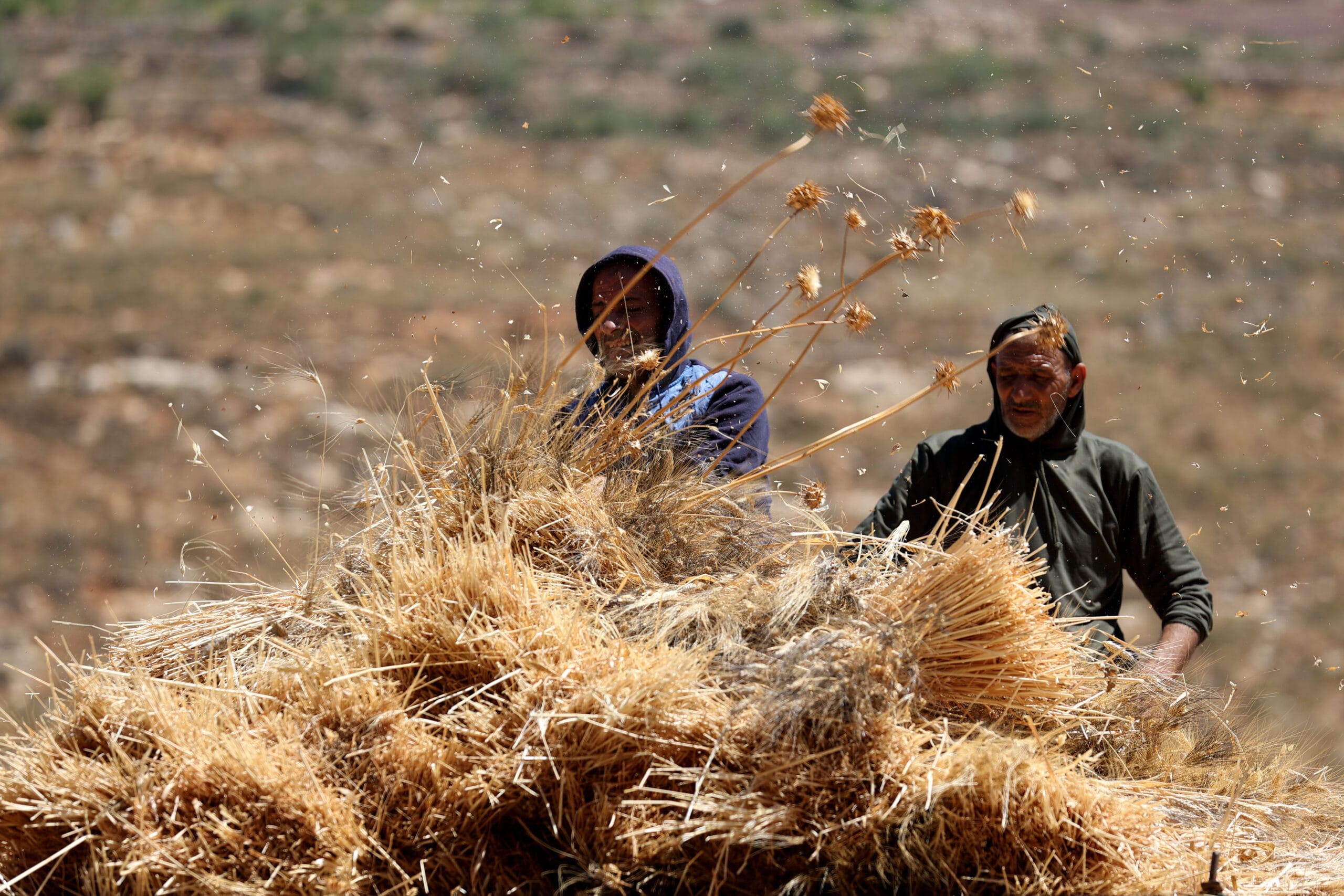
SINJIL, OCCUPIED WEST BANK – In the eastern plain of Sinjil, north Ramallah in the occupied West Bank, dozens of Palestinians are working quickly among the yellow wheat stalks, harvesting their crop this year.

This year’s harvest season is anything but ordinary; it’s a race against time, as farmers fear Israeli settlers will seize their crops by burning or destroying them. This comes amidst a surge in settler attacks on Palestinian farmers and their land.

Residents say they were forced to harvest their wheat and transport it quickly from the fields to the town after repeated attacks by settlers who attempted to burn the crops

and prevent landowners from accessing their land.

The town of Sinjil and its surrounding lands are subjected to frequent attacks by settlers seeking to seize as much land as possible. According to the Sinjil Municipality data, the town has lost approximately 8,000 dunams (a dunam is equal to 1,000 square meters) of its 16,000 dunams.

The town is surrounded by settlement outposts and a barbed wire wall that isolates it from its surroundings. All but one of its entrances are closed, allowing residents to move freely.

Our presence protects our land

Ayed Ghafri, an activist against settlement expansion, said that farmers are working under exceptional circumstances in the eastern plain of Sinjil, a vital area upon which residents depend for cultivating wheat and seasonal crops.

Ghafri told Anadolu Agency: “We are here today in the eastern plain of Sinjil, a vital and strategic area for farmers. We rely on this land for cultivating wheat and seasonal crops.”

He added: “But Palestinian farmers are constantly under threat. Some crops have been vandalized and destroyed, and there have been attempts to burn the wheat more than once.”

He continued: “Recently, farmers tried to work their land, but settlers attacked them and prevented them from doing so.”

He added: “Therefore, we are here today to support the farmers and save the wheat crop, because we believe that leaving it in the ground means it will be subjected to further attacks and the destruction of a large portion of it.”

“Being on the land is the only way to preserve it, and that’s why we are committed to maintaining a continuous presence to affirm its Palestinian identity and protect it,” Ghafri emphasized.

Farmers: “Resilience at an Extra Cost”


Farmers in the area cultivate hundreds of dunams of wheat, but this year’s harvest is taking place amidst growing fears of settler attacks.

Farmer Ashraf Alwan said that about 300 dunams are planted with wheat in the area.

He added: “We came last week to harvest the wheat, but settlers, under the protection of the occupation forces, attacked us and forced us to leave. If it weren’t for the support of the townspeople, we wouldn’t have been able to complete the work.”

He continued: “Today we returned to finish the harvest, but we had to completely change our methods. Under normal circumstances, we would have gathered and threshed the wheat in the field.”

He further explained: “But now we are forced to bring tractors and trucks to transport it to the town center for fear that the settlers will burn or steal it.”

Alwan pointed out that these measures have significantly increased costs for farmers, adding: “The harvest barely covers a small portion of the costs of plowing, planting, harvesting, and threshing, but we are here because it’s no longer a matter of profit and loss, but rather a matter of resilience and holding onto our land.”

He emphasized that “the farmers will not abandon their land despite the attacks, and they will continue to work it and remain on it.”

Farmer Mustafa Shabaneh said that he came with a number of residents to move the wheat from the fields for fear it would be stolen or burned.

He added: “I own seven dunams planted with wheat, and the settlers have tried to burn the crop more than once. On one occasion, they set fire to the area, but the young men of the town intervened and managed to drive them away.”

He continued: “We kept watch over the area, fearing the settlers would reach the crop, but they returned at night with a bulldozer and cleared a path to the farmland. Therefore, we decided to move the wheat from here as quickly as possible to prevent it from being stolen or destroyed.”

In a neighboring field, farmer Ali Bashir anxiously oversaw the harvest.

“Farmers can no longer work normally in this area,” he said. “Even shepherds are afraid to reach their grazing lands because of settler attacks.”

“If settlers come, they might attack you, steal your sheep, or prevent you from accessing your land. People here fear for their crops because there are precedents of crops being burned and farmers being targeted.”

Bashir continued: “We’re supposed to thresh the wheat here in the field, but we transport it hastily because of the fear. This process costs us extra for transportation, harvesting, and threshing, but we have to do it to preserve the harvest.”

He concluded: “What’s happening isn’t just targeting the wheat crop; it’s an attempt to force Palestinians to leave their land so it can be seized. That’s why farmers are clinging to their land and working it despite all the difficulties.”

Accusations of “Ethnic Cleansing”

On June 10, Amnesty International accused Israel of leading and sponsoring a campaign of ethnic cleansing against Palestinians in the West Bank, asserting that arming thousands of settlers has contributed to the escalation of these attacks.

The organization stated that “the Israeli government is implementing the religious-nationalist agenda of the settlement movement and has accelerated the pace of settlement expansion and land confiscation.”

Israel has increased its financial and logistical support for the settlements and supplied the settlers with weapons.

Scattered areas of the West Bank have witnessed a marked escalation in settler attacks, coinciding with the ongoing Israeli military operations that began on October 7, 2023.

Since that date, the Israeli escalation in the West Bank, including East Jerusalem, has resulted in the deaths of more than 1,170 Palestinians and injuries to approximately 12,666 others, in addition to the arrest of around 23,000 people and the displacement of approximately 33,000.

This article was written in Arabic by Qais and Darwesh Omar for Anadolu
Continue reading
Israeli Forces Arrest 4 Palestinians in Ramallah, Bethlehem

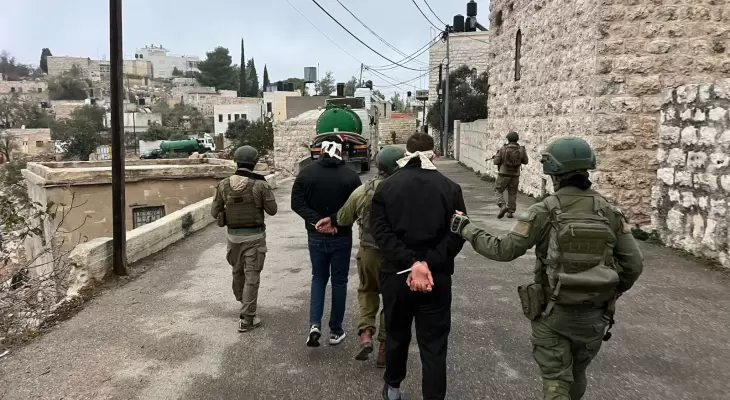
Israeli occupation forces continued their arrest campaigns in the West Bank early, Wednesday morning, detaining four Palestinians in the Bethlehem and Ramallah governorates, including a released prisoner.

In Bethlehem, occupation forces arrested Sharif Bassam al-Balboul, 18, from the town of al-Khader, south of the city.

The arrests also included brothers Amir Adel Ali, 45, and Sufian Adel Ali, 31, from the Beit Falouh area, east of the city, after raiding and searching their homes.

Continue reading
Al Rimawi Freed After 25 Years in Jail

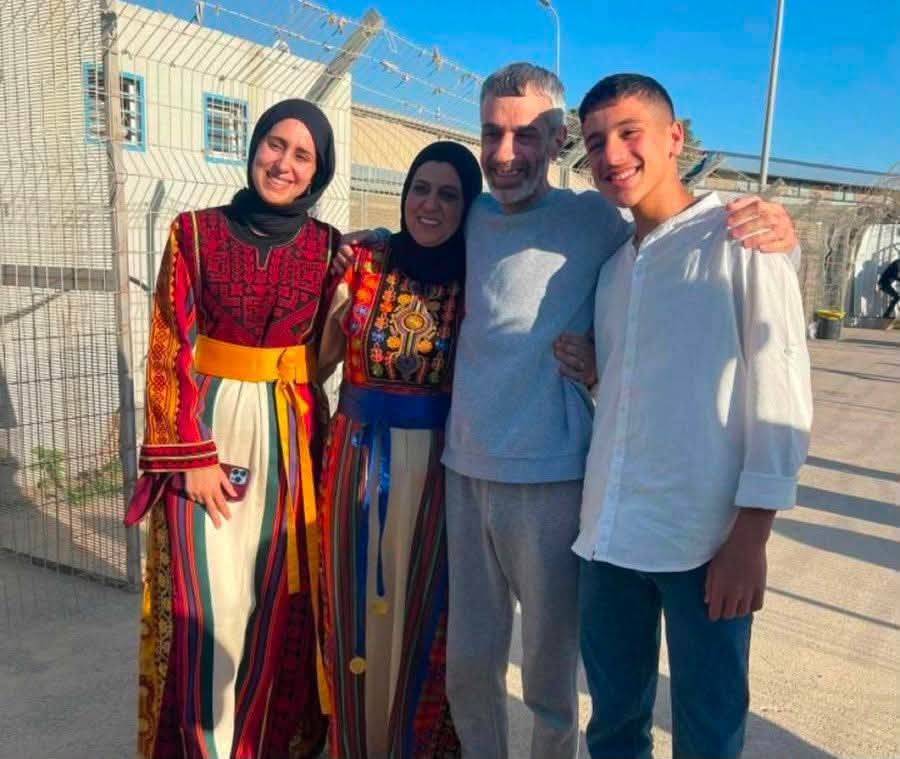
After 25 years in Israeli prisons, Abdel Kareem Al Rimawi is finally set free. After quarter of a century, his wife, daughter and his son waited for him at the Al Thaheria Checkpoint, south Hebron. His son Majd was born 14 years ago, when his father’s semen was smuggled out of prison. As to the daughter Rand, she was still a toddler when Abdel Kareem was jailed. She is now a 26-year-old woman with an MA degree in media studies. He was due to be released a year-and-a-half ago, but he refused to be exiled to Egypt, then, a condition made by the Israeli authorities. After his release he visited the tomb of the late Palestinian leader Yasser Arafat, and made his way to Biet Rima, north-west of Ramallah.

Continue reading
Battle of Wills: Resistance V. Israeli Settlements

By Najla M. Shahwan|

As a part of its broader policy push to increase Israeli settlement presence in the occupied West Bank, Israel has approved recently the construction of more than 2,000 new housing units distributed across several strategic locations.

Pushing to annex more and more of the Palestinian territory Far-right Israeli Finance Minister Bezalel Smotrich has announced a major expansion of illegal settlements in the occupied West Bank.

Smotrich, who holds authority over parts of Israel’s civilian administration in the West Bank, said on 3 June that a planning committee had approved the construction of 2,162 new Jewish homes, of which 1,006 units will be in a new illegal settlement near Jerusalem, 922 near the city of Nablus and 234 near Hebron.

“We are continuing to build the Land of Israel in practice,” Smotrich said in a statement.

The new homes would “strengthen our hold on the land, reinforce Israel’s security, and establish clear facts on the ground that prevent the creation of an Arab terror state in the heart of the country”, he added.

Smotrich has been sanctioned by the United Kingdom, France, and other states, which accuse him of inciting violence against Palestinians.

The minister has denounced the sanctions and said they would not change Israeli policy.

Besides, on June 4, Israeli forces had delivered demolition notices to a number of shops at the intersection of the town of Bazariya, northwest of Nablus, to make way for a colonial road.

Meanwhile, some settlers stormed the village of Deir Sudan, northwest of Ramallah, accompanied by bulldozers, to seize it.

The developments come months after the Israeli government approved a land registration process in February that allowed Israel to take territory as “state property” if Palestinians could not prove ownership.

Palestinians seek the West Bank, including East Jerusalem and Gaza, as part of a future independent state.

Israel, meanwhile, maintains military and administrative control over large parts of the territory, while expanding illegal settlements in several areas.

The settlement expansion comes amid ongoing debate within Israel’s political leadership over the future of the occupied territories.

The Israeli Knesset gave on June 4 final approval to legislation granting tax exemptions to dozens of illegal settlements in the occupied West Bank.

In a statement, the Knesset said lawmakers approved the bill on its final reading, granting tax benefits to illegal settlements located in what it called the “eastern confrontation line zone.”

The legislation was sponsored by Knesset members Zvi Sukkot, from the Religious Zionism party led by Finance Minister

Bezalel Smotrich, and Limor Son Har-Melech, from the far-right Jewish Power party led by National Security Minister Itamar Ben-Gvir, along with other lawmakers.

The bill passed by 32-23 votes. Under the law, occupants will be entitled to tax exemptions throughout the tax year and may choose among available tax benefits if they qualify for more than one exemption.

The legislation is set to take effect in January 2027 and remain in force through Dec. 31, 2027. It also authorizes the finance minister, with approval from the Knesset Finance Committee, to extend its validity for additional periods of up to two years each.

In a report published at the end of May, the Israeli anti-settlement group Peace Now said the law would classify dozens of illegal settlements as areas whose residents are eligible for substantial tax benefits.

The group noted that the original bill sought to extend tax benefits to all settlements but was narrowed due to its high cost and professional objections, ultimately applying to 58 illegal settlements.

According to Peace Now, the updated version primarily includes illegal settlements where support for the Religious Zionism party is particularly strong.

The international community considers settlements built in the occupied Palestinian territory illegal under international law and a major obstacle to a two-state solution.

Netanyahu’s government has openly championed a significant expansion of illegal settlement activity since taking office at the end of 2022. According to Peace Now estimates, more than 750,000 Israeli occupiers live in the occupied West Bank including East Jerusalem.

While some international actors have warned against further annexation or expansion, enforcement measures remain limited.

The United States has historically expressed opposition to settlement expansion, although its positions have varied in intensity depending on administration policy.

On its part US President Donald Trump ‘s administration has been far less critical of the fast-expanding Israeli settlements.

The approval of thousands of new settlement homes further entrenches Israeli presence in the West Bank and complicates already fragile prospects for a negotiated political settlement.

Additionally, settlement expansion changes demographic and geographic realities on the ground, making territorial compromise increasingly difficult and it reinforces perceptions that a viable independent state is becoming harder to achieve.

For Israel, supporters of settlement growth argue it strengthens security and consolidates control over strategically important areas while critics, , say it increases friction with Palestinian communities and fuels long term instability.

However, with diplomatic efforts largely stalled, continued expansion is likely to remain a central flashpoint in the conflict and a key issue in deepening regional tensions.

Najla M. Shahwan is a Palestinian author, researcher and freelance journalist and published this article in the Jordan Times

Continue reading
Punishing The Olive Tree

By Dr Marwan Asmar

Israel’s government, soldiers and settlers destroyed between 13,000 and 14000 olive trees in the occupied West Bank in the first five months of 2026. The figures are based on different Palestinian and Israeli sources.

In May 2026 alone Israeli Finance Minister Bezalel Smotrich said he had ordered the uprooting and destruction of 3000 trees in northern Palestine. The uprooting of these trees were ordered to be felled in a single day.

In early February, 2006 human rights’ groups reported that over 8000 trees were destroyed and a report by the Palestinian Wall and Settlement Commission (PWSC) released last Mid-May showed that 4,414 had been uprooted, destroyed and/or poisoned.

The uprooting of “Palestinian trees” by Israeli settlers backed by the Zionist army has become a normal state of affairs as it has increased viciously since October 2023 when over 37,200 olive trees were “uprooted”, “broken” and “burned” in conjunction with the Israeli war and slaughter of Gaza.  

The situation spelled disaster for Palestinian farmers. In cahoots with Israeli soldiers, settlers would go down on Palestinian villages and towns and start uprooting olive trees out of sheer vandalism.

At the end of last April, this is exactly what happened when settlers from the “Adi Ad” settlement descended on the Turmus Aya village that lies to the north-east of Ramallah in the occupied West Bank and started to destroy and vandalize 400 olive trees.

As they did this, on Saturday night, they were guarded by the Israeli army. This attack came days after the settlers descended on the village and set fire to a house and a car there.

The attack on Turmus Aya is not an isolated incident. The village has been targeted for the past few years. The PWSC, a monitoring organization of such attacks said the Israeli army had been responsible for 1,322 of such attacks while the settlers involved for 497 acts of vandalism on different Palestinian cities with Hebron topping the list at (321), Nablus (315), Ramallah (292) and Jerusalem (203).

Statistics point out that Israel has destroyed between 800,000 and 1 million olive trees in the occupied Palestinian territories from 1967 till now. However, since that year, when Israel effectively occupied all of the Palestinian territories, it destroyed 2.5 million trees.  

Besides olives, they included orange (different varieties), lemon, grapefruit and clementine trees. The Palestinian territories are known for their varieties like almond, figs, apricots, peaches and plums trees.

These trees were destroyed by the Israeli occupation for basic military takeover to expand the Palestinian lands with Israeli settlements – about 147 settlements and 224 outposts – and create the required infrastructure and roads for these since some of them resemble big cities.

In the case of the Smotrich announcement for example, and the uprooting of 3000 trees on Palestinian lands in the north West Bank, the purpose there was to expand the Israeli Shaked Industrial Park which is next to the settlement there that has the same name.

Gaza, another story

Gaza is another sad story for the Israeli genocide has affected the whole of the agricultural sector. During the last war on the Gaza Strip, Israel destroyed 1 million trees according to Fayyad Fayyad, head of the Palestinian Olive Council. The destruction literally decimated the agriculture sector of the enclave.  

Prior to 7 October, 2023, Gaza had 1.1 million trees roughly producing 50,000 tons of olives every year but no more.  About 98 percent of Gaza’s tree cropland has been destroyed.

Dr Mazen Qumsiyeh, a biologist at Bethlehem University, calls the destruction in Gaza an “ecocide” as statistics show that over the past two years and more, Israel has destroyed between 500,000 to 700,000 non-olive trees.

Today in Gaza everything has been razed to the ground. There had once been 35 olive oil presses in the Strip but most of these have been destroyed with only five left as of the end of last year.

The loss of a million olive trees is a $50-million-plus-loss since the total olive oil sector (West Bank and Gaza) contributed between $160 and $190 million to the Palestinian national economy as a direct result of exports to regional and international markets.

The olive oil sector accounts for roughly five percent of the Palestinian GDP and 20 percent of the agricultural sector. Further olive oil production sustains 100,000 families in the Palestinian territories.

Marwan Asmar is a writer from Amman and blogs for crossfirearabia.com

Continue reading