Jordan’s PM: ‘Greater Israel’ Illusion

Jordanian Prime Minister Jafar Hassan on Tuesday called the so-called “Greater Israel” vision an “illusion,” stressing that Tel Aviv is “isolated” due to its “extremist” policies.

“We hear about visions and proposals that imply a perpetual war with no end, such as the illusion of Greater Israel entertained by extremist politicians in Israel,” Hassan said during a meeting in Amman with his Lebanese counterpart, Nawaf Salam, who arrived in the Jordanian capital early Tuesday for an unannounced visit.

He said Israel is “isolated and besieged because of its extremist policies.”

“The entire reality points to (Israeli) policies that deepen hatred and resentment as a result of ongoing massacres, and the peoples of the world and the region will not forgive them,” he added in his comments carried by the official Petra news agency.

On Monday, Jordanian government spokesman Mohammad al-Momani accused the far-right in Israel of “threatening the region and undermining prospects for a two-state solution.”

“Greater Israel” is a Biblical term used in Israeli politics to refer to the expansion of Israel’s territory to include the West Bank, Gaza, Syria’s Golan Heights, Egypt’s Sinai Peninsula, and parts of Jordan.

Last week, Israeli Prime Minister Benjamin Netanyahu told a news channel that he feels “very attached” to the vision of a Greater Israel. He said he considers himself “on a historic and spiritual mission” which “generations of Jews that dreamt of coming here and generations of Jews who will come after us,” according to Anadolu.

Israel has killed more than 62,000 Palestinians in Gaza since October 2023. The military campaign has devastated the enclave and brought it to the verge of famine.

Last November, the International Criminal Court issued arrest warrants for Netanyahu and his former Defense Minister Yoav Gallant for war crimes and crimes against humanity in Gaza.

Israel also faces a genocide case at the International Court of Justice for its war on the enclave.

Continue reading
Bombing Damascus, Arab Silence!

In a scene that reflects its utmost political and military arrogance, Israel, Wednesday, bombed the Syrian General Staff and the Republican Palace in the heart of the capital, Damascus.

This blatant attack crosses all red lines, interfering in Syria’s internal affairs as if it were the world’s superpower, openly defying international law and humiliating some Arab regimes with its silence and suspicious incompetence.

This is not a passing event, nor is it merely a “security message,” as Western media attempts to gloss it over. It is a blatant aggression against the sovereignty of an Arab state, striking its most important symbols of sovereignty in broad daylight.

The military strikes are a declaration of rebellion against international law and an insistence that Israel remains “above the law,” capable of destroying any Arab capital without fear of punishment or even blame.

What does Israel want?

It wants to brazenly say:


“I decide who lives, who is bombed, and whose voice is forcibly silenced.”

It seeks to impose the logic of force and dictate new rules in the region, titled: There is no place for an Arab state with independent decision-making, capable army, or a resistance project.

What is happening in Syria today has happened and is happening in Gaza, in southern Lebanon, in Iraq, in Yemen, and in every region trying to breathe outside the Zionist orbit.

The challenge is not only facing Syria…but all Arabs.

Anyone who thinks that these raids target Syria alone is delusional.

Every Arab country is now on the waiting list.

Today, Damascus is being bombed, and tomorrow… who will be next? Baghdad? Beirut? Yemen, Khartoum? Riyadh, Cairo? No one is immune to this arrogance as long as silence is the only response.

It is the Arab silence that has encouraged Israel to persist. The disagreements, divisions, and humiliating normalization are what have reassured Tel Aviv that no one will hold it accountable, or even condemn it.

What’s needed now: Break the silence and stop the collapse.

It’s time for the Arab nation to wake up from its slumber and realize that what is happening is not a “Syrian crisis” but a “collective Arab setback.”

Overt and gratuitous normalization with Israel must be halted immediately.

The Joint Arab Defense Charter must be activated, even if only verbally at first.

The steadfastness of Syria—its people, army, and institutions—must be supported, because the ultimate target is every Arab state. Everyone’s turn will come if Arab silence continues.

Israel is not destiny… and if the Arabs want to, they can.

Our history is full of moments of steadfastness and victory, but we need an awakening of conscience and a political will to halt this unbearable collapse.

Israel does not respect the weak, nor does it take into account those who remain silent.

Unless it is curbed now, every Arab state will one day find itself in its crosshairs, without support or dignity.

This opinion was written by Awni Al Rjoub in Arabic and published in Jo24.

Continue reading
Houthis Launch Three-Pronged Attack on Israel

Yemen’s Houthi group announced Wednesday it targeted Israel’s Ben Gurion Airport, Eilat port and a military site in the Negev region in a series of coordinated missile and drone attacks.

“The Houthi missile force launched a ballistic missile of the Zulfiqar type at Lod Airport (Ben Gurion) in the Tel Aviv area,” Houthi military spokesperson Yahya Saree said in a prerecorded statement.

He added that the strike forced “occupying Zionist settlers into shelters and halted airport operations.”

Saree said the group also conducted operations using drones. Two drones targeted an Israeli military site in the Negev region, while others were aimed at Ben Gurion Airport and the port of Eilat according to Anadolu.

Earlier, the Israeli army said it intercepted a missile fired from Yemen, triggering air raid sirens in several southern areas. The army did not mention any drone activity in its statement.

Air raid sirens sounded across multiple towns and settlements in the Negev and Dead Sea areas, according to Israel’s Yedioth Ahronoth daily.

Meanwhile, Israel’s Channel 12 reported that the port of Eilat will suspend operations starting Sunday due to financial distress, largely attributed to a sharp decline in revenue caused by the ongoing Houthi naval blockade in the Red Sea.

According to the report, the port has accumulated roughly 10 million shekels ($2.9 million) in debt, primarily due to unpaid municipal taxes. The network said ships that previously docked at Eilat have diverted to Ashdod and Haifa ports on the Mediterranean, citing “aggressive Houthi activity in the Red Sea.”

The Houthis have intensified missile and drone strikes on Israel since Israeli forces resumed their attacks on the Gaza Strip in March after two months of a shaky ceasefire.

Since November 2023, the group has also targeted commercial shipping in the Red Sea, the Gulf of Aden and the Arabian Sea in support of Palestinians in Gaza, where nearly 58,900 people have been killed in an Israeli onslaught.

Continue reading
How Britain Funded The Israeli Genocide

Britain’s support for Israel’s genocidal conduct in Gaza, through weapons, intelligence sharing, and diplomatic cover, is in the spotlight again after this week’s court ruling on a legal challenge to the UK’s continuing arms exports to Tel Aviv.

Critics, ranging from top human rights groups to legal experts and members of Parliament, say the UK has become complicit in the devastation Israel is inflicting on Gaza, where its forces have killed more than 57,000 Palestinians and wounded over 134,000 since Oct. 7, 2023.

The UK High Court on Monday dismissed a judicial review brought by Palestinian human rights group Al-Haq and London-based Global Legal Action Network (GLAN), supported by Amnesty International UK, Human Rights Watch, and Oxfam.

The case centered on Britain’s decision to exempt F-35 parts when suspending some arms export licenses for Israel last year, citing the UK’s legal obligations under international humanitarian law, including the Geneva Conventions, the Arms Trade Treaty, and the Genocide Convention.

Despite acknowledging these concerns, judges Stephen Males and Karen Steyn ruled that the so-called “F-35 carve-out” policy was lawful and beyond the jurisdiction of the courts. The decision drew widespread condemnation from the rights groups, who have vowed to keep up their efforts to force the British government to halt all arms exports to Israel.

According to a detailed investigation by London-based watchdog Action on Armed Violence (AOAV), the UK has supplied thousands of munitions, continued shipments of components for the F-35 fighter jet used in Israeli airstrikes, and conducted over 570 surveillance flights over Gaza since December 2023.

Arms and material

Britain has continued to arm Israel despite mounting civilian casualties in Gaza. “Since October 2023 there have been at least 14 shipments of military goods from the UK to Israel,” Labour lawmaker Kim Johnson said in Parliament last month.

“Those include over 8,500 munitions, bombs, grenades, missiles, and 146 armored vehicle parts. In October 2023 alone, the UK exported 150,000 bullets.”

In September 2024, under growing pressure, the Labour government announced it was suspending around 30 of 350 active export licenses for Israel, citing a “clear risk” that British-made weapons could be used in serious violations of international humanitarian law.

However, the move fell far short of a full embargo, with AOAV noting that “the vast majority of licenses remained valid.”

Critically, the UK exempted components for the F-35 fighter jet program from suspension. BAE Systems, a key British arms manufacturer, contributes to the jets used in Israeli airstrikes.

AOAV reports that F-35s have played “a critical role in the Israeli bombing campaign,” including an attack in March 2025 that killed more than 400 Palestinians.

While the UK insists that all exports are rigorously assessed, Parliament has heard warnings that Britain cannot ensure its arms are not used in Gaza.

“It is completely conceivable that those weapons have been used to kill and maim children in Gaza,” Labour MP Warinder Juss said in a Parliament session.

Surveillance and intelligence

Starting in December 2023, the Royal Air Force began flying near-daily surveillance missions over Gaza and southern Israel from the RAF Akrotiri base in the Greek Cypriot Administration.

According to AOAV data, Britain has flown over 570 such sorties, with more than 200 under the current Labour government.

The primary aircraft used is the Shadow R1, operated by the RAF’s 14 Squadron, equipped with high-resolution cameras and signals intelligence tools. The RAF also deployed RC-135 Rivet Joint planes to collect electronic intelligence.

The UK government claims these flights are “solely” for hostage rescue purposes. However, AOAV raised serious concerns about how the intelligence is used, warning that “British spy aircraft may have given Israel additional eyes and ears over Gaza’s battlefields.”

Britain’s membership in the Five Eyes intelligence alliance complicates matters further. As AOAV explains, the UK has long held responsibility for Middle East monitoring within the alliance, and signals intelligence shared with the US may have ultimately supported Israeli military operations.

Legal challenges and ethical concerns

Despite the September 2024 suspension of some export licenses, arms shipments from the UK to Israel appear to have continued. Human rights groups have sharply criticized what AOAV calls a “blind alliance.”

In early June, former Labour leader Jeremy Corbyn called for an independent public inquiry into the UK’s involvement in Israeli military operations in Gaza, urging the government to end arms sales to Israel and accusing ministers of complicity in what he described as “mass murder.”

Most recently, on June 30, the UK High Court dismissed the judicial review brought by Al-Haq and GLAN, saying that decisions on whether to continue UK’s involvement in the F-35 program were for the government and Parliament according to Anadolu.

Continue reading
Iran Strikes Mossad Center

Iran’s Islamic Revolutionary Guard Corps (IRGC) announced, Tuesday it had directly targeted and struck two high-level intelligence facilities inside Israel, including the headquarters of Israel’s Military Intelligence Directorate (Aman) and a Mossad operational center.

The announcement came after a wave of Iranian ballistic missiles struck central areas of the occupied territories early Tuesday morning. 

Israeli media confirmed at least five missiles hit targets across the Tel Aviv metropolitan area, with one reportedly landing in Herzliya—a coastal city that hosts key Israeli security and intelligence infrastructure.

A separate strike targeted the Glilot area, a highly sensitive site believed to house core logistical operations for Aman. 

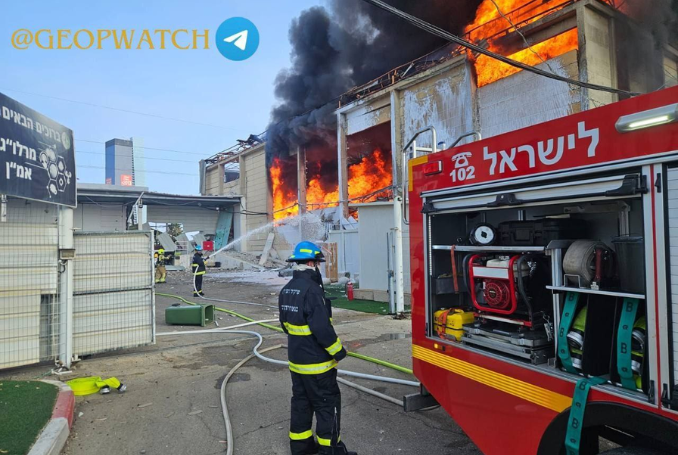
Military censorship was swiftly imposed on coverage of that location, though images published by Israeli outlets suggest a large warehouse or command center was hit.

The IRGC stated that the precision strikes were part of its ongoing Operation True Promise 3, which aims to deliver “precise and painful blows” to the Israeli occupation in retaliation for recent attacks on Iranian cities and infrastructure.

The broader missile barrage included the launch of 20 to 30 ballistic missiles from Iran toward central and southern areas of the occupied territories. 

Air raid sirens were heard across Tel Aviv, Gush Dan, and surrounding towns as Israeli air defenses attempted interception.

Despite those efforts, multiple explosions were recorded across the region. Israeli media reported loud blasts in Herzliya, Ramat HaSharon, and Ra’anana, with several buildings damaged and injuries reported. 

According to Magen David Adom, ten Israelis were injured while rushing to shelters.

Fires, Evacuations, and Structural Damage

The Fire and Rescue Authority responded to at least eight incidents in the Hasharon region and greater Gush Dan. 

Over 20 firefighting teams were deployed to contain fires caused by falling debris and missile shrapnel. A blaze was also reported in Kfar Saba after Iranian projectiles impacted the area.

Three additional Iranian missiles reportedly struck targets in southern “Israel”, including near Beer al-Sabe’ (Beersheba) in the western Naqab.

Authorities are investigating reports that some Israelis may be trapped beneath rubble in the Tel Aviv area, though official casualty counts have not been released.

Israeli media reported a delay in the missile alert system, with detection occurring only two minutes before impact. Sirens were reportedly triggered just three minutes before the strikes, prompting criticism of the so-called Home Front Command.

Iran Responds

Iranian officials said the missile operation was a direct response to the Israeli occupation’s continued bombing of Iranian hospitals, media buildings, and residential neighborhoods. 

While Israeli authorities claim to be targeting “military sites,” the rising civilian death toll inside Iran has drawn international condemnation.

The missile strikes appear intended to demonstrate Iran’s capacity to hit deep inside the occupied territories with precision, targeting not only population centers but also high-value strategic and intelligence locations.

The IRGC confirmed the launch of the ninth wave of Operation True Promise 3 on Monday night, stating that strikes would continue through dawn on Tuesday. Iran’s Tasnim News Agency published footage showing missiles traversing the skies over the occupied West Bank.

Separately, the IRGC said it had struck the same base from which Israeli aircraft had launched an attack on Iran’s state broadcasting authority days earlier.

Air raid sirens were also activated across the north, from Nahariya to Caesarea and Haifa, as well as in the occupied Syrian Golan, amid fears of further drone or missile attacks according to the Palestine Chronicle.

Continue reading