Hassan Al Karmi: The Dictionary-Maker
 CrossFireArabia
- June 14, 2026
EDITOR’S NOTE: This is a tribute article I wrote originally about the Palestinian dictionary-maker who died on 5 May, 2007. It is befitting to reprint now from the hackwriters website because of the enormous contributions this man made to Arabic-English, English-Arabic dictionaries.
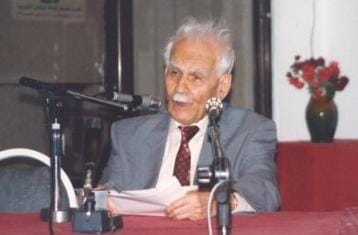
I first met Hassan Al Karmi when he was in his 90s. He was still as sharp as a tack. He was living another of his golden ages. He had already 14 Arabic-English, English-Arabic dictionaries under his belt and he was now writing treatises on Islam and the West. After our first meeting to do an article on him that appeared in a local newspaper–not written by me–we became friends and I started to visit him regularly though not as much as I would have liked. He would tell me Marwan keep coming to see me, I want to discuss what is happening in this world that has gone mad!
He first lived alone with only a Sri Lankian maid to look after him although he had numerous old guard friends, part of them his relatives, and part admirers, just happy to be in the company of a man who started to make dictionaries in the 1960s.
Hassan Al Karami made Amman his home in 1990 saying this is where he wanted to spend his retirement and the rest of his life. He came here quite by chance en route to Damascus where his wife wanted to see her original birthplace. Whilst in Amman, she passed away and so Hassan Al Karmi, nom de guerre Abu Zeyad, decided to make his home permanently here. He says he was 87 or there about by then and felt that it was time to come home.
Hassan Al Karmi had lived most of his life in London, and therefore could legitimately be called Anglo-Palestinian as he migrated to Britain in 1948 when Palestine fell to the Zionist occupiers. However, he never forgot his roots.
He was a Jerusalemite, born and bred, a teacher and an educational inspector by profession who traveled all over Palestine in the inter-war years from 1918 till 1948. He wasn’t too sure of the exact date of his birth, although he would tell me it was either in 1904 or 1907 but all he would say is he and his family would move at that time freely between Palestine, Syria and Jordan where his father served as chief judge in the 1920s to then Prince Abdallah of Trans-Jordan.
In an unpublished autobiography, Al Karmi vividly describes these years. The information he provides about his life in the various cities of Palestine during the 1920s and 1930s in places like Al Ramleh and Jerusalem are particularly illuminating. The reader receives a sketchy but a clear picture of the educational system in Palestine under the British Mandate with the young Al Karmi moving from one school to another.
From 1948 to 1990 London was to be his home, finding a job at the British Broadcasting Corporation–BBC Arabic–as a language supervisor, checking and correcting the Arabic that was spoken and broadcast to the Arab world. He remained at the BBC till his retirement in 1968, but by then he was known all over the Arab World through his program Qawl al Qawl, “Saying Upon Saying” that started in 1954 and lasted till the 1970s.
This program made him famous, almost a star, heard by many across the Arab world, commoners and kings, intellectuals and princes. He would tell me his presence at the BBC allowed him to meet and interview people like the late Sir Anthony Eden who was British Foreign Secretary at the time of the Suez Crisis in 1956 when Britain, France and Israel attacked Egypt, and he frequently interviewed Glubb Pasha who headed the Arab Legion in Jordan in the early 1950s.
The late King Faisal of Saudi Arabia who was murdered in the early 1970s wouldn’t miss an episode of the program, Karmi told me when they used to meet in the 1960s the king would tell him he was a judicious listener to the program. The late Egyptian President Gamal Abdel Nasser was another admirer, and ordered his own media to emulate the program.
Abu Zeyad was very proud of his BBC series not only because of the many friends he made across the Arab world including the late King Hassan II of Morocco but it helped him to maintain his roots and culture for he would frequently travel to the region to buy books and dissect the knowledge which he would use as quizzes for his program.
And in his London home he built an impressive collection of books, numbering at least 1000, which he left to one of his two daughters, Ghada Karmi, a medical doctor-turned academic, an author, commentator, and now a researcher at Exeter University’s Institute of Middle East Studies. Although the 48-volume collection of “Saying Upon Saying” was brought from London to stay as a cherished prize in his Amman flat.
He only bought a fraction of his books to Amman and some of his dictionaries, a number of which are out of print, but many others still on the market. He used to say to me proudly in actual fact he wrote 14 dictionaries but only eight are published, a great achievement in itself.
His first, Al Manar dictionary, was started in the early 1960s at the height of his career at the BBC, but was published in 1970, it is today long out of print although I managed to see a copy of it in one of the bookshops in downtown Amman.
On occasions I tried to ask him how he actually went about making his dictionaries but at many times his thoughts would seem intellectually scattered and his mind thinking of too many ideas. He was much too concerned with the malaise of the Arab world, arguing there was now another Christian crusade led by the United States against every Arab man and women, young and old.
Words seems to him superfluous if they are not connected to the culture, politics, religion and economics of the region. He looked for social habits and idiosyncrasies, seeing the Arab man as riddled with contradictions that are as much as his own fault as the fault of the globalist culture and the dictation of the outside world, of Bush’s America.
He was an inter-disciplinarian in the way he approached his work. He would always say that making dictionaries was the hardest projects he ever embarked on, but it was one of his priceless projects because it put the course of the Arabic language on a fixed linage and protected it. That’s why an endless amount of reading was required to look at the normative values of Arabic words and phrases, how the Arabic word was used and understood by the ordinary man-in-the street rather than how the intellectual and the pedagogues understood them and handed them down to the plebs.
What made making dictionaries in Arabic harder still he would say is, because unlike English, there is no ready-made references in Arabic and involved looking at words and going back to their origins, dissecting their consonants, or when they were said and come up with modern equivalents but one that ensure consistency and not deviate from the tone, intonation and syntacs.
Of course he had to look at other dictionaries which he brought back to London from his frequent trips to Arabia. Sometimes he would expressly travel to Egypt, Lebanon and Syria to gather what he termed as a book culture which he would ship to his house in London and sift through patiently to understand how one would differ from another and the context in which it is being used.
He thought there was no time to lose, for him time was of the essence, his dictionaries, books and world news was of paramount importance. When he wasn’t preparing one book, he would be seen scribbling in his shaky writing and would at times amusingly say ‘I can’t make head or tail of what I wrote’. On seeing him sign a book for me, his son Zeyad once comment amusingly, ‘take care of the signature, one day it will be very valuable.’
I remember his late 90s, where he would be sitting at his desk or at his favorite armchair with a magnifying glass in one hand and a pen in the other saying I just completed the adding of 10,000 extra words to one of my dictionaries that was to be printed in Beirut, then switching his mind to George W. Bush and his neo-conservatism, curse their politics in Iraq and on Palestine and say ‘why don’t they leave us in peace, we are a peaceful people.
The sum total of all of his printed dictionaries was eight over the span of the 1970s, 1980s and 1990s. They included Al Mughni Al Akbar, (English-Arabic), Al Mughni Al Kbir (English-Arabic), Al Mughni (English-Arabic), Al Mughni Al Waseet (Arabic-English), Al Mughni Al Waseet (American English-Arabic, Al Mughni Al Wajeez (English-Arabic), Al Hadi for Arabic language, Al Hadi Al Waseet, Al Hadi for students).
It was very strange to be in the company of such a man, I never thought of him per se as a dictionary-maker. I suppose I was very privileged to have known a man whose mind was to say the least multi-dexterous, leaping from one idea to another, it simply kept buzzing and enthused with intellectual thought. There was no end to his surprises.
One day I went to see him and out of the blue handed me a book he just published on a cat he had in his inter-war years in Palestine. Would you believe somebody would write a book on his cat, he would tell me, and yet why not, cats are very clever things you know and we should appreciate them more, one day I was trying to get rid of my cat, so I took it 20 kilometers from where I lived and left it there, and when I went back home there it was on my door step, what other animals would have the sense to do that.
He would tell me the story time and again and I would just nod my head and think of his many talents. It was his almost devoutness to knowledge, almost a humbling trait, that would probably stick out as his most basic of his character.
Hassan Al Karmi was not the kind of person who would be sidelined. While many people start becoming peripheral as they enter their octogenarian years, the intellectual caliber of Al Karmi left no room for peripheralism or the sense of being left out on any topic of conversation.
His mind never surrendered to his enfeebled body, and which radiated with sparkles of intellectualism about the moderation and enlightened forces of Islam and the godlessness of the West led by America and George Bush’s version of global domination. Towards his latter years, and through a penetrating historical analysis he came to speak of an embedded alliance between Judaism and Christianity and even supported the coining of the phrase of “Judeo-Christianity” to express an intrinsic relationship between the USA and Israel.
Towards the latter part of his life, his daughter Siham, herself a lady in her 70s and a biology teacher, came all the way from London to be with her father, while the others would try and come as much as possible. He and they shall be remembered as living in two cultures and trying to reconcile themselves with both.