Winners, Losers in Ceasefire Gaza

Dr Khairi Janbek

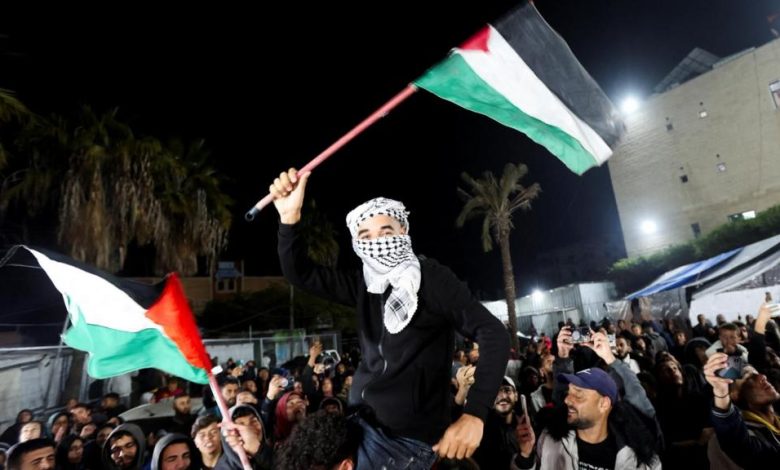
The idea of peace in Gaza is a deeply complex and sensitive issue that involves multiple layers of history, politics, and human rights concerns. When asking who is the winner in such a situation, it is important to note that in conflicts like this, there is often no clear cut winner. Both sides have experienced significant losses, and the true victory is ideally peace and justice for all involved.

Therfore, writing about peace in Gaza and identifying a winner is a delicate and complex issue, given the long history of the conflict, the many political, religious, and social factors involved , anf the human toll. Rather than framing it in terms of winner, it might be more constructive to focus on how peace could be achieved and what that would mean for the people of Gaza, Israel, and the broader region.

To move forward, in any conflict the idea of a winner is flawed. For those caught in the crossfire, both Palestinians and Israeli have face immeasurable losses, so instead of asking who emerged victorious, we must ask how can both, Israelis and Palestinians, live side by side in dignity and security? Essentially, a lasting peace would not mean the obliteration of one side or the domination of another. It would require mutual recognition of each other’s rights, history and humanity. It would mean ending the cycle of violence that harms innocent civilians and leaves communities devastated, while opening the door for political and economic solutions that allow both peoples to thrive.

Heavy hand

For Israel, security is a non-negotiable priority. The persistent threat of violence from militant groups in Gaza has been a constant concern. On the other hand, Palestinians in Gaza must also be able to live without the heavy hand of occupation and blocade, ensuring their freedom. In this context, the international community must ensure that the rights of both Palestinians and Israelis are upheld, with a focus on dignity of the individuals; whether it is the right to live without fear of violence, or the right to self- determination and sovereignty.

Indeed the people of Gaza have long suffered under economic hardship, with hardly any access to basic services like healthcare, education, and employment opportunities, consequently any peace agreement must include a comprehensive plan for rebuilding Gaza, improving living standards, and opening up pathways to regional cooperation and trade. Achieving peace will require honest peacemakers on both sides, committed to negotiation and diaogue over violence. This clearly will involve the international community playing a much more active rôle in mediating talks, promoting trust-building measures, and holding all parties accountable.

The true winners in a new beginning would be the people; both Palestinians and Israelis, whom have suffered for too long. Peace would allow for the children of Gaza to grow up without fear of bombings, and for Israeli families to live in security without constant worry of attacks. Therefore, victory would be a shared one, a victory of humanity over hate, of hope over despair, and of a future where both Palestinians and Israelis can claim their right to live in peace, security, and mutual respect.

Dr Khairi Janbek is a Jordanian analyst based in Paris

Continue reading
Trumpography!

By Saleem Ayoub Quna

Yes, this is the only way I could come up with to describe the special type of approach and fascination, just recently demonstrated by US President-elect Donald Trump, versus the science of geography.

As we all know, geography has for centuries, drew the lines not only between countries and peoples, but also built demarcation signs for different nations to respect each other’s space, identity, culture, way of life and freedom.

Geography in this sense is good and useful. But when some men at the top in the past failed to read its subtle codes, problem happened. History is rich of such incidents.  Take for example Genghis Khan of Mongolia in the 11th century, Napoleon Bonaparte of France in the 17th century, and Adolf Hitler of Germany in the 20th century.

Who do think would be a good candidate today to replay the role of one of those who once misread the language of maps?

No one on earth can tell what’s really was going on in the mind of Donald Trump, the newly re-elected President of the US, when he talked the way he did, about his plans for his country’s second door neighbors and allies such as Canada, Mexico, Panama and even faraway Greenland, all in one coup, just few days before he takes office!

Surely, Trump’s hands are full at home and abroad. But it seems that his biggest obsession next to blaming Joe Biden for all mischiefs at home and abroad, is China!

China, he is told, is doing well. Not only its business and reputation are flourishing all over the world, including in the US, but also at home, where the standard of living and economy is impressively on the rise.

In addition to all of these strong cards China holds, its army must be the biggest in the world, plus its nuclear arsenal. Trump is aware of that too.

China for its part, is talking about Taiwan, the American and Western success story, since the end of WWII. China wants it back as part of its territorial national sovereignty. The US, Taiwan’s government and its people (23 million) and the West, do not agree to that, saying that the current world order has been constructed on the results of that war which they won, as did Communist China.

The current situation in the eastern Pacific Ocean, which harbors among others, South Korea, Japan and Taiwan is part and parcel of that glorious history.

Trump, to his own credit, is aware of China’s credentials. He obviously realizes the meaning of a full scale war with China. In some way, Trump thinks, and this goes also to his credit, that economy could be more important and effective than military force with equal rivals!

So to get out of this self-dug quagmire, Trump’s imagination takes him and the whole world, beyond all known classical boundaries of imagination, that politicians and strategists have experienced before.

Here, emerges the other hidden side of Trump, the visionary leader who, most probably, is living an illusion that he could be the greatest American President since 1776! Maybe, he thinks that, if George Washington, 250 years ago was chosen to become the first President of this vast rich country, it is now time for America, under his watch, to change the course of history and adjust some lines of geography again!

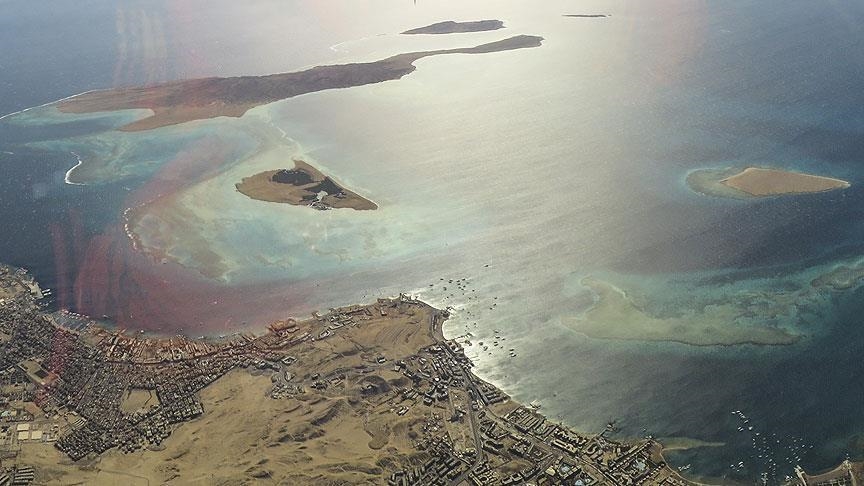
So what is he coming up with? He wants to change the name of the Gulf of Mexico to the Gulf of America, because, first it is appropriate, and second because it is a more beautiful name! Thanks God that he did not suggest to name it the Gulf of Trump!

But what are the facts on the ground?

The Gulf of Mexico was known since Mexico and Mexican civilization were born nearly 3000 years ago. The US as such came to exist less than 300 years ago. The coast line of the Gulf of Mexico makes the waterfront boundaries of states that were taken by the American colonizers, as a result of the Mexican-American War of 1846-1848. Look at the map again!

Other inland states such as Utah, Wyoming, Colorado, Nevada, Kansas and others were all also part of Mexican territory before that war. According to the Treaty of Guadalupe-Hidalgo signed between representatives of the two governments of the US and Mexico at that time, Mexico had conceded all these territories to the strong and better armed Americans. In brief, more than 50% of what constitutes the USA today, was originally Mexican, but still the names of all these states are still Spanish, not English!

Looking north, Trump beholds Canada, a vast and sparsely populated land with lot of rich natural resources. Why not make it the 51 state now? If the Founding Fathers managed to conquer all these states that make half of the country today, from Mexico 200 years ago by force, why not invite Canada to join the Union, without a fight? Together they would make a great beautiful landscape, and a unique merging venture, Trump fantasizes!

Then he turns to Panama Canal! He wants to take control of this strategic water way between South and North America, because he does not like the news that the Chinese are using it to market their merchandise!

Finally, he looks way up to the Atlantic Ocean and spots a huge island covered with ice, where nearly 60,000 people live. They formally and willingly are loyal to the Danish Crown in Copenhagen, the capital of Denmark. According to the Mercator Map Projection, Greenland is as big as Africa, although topographically Africa is 14 times larger. But that does deter Trump from wanting to annex it to America as well!

The only way Trump would convince those 60000 Greenlanders to accept his offer would be to offer them all full-board stay in three star Hotels in America which do not belong to his hospitality empire of course, but are owned and run by a Cuban businessman, who was once granted political asylum in Florida along with other Cubans soldiers, after the American planned invasion of the Bay of Pigs in Cuba, during the JFK presidency in the early 1960s, had failed!

With this nostalgic note, I want to close, by sincerely hoping that this Trumpography bubble will not be around after Trump himself is gone four years from now!

This opinion was especially written for Crossfire Arabia by Saleem Ayoub Quna who is a Jordanian author writing on local, regional and international affairs and has two books published. He has a BA in English Literature from Jordan University, a diploma from Paris and an MA from Johns Hopkins University in Washington. He also has working knowledge of French and German.

Continue reading
Israel’s War on Truth

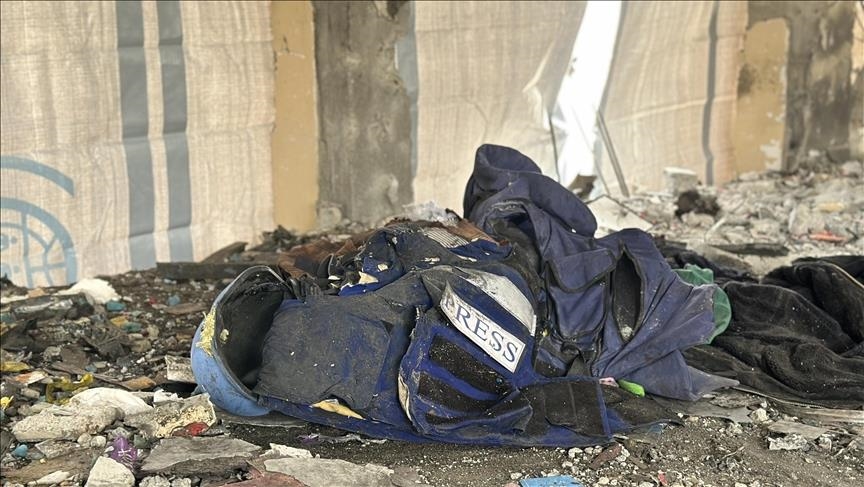
The number of journalists killed in Gaza since Oct. 7, 2023 is unprecedented in human history. More media workers have lost their lives in the Gaza war than in World War II, the Vietnam War or the 1990s conflicts in the former Yugoslavia. Tallies vary because of different counting methodologies. The International Federation of Journalists puts the toll at 148 deaths while others record a figure of over 200. For context, there were around 1,000 journalists working in Gaza at the start of 2023, so the mortality rate is significant. Of course, the overall toll in this war is horrendous; more than 45,000 have perished, according to the authorities in Gaza. However, the death toll among journalists is dramatically higher than that among any other occupational group.

Explaining such an extraordinary proportion of lost lives is necessarily speculative – but there are factors that are impossible to ignore. The Israeli Defense Forces have access to sophisticated monitoring equipment, such as Pegasus, which secretly infects mobile phones and discloses their precise locations. They have AI-powered systems known as “Lavender” and “Gospel” to select targets and program weapons systems to precise geo-locations. They also have a fleet of deadly drones.

Obstacles to reporting

Neither of these are the only circumstantial evidence that something terrible is in progress. International reporters have been barred from Gaza since the war’s outset. Foreign correspondents have repeatedly petitioned to pass through the Rafah crossing to witness events for themselves, and they have been consistently denied. The Foreign Press Association in Jerusalem has stated: “Never before has Israel enforced such a long and strict information blackout. It has repeatedly rejected our appeals for access, (and) fought us in court to uphold this draconian ban.”

During the same period, the Israeli daily paper Haaretz has been sanctioned by its own government, and the Qatari television station Al Jazeera has been banned from operating in both Israel and the West Bank. The most profound effect of this campaign is felt in Gaza, of course, but such an attack on free reporting has an impact all around the world.

Call for international action

As long as the Israeli government pursues such a policy, and is facilitated by its allies, it provides cover for all those around the world who would undermine media freedom. So, what then can be done by those of us who support free and unfettered journalism?

The first step is to recognize the extraordinary bravery of those who continue to report from Gaza. They deserve every form of support that we can provide. In recent months, the IFJ, working with UNESCO, has launched three journalists’ solidarity centers in Gaza where reporters work, recuperate, socialize and access training. Alongside many other agencies, the IFJ also directly aids journalists through their union, the Palestinian Journalists’ Syndicate. Anyone can support this work via the IFJ’s International Safety Fund.

No less important is the demand for an international investigation into what has happened to journalists in Gaza. Karim Khan, the chief prosecutor of the International Criminal Court has already announced that he has “reasonable grounds to believe that Benjamin Netanyahu and Yoav Gallant bear criminal responsibility for war crimes and crimes against humanity.” It is critical that Khan’s investigation progresses and that its findings are examined in a court of law. Only when this happens will there be a chance for Palestinians to start believing that international law protects them.

International law needs to be more accessible

Such a long wait for the ICC to take up this case – and previous crimes such as the killing of Shireen Abu Akleh in 2022 – makes it clear that obtaining international justice for journalists is a significant challenge. For this reason, the IFJ has long campaigned for a specific UN Convention on the Safety of Journalists. This would not create new rights, but would make international law more accessible when journalists are targeted. Adoption of such a Convention in the next few years will be of little comfort to those who have lost their lives in Gaza. It would, however, be a recognition of the service that journalists provide and the sacrifice that this often demands.

Without journalists, the people of the world would have little idea of how lives beyond their own neighborhoods are impacted by global events. Most of us may have cause to disagree with the perspectives of some or many individual journalists, but the more reporting is available to us, the more voices are heard, the better we will be able to make up our own minds about what is important. Emphasizing the international legal provisions that protect journalists will improve the safety for all – whether they work in war zones or at home alone.

The above piece is written by Tim Dawson who is the deputy general secretary of the International Federation of Journalists for Anadolu.

Continue reading
Day 460 of Israel’s Genocide

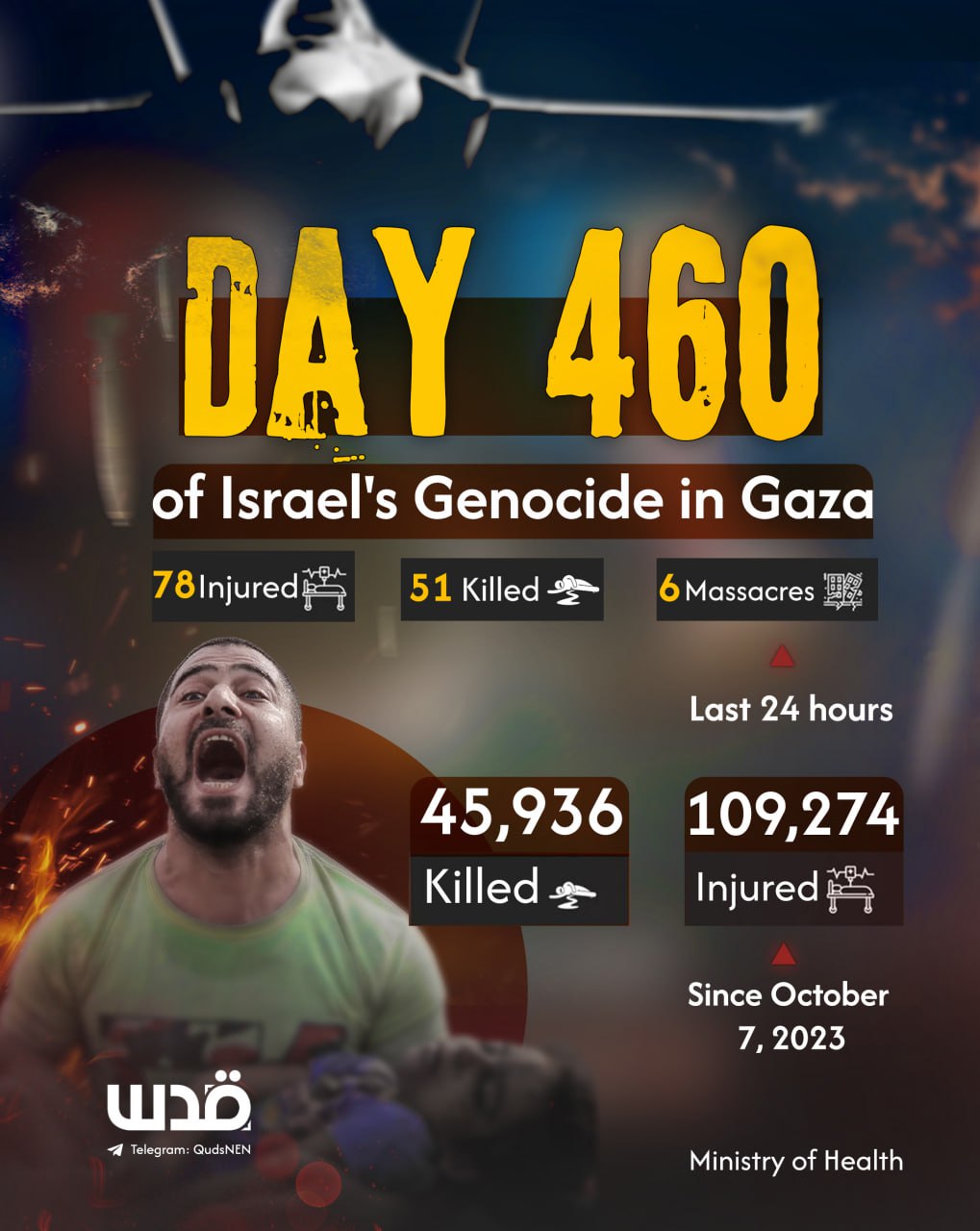
Daily briefing by the Ministry of Health in Gaza on day 460 of the ongoing Israeli genocide:

The Israeli occupation committed six massacres against families in the Gaza Strip over the previous 24 hours, resulting in 51 documented fatalities and 78 people injured.

The documented Palestinian death toll has now reached 45,936 individuals killed and 109,274 others injured since October 7, 2023.

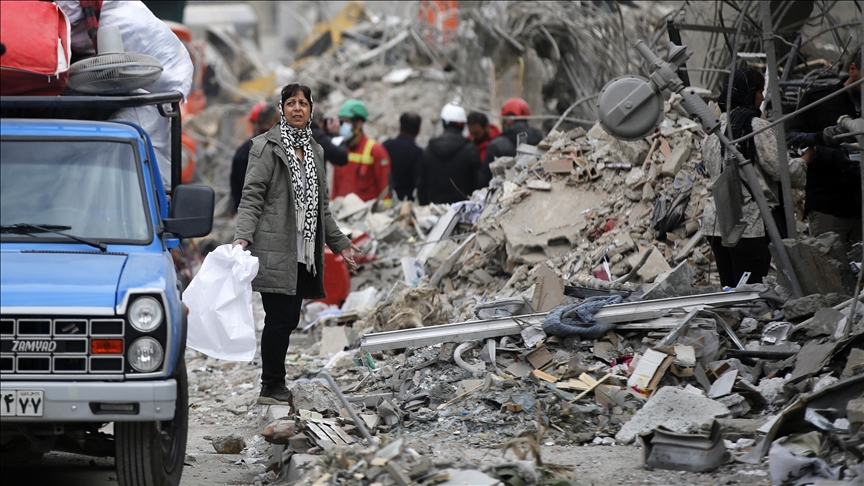
Many victims are still unaccounted for, either buried under the rubble or scattered on the streets, and rescue and civil defense teams are unable to reach them.

Continue reading
‘We Are Supporting a Genocide in Gaza’

Sony Thang quotes

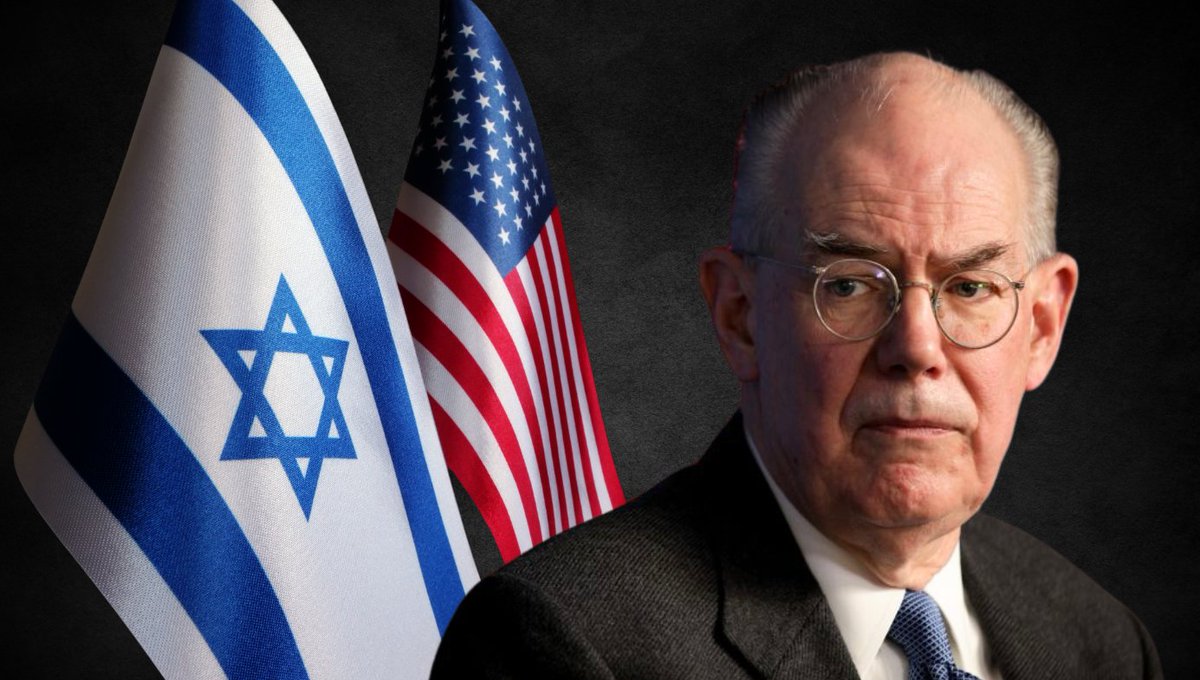
Political scientists John Mearsheimer:

“I think once you get outside of the West, almost everybody thinks that the United States and the Europeans are morally bankrupt.

I mean, we are supporting—and I’m choosing my words carefully here—we are supporting a genocide in Gaza. It’s a genocide that people see on their computers and on their TVs on a daily basis.

So they know exactly what’s going on here, and the hypocrisy is just quite stunning. Because the West makes a big deal of the fact that it is morally virtuous, that we are, you know, an exceptional Nation—we stand taller, we see further.

And when you think about the fact that we’re complicit in a genocide, I mean, it looks like hypocrisy in the extreme. So I think outside the West, people understand full well that we are morally bankrupt. And I think even inside the West, there are lots of people who have just begun to lose hope that we have our moral gyroscopes in place when it comes to dealing with the Middle East.”

These are excerpts from remarks by Professor John Mearsheimer, American political scientist and international relations scholar, in an interview with Judge Napolitano, January 3, 2025.

Continue reading