Ghasan Kanfani: The Novelist, Activist, Fighter, Marxist and Musician
 CrossFireArabia
- July 10, 2026
“Our songs are swords when we brandish them.”
– Mahmoud Darwish
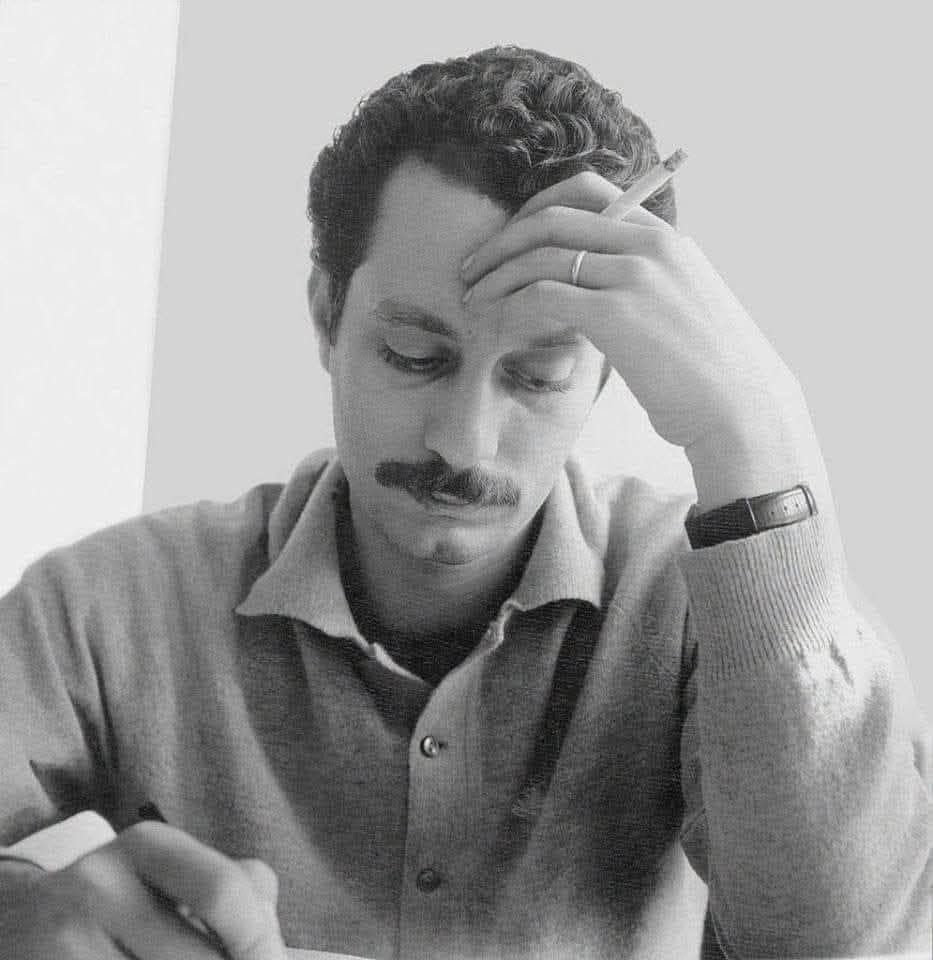
Descriptions of assassinated Palestinian writer and leader Ghassan Kanafani are not merely superlative. A novelist, political theorist, Marxist-Leninist, newspaper editor, visual artist, playwright, public speaker and more, Ghassan had so many strings to his bow that his late comrade Fadle al-Nakib called him an example in “total resistance.” Fellow cultural activist and PFLP leader in Lebanon, Marwan Abd el-’Al told me that anytime those in his organization introduce Ghassan’s works, his name is necessarily prefaced with “the martyr, the leader” and other titles, both honorific and viscerally embedded in a multilayered legacy.
Coining the term “resistance literature” through his introduction of Mahmoud Darwish, Tawfiq Zayyad, and other then-young Palestinian poets to the displaced masses, Ghassan was himself a genre-defying pioneer in the field. But, in the era of Arab singers Fairuz, Umm Kulthum and Abdel Halim Hafiz, and with the rebirth of Palestinian revolutionary song by the late 1960s, was there also a musical Ghassan? Could “musician” be added to his titles?
Fear not, dear reader. In a world of misattributed poetry, false quotations and AI slop images, this is not my attempt to add another myth to a cause grounded in violent materialism and real-life resistance. At the same time, with music central to Palestinian liberation, musical themes in Ghassan’s works are a present and unique window into understanding the assassinated writer’s worldview.
A strong case in point came in 1957 when a then 21-year-old Ghassan was living between Syria and Kuwait. Unable to finish his university studies in Damascus “for political reasons,” he had already been recruited to the Arab Nationalist Movement (ANM) founded by George Habash, Hani al-Hindi and other activists. Working as a teacher in Kuwait, Ghassan also worked on the editorial board of the ANM newspaper al-Ra‘i (The Viewpoint) and published short stories there and in the organization’s al-Tali’a (Vanguard) magazine. During these years of exile, camp poverty and reorganization, music for Palestine was largely voiced by non-Palestinians.
A rising star, Lebanese singer Fairuz released Rajioun (We are Returning) in 1957. Composed by the Rahbani brothers and steered by Palestinian producer Sabri Sharif, the album was filled with imagery of village life, olives and Palestine, less than a decade on from the horrors of the Nakba:
Love and Jerusalem on the mind
Despite the impossible
and a night where beauty did not depart
Yet justice has vanished
and the shadows have turned black
Built operatically around Western orchestration and Fairuz’ voice, the 12-minute title track broke through bleakness to declare in its finale:
Amidst sand and shadows, in ravines and on hills
We are returning! We are returning! We are returning!
Ghassan Kanafani was among the Palestinians to take heart from these words. Also a budding artist, he produced an artwork, “The Return,” in the wake of Rajioun’s release. Like the Fairuz album artwork, Ghassan used a black canvas and white paint, in a simple line-drawing. On mountains dotted with village buildings, below birds migrating in the same direction, a huddle of refugees walk together: elderly people carrying walking sticks, children, women carrying babies. Above them is the figure of a youth, carrying a pointed weapon; behind him, the flag of Palestine, glowing like a torch. Below the imagery, Ghassan wrote the words:
We are returning! We are returning! We are returning!
The reference was direct and an indication of the popularity Fairuz and others singing for Palestine found among young ANM activists of the time.
Ghassan would work Fairuz into his literature too. In August of the same year, he wrote the short story “Path to a Traitor” (Darbu ila-Kha’in) in Damascus. Travelers on the desert road from Baghdad to the Jordanian transit city of al-Mafraq find a stopping point at a shelter built by Bedouins:
“We were waiting for tea.
The desert was open in front of us, vast and silent, bathed in the gentle glow of the moon. Cool breezes passed lightly through the tent, lending the place a certain holiness. I felt no desire to talk nor listen to others, just to gaze outwards. But, despite this, I felt a touch of delight when I caught the words of someone over on the wooden platform opposite:
‘All that this atmosphere is missing is the voice of Fairuz.’”
Music could also be used in symbolic ways that recreated the “atmosphere” of Palestine before its colonization. During his time as a militant of the Popular Front for the Liberation of Palestine (PFLP) and two months before he became founding editor of its al-Hadaf newspaper, Ghassan wrote the Nakba story, “He was then a Child” (Kan Yumathak Tiflan). The story’s opening describes the backdrop of a winding journey of passengers on the back of a transport car from Haifa to Acre, of treetops, stone walls and the Mediterranean breeze. The narrative centers on a young boy:
“Ahmad took the shabbabeh (reed flute) from his basket, leaned back in the corner of the vehicle and began to play an ‘ataaba – the heartbroken melody for an eternal lover, at home in any of the villages scattered like an earthly constellation across the length and breadth of Galilee.”
As the passengers traveled to the sounds of this skillful young boy, “the melody emanated from everything around them,” and their conversation was dispersed with talk about the olive harvest and a Zionist massacre of orphans in Haifa. At one point, the driver joins Ahmed, singing romantic lyrics along to his melody.
The ‘ataaba is a folk form found historically in Palestine, Lebanon and the near region, relying on improvised poetry around a set rhyming scheme and a known melody. In the same oral tradition, Ghassan would later include examples of sahja, another genre of folk poetry, in his 1966 book Resistance Literature in Occupied Palestine, 1948-66. It is clear that he and the musical revolutionaries of his generation saw these traditional song forms as referential to Palestinians’ rootedness on the land.
In “He was then a Child,” the journey of the passengers is cut short when a band of Zionist terrorists orders them off the bus. After being searched, their leader orders a young machine-gun-toting recruit to kill them, their bodies falling into a trench. The boy is the only survivor – the killers want him alive to tell others, to spread the fear of more massacres among the Palestinians and hence expel them from their land. Told to run or face gunfire, the boy, who had been beaten by the paramilitary leader, soon stops in the middle of the road to ponder what just happened. He walks away calmly, rhythmically. Palestine would live to carry its melody onwards.
Ghassan was clearly drawn to music. Seeking deeper understandings of world politics, his early forays into Marxism were accompanied by both the literature and music of the Soviet Union – the composer Sergei Prokofiev is named in his notebooks of the 1950s. Family members remember that Ghassan collected vinyl records at their home in Hazmieh, Beirut, and that he had a particular affinity for Nina Simone and other black US singers. Finding out that Ertha Kitt and other touring musicians had performed on Israeli stages, he wrote them letters denouncing normalisation and demanding a boycott.
Later, as Ghassan edited al-Hadaf, pages of the newspaper would increasingly connect the black struggle in the US to the global fight against racism and imperialism, reporting on the 1971 Attica prison uprising and demanding freedom for imprisoned activists like Angela Davis.
His comrade and widow Anni Kanafani remembers that “Ghassan and I loved singing and dancing,” and during their 1964 trip to visit her family in Denmark, their gathering featured “speeches, songs and dances. Ghassan even taught the guests the Palestinian/Lebanese folkdance, the Dabke…” The next year, while traveling in China as a journalist with al-Muharrir newspaper, he attended the 1 October Revolution celebrations and wrote:
“From early morning we heard the loud crescendo of singing and music before we were driven to the main square. There we were looked on, amazed by the indescribable spectacle of half a million people marching in columns amidst the vibrant colours so characteristic of China.”
Ghassan and his comrades took worldly influences as they forged a new path ahead, with internationalism in politics and culture already part of their practice as they formed the PFLP. As leftists in the liberation movement engaged in years of intense debate, writing and guerrilla training, Ghassan produced two epochal studies on resistance literature. Both contained long collections of poems by figures who were then rather obscure, including Mahmoud Darwish, Tawfiq Zayyad and Rashid Hussein. Some of these poems became songs, with lyrics used by Sabreen and al-Fajer bands, and musicians like George Kirmiz and Mustafa al-Kurd in the 1980s found in the poetry compendiums Ghassan compiled in the mid-1960s.
Indeed, the resistance poetry of this era still finds musicians keen to put the words to song, as in a 2021 version of “A Lover from Palestine” by Gaza’s Sol band and songwriter Nahed Elrayes. The Darwish poem appeared twice in Resistance Literature in Occupied Palestine, with emphasis on the stanza that said, “Our songs are swords when we brandish them.”
This work of poetic rebellion serves to push back against Zionist attempts to smash Palestinians’ connections to a vibrant heritage of political culture. Verses of “Hizz al-Rimh” (Shake the Spear) quoted in Ghassan’s 1972 work The 1936-39 Revolt in Palestine were sung by Rawan Okasha’s Dawaween band in Gaza between the Second Intifada and al-Aqsa Flood.
The brutal assassination of Ghassan Kanafani and his niece Lamis Najem on July 8, 1972 did not have the intended effect of severing the revolutionary influence of the PFLP writer and leader from the cause of Palestine. One indication of this comes through his own immortalization through song. When we compiled the book Ghassan Kanafani: Selected Political Writings, we began with the words of Ghazi Mikdashi, who led a children’s choir in Lebanon in the 1970s, singing “Ghassan taught us the love of the cause.”
Dedications to his legacy have also been sung by Lebanese icon Wadi’ al-Safi, Palestinian vocalist Amal Kaawash, and by the mothers of political prisoners released from the jails of the occupation. Whether or not we call Ghassan a musician, the role of revolutionary music in his life and afterlife is undeniable. May he continue to dance dabke along the path of total resistance.

– Louis Brehony is a musician, activist, researcher and educator. He is author of the book Palestinian Music in Exile: Voices of Resistance (2023), editor of Ghassan Kanafani: Selected Political Writings (2024), and director of the award-winning film Kofia: A Revolution Through Music (2021). He writes regularly on Palestine and political culture and performs internationally as a buzuq player and guitarist. He contributed this article to The Palestine Chronicle.