Destroying The Ceasefire

Dr Marwan Asmar

Since the signing of the ceasefire on 10th October 2025 Israel killed at least 347 Palestinians in the Gaza Strip. 

Although the Donald Trump team officials in the White House keeps saying how they satisfied are about the maintenance of the Gaza ceasefire, the truce is in a precarious mode. Many expect the ceasefire to be broken any day because of the bloody Israeli military actions and fire on the whole of the Gaza Strip.

Since it took effect last October, Israel violated the truce over 500 times. Israel begun attacking the Gaza Strip at the end of the first week of the ceasefire, and continued thereafter with the average daily killed standing at seven at least.

However, the highest number of those killed was on 29 October, 2025, when 109 people were slaughtered and a reminder of the carnage days of the war. But after that, the number went down significantly. On 19 October the number of those killed went down to 45, 33 on 19 November and at least 21 people on 23 November. Here as well, and although figures may vary, UN experts say at least 70 of those killed were children. Did they pose a threat to the mighty military machine?

This is not to say anything about the number of those injured, a figure conservatively put at 889 and likely to increase as the days go by especially since there is nobody to stop the Israelis.

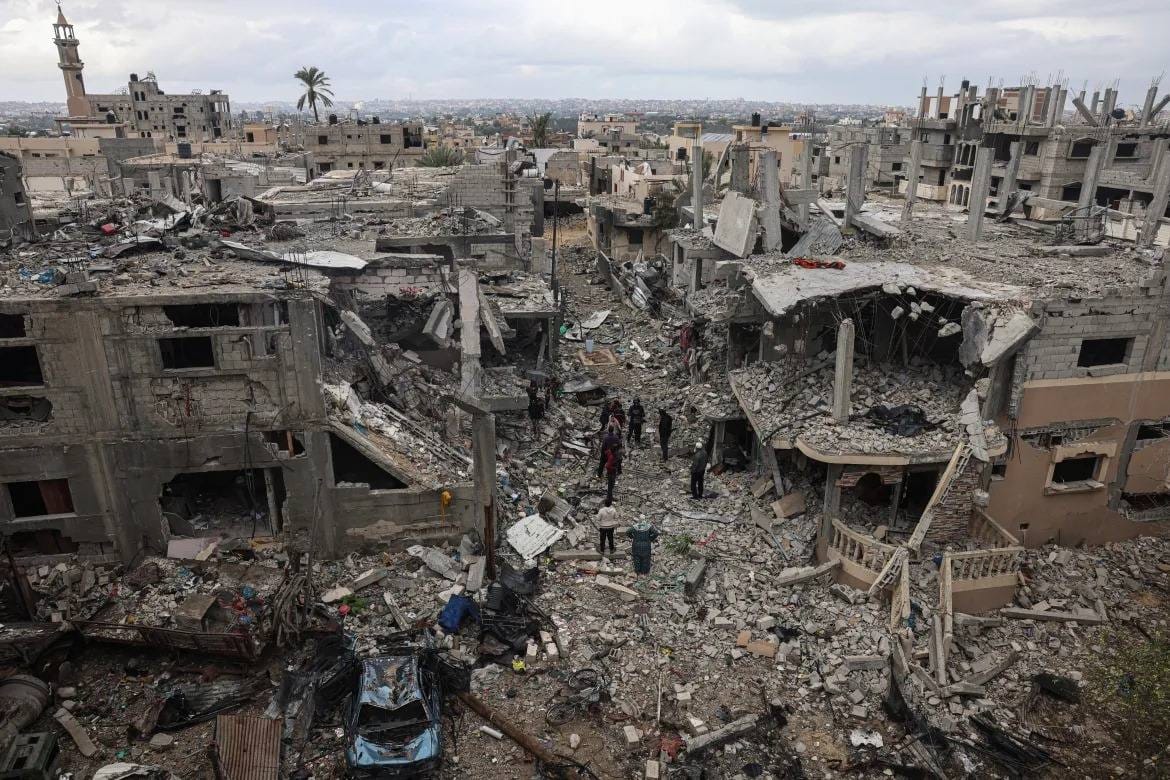
While the number of those murdered may have gone down drastically, the Israeli war machine continues to bomb different areas of Gaza, from its north, center and south of the Strip, neighborhoods, communities, cities, towns and refugee camps that exist only in names but already lie in debris, heaps of rubbles and destruction.

Biet Hanoon, Jabalia, Biet Lahia, Gaza City, Al Maghazi, Khan Younis and Rafah and more, once thriving population centers have become mounts of rubble and wreckage unfit for human habitations, gorges stumped into the earth with nothing but skewed bricks and mortar.

The Israeli army, and through its air force, has continued to re-bomb schools, mosques, residential building and tattered infrastructures and/or what remained of them. Israeli pilots and/or quite often through drones, are flying over sorrow horizons of destroyed mounts and bombing what is left of a past society, all in search of illusive Palestinian groups they were unable to “flush out” in the last two years of their genocide of Gaza.

The genocide has created a sence of acceptable madness among the Israeli populace that “you bomb as much as you can” twice, thrice, four times and more so the vicious cycle of violence is indelibly printed on helpless civilians who nevertheless, refuse to be expunged.  

Today, Gaza is a horror story with its new cold, calculated and unforegiven Israeli masters refusing to accept their new stalemate. They continue to occupy 53 percent of the enclave with them unwilling to quench their thirst for blood but leap into the misery they have created. Just after 10 October, they have demolished 1500 buildings in the areas they control and this is just the beginning for Israel is planning for a long occupation despite the US plan outlined by president Donald Trump on 29 September to end the war on Gaza and start to redevelop the enclave. This is certainly a pipedream.

The killings continue as Israel pays lip service to a US plan outlined at the heart of which is dismantling Hamas and the rest of the Palestinian resistance groups. But the story as plotted by the new political masters of Trump et el., begins here. With the ending of Hamas, the redevelopment of Gaza is supposed to start.

However, everyone is still stuck at stage of one of the plan. Hamas has already set free the 20 remaining Israeli hostages and is yet to handover the final two of the 28 dead hostages it already delivered to the Israeli hostages. God only knows when they will be delivered.

The movement says it has been finding it extremely difficult to search for the remains of the hostages and finding the final two would be a grueling task because of the mass bombing of the enclave whose geography has been drastically altered with people no longer knowing where former places, houses and roads no longer are. They have become alien to a society they lived in all their lives.

Of course, this has become music to the ears of Israeli Prime Minister Benjamin Netanyahu and his extremist government who feel they can continue to bomb Gaza under the eyes of the Americans in a pretext that the final remains of the hostages are still to be delivered and that Israel continues to fight Hamas.

Within this context many observers are saying Israel wants to “lock” the Trump 30-point plan in phase I and doesn’t want to move to stage II because that would mean it’s war objectives was for nothing apart from destroying Gaza: No Palestinian transfer, No end to Hamas and the calls for a Palestinian state growing by the majority of countries of the world. 

Despite the close alliance between the United States and Israel, the ultimate aim of the Trump plan – being its end result – is the call for a Palestinian state. Netanyahu has long realized this and this is why he wants to lock Gaza into an initial ceasefire phase in which he will continue to call the violent shots on Gaza.

Continue reading
The Olive Tree Defies Israel

By Ali Osman Karaoglu  

A lesser-known dimension of Israel’s ongoing occupation of Palestine since 1967 is the systematic destruction of the Palestinian people’s economic resources and means of livelihood. One of the most important sources of income for Palestinians is olive cultivation – so much so that the olive tree is regarded as one of Palestine’s national symbols. Palestinian poet Mahmoud Darwish captured this symbolism in his famous words: “Here we remain, as long as thyme and olives remain.”

Beyond its symbolic value, the olive tree is the main source of income for nearly 80,000 Palestinian families. According to UN data, about 48% of the agricultural land in the West Bank and Gaza is covered with olive trees. Olive production contributes around 14% to the Palestinian economy. About 93% of harvested olives are used for olive oil production, while the remainder is used to make soap, table olives, and pickles.  

Usurpation of olive trees: Israel’s assault on nature and identity

Recently, Israeli settlers in the West Bank prevented Palestinians from harvesting olives, an essential source of livelihood, and destroyed 13,000 olive trees. Such actions, either directly committed or condoned by Israeli authorities, are known and documented as systematic practices.   

According to various international reports, Israel has destroyed around 800,000 olive trees over the past 20 years, and more than 2.5 million trees since 1967.

Palestinians face great difficulty in harvesting and protecting their olive trees. Since the Oslo Accords, Israel has exercised full control over 60% of the West Bank and requires Palestinians entering these areas to obtain a “permit issued by Israeli authorities.”

Farmers are therefore forced to secure permission to access their own land, but this permit system is largely arbitrary. There are no clear criteria specifying what conditions Palestinian applicants must meet to obtain a permit.

Even when they provide ownership documents and pass “security” checks, permits are often issued only to the person named on the deed, excluding other family members from entering the land. The permits are typically short-term, and each time they expire, farmers must reapply without any guarantee of renewal.

According to UN data, nearly half of permit applications are rejected on arbitrary grounds, turning the system into a policy of harassment and attrition. The same restrictive policy applies to bringing in agricultural necessities such as tractors, equipment, and fertilizers.

Over time, many Palestinians who once cultivated other crops have converted their land into olive groves, since olive trees can survive even without intensive care.  

How Israel’s seizure of olive trees violates international law

The destruction of olive trees in the occupied Palestinian territories occurs almost every year. Thousands of trees are destroyed annually during Israeli military operations or through attacks by settlers. Such incidents are rarely taken seriously or investigated by police or other public authorities.

Israeli soldiers frequently fail to protect Palestinians from settler attacks and, in many cases, act against the Palestinians themselves when they try to defend their land and trees.

In fact, the destruction of Palestinian farmlands and olive trees violates international law. Even Israel’s own Supreme Court has recognized the illegality of arbitrary practices in the “Morar v. IDF Commander” case.

In that case, Palestinian farmers appealed to the Israeli Supreme Court after a military commander denied them access to their farmland. The commander claimed the closure was intended to “protect Palestinian farmers from settler harassment.” The plaintiffs argued, however, that Israeli settlers systematically harass, assault, and damage the property of Palestinian villagers, while the Israeli army fails to intervene to stop this violence or take necessary measures to protect Palestinians and their agricultural products.

The court ruled that the army must take steps to prevent settler violence, stating that the proper way to protect Palestinian farmers from harassment is for Israeli military authorities to implement necessary security measures and impose restrictions on the settlers responsible for unlawful actions. Nevertheless, Israeli authorities continue to disregard their own court’s ruling and persist with arbitrary practices.

Under international humanitarian law, causing environmental damage as a military tactic is prohibited. The law stipulates that “care shall be taken to protect the natural environment against widespread, long-term, and severe damage during armed conflict.” This protection includes prohibiting methods or means of warfare that are intended – or expected – to cause such damage, as these may endanger the health or survival of the population.

Palestinian territories have been under Israeli occupation since 1967. This ongoing occupation constitutes a “continuing act of aggression,” and under the provisions of the 1949 Fourth Geneva Convention, imposes obligations on the occupying power.

The occupying power is responsible for ensuring a secure environment that allows the local population to meet its daily needs, and must protect civilians against looting and destruction of property.

Moreover, the damages caused by Israel – an apartheid regime – to the environment and to olive trees are considered war crimes under Article 8 of the Rome Statute.

UN Security Council resolutions also emphasize that Israel must refrain from harming the environment and is obligated to prevent settler provocations. Israel has repeatedly violated these obligations and continues to act in breach of international law.

It is known that Israel’s policy of destroying olive trees aims both to make its occupation permanent and to clear land for the establishment of future settlements. Therefore, Israel’s environmental crimes should be added to the cases currently being pursued against it at the International Court of Justice (ICJ) and the International Criminal Court (ICC).  

The author who contributed this piece to Anadolu, is a faculty member in the Department of International Law at Yalova University’s Faculty of Law. 

Continue reading
Analysis: Israel Seeks “Most” Out of Ceasefire

Military-strategic expert retired Major-General Mamoun Abu Nuwar states the ceasefire in the Gaza Strip remains extremely fragile as Israel continues to control the ground, security corridors and the buffer zone east of the enclave.

Abu Nuwar told Jordan 24 the current situation on the so-called “yellow line”—with its construction, improvements, and the creation of earthen fortifications—clearly shows Israel wants to make this line a permanent reality and has no intention of withdrawing from east of Gaza and will continue to carry out airstrikes and artillery shelling under the pretext of “thwarting imminent terrorist attacks.”

He added Israel seeks to establish a new reality on the ground and reinforce its security presence in the eastern areas, while simultaneously continuing to bombard the western areas of the Strip. This, he clarified, threatens the continuation of the truce and reduces it to a mere shadow.

Retired Major-General Mamoun Abu Nuwar

Regarding the formation of an international stabilization force in Gaza, Abu Nuwar explained it would be “a key element in the transitional phase,” but its success hinges on several crucial factors, notably a clear UN and Security Council.

He pointed out that any international force wouldn’t succeed without first of all coordinating it with and agreement of Hamas. He said without this, such a force would be seen as an occupation force exposing it to armed confrontation with the other resistance factions.

He stressed such force must have specific and clear tasks limited to maintaining security and assisting in the reconstruction of Gaza, along with establishing rules of engagement and a unified command structure to prevent a slide into open conflict.

Abu Nuwar indicated disarming Hamas is going to be one of the most “significant obstacles” to a settlement, as Israel insists on making it a precondition for any reconstruction or withdrawal. This is while Hamas states it would only disarm if a just political settlement leading to the establishment of a Palestinian state is reached.

He added Hamas agreed in principle to the formation of a technocratic administrative committee to take over the administration of Gaza and to allow the deployment of a new Palestinian force currently being trained in Jordan and Egypt, as part of an international plan to manage the next phase. However, Israel rejects the presence of Turkish forces in any potential mission and prefers the participation of countries such as Azerbaijan, Malaysia, and Indonesia.

Abu Nuwar believes Israel will not withdraw completely from the Gaza Strip and will seek to maintain its security and military control over the border crossings and areas. He pointed out the continuation of this situation could lead to new waves of displacement of Palestinians, given the catastrophic humanitarian conditions in the south, particularly in Rafah and Khan Younis.

He indicated any attempts to rebuild or develop new areas in Rafah will fail unless the siege is lifted and full Palestinian control is restored. He noted the continued ambiguity surrounding the “yellow line” drawn by Israel east of the Gaza Strip suggests there is an attempt to impose a new geographical and political division in the enclave

Abu Nuwar concluded by saying that the road to a political solution or a comprehensive peaceful settlement is still long and arduous, especially with Israeli Prime Minister Benjamin Netanyahu’s lack of interest in the political process due to his internal electoral calculations. He stressed that the continuation of the current situation will make the ceasefire merely a cover for a new occupation reality, and will open the door to repeated clashes and numerous difficulties in implementing any peace plan or genuine reconstruction.

Continue reading
Keeping Israel’s Secret in The Closet

Israel continues, in a deliberate and institutionalised manner, to implement a systematic policy aimed at erasing physical evidence of genocide, war crimes, and crimes against humanity committed over the past two years in the Gaza Strip. This policy is carried out through a series of field and administrative measures, including the prevention of international journalists and independent investigation committees from entering Gaza, in an attempt to obstruct any criminal investigation or field documentation that could establish the truth and confirm Israel’s legal responsibility.

The recent decision by the Israeli Supreme Court granting the government an additional delay regarding the entry of independent journalists into Gaza reflects the institutional complicity within the Israeli state apparatus in concealing crimes and protecting their perpetrators. The judiciary thus provides a legal cover for government policies designed to suppress transparency and erase field evidence of crimes committed in Gaza.

The continued prevention of international journalists and investigators from entering Gaza forms part of a consistent and coordinated policy exercised by Israeli authorities through their executive, security, and judicial arms to keep the crimes beyond international scrutiny and obstruct any independent accountability or investigation into the grave violations committed.

The ongoing ban on independent journalists entering Gaza represents a long-standing Israeli policy since the beginning of the military assault on the Strip. It aims to deprive the world of witnessing the reality on the ground by imposing a complete media blackout and preventing all documentation and international monitoring tools from accessing the crime scenes.

Despite the enforcement of the ceasefire agreement on 11 October, Israel continues to deny entry to international journalists, except for limited tours organised under the supervision and escort of the Israeli army. As a result, all scenes shown from the field remain under military censorship and devoid of the independent coverage guaranteed by international standards of press freedom.

The killing of 254 Palestinian journalists and the ban on the entry of international media workers exemplify an integrated Israeli policy aimed at concealing the truth and monopolising the narrative by maintaining tight control over the media scene and preventing any independent oversight or field documentation. This policy not only withholds information but also strips victims of their right to tell their story to the world, turning their tragedy into a one-sided account narrated by the very perpetrator of the crime.

Israel’s actions to erase evidence of genocide include continuing to prevent the entry of the UN-mandated Independent International Commission of Inquiry on the Occupied Palestinian Territory, the investigation team of the International Criminal Court, as well as fact-finding missions and other international mechanisms specialised in investigating grave crimes. This deliberate obstruction of international justice constitutes a violation of Israel’s obligations under international humanitarian law.

Israeli authorities also block the entry of forensic teams and forensic anthropology experts who should secure crime scenes, examine human remains, and document biological and physical evidence proving mass killings, genocide, and the use of prohibited weapons and projectiles. This obstruction undermines a fundamental pillar of international criminal investigation, aiming to destroy material evidence before examination, deny victims and their families the ability to identify their loved ones, and prevent the international community from verifying the nature and scale of the crimes committed.

Israel further refuses to allow the entry of essential equipment and materials needed for exhuming bodies and identifying victims, including laboratory tools, autopsy instruments, and DNA analysis kits. This has left hundreds of bodies unidentified and deprived families of their basic human right to know the fate of their loved ones and bid them farewell with dignity.

Among these are around 195 bodies that Israel handed over without any details about their identities or circumstances of death, many of which showed clear signs of torture and summary execution. These findings indicate extrajudicial killings and inhumane treatment of Palestinian detainees and prisoners, including those subjected to enforced disappearance.

The continued retention of bodies and prevention of independent investigations constitute an additional form of collective punishment against Palestinian families, denying victims their basic human right to be identified and buried with dignity.

Israel has also carried out the total erasure of several cities, towns, villages, camps, and residential blocks where horrific mass killings occurred. Satellite images and field testimonies documented show that Israeli forces removed the surface layers of the ground, levelled targeted areas, destroyed rubble, and transferred it to unknown locations, effectively erasing potential physical evidence such as munitions remnants, bodies, original patterns of destruction, and explosion traces.

Israel continues to exercise full, unlawful military control over roughly 50 per cent of the Gaza Strip, reshaping the geography entirely through demolitions, bombardments, and bulldozing, and establishing new military routes and bases atop the ruins of destroyed buildings and farmland. This goes beyond military occupation, amounting to an engineered redesign of the field landscape to erase material evidence and prevent future verification of the crimes committed.

Israeli military deployment in these areas, coupled with the targeting of anyone approaching what it calls the “yellow line”, effectively isolates half of the Strip and turns it into a no-go zone, blocking journalists, researchers, and humanitarian teams from entering and preventing any genuine field documentation of the mass killings and widespread destruction that took place there.

Such acts constitute a flagrant violation of fundamental principles of international humanitarian law, which obligate parties to a conflict to preserve crime scenes until independent investigations are completed and to ensure that evidence is not tampered with. They also contravene the International Court of Justice’s ruling obligating Israel to take all necessary measures to prevent genocide, including preserving evidence and preventing its destruction.

Israel continues to withhold hundreds, possibly thousands, of bodies, including those of Palestinian prisoners and detainees killed under unclear circumstances, preventing autopsies and forensic examinations that could verify causes of death. This is a blatant violation of Article 130 of the Third Geneva Convention, which obliges occupying powers to respect the remains of the deceased and return them to their families without delay.

Denying victims justice and preventing the world from knowing the truth are not merely additional violations but an extension of the crime of genocide itself. Through these actions, Israel seeks to erase the traces of its crimes, obliterate collective memory, and strip Palestinians of their right to narrate their story and existence, attempting to eliminate both the victim and the evidence of their existence.

The international community and relevant United Nations bodies must ensure the immediate entry of international journalists and correspondents into the Gaza Strip and enable them to work freely and independently, without military oversight or escort. This is essential to guarantee transparency, expose the truth about the crimes committed, and allow urgent international access for forensic experts and specialists in forensic anthropology and explosives to secure crime scenes and collect physical and biological evidence before it is lost or tampered with.

Reconstruction and debris removal in areas where massacres occurred must be carried out with full consideration of evidence preservation and documentation, as any reconstruction effort that fails to do so will effectively serve as a tool to erase the truth and destroy the forensic memory of the crimes committed.

The international community and UN agencies are urged to support the establishment of a specialised framework for managing Gaza’s debris that links reconstruction and dismantling processes to the preservation and documentation of evidence—making adherence to this framework a prerequisite for any construction or debris removal activity.

There is also an urgent need to disclose the lists of the forcibly disappeared, missing persons, and bodies, reveal burial locations, return remains to their families, and allow international and UN mechanisms to conduct independent investigations into the crimes committed. Perpetrators must be brought to justice before international courts to ensure accountability, compensation, and redress for victims and their families.

The UN Human Rights Council should act swiftly to activate and reinforce existing monitoring and investigation mechanisms, enabling them full access to the Gaza Strip to protect crime scenes and ensure that evidence is not destroyed or altered. These mechanisms must be provided with the necessary technical and logistical support to operate independently and effectively.

The International Criminal Court must expand its ongoing investigation into the situation in Palestine to include the ongoing genocide and the systematic erasure of evidence, and take practical measures to protect crime scenes and related evidence. This includes establishing a dedicated field office for Palestine, similar to the one created for Ukraine, to coordinate on-site investigations, collect forensic evidence, and ensure continuous international oversight over the investigation process.

Any delay in such intervention will grant Israel more time to complete the destruction of evidence and the physical traces of its crimes, undermining the international community’s duty to protect truth and uphold justice. Saving the truth in Gaza is no longer merely a moral obligation, but a legal and humanitarian imperative that cannot be delayed.

EuroMed Human Rights Monitor

Continue reading
Trump’s Nightmare Triangle

By Dr Khairi Janbek

For all intents and purposes, US President Donald Trump is presenting himself as the arbiter of Arab-Israeli relations, and/or Arab-Israeli conflict and showing his presence as the patron for the time being, of the Gaza agreement. Therefore, no one, including Israel will be allowed to make him look bad in this multi-phased accord.

Most likely, his intention to reign in Prime Minister Benjamin Netanyahu and rejecting the Israeli rejection of the West Bank, boils down to keeping the Arabs on board in terms of money and influence for the success of his Gaza plan, as well as keeping his hopes alive for the Abrahamic Accords especially the red apple, Saudi-Israeli normalization.

Indeed Trump’s ambiguous stand of rejecting a Palestinian state while at the same time, rejecting Israeli annexation, either means giving the positive nod to Tel Aviv to create facts on the ground and create de facto annexation without the fanfare, and start the gradual population transfer, if we take Gaza as a precedence for his words, to Jordan and probably also to the wider Arab world, or, it could also be, that the future of the West Bank is intended to be united to the East Bank of River Jordan.

In the mean time, the world press talks about the continuous shuttle diplomacy of high-ranking Washington officials to Israel, and Trump’s warnings to Netanyahu, veiled as well explicit not to attempt to jeopardize the Gaza peace, to the extent of saying that Israel would lose all US support.

But what about the other side of this presumed potential rift? Netanyahu after two years of war, has nothing to show for it to the Israelis except barbarism, murder and destruction, in addition to gaining the status of becoming a fullyfledged international war criminal.

The war which he declared to finish off Hamas is increasingly controlled by the American plans, now, face a big failure with him reluctantly having to put up with. However it does not necessarily mean there are no other parties in his government, whose messianic fervour does not override the risk of losing American support, which indeed means, Netanyahu is now stuck between the rock and the hard place.

Indeed one cannot predict his longevity as the prime minister for Israel, but all what can be said is that, the alternative to him, is neither likely to be more peace loving, or more liberal in political outlook.

Dr Janbek is a Jordanian writer based in Paris, France

Continue reading