Happy Parents: Premature Babies Returned to Gaza

“I am meeting my daughter for the first time. It’s as if today is the day of her birth. I can’t describe my feelings.”

By Abdel Qader SabbahJawa Ahmad, and Sharif Abdel Kouddous

KHAN YOUNIS, GAZA—Ahmed Al-Harsh waited outside Nasser Hospital in Khan Younis on Monday to meet his son, a toddler and the only other survivor of his entire family.

“I’m waiting for my son Mahmoud. I haven’t seen him in two and a half years except once, before he was transferred to Egypt. I’ve been waiting for two and a half years,” Al-Harsh, 31, told Drop Site News.

Mahmoud is one of 28 Palestinian infants who were evacuated to Egypt as premature babies in November 2023 from the neonatal intensive care unit in Al-Shifa Hospital in Gaza City, as the Israeli military laid siege to the medical complex and raided it. Mahmoud and seven other children were returned to Gaza on Monday to be reunited with their families, or what was left of them.

On October 14, 2023, one week into Israel’s genocidal assault on Gaza, the Israeli military bombed the Al-Harsh’s family home in the Jabaliya refugee camp. Al-Harsh’s entire family was killed in the attack—his four-year-old daughter, his father, mother, brother, sisters-in-law, nephews, and nieces. Al-Harsh initially thought his wife, who was eight months pregnant at the time, had also been killed. He only later learned that she had been gravely injured and had given birth to their son, Mahmoud, in hospital before succumbing to her injuries.

(Left) Ahmed Al-Harsh outside Nasser Hospital in Khan Younis as he waits for his son, Mahmoud, to arrive after 2.5 years in Egypt. (Right) Ahmed Al-Harsh holds up a photo of his son Mahmoud on his phone. March 30, 2026. Screenshots of video provided by Abdel Qader Sabbah.

Al-Harsh was able to see Mahmoud only once before he was taken to the neonatal intensive care unit in Al-Shifa’s hospital for care. He had been staying in Beit Lahia, unable to move amid the escalating Israeli assault. In November, Israel laid siege to Al-Shifa hospital, surrounding the medical complex and cutting it off from the rest of Gaza City before raiding it on November 15. Doctors inside scrambled to keep their patients alive, including the nearly 40 premature babies in the hospital’s neonatal intensive care unit, Mahmoud among them. There was no electricity and incubators were failing. The World Health Organization, which was able to coordinate a one-hour visit to Al-Shifa at the time, described the hospital as a “death zone.”

After much negotiation, 31 premature babies were evacuated from Al-Shifa on November 19 and taken to Rafah. UNICEF said the conditions of the babies had been “rapidly deteriorating” inside the besieged hospital. Five died before they could be evacuated. The next day, 28 of the babies were transported across the border to Egypt for treatment. None were accompanied by family members.

For the past two and a half years, Al-Harsh has seen his son only in photos or videos sent to him from Egypt—first as an infant, then a toddler. “The feeling is indescribable. What can I tell you about this feeling?” he said. “These two years felt like forty, even more—a lifetime. During this time, I was a body without a soul. I couldn’t work or do anything.”

Video of the convoy arriving at Nasser Hospital in Khan Younis bringing eight children who were evacuated from Gaza to Egypt in November 2023. March 30, 2026. Video provided by Abdel Qader Sabbah.

By early afternoon on Monday, the convoy from Egypt finally arrived. A Red Crescent ambulance and UN vehicles escorted a large bus carrying the children. Families crowded around the doors as they pulled up outside Nasser Hospital. The children were passed into the waiting arms of family members, most of them meeting for the first time, in scenes of joy. Al-Harsh appeared overwhelmed with emotion as he held Mahmoud, chubby, bespectacled and crying, in his arms. When Mahmoud grabbed a bottle of water and drank thirstily, Al-Harsh broke down and wept.

“Every human being needs the love of a mother and father. I am 31, I lost my mother and father, and I’m still suffering,” Al-Harsh said. “This boy—where do I find him a mother? Where do I find him his mother? When he grows up and asks about his mother, what do I tell him?”

At least four of the babies who were evacuated to Egypt died while there, Dr. Ahmed Al-Farra, the director of the pediatric department at Nasser Hospital, told Drop Site. He added that the children who returned to Gaza, while healthy, would require additional medical and psychiatric evaluation.

Gaza’s health care system has been systematically destroyed by the Israeli military since October 2023. Every single hospital was attacked and 25 were completely shut down while 13 remain partially functioning, according to Gaza’s Health Ministry. Despite a “ceasefire” that went into effect in October, Israel has continued near daily attacks in Gaza, killing over 700 Palestinians since then. Israel has also continued to severely restrict the amount of humanitarian aid, fuel, medicine and other essentials, allowing in an average of only 200 trucks daily instead of the 600 agreed upon in the deal.

At the onset of the U.S.-Israeli war against Iran on February 28, Israel reinforced a total siege on Gaza, citing “security concerns.” The Kerem Shalom crossing was partially reopened three days later. The Rafah Crossing between Gaza and Egypt—which had only opened in early February for medical evacuations and for Palestinians returning to Gaza—was also closed at the onset of the Iran war and only reopened on March 18. Roughly 20,000 people are on waiting lists for medical evacuation abroad, 4,000 of them children, according to the Health Ministry.

The Gaza Health Ministry this week warned of a severe shortage of generator fuel that threatened hospital operations. The Ministry said that remaining generators are “worn out and prone to repeated breakdowns,” placing critical departments such as intensive care, surgery, neonatal units, and dialysis at risk of shutting down. Israeli forces have allowed the entry of only 1,240 fuel trucks out of the 8,350 that were supposed to enter over the 167 days since the ceasefire agreement took effect—a compliance rate of just 14.8%—according to the latest statistics from officials in Gaza shared with mediators and obtained by Drop Site. The Health Ministry warned that 90 generators are already out of service, while 11 are running on limited supplies. All hospitals in Gaza remain fully dependent on emergency back-up generators, according to OCHA.

Regardless of the continued Israeli siege and daily military assaults, the families who were finally reunited with their children in Gaza on Monday after nearly two and a half years of separation, described the moment as nothing short of miraculous.

Sundus Al-Kurd was among them. She was badly wounded in an Israeli airstrike on her family home in Beit Lahia on October 22, 2023. Her daughter Habibat Al-Rahman was killed in the attack. Eight months pregnant, Al-Kurd was rushed to hospital where doctors operated on her to save her life and conducted an emergency delivery to save her unborn daughter, Bissan.

“On the day I gave birth to my daughter, I lost her only sister,” Al Kurd said.

“When I woke up, I asked, ‘Where is my daughter?’ They told me, ‘Your daughter is fine and doing well,’” she added. “They told me she was in an incubator and that due to my health condition I wouldn’t be able to care for her.”

Al-Kurd continued to recover from her injuries and was unable to see her daughter before the Israeli military attacked Al-Shifa in November 2023.

“I was evacuated from the hospital with difficulty and I asked to take my daughter with me, but they said I wouldn’t be able to care for her due to my medical condition,” she said.

Having lost her other daughter, parents, and two siblings during the war, Al-Kurd said she could not bear the thought of losing Bissan, whom she described as “a gift and compensation from God.” Al-Kurd did not know what had happened to her daughter until much later when she found out she had been among the 28 premature babies evacuated to Egypt.

Sundus Al-Kurd holds up a traditional Palestinian dress she brought for her daughter Bissan, who returned to Gaza after being evacuated to Egypt 2.5 years ago for medical treatment. Khan Younis. March 30, 2026. Screenshot of video by Abdel Qader Sabbah.

“Today, after two and a half years, God willing, we will be reunited with our daughter,” Al-Kurd said. She brought a traditional Palestinian dress for Bissan to wear. When her daughter finally arrived in the convoy to Nasser hospital, Al-Kurd held her tightly before dressing her in the white and red dress as relatives took turns embracing her.

“I am meeting my daughter for the first time,” she said. “It’s as if today is the day of her birth. I can’t describe my feelings.” Drop Site

Continue reading
The US General Who Swallowed His Own Truth

By Jassem Al-Azzawi

General Dan Kaine, Chairman of the Joint Chiefs of Staff, delivered a confidential warning to President Trump with the utmost candor—the kind of candor that democracies rely on and empires routinely ignore. He said: “We don’t have enough ammunition to win this war. It’s not going to be pretty.” This warning wasn’t born of cowardice; it was the last vestige of institutional integrity that still flickers within the halls of American military power.

Trump’s response was that of a circus clown, not a commander-in-chief. Through his “Truth Social” platform—that distorted mirror of American political life—he dismissed the warning with the arrogance of a street vendor, saying: “Oh, no, no, no. If we do it, we’ll win easily.” Thus, a sober assessment became mere publicity, and caution a lie.

But the biggest lie came later. When Kaine’s warning leaked, Trump not only rejected it but completely reversed it. With the confidence of a man who has never been held accountable for anything, he told the American public the general had said the exact opposite—that the United States had plenty of missiles, munitions, and everything else. “That’s not what he said at all,” Trump declared, putting words of false victory in the mouth of a man who had offered only warnings.

And General Cain remained silent

This silence is not just a footnote in this story; it is the story itself. By remaining silent, Cain allowed the American public to absorb the falsehood as truth. He did not say: “No, Mr. President, that’s not what I said.” He did not invoke his oath, nor the soldiers who would pay with their lives for the gap between political rhetoric and logistical reality. He chose the safety of silence over the danger of truth, and in doing so, he betrayed not only himself but the Republic. This is the rot at the heart of American militarism.

As historian Andrew Bacevich has long warned, the professional military has become more of an instrument of imperial ambition than a defender of democratic values, with senior officers more concerned with their next post than with the Constitution they swore to uphold. Kaine’s silence was not a mere slip of the tongue; it was a symptom of a deeper malaise.

The logistical picture Kaine described in private was not theoretical; the calculations were unforgiving.

Current stockpiles of interceptor missiles and precision munitions could not sustain a prolonged air campaign against a country three times the size of Iraq. The Wall Street Journal documented a “worrying gap” in U.S. missile stockpiles, noting that reserves were “far below” the requirements of intensive and sustained operations. Pentagon contractors were instructed to “double or even quadruple” production of Patriot, SM-6, and precision-strike missiles—a tacit admission that the arsenal built for Cold War scenarios is inadequate for the war being fought today.

Consider Gaza: Israel, the most heavily armed military power in the Middle East, with complete air and naval dominance, has turned a tiny coastal strip into a moon-like landscape of devastation over two and a half years, yet it has not broken Hamas. Gaza is only 37 kilometers long. Iran, on the other hand, is a nation of 90 million people, with mountainous terrain, strategic depth, fortified infrastructure, and a combat-hardened Revolutionary Guard. The idea that it will collapse under a few weeks of American airstrikes is not strategy; it is wishful thinking. “God help us if this continues, if it gets to four weeks,” Colonel Daniel Davis warned on the Deep Dive podcast. He was speaking in military terms, and the same prayer applies. Politically.

When Trump now raises the prospect of sending ground troops, he is not escalating from a position of strength, but rather improvising from a position of denial. Admitting that air power and missiles alone cannot achieve the political objective is an admission that the original objective was never honestly assessed. This is the pattern of American wars at the end of an empire: Glittering promises, disastrous calculations, and then a grim and horrific reckoning paid in blood by those who had no seat at the table where the lies were told.


The costs are already piling up—not just in the currency of munitions and riches, but in the currency that empires always ultimately spend and regret most: credibility. America’s word, already devalued by two decades of contrived justifications for war, is getting cheaper by the day.

Democracies can tolerate miscalculations, and they can tolerate bad presidents, but what they cannot long tolerate is the institutionalization of a culture where the truth is whispered behind closed doors and swallowed whole in front of cameras. When the chairman of the Joint Chiefs of Staff allows his words to be weaponized for propaganda — when the man in charge of counting missiles refuses to correct a president who pretends they are plentiful — something far greater than military credibility collapses.

What is crumbling is the social contract between the governed and those who send them to their deaths.

Caine’s silence was not cautious; it was complicity. And in an imperial machine suffering from a shortage of ammunition and a shortage of truth, complicity is the only resource that seems inexhaustible, because when the missiles finally run out, slogans won’t replace them.

Reality will.

Al-Azzawi is an Iraqi writer who contributed this piece to Al Rai Al Youm which was translated and appeared in crossfire.com

Continue reading
Hammering The UN?

By Dr Khairi Janbek

Even from the moment of its inception, the UN was subjected to constant criticism and derision. Though it started as a coalition of the willing in order to deal with differences and sources of conflict in a peaceable and/or diplomatic manner, the term willing remained nebulous.

The strong and mighty wanted to bend this will to suit their interests, and the weak and the needy wanted to bend this will for their own protection. Still in this dialectical formula the need for the UN remains as the only viable formula which offers the possibility of negotiations in the Churchillian wisdom of jaw jaw, better than war war, and it remains in this sense, the standard which provides the vaneer for international legality and the semblance of consensus.

Then suddenly and apparently, the concept of the Donald Trump Board of Peace emerged on the scene, thought of, initially, as an effort to deal with the mayhem of Gaza, and to which one may add ironically and cynically, that the most two concerned parties – Palestinians and Israelis – are out of its functioning. On top of this, the notion was propelled in the media that this Board is really an attempt to replace the UN.

So in this context we can assume what is meant is that if the UN started, all these years ago, as a coalition of the willing, today’s Board of Peace is a coalition of the frightened, of states who want to stay on the good side of Trump. This is aside from the reluctant opportunists whom seek some benefits out of becoming a member of this entity.

On the face of it, one can say that the real purpose of its establishment is not to replace the United Nations per se, but a serious attempt to bypass the UN and redefine international relations in accordance with the Trump notion of who is the enemy of peace and who is its friends, with the essential outlook of not needing the international organization at all. Under the new legality, it is Trump who lays down the law, and the one whom distributes the spoils. As for the UN it remains in his eyes as a gathering for losers.

But if we go back to the beginning, in fact the Board of Peace, not only got the blessing of the UN for its creation, but also the support of the Security Council with resolution 2038, but then again, it was linked to the reconstruction and ‘stabilization’ of Gaza, while the current format of the Board emerged on the sidelines of the recent World Economic Forum meetings.

Now irrespective of some in the international community wanting to spite Trump or of waning his influence, there is a serious and big concern that President Trump and the fact that he is presiding over this Board, will mean that the talked about peace will be the peace of the strong imposed by the strong. In itself this rings many alarm bells on the strategic level for many regions in the world about the kind of peace Trump is talking about.

Among the myriad of world conflicts, currently the Palestinian problem, Ukraine war, and Iran, stand out as the most deadly and critical. So in what shape the proposed peace will come?

Dr Janbek is a Jordanian writer based in Paris.

Continue reading
Only 726 Bodies Recovered 4 Months After The Ceasefire

CROSSFIREARABIA – Only 726 bodies from under the rubble were uncovered in Gaza. This is a pitiful number since the Gaza ceasefire took effect four months ago on 10 October, 2025.

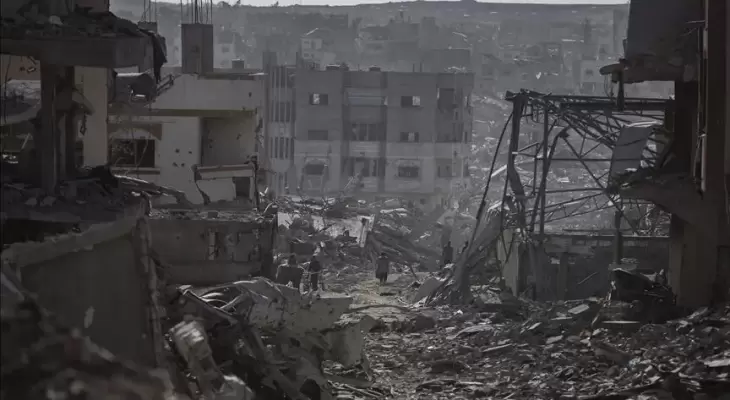
It is especially disheartening when it is estimated that between 8000 and 10,000 of civilians still lie under the mass tonnage rubble and debris destroyed by Israeli warplanes, tanks and armor.

The process of finding more bodies is especially hampered by Israel which refuses to allow heavy machinary such as excavators, bulldozers and cranes into the Gaza enclave.

These are essential to lift the massive concrete slabs of debris of destroyed high-rise buildings, homes and other civilian infrastructure. Civil defense teams often use rudimentary equipments like shovels, manual saws and their bare hands.

Figures are being revised all the time but the UNDP estimates that the Israeli mass destruction created 61 million tons of wreckage and debris that could take seven years to remove even under ideal conditions.

Continue reading
9,500 Missing Under The Rubble in Gaza

CROSSFIREARABIA – More than 9,500 Palestinians remain missing under the rubble of Gaza according to the Gaza Media Office.

This is while the Gaza Health Ministry stated Sunday, only 726 bodies were recovered since the 10 October, 2025 ceasefire deal was signed with Israel. This is because Israel refuses to allow equipment into the territory to help in the removal of the mass debris and rubble.

Local authorities are finding it very difficult to search for the bodies under the massive rubble created by Israel’s genocidal war on the strip that resulted in the killing of more than 72,000 Palestinians and the wounding of over 171,000 others.

The destructive war, started soon after 7 October, 2023 caused widespread destruction affecting 90% of the civilian infrastructure.

The UN estimates that approximately $70 billion would be required for the reconstruction of Gaza.

The UNDP estimates that Gaza lies in ruins at between 61 million to 68 million tons of rubble putting the enclave human development back by nearly 70 years.

Continue reading