Israeli Soldier Admits to Killing, Sexual Violance Livestream

A livestream conversation between American content creator Jeff Davidson and a self-identified Israeli soldier inside Gaza has ignited widespread outrage online after the soldier openly described the destruction of the territory and made statements acknowledging the killing of civilians and acts of sexual violence.

The footage circulated widely on social media during Israel’s ongoing war on the Gaza Strip, where international organizations have repeatedly documented large-scale devastation and mass civilian casualties.

Key Takeaways

  • An Israeli soldier says he is broadcasting from inside Gaza and shows widespread destruction.
  • When accused of killing civilians, he repeatedly answers “Yeah, yeah.”
  • He said soldiers committed sexual violence during operations.
  • The video’s circulation has renewed calls for independent international investigations.
  • Human Rights Watch says Israel committed war crimes, crimes against humanity and acts of genocide in 2025.

Livestream from a War Zone

The exchange occurred during a TikTok livestream with American YouTuber Jeff Davidson, who initially questioned the man about his identity and military affiliation. The individual stated he was part of the Israeli army and broadcasting from inside Gaza.

“So, what’s IDF?”

“Israel Defense Force.”

“So, you’re in the army down there, or military?”

“Yeah, I’m right now in this video chat in Gaza.”

When asked to show his surroundings, he pointed the camera outward and described extensive destruction across the area.

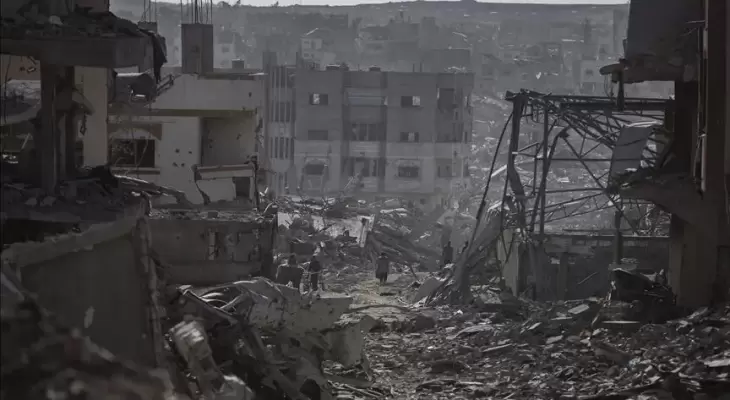
“You wanna see Gaza? Don’t be surprised, there’s no house here. Flat, all flat,” the soldier said.

Davidson responded: “You guys flattened it?” The soldier replied: “Oh yeah.”

The video surfaced as images of destroyed neighborhoods across Gaza have become emblematic of the war, with large residential areas reduced to rubble and hundreds of thousands of residents displaced.

The conversation escalated when Davidson accused the soldier of killing civilians, referencing children and women killed during the war.

“You guys killed a bunch of kids and sh*t bro. Bro, you just killed a bunch of women and children, bro.”

The soldier repeatedly answered: “Yeah, yeah.”

The exchange continued without denial. The Israeli soldier remained on the livestream and continued responding to the accusations while the creator warned him the video was public.

The footage appeared during a period in which international agencies and rights organizations have raised alarm over the scale of civilian casualties in Gaza, where a significant portion of those killed have been women and children.

Sexual Violence and Open Indifference

The most disturbing part of the exchange occurred when the soldier escalated his statements beyond killings and spoke about sexual violence.

“Hey, don’t worry. And we raped him also. We’re not just kidding. We’re raping also, OK?,” he said

The YouTuber warned him that viewers were watching and the reaction would be severe.

“Hey, bro, I’m letting you know. Hey, I’m going to let you know right now. I’m streaming, bro. You are going to be f*cking hated by every American.”

The soldier responded: “Bro, bro, I don’t give a f*ck.”

Growing Calls for Investigation

The widespread circulation of the video has revived growing calls for independent and transparent international investigations to determine responsibility for potential crimes and to address what activists describe as a climate of impunity that enables repeated violations.

Human rights organizations have already documented serious allegations during the war. In its annual global report, Human Rights Watch accused Israel of committing war crimes, crimes against humanity, acts of genocide, and ethnic cleansing against Palestinians throughout 2025 in both the Gaza Strip and the West Bank. The organization said the violations resulted in the killing, injury, and displacement of hundreds of thousands of people and took place with US support.

Reviewing conditions in more than 100 countries, the report described the scale of violations attributed to Israel in 2025 as “unprecedented in the recent history of Israel and Palestine.” – Palestine Chronicle

Continue reading
German Visit to Israel’s ‘Yellow Line’ Slammed

Bundestag President Julia Kloeckner’s visit to Gaza under Israeli military escort has drawn sharp criticism from lawmakers who called it a one-sided tour that excluded Palestinian perspectives.

The conservative politician traveled on Thursday with the Israeli army into what is known as the “Yellow Line” – an area occupied by Israeli forces for months that international observers fear could become permanent.

Adis Ahmetovic, foreign policy spokesman for the Social Democratic Party (SPD), criticized the visit in remarks to public broadcaster ARD, saying it sent the wrong message just days after Israel announced plans for de facto annexation of the occupied West Bank.

“This must not be legitimized,” the lawmaker said. “And such a visit to the Gaza Strip with the Israeli army does not help to clarify or criticize these plans, but may even give them further support.”

Ahmetovic noted that Kloeckner’s itinerary included no meetings with high-ranking Palestinian representatives. “No visit to the West Bank, no visit to East Jerusalem, and during her planned visit to Gaza, she didn’t listen to a single voice,” he said. “That’s something that’s difficult to explain.”

Franziska Brantner, co-leader of the oppostion Greens party, echoed the criticism in an interview with Der Spiegel magazine.

“It is good that Bundestag President Julia Kloeckner wants to see Gaza for herself,” she said.

“But if she does so without even listening to the Palestinian side, she must accept the criticism that she only wants to perceive reality in this region from one perspective,” she said.

Kloeckner’s Israel trip began on Tuesday. She visited the Yad Vashem Holocaust memorial on Wednesday, followed by a red carpet reception at the Knesset. She dismissed the criticisms, saying she raised the humanitarian situation in Gaza in meetings with Israeli officials and discussed the developments with opposition representatives and nongovernmental organizations. Anadolu

Continue reading
Gaza Readies For ‘Sweet’ Ramadan

As the Islamic holy month of Ramadan set to start next week, Palestinians in the Gaza Strip are preparing to mark the fasting month by reviving the tradition of making Qatayef on makeshift wood-fired stoves.

In Gaza, the arrival of the holy month is not counted in days, but sensed in the aroma of this classic Palestinian dessert once again filling the markets after two years of devastating war.

In the “Garage Rafah Market” in the city of Khan Younis in southern Gaza, which used to be crowded with shoppers before the Israeli war, a number of shop owners are trying to revive their businesses as the fasting month approaches. Among them are Qatayef makers who have returned to lighting wood stoves amid the rubble.

In the middle of widespread destruction and near areas still occupied by Israel east of the city, shop owners continue their work under difficult conditions, including shortages of fuel and gas.


Deep-rooted Ramadan tradition

With more than 20 years of experience, Salim Al-Bayouk — known as the “King of Qatayef” in the market — continues to prepare the dessert by hand despite scarce resources and the lack of basic materials.

Bayouk, 54, told Anadolu that he began the business in the city of Rafah before moving to Khan Younis after Israel occupied the city, expressing his determination to continue despite the difficult circumstances.

Qatayef is considered “the queen of Ramadan desserts” among Palestinians, distinguished by its ease of preparation and low cost. It consists of a small pancake filled with nuts, cheese, or dates, then baked and soaked in sugar syrup.

Bayouk said during Ramadan, his work primarily depends on cooking gas, requiring about 25 kg daily. However, supply shortages have forced him to rely on wood in order to continue his profession.

Since a ceasefire agreement came into effect in October, Israel has allowed limited quantities of cooking gas into Gaza, while the enclave needs 20 truckloads daily, according to local officials.

Despite shortages and rising operating costs, Palestinians insist on continuing, rejecting displacement and holding fast to Ramadan traditions they refuse to let disappear from their city.

Bayouk said he reduced the price per kilogram to 10 shekels (about $3) and provides work for 10 to 15 workers during the season, emphasizing his commitment to remain despite the damage to his shop and his reliance on makeshift repairs.

Hundreds of other Palestinians across different parts of the Gaza Strip also continue this seasonal profession among tents, narrow alleys, and crowded camps.

They set up makeshift stoves and light wood fires to compensate for gas shortages, attempting to revive a Ramadan ritual they are accustomed to despite the restrictions.


Basic dish

For his part, Saeed Khalaf, 38, said that the street where the market is located used to be packed with shoppers before the war, and it was nearly impossible to walk through due to the crowding.

“Qatayef remains a basic dish on every family’s Ramadan table,” Khalaf said, expressing hope for the restoration of normal life, and the actual implementation of the second phase of the ceasefire deal.

The ceasefire ended an Israeli offensive that began in October 2023 and lasted two years, killing over 72,000 Palestinians and wounding over 171,000 others, while destroying about 90% of Gaza’s infrastructure.

Despite the ceasefire deal, the Israeli army has continued to violate it, killing at least 591 Palestinians and injuring more than 1,578 others, according to Gaza’s Health Ministry

The US announced in mid-January the launch of the second phase of the agreement after delays, saying the plan includes further Israeli troop withdrawals, transitional governance arrangements for Gaza, and the start of reconstruction efforts.

By Serdar Dincel for Anadolu

Continue reading
‘We Are Dying’: Cancer Patients Plead For Treatment

As World Cancer Day is marked on Wednesday, thousands of patients in Gaza face worsening illness, untreated pain and closed crossings – despite the limited opening of the vital route through Rafah this week.

“We are dying. Every day, between two and three patients die inside this hospital,” says Munther Abu Foul, a cancer patient lying on his bed in Gaza’s largest hospital. “I can’t get out of bed because of the pain. We want a solution – open the crossings.”

His words capture the reality facing thousands of cancer patients across the Strip, where access to specialist care has collapsed and evacuation for treatment abroad remains out of reach for many.

Local health organisations warn that around 11,000 patients are currently deprived of specialised or diagnostic cancer treatment inside Gaza. 

Some 4,000 patients who received medical referrals to hospitals outside the Strip have been waiting for more than two years to travel.

UN News visited Al-Shifa Hospital in Gaza City, documenting the dire conditions inside its oncology department. Patients crowd corridors and wards, waiting for consultations or treatments that are no longer available. 

Essential medicines and equipment are in short supply, while many patients endure chronic pain that leaves them barely able to move.

Raed Abu Warda, a man in a green jacket, comforts his brother Hamid Abu Warda, a cancer patient, at Al-Shifa Hospital in Gaza City.

UN News

A man takes care of his brother, a cancer patient at Al-Shifa hospital in Gaza City.

‘Every day, two or three patients die’

Mr. Abu Foul flips through his medical transfer papers, issued long ago for treatment outside Gaza. He has not been able to travel for more than two years.

“The health situation in the Gaza Strip is dilapidated,” he says. “There is no treatment or medicines, and we are dying. Every day, two to three patients die here inside this hospital. I can’t get out of bed because of the pain.”

He appeals directly for help. “We want a solution. Open the crossings properly so that God will release us from this suffering. Everyone will be held accountable.”

Nearby, Mohamed Hammou tends to his elderly mother, who is also battling cancer. He says families are forced to watch loved ones deteriorate without care.

We want a solution. Open the crossings properly so that God will release us from this suffering – Abu Foul

“This is how we stand in front of a patient who is dying, without treatment or any medical facilities that help them recover,” he says. “This does not please God and it does not satisfy people. We call on Islamic, Arab and international nations to look at the sick with mercy.”

A brother in pain

In another ward, Raed Abu Warda cares for his brother Hamid, whose cancer has worsened after long delays in treatment. What began as a small, benign illness has become a life-threatening condition.

“He has been suffering from cancer for two years,” Raed explains. “He waited all this time for the crossing to open so he could be treated outside. His pain has increased, as you can see.”

He gestures towards a wound that has opened beneath his brother’s chin. “The disease has created this wound, and his condition is getting worse every day. I stand watching my brother and mourning his condition because of the pain.”

Mundhir Abu Foul, a cancer patient in Gaza, sits on a hospital bed with his hands open, appearing to speak or gesture.

UN News

The health situation in the Gaza Strip is deteriorating for those suffering from life-threatening cancers, despite the limited opening of the Rafah crossing.

The number of patients seeking care at Gaza’s oncology departments continues to rise, even as hospitals face severe shortages of medicines, equipment and specialised staff. For newly diagnosed patients, the future is increasingly uncertain.

Evacuations far short of needs

With the limited reopening of the Rafah crossing, the World Health Organization (WHO) is supporting the evacuation of patients and their companions from Gaza, focusing on ensuring safe transport. Yet the scale of need far outstrips what is currently possible.

All we ask for is a way to live

More than 18,000 patients – including around 4,000 children – are waiting to be evacuated abroad for medical treatment, according to WHO.

The UN Office for the Coordination of Humanitarian Affairs (OCHA) reported last week that Gaza’s Ministry of Health had recorded more than 1,200 patient deaths while people were waiting for medical evacuation. Around 4,000 cancer patients remain on critical waiting lists, trapped between closed crossings and a health system pushed beyond its limits.

For patients like Munther Abu Foul, time is running out. “We are dying,” he repeats. “All we ask for is a way to live.” – UN News

Continue reading
Rafah Crossing: 1st Gaza Returnese Speak of Humiliation, Insults and Blindfolding

The woman described her journey through the Israeli checkpoints as “like death”. She said this while fighting back tears as her sojourn was filled with fear and suffering.

She and her mother, along with another lady, faced humiliation and insults, and subjected to arbitrary arrest, blindfolding, and the confiscation of her personal belongings and threatened and intimidated during their detention, she added.

Ordeal at Israeli Checkpoints

In other shocking testimonies from women returning through the Rafah Crossing, one lady said the Israeli army tried to arrest her and detained her for about an hour-and-a-half, then released her with difficulty. She said what she experienced in her detention was among the harshest moments she had ever endured.

Another elderly woman recounted her suffering with anguish and pain, saying about 50 people were preparing to enter Gaza, but the Israeli army allowed only 12 to cross and turned the rest back. She added: “They humiliated us terribly, and there was a long wait.”

She added the bus they were traveling on was escorted by two jeeps, one in front and one behind, before being taken to an area where the army was deployed. There, they were subjected to an interrogation that lasted two to three hours.

The returnees arrived on a bus carrying only 12 passengers, including three children and the rest women, at the Nasser Medical Complex, which had been prepared to receive those returning from outside the Gaza Strip. Their harrowing journey lasted approximately 20 hours, during which they were subjected to thorough searches and lengthy interrogations by the Israeli army.

These testimonies come amidst a limited return of travelers through the Rafah Crossing, under tight security measures and, according to the returnees, severe humanitarian hardship.

Anger and Resentment on Social Media

Their testimonies sparked widespread anger among Gaza residents on the social media who expressed their dismay at the suffering endured by the returnees. They emphasized their journey epitomized the ordeal and suffering experienced by residents of the Gaza Strip.

Social media users described the humanitarian situation at the crossing as extremely harsh, citing harrowing accounts from those who returned during its partial opening. These accounts detailed the abuse and violations they suffered at the hands of the Israeli occupation forces.

Others described the limited number of travelers as a microcosm of the entire situation, emphasizing that the partial opening of the crossing was merely symbolic, while the suffering was far greater than the number of people allowed to cross.

They pointed out the phrase “No one is allowed to leave Gaza” encapsulates all the forms of death and suffering endured by Palestinians simply for being Palestinian.

They also described what happened on the first day the crossing was opened as a complete farce, with only about 10 people crossing, compared to the hundreds or thousands who crossed before or at the beginning of the war.

Social media users pointed out that the Israeli-established crossing in the center of Gaza has become a point of interrogation, extortion, arrest, and recruitment. Returnees are subjected to lengthy searches and threats of detention for hours, in addition to strict restrictions on their belongings. This will deprive hundreds of thousands of people of their right to leave or return, jeopardizing their future.

Several users added that these measures are leading to widespread fear and constant anxiety among Gaza residents. They noted that families now dread any attempt to cross, and that opening the crossing in such a symbolic manner has not alleviated their suffering but rather exacerbated their sense of injustice and humiliation.

Last Monday, the Rafah land crossing was officially opened in both directions for the first time since May 2014, following a trial period on Sunday. This comes as part of the implementation of the second phase of the ceasefire agreement between Israel and Hamas. – Al Jazeera

Continue reading