By Shireen Al Akka
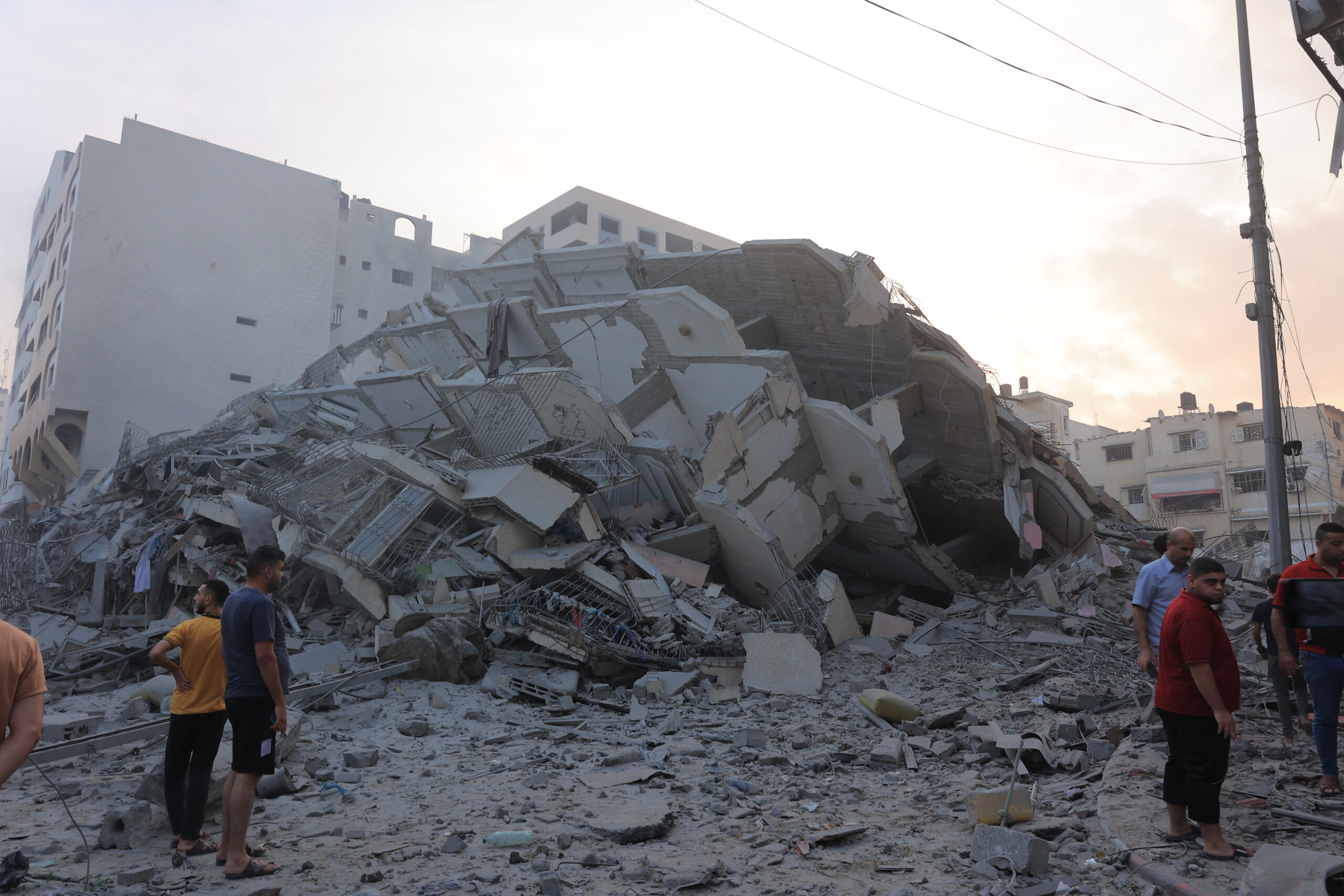
Amid the scenes of widespread destruction caused by the Israeli extermination war, there is a deep wound in the heart of Gazans who passe by destroyed houses, and still feel the souls that made their last breaths from under the rubble, and did not find anyone to rescue them alive or even honor them with burial.
These are souls that were not given a farewell and whose names were not mentioned in the records of martyrs. No one knows about their attempts to cling to life, and how much they tried to call for help before their final breaths were quashed by the dust and stones.
Since November 2023, my young brother Tamer Al-Akka has been trapped under tons of rubble, along with his wife Hind Hassouna and their children Tala (8), Zainab (6), and Khalil (3), as well as 18 others from his wife’s family.
My 60-year-old father, Khalil Al-Akka, searched for them with both hands for three consecutive days before he was forced to flee south. He was unable to dig them up due to the lack of fuel and the occupation’s prevention of rescue operations.
He repeatedly appealed to Civil Defense to bring in equipment to remove the rubble and rescue the survivors whose cries for help could be heard, but to no avail. Meanwhile, giant trucks were brought in from the Israeli side to transport tons of rubble mixed with the blood of martyrs to the Gaza beach, to build a sea pier said for bringing in humanitarian aid to the Strip.
Their presence under the rubble overwhelmed us.
My father wanted to honor his son and grandchildren with a burial. Perhaps the tombstone would have read “Martyrdom at the age of roses”, while my mother wanted to embrace his strong, healthy body to make sure that he had passed away, but she did not have the chance to see him and could not believe that she had lost him forever with her daughter-in-law and grandchildren.
None of us believed the news of his passing, and we were satisfied with saying that “my brother is under the rubble”. We procrastinated a lot until we mourned him, and we kept betting on his release. Perhaps because his personality was characterized by stubbornness and always searching for a way out and solutions!
In a phone call with my brother, Moamen, who lives abroad, he told me: “I do not accept condolences… perhaps he was able to save himself and will contact us soon”. At that time, I was silent for a long time and adopted his opinion that we are all waiting!
A comforting friend told me that “it is better for him -my brother – to remain under the rubble, because the bodies of the martyrs scattered in the streets are being devoured by dogs”. I was upset by her expression, but these tragic scenes were actually published by the media. I felt a kind of relief about their fate.
The Euro-Mediterranean Human Rights Monitor documented, in early January, the occupation army’s attacks on at least 12 cemeteries in the Gaza Strip, deliberately vandalizing them and stealing dozens of bodies. The Observatory’s field team inspected the (Al-Batsh) cemetery east of Gaza – established in October 2023 to bury dozens of unidentified martyrs after they were crowded into Al-Shifa Hospital – and their exposure to bulldozing and military vehicles trampling on the bodies. “Israel” does not stop at killing people, but goes so far as to deprive their families of even visiting their graves.
This act was repeated from Beit Hanoun in northern Gaza to Rafah in the south, and one father expressed his concern on his Facebook page for his child buried in a cemetery in Rafah, after he was forced to flee it. People still fear for the fate of their children, whether they are dead or alive.
At the time, I felt my brother might have been luckier than the others, and it seemed these feelings were nothing more than a temporary anesthetic, before the volcano ignited inside me again, and I wondered: “What are their bodies like now? Have they turned into bones? How will we recognize them? Well, my family cannot mistake their son. We will recognize him by looking at his teeth! When he was 15 years old, he lost one of his front teeth and had another artificial one installed, but what about his wife and children? How will we recognize them? Especially since the house was full of displaced women and children?”
No one knows how many martyrs remained under the rubble, but a report by the British organization “Save the Children” indicates that about 21,000 children in Gaza were lost as a result of the war. They were either trapped under the rubble, detained in occupation prisons, buried in unknown graves, or lost to their families.
Thus, after eight months, I was once again curious to know the number and names of the people who were with my brother. My sister Shaimaa, who is now living its the seventh displacement in Deir al-Balah and is taking shelter with her two children, Mira and Abdullah, in a palm frond roofed hut with no walls, spoke to me.
She was surprised by my question and answered me with a more bizarre and deadly question: “Why are you asking? Did you find him? Did you find Tamer alive?” My body trembled. I couldn’t find anything to say to her, but I adopted her question, and it has now become my obsession. A decent burial is one of the most basic human rights.
The family of the deceased does not give up this right even in the darkest and most difficult times. The 70-year-old woman, Laila al-Qulaq, who is my relative on my father’s side, did not give up burying her son, Mohammed (35 years old), a person with disabilities. When the Israeli occupation “army” penetrated Tel al-Hawa in Gaza and ordered the residents to flee, while she was busy with her other children, Mohammed caught her off guard by looking out the window and was immediately sniped.
The “fighter” – that’s what those who knew her called her, because she was widowed at a young age and raised 7 orphans, 4 of whom were disabled, whom she took care of alone, watching them from behind the sewing machine that stitched together me the most beautiful dresses of my childhood – wanted to bury her son’s body, but the occupation “army” forced her to leave.
Burial with honor
The next morning, Laila Al-Qulaq returned with her stubbornness that made her forget her fear. She insisted on removing her son’s body from the house and burying him with honor. Laila also lost her sick little granddaughter who passed away due to lack of treatment. I don’t know where she is now because of the incessant displacements, her situation is like that of two million people in Gaza struggling for survival or immortality.
The Israeli aggression on Khan Yunis has been ongoing for more than two months. With the frequent news of the genocide, the number of martyrs, and my pursuit of my family who are living in perdition in displacement, I forgot to check on my childhood friend Fidaa Ayyad, who is also displaced to Khan Yunis, until she called me recently, and her voice was very weak, “I am not well.”
I felt terrified and prepared myself for something great that I did not imagine would be this heavy, “Badr is gone, Shireen, Badr Badr,” and her voice disappeared. I lost contact with Fidaa.
Badr (14 years old) was his mother’s right hand in completing the tent work. He makes the bed, cleans the dishes, and collects firewood to light the fire in the oven. That day, he left his mother alone to bake loaves of bread. She turned around to look for him, thinking that he had gone away to play with his peers, especially since he insisted that day on taking an early shower and wearing his older brother’s shirt.
Badr moved away from the hard work next to the oven in the hottest month of the year… July! He went to the corner of the street. His father saw him and asked him to accompany him on a quick walk, but he also hesitated to accompany him. He stayed in his place on the corner of Al-Attar Street and was soon bombed, killing more than 28 martyrs and twice that number of wounded. His mother got up immediately and left the loaves of bread burning behind her. She went to look for Badr specifically, without his four brothers.
I learned these details later after many attempts to contact her. I hesitated a lot before asking her the question that had become my obsession: “Did you get to say goodbye to him? Did he get a grave?” She quickly answered me: “Yes, they brought him to me and I said goodbye to him, and yes, we buried him. My son has a grave and we buried him in Khan Younis, next to many martyrs.” She continued: “He who is not buried will be lost!” I felt the sting of her words, but I cannot blame her. We were silent, then she added anxiously: “When we go to Gaza, will we leave him here?” I stopped at that moment and I had been pacing the room back and forth throughout the call. I stopped and asked her to explain: “What do you mean?”
Shireen Al-Akka is a writer from Gaza and this article was originally printed from Arabic in the Al Mayadeen website.

 CrossFireArabia
 marwan