Trump, Netanyahu’s Shared Secret!

By Dr Hasan Al Dajah

Since his arrival on the American political scene, Donald Trump has been an exceptional case in the United States’ relationship with Israel. Historically described as a strategic alliance, this relationship has transformed under Trump into a personal partnership between him and Israeli Prime Minister Benjamin Netanyahu. This relationship has deepened to an unprecedented degree, with Trump becoming one of the most biased and supportive American presidents toward Netanyahu, not only in foreign policy decisions but also on issues of a purely Israeli domestic nature, such as the ongoing trials against Netanyahu or calls for early elections.

What drives Trump to this level of involvement in Israeli domestic affairs? And why does he insist on defending Netanyahu despite the criticism and accusations against him? In the current Israeli landscape, Netanyahu faces significant domestic challenges related to multiple corruption trials, in addition to escalating tensions within the ruling coalition, particularly with the religious parties, which have expressed on more than one occasion their desire to dissolve the Knesset and call for early elections. These parties, despite being partners in the government, view continuing under Netanyahu’s leadership as a political burden due to the corruption cases and poor performance in some cases. This recently prompted them to propose a vote within the Knesset to call for new elections.

In this context, Trump’s position was clearly supportive of Netanyahu, expressing his rejection of any attempt to remove Netanyahu from power and considering his continued rule essential to Israel’s stability and its security and political future. Even stranger are the reported interventions by Trump or his circle in the matter of Netanyahu’s trial. It has been reported—through both official and unofficial channels—that he called for a pardon or an end to the legal proceedings against him, arguing that these trials are politically motivated and that Netanyahu is being subjected to an unfair campaign by the Israeli judiciary. This intervention raises many questions, most importantly: What is Trump’s interest in Netanyahu’s survival? Why would he risk his political reputation for the sake of being a foreign leader facing criminal charges?

The answer to these questions requires examining the nature of the relationship between the two men. Since Trump assumed the presidency in 2017, he has pursued an unprecedented agenda in support of Israel, including moving the US embassy to Jerusalem, recognizing Israel’s sovereignty over the occupied Syrian Golan Heights, and supporting the “Deal of the Century,” considered the most biased in the history of US mediation.

All these measures were met with widespread acclaim and celebration by Netanyahu, who used them in his election campaign to bolster his domestic popularity, portraying himself as capable of bringing absolute US support to Israel.

In turn, Trump found in Netanyahu a reliable ally who reflects his vision for the Middle East and helps him win the support of a pivotal electoral base within the United States: evangelical Christians. People must realize that the true backbone of support for Israel in America is not the Jewish community, but evangelicals, who constitute approximately 25% of the population, compared to less than 2% of American Jews.

Therefore, Trump—as he has stated on more than one occasion—considers engaging with evangelicals more effective than appeasing the Jews, because they constitute a formidable lobbying force pushing for American policies aligned with the Israeli right-wing agenda, and view support for Israel as part of the Christian Zionist religious doctrine. These people see Netanyahu as the leader most qualified to preserve the “Jewishness of the state” and advance policies of expansion and hegemony.

Accordingly, Netanyahu’s downfall, or even his trial, represents a threat not only to Trump, but also to the political and ideological system he has meticulously crafted during his presidency. It is impossible to trust that potential Israeli alternatives will maintain the same level of loyalty or pursue the same confrontational approach toward Iran and the Palestinians.

Hence, for Trump, defending Netanyahu becomes a defense of a broader regional project that keeps Israel at the forefront of the confrontation with Tehran and strengthens right-wing populist alliances globally.

Moreover, Trump himself faces investigations and legal prosecutions in the United States, whether related to his attempt to overturn the election results, his retention of classified documents after leaving the White House, or various financial issues. Therefore, his defense of Netanyahu may be implicitly understood as self-defense. He seeks to establish the principle that the trial of political leaders is primarily a selective political process, not a fair judicial process. If Netanyahu is able to escape accountability or obtain a pardon, Trump will see this as a precedent that will strengthen his argument before the American judiciary and domestic public opinion.

Strategically, Trump does not view Israel merely as a traditional ally, but rather as an extension of his global political vision based on isolation from international institutions, undermining the liberal multilateral order, and strengthening bilateral alliances with strong leaders who share his political style and confrontational personality. For him, Netanyahu is the Israeli version of this model: a leader who clings to power despite internal and external pressures, fiercely confronts the media and the judiciary, and relies on a solid right-wing popular base fueled by a sense of existential danger and threat.

From this perspective, Trump’s support for Netanyahu is not limited to domestic issues but extends to regional security issues, most notably the open confrontation with Iran. Trump believes that an alliance with Netanyahu is necessary to sustain the escalation against Tehran and contain its influence in the region. Therefore, any weakening of Netanyahu, whether through elections or trials, is viewed as a direct blow to the axis of pressure on Iran and a threat to the deterrence strategy adopted by Trump during his presidency.

All of this explains why Trump supports Netanyahu and even intervenes in domestic issues, such as seeking a judicial pardon or rejecting early elections that could lead to Netanyahu’s removal from the political scene. It is a deeply mercenary relationship that transcends diplomatic protocol and extends to an ideological alliance between two leaders who each see the other as a mirror to their own selves and a first line of defense for their political and personal futures. Despite the criticism Trump faces for this involvement, he continues this approach without wavering, driven by an overwhelming desire to return to the White House and see a world shaped according to his own vision. In this world, there is no place for trials of political leaders, no room for elections that bring down allies, and only mutual loyalty, no matter the cost.

Dr Dajah is a professor of Strategic Studies at Al-Hussein Bin Talal University. He contributed this article to the Jordan Times.
Continue reading
Iran Targets Israel, Ignores Trump’s Surrender Call

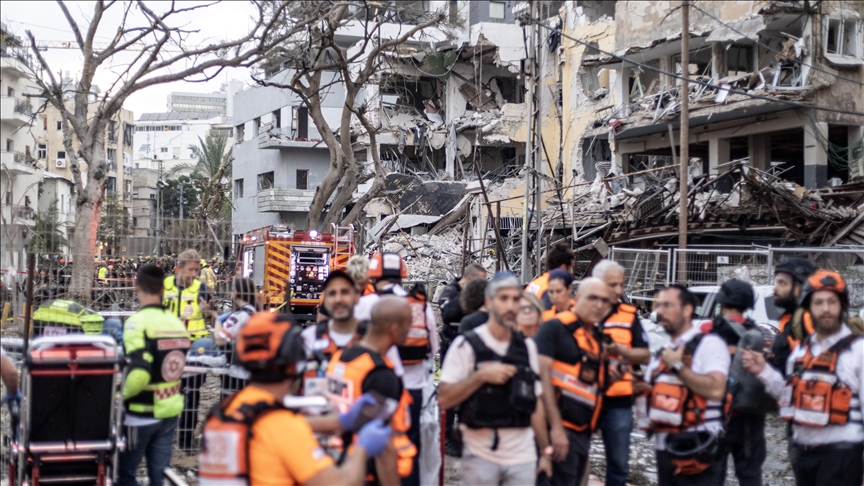
Iranian missiles have continued to fell on Israeli areas, Tuesday/Wednesday according to the Israeli media which also reported that the projectiles fell after the Israeli defenses failed to intercept them.

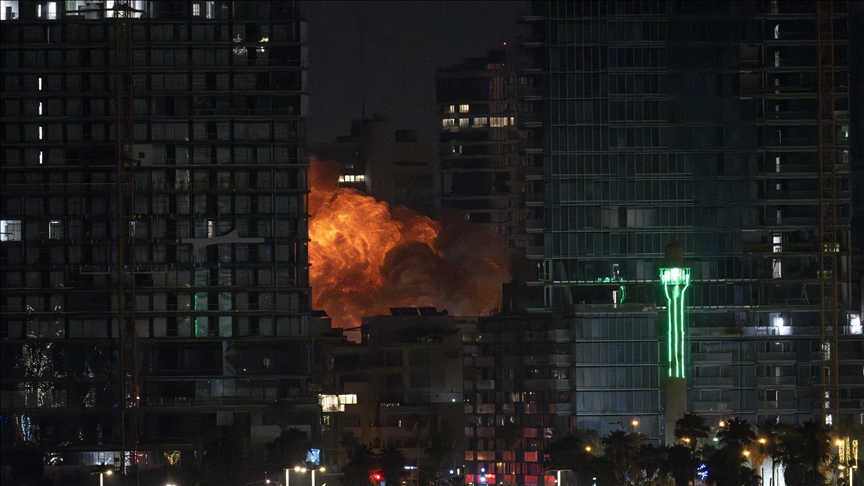
This failure caused fires and much damages including to a building after two missile salvos from Iran of approximately 30 missiles in less than an hour on Israel.

Iran’s Revolutionary Guard (IRG) announced in the attack it used hypersonic ballistic missiles for the first time. Observers say this is a clear message to US President Donald Trump, to steer away from entering the war despite his calls for Iran to surrender unconditionally.

At 00:35 local time (GMT+3), the Israeli military said in a statement: “Alerts were activated in several areas within the country after missiles were identified being launched from Iran towards Israeli territory,” as reported by Anadolu.

The Hebrew newspaper Yedioth Ahronoth reported air raid sirens blasted in the greater Tel Aviv area, Haifa, and Jerusalem, because of the eighth Iranian missile barrage since Tuesday morning.

Loud explosions in Jerusalem were held as a result of the interception of Iranian missiles according to the Turkish news agency.

On the other hand, Israel’s Channel 12 reported it estimated Iran fired 20 missiles at Israel in that barrage and as grudgingly confirmed by the Israeli  Army Radio.

This is while Israel Hayom reported that at least two missiles fell in Jerusalem and the Sharon region near Tel Aviv and with the Hebrew media also reporting of the damages caused in central Israel.

It added that missile fragments fell on a building in the northern region, while several fires broke out in open areas as a result of the fall of Iranian missiles or their fragments.

Air raid sirens

Air raid sirens sounded in central Israel, including in the Greater Tel Aviv, Ashdod, Rishon LeZion, and Netanya, following the detection of new missile launches from Iran. This is the ninth barrage since Tuesday morning with at least 10 rockets toward Israel and resulted in mass fires that engulfed at least 20 vehicles in central Israel.

The extensive fires were reported and dealt with Israeli fighters despite the strict news blackout the Israeli government is imposing and especially when reports are made on military bases and other installations.

Iran Fateh Rockets

Iran’s Revolutionary Guard said the first-generation hypersonic Fatah ballistic missiles are being used for the first time and wants to send a clear message to Israel and the USA,that Iran is willing to go the full away despite the extensive Israeli attacks on the country.  

“The powerful and highly maneuverable Fatah missiles repeatedly shook the shelters of the cowardly Zionists this evening after penetrating their defensive shield,” an IRG statement conveyed.

“Tonight’s missile attack proved that we have established complete control over the skies of the occupied territories, and that their residents are now defenseless against Iranian missile attacks,” it added.

According to Army Technology, a leading global website specializing in analyzing and documenting information related to defense industries and military technologies, the Fateh missile is one of the most advanced weapons in the Iranian Revolutionary Guard’s arsenal, thanks to its hypersonic speed.

The missile has a range of approximately 1,400 kilometers and features a movable nozzle and an advanced guidance system, allowing it to adjust its trajectory during flight and perform precise maneuvers both inside and outside the atmosphere, including lateral and rotational movements.

Continue reading
Iran-Israel War: Cost And Opportunities!

By Mohammad Abu-Rumman

Benjamin Netanyahu has placed the Iranian regime, the Wilayat al-Faqih system, before a fateful challenge through a harsh pre-emptive strike. While extremely risky, the strike was not decisive enough to settle the confrontation. Netanyahu himself did not expect that an ideological-nationalist regime like Iran’s would surrender and offer immediate concessions following the strike, without launching a retaliatory blow against Israel.

Despite Iran’s unprecedented powerful strikes on Tel Aviv, the reformist current in Iran, represented by Foreign Minister Abbas Araghchi, has also demonstrated its continued commitment to “the negotiating table” and to finding a way out of this war. Iran has deliberately avoided using its full missile capabilities against Israel to prevent the battle from reaching the point of no return.

Current indicators suggest that this war will likely not last long, nor will it expand geographically, because the destruction costs—for both sides—are immense. For Iran, this includes damage to its oil facilities, which are the backbone of its economy, as well as the protection of what remains of its nuclear program and infrastructure. For Israel, the fact that Iran managed to breach the Iron Dome and cause major direct damage in the heart of Tel Aviv and Haifa presents a reality that Israelis cannot endure.

In this light, there will likely come a tipping point at which both parties will be willing to end the conflict. The timing of that moment will be decided by the U.S. administration, which will step in to halt the military escalation. But when will this moment arrive? It will come when both sides realise that they can no longer achieve significant additional objectives, and that the cost of continuing the conflict far outweighs the cost of stopping it, especially given that a so-called “knockout blow” is impossible in such existential wars.

On the Israeli side, there are two major areas of superiority: First, Israel’s air force has successfully destroyed much of Iran’s air defense systems, allowing it to operate freely over Tehran and strike targets at will. Second, intelligence penetration, which could lead to further surprises that may force the Iranians to retreat or make subsequent concessions. However, Israel’s major vulnerability lies in its inability to withstand sustained, large-scale missile attacks, especially after a prolonged multi-front military conflict.

As for Iran, it has two primary objectives in the current military confrontation: To preserve the political legitimacy of the Wilayat al-Faqih regime, which is built on religious ideology and propaganda. Failing to respond or retreating now would reflect poorly internally and could erode the regime’s very source of legitimacy. To protect Iran’s deterrence capacity and prevent its regional standing from deteriorating—especially after losing the bulk of its regional influence in the aftermath of “Flood of al-Aqsa” (the Gaza war).

American intervention, whether military or diplomatic, will be decisive in ending this conflict. It is evident that President Donald Trump prefers a negotiated path, aiming for political, military, and economic gains. Netanyahu, however, is betting that a major military defeat for the Iranian regime will lead not only to concessions on its nuclear program (the primary stated objective) but potentially to changing or collapsing the regime itself, thereby neutralizing it within the regional power structure. This would constitute a strategic shift in the regional security equation in Israel’s favour.

Direct US military involvement remains unlikely, except in two scenarios: If Israel were to request assistance after a massive and successful missile strike against its territory. If the U.S. concludes that Iran will not back down unless there is a more dramatic shift in the military balance of power that compels it to return to the negotiating table and offer substantial concessions.

This equation was not the same two years ago. Back then, Iran had greater geopolitical space and extensive tools of influence in the region. However, what has occurred with the fall of Bashar al-Assad’s corridor (the Syrian axis), and the diminished power of Hezbollah and Hamas, has cost Iran critical advantages in the regional balance of power. After this war, there will be significant consequences even for Iran’s remaining influence in Iraq, which may become the final outpost lost by Tehran, ending a twenty-year effort (since the 2003 invasion of Iraq) to weave its intricate carpet of regional influence.

Mohammad Abu Rumman is the Academic Advisor of Politics and Society Institute in Amman and has contributed this article to The Jordan Times.

Continue reading
The Devil You Know!

By Dr Khairi Janbek

One wonders what more can be said about the tragic war in Gaza, more than the outpouring of words in the East, West and the Arab world with the habitual accusations and counter-accusations which have reduced the question of Gaza, after many other things to a mere question of semantics with the same words and same policies, while the habitual loser, the hostages and their families, and the Gazan people continue to suffer relentlessly.

Delegations keep going and coming, ceasefires agreed then broken given the impression that all what is being attempted is to keep the war going without the pangs of guilty conscience or more pragmatically, pending how public opinion shifts in western countries.

For all intents and purposes, can Israel destroy Hamas or at least break its military structure, if indeed this is the intention of Israel? If it is not, what would be the point of this war?

This is because all of what is being done is mere destruction of lives of innocent civilians who have no say when it came to “Hamas terrorism” and the subsequent Israeli retaliation. The tragi-comedy of the situation, is that Israel is fighting Hamas in order to keep a smaller version of Hamas, in the manner possibly of the devil you know is better than the one you don’t.

As for the other side of the divide, one doesn’t believe that Hamas cares about the innocent Gazans more than Israel, of course their aim is to survive, and rule for another day, because as it appears they seem to believe that Israel has no wish to occupy Gaza, and they stand a good chance to rule a diminished territory compatible with their diminished organizational size.

One wouldn’t actually be surprised knowing only too well than in the Middle East nothing is meant to be resolved; neither with peace nor with war.

Then comes the international community, President Trump’s policy towards the region fits very well with all what is going on, and it reflects this inconsistency with its own inconsistency. At one point, he wants the destruction of Hamas, then he wants a ceasefire and wants the war to stop, with the only logical demand of wanting what everyone else wants, the release of the hostages.

But even on this path one wonders for how long he will be able to keep his attention span on the question. The EU has its twists and turns, apart from’Ireland and Spain, the governments of Europe have their own contradictions with each other and subject to the fluctuations of public opinion, nevertheless, there will be plenty of rhetoric but the same policies will continue.

Ironically, the only side which is not counted on, and the only side which seems reluctant to get involved actively, save for holding hostage release negotiations, is the Arab side.

One firmly believes, against common wisdom, that only the Arabs can convince Hamas to surrender its weapons, and manage a post-Hamas Gaza, guaranteeing security for Israel and start the reconstruction efforts for Gaza. It is only after that, a permanent solution can be thought of.

Dr Janbek is a Jordanian writer based in Paris, France.

Continue reading
Why Doesn’t Trump Want Netanyahu to Strike Iran?

By Dr Marwan Asmar

CROSSFIREARABIA – United States president Donald Trump seems to be a very happy man these days. He says he is about to reach a deal with Iran on its nuclear file very soon.

Israeli Prime Minister Benjamin Netanyahu on the other hand is particularly worried, concerned, frustrated and even downhearted. He says ‘we need to strike Iran now before it’s too late and it goes ahead and develops a nuclear bomb’. 

But, and on the contrary, Trump believes that it’s because Iran is still at a weak stage before reaching nuclear  weapons capability, the US can force a deal that would make sure it checks its nuclear arsenal and would submit to the American will.

To prove his point, Trump through his US negotiating team led by Steve Witkoff, is continually talking to the Iranian team through Oman, now in their fifth mediating session about ironing out a new deal that would satisfy the US point of view and give the Iranians peace of mind and something to look forward to like lifting sanctions on the country.

To that extent, and no doubt for public relations, Trump is never short these days on complementing the Iranians with his glowing uttrances on the country and how it can become “great” again.

By their own accord however, both teams who are talking indirectly through the Omanis, say that negotiations is tough and may even going through a rough patch.

The Iranian delegates are sticking to their position, they want a deal but not at any price. They want to continue to pursue their uranium enrichment program believing this is a question of state and national sovereignty. They say they haven’t reached such a local, indegenous breakthrough in order to give it, whilst praising their scentific and technological advancements in this area of power.

The Americans on the other hand insist that Iranian divest itself from this nuclear process for uranium enrichment is a ‘redline’ as it leads to the possession of a nuclear weapon. To the Trump administration, this point is intractable which Iran has to give up on. 

But if this is the case why is the US continuing to talk to Iran? Further still, why should Trump be happy and talk about an impending deal that would lock the hands of the Iranians? Clearly, the American president is happy despite the murky regional waters.

Back to Israel. Netanyahu is deeply worried and wants to frustrate any impending nuclear deal. But he was always frustrated about Iran and argued, well, at least for the last 10 years, against talking to Iran and placating it. It was argued he was the person to convince Trump to leave the international JCPA treaty signed between the five-members of the UN Security Council and Iran in 2018.

Today however, and for Netanyahu, its “horrors” on the horizons. Leaked newspaper reports in The New York Times suggest there is deep tension between Trump and Netanyahu on this issue for the US president doesn’t want the later to embark on any action such as military strikes that would jeopardize any upcoming deal.

That is why Israeli Strategic Affairs Minister Ron Dermer and Mossad Chief David Barnea are being invited to Washington to the White House to impress upon them not to embark on a drastic Israeli action and bomb Iranian military and nuclear sites whilst negotiations are going on.

Many US and European experts however are fearful that Netanyahu wouldn’t be able to be controlled and if he embarks on striking Iran he would do so without consulting the Americans and go it alone and in spite of the ‘talked-about” pressure that is being exercised by the White House on Tel Aviv.

Regardless however, Trump wants a deal come what may for he believes this would be a great achievement for America and would vindicate his earlier action when he got the US out of the deal in 2018 and now in return for a better accord, and moving his own view to create a safer world and enforce his image that he is a man of peace and doesn’t support world wars like his recent attempt to stop the Ukraine War.

If Israel does strike Iran, in theory that would make Trump very unhappy because it would mean the United States is no longer able to control its strategic ally, or it could mean that behind the international and regional diplomatic chit-chat, the US is not too bothered about striking Iran.

But there are also other problems to consider: Wouldn’t a strike on Iran, especially on its nuclear sites, produce a spiral and a slippery-slope in which the latter would surely retaliate and be capable of doing so, with vehement force.

Apart from what that would do to the region, ie, “nuclear catastrophe”, would Netanyahu go along that road and risk annihilation for Israel and its surrounding areas.

These are tough questions to consider and may force Netanyahu to back down and listen to the US.

Continue reading