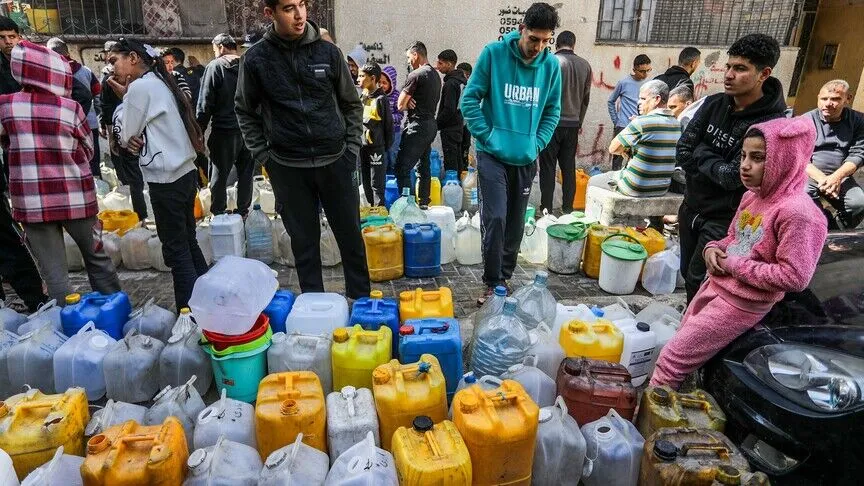
The Long Road Back to North Gaza

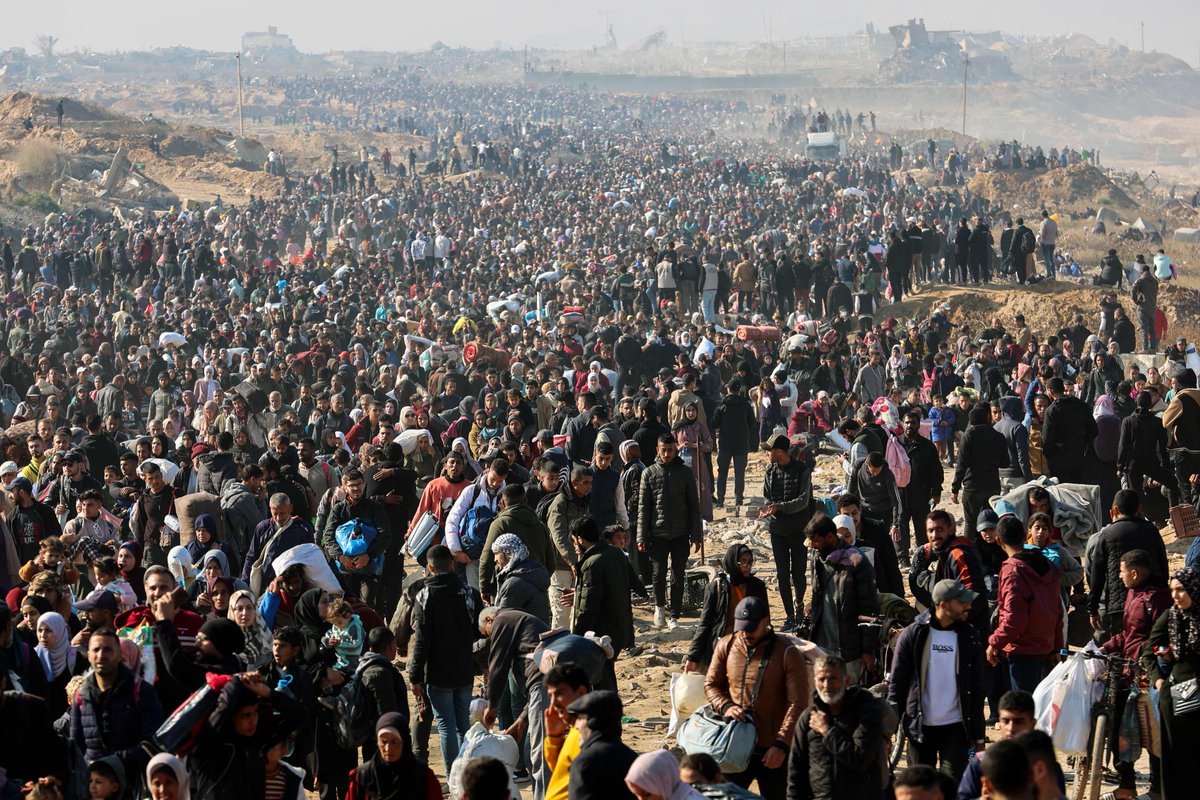
According to the Government Media Office, more than 300,000 displaced Palestinians in southern Gaza have returned to their neighborhoods in the north of the enclave since this morning, after the withdrawal of Israeli occupation forces from the Netzarim axis in central Gaza.

Activist Aboud Battah documents the return of displaced Palestinians from southern to northern Gaza after Israel’s dismantling of the Netzarim Corridor.

Palestinian journalist Mohammad Shaheen reunites with his children, who returned from southern Gaza to the northern areas after being separated by the Israeli occupation during the genocide that lasted for 15 months.

Continue reading
Trump’s ‘Business-like’ Solution to Gaza

By Dr Khairi Janbek

If you remember in the films, when the big mafiosi harms a friend or an ally, says, usually I had nothing against him, I even liked him, but this is pure business.

One is using this adage, because it simply reminds me of what president Trump said about the Jordanian monarch and the Egyptian president. He expressed his affection towards both, and said he got on well with them and liked them, but wants them to take refugees from Gaza and settle them in their own territories.

Now, doesn’t Mr Trump know that this move presents an existential threat to all? Or is he indifferent to their concerns, the fact being that, it’s nothing personal, just a businesslike solution to the Gazan Palestinians, whom in fact do not wish to leave their land as things stand now.

Unfortunately, this proposal stems from a very long history of the notion that, Israel is a very small country, and the Arab world is vast, and since the Palestinians are Arabs then they can be absorbed in other Arab countries!

Of course, this notion does not take into consideration that the Palestinians do not wish to leave their lands and seek justice in their own homeland, but then again there is an Arab contribution to this dimension which emerged in the so-called post-Arab-Israeli peace process, albeit in all probability unintentionally.

The fundamental idea of land for peace, which implicitly and explicitly meant land and state for the Palestinian people; which is incidentally a political notion, is that the Palestinian problem becomes a humanitarian issue that of refugees demanding the right of return.

In essence a people without land, or unspecified area of land doesn’t not constitute a nation. One is not going to bore everyone with justice and injustice, rather wishes to say why is it assumed by Mr Trump that the Palestinians should not have a say in their independent destiny? Why doesn’t he address them directly, after all the US is one of the guarantors of the Oslo accords, which incidentally gave legitimacy to the PNA.

Having said all that, where do we go from here, and for whom is Gaza supposed to be built for? If it is supposed to be built for the Gazans would that mean the Gazan status in Jordan and Egypt is a temporary proposal, in other words until Gaza is rebuilt? And who will rebuild Gaza?

These are very important details which cannot be swept aside without discussions involving the Egyptians, Jordanians and the PNA. But can Mr Trump’s idea really be worth considering and entertaining in terms of practicalities or is it on top-of-the-head remark?

The writer is a Jordanian columnist based in Paris

Continue reading
Palestinians Return to North Gaza in Thousands

Tens of thousands of displaced Palestinians in Gaza are crossing today the Netzarim Corridor and returning home to their loved ones in northern Gaza for the first time since Israel’s genocide on the enclave began.

Israel’s military said Palestinians will be allowed to cross al-Rashid Street by foot starting at 7am (05:00 GMT) and Salah al-Din Street by vehicle from 9am (07:00 GMT) on Monday.

Earlier on Sunday, Israel had blocked tens of thousands of Palestinians waiting to return to their homes in northern Gaza. Ismail al-Thawabta, director general of Gaza’s Government Media Office, said there were “between 615,000 and 650,000” people waiting to go past the Israeli military positions in the Netzarim Corridor, which runs through the centre of the Gaza Strip according to the Quds News Network.

Continue reading
Calls to Displace Palestinians is a New Battle For Jordan

By Samih Maaitah

As Jordan has only just recovered from the aggression on Gaza and has seen some relief along its northern borders, the issue of displacement has resurfaced once again. This time, it arises either from Gaza, exploiting the humanitarian and political catastrophe it faces, or from the occupied West Bank, where Netanyahu’s most right-wing government continues to escalate security and military tensions.

From the beginning of the aggression on Gaza, Jordan understood that the goal was to displace its people. Alongside its Egyptian brothers and other Arab and international parties, Jordan worked to confront this scheme. Jordan is fully aware that displacement is not just about relocating Gaza’s residents to another country; it is about dismantling the Palestinian cause and undermining its major pillars. Amman is cognizant that Israel seeks a Palestine without Palestinians and, through displacement, it seeks to destroy the prospects for a Palestinian state and the right of return.

Jordan, which has already received millions of Palestinians and millions of others due to the region’s endless crises and wars, has paid a heavy price in terms of its limited resources and political stability. Each wave of migration—most recently from Syria—has come at a significant cost. Jordan is aware that accepting any number of people from Gaza or elsewhere is no longer acceptable or tolerable, especially given the political implications for Jordan’s demographic composition, its national identity, and the Palestinian national identity.

Logic dictates that after all these wars and acts of aggression, the world should seek to resolve the Palestinian issue by granting Palestinians their rights on their national soil. It should not seek solutions to address Israel’s so-called security concerns by emptying Palestinian land of its people and displacing them to other countries.

Jordanians will not accept any solution at the expense of their national identity, homeland, and state. Those who truly seek peace must understand that the path to peace lies in granting Palestinians their rights on their land, not through displacement or the illusion of peace based on a scheme that can only be described as a liquidation of the Palestinian cause.

The writer is a columnist in the Jordan Times

Continue reading
1000s of Palestinians Wait at Netzarim to Cross Into North Gaza

Thousands of displaced Palestinians have been gathering at the closest point to the Netzarim Corridor in central Gaza since Saturday, spending the entire night on the streets as they await a permit from the Israeli occupation to return to their homes in northern Gaza.

Women, children, and elderly people have been lining up along Al-Rashid Street (west), waiting for the Israeli military to permit them to begin streaming into northern Gaza. Meanwhile, vehicles filled with residents and their belongings are also waiting on Salah al-Din Street (east), where they will undergo searches before being allowed to cross into the northern areas.

The movement was expected to resume after Hamas handed over four Israeli soldiers as part of the ceasefire agreement on Saturday.

According to the agreement, the Israeli army is required to withdraw completely from west of the Netzarim axis, including the coastal Al-Rashid Street, to Salah al-Din Street in the east.

Under the deal, Israeli forces must dismantle military positions in the Netzarim area. Once completed, Palestinians would regain freedom of movement between Gaza’s north and south. Hamas sources confirmed this and said displaced Palestinians would be allowed to return to their homes unarmed. Humanitarian aid would also move freely via Al-Rashid Street.

Earlier on Saturday, Hamas said that Israel is delaying the ceasefire terms. In a statement, Hamas said, “The occupation continues to stall in implementing the ceasefire and prisoner exchange agreement by keeping Al-Rashid Street closed and blocking displaced civilians from returning north.”

Hamas warned Israel against further delays, holding it accountable for any disruptions to the agreement.

The ceasefire, which began on January 19, is set to last 42 days in its first phase. Egypt, Qatar, and the United States brokered the agreement.

From October 7, 2023, to January 19, 2025, Israel’s genocide in Gaza caused catastrophic losses. Over 158,000 Palestinians, mostly women and children, were killed or injured. More than 14,000 remain missing, making this one of the world’s worst humanitarian disasters according to the Quds News Network.

Continue reading