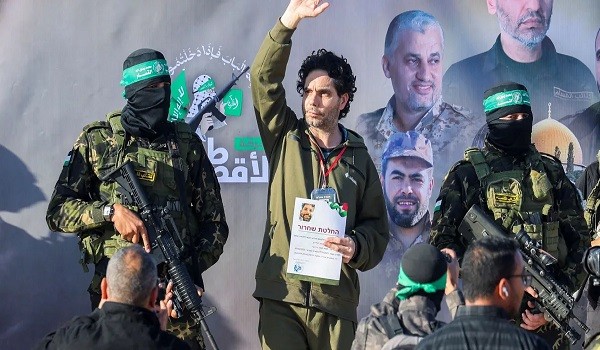
Military and strategic expert Nidal Abu Zeid said the scenes of the handing over of the three Israeli prisoners, Saturday, were more disciplined and organized and carried many messages that the Palestinian resistance wanted to send to the Israeli occupation as part of the superiority it achieved in the battle of image and media.
Abu Zeid added to Jordan 24 the handover took place in two locations in the north and center of the Gaza Strip, which indicates the continuing strength of leadership and control of the resistance even after Hamas announced the martyrdom of seven of the first-rank leaders of the Qassam Brigades.
He pointed out this indicated that the Palestinian resistance also succeeded in overcoming the crisis of its organizational structure as well as in replacing its leaders who were killed in Israel.
Abu Zeid pointed out the black jeep that appeared during the handover of the two prisoners in Khan Yunis is one of the occupation army vehicles the resistance seized during its military operations there. This is in addition to the scenes of weapons carried by the resistance fighters during the handover, such as the Uzi and Scorpion, which are weapons of the elite units of the Israeli occupation forces.
He explained the place of handover in Khan Younis and the background pictures of leaders Mohammed Deif, the Hamas military chief and Rafeh Salama on the platform, shows the symbolism of the city, as the birthplace of Deif and leader Salama who led the Khan Younis Brigade, and both were martyred in an operation by the Israeli occupation in Al-Mawasi, west of Khan Younis.
This is in addition to the symbolism of handing over one of the prisoners who holds American citizenship in the Gaza port near the area where the American side tried to establish the sea pier but miserably failed and ended in losing millions of dollars.
Abu Zeid pointed out the resistance is still superior in the battle of the image and the media it broadcasts through scenes of handing over prisoners within messages related to the capabilities of the resistance and decoding some of the symbols of the signals through which it wants to prove its capabilities and the fact it is able to continue, whether through the diplomatic dimension and negotiations or a return to the military operational dimension.
As Israel shuts down UNRWA in Gaza and the occupied West Bank, the move serves a strategic purpose: Undermining Palestinian national liberation and the right of return.
By Sara Troian
This week, Israel’s ban on the United Nations Relief and Works Agency (UNRWA) takes effect, cutting off its services in its two main areas of operation in Palestine; namely, Gaza and, the occupied West Bank, including east Jerusalem.
Established in 1949 in response to the Nakba, UNRWA was meant to provide humanitarian aid and protect Palestinian rights until a just resolution to the refugee crisis was achieved. Central to this is the Palestinians’ inalienable right of return, which Israel has consistently denied.
Beyond the 5.4 million UNRWA-registered refugees, at least five million more Palestinians have been forcibly displaced by Zionist colonisation. The right of return belongs to them all.
Calculated attack on Palestine
In October, the Israeli parliament passed two bills targeting UNRWA. The first prohibits the agency from operating within the 1948 borders. The second bars Israeli officials from engaging with UNRWA in any capacity.
These laws are designed to remove Palestinian rights to a homeland and further weaken the agency that serves them. They also mark the culmination of decades of attacks by Israel and its allies seeking to dismantle UNRWA as part of the broader Zionist settler-colonial project.
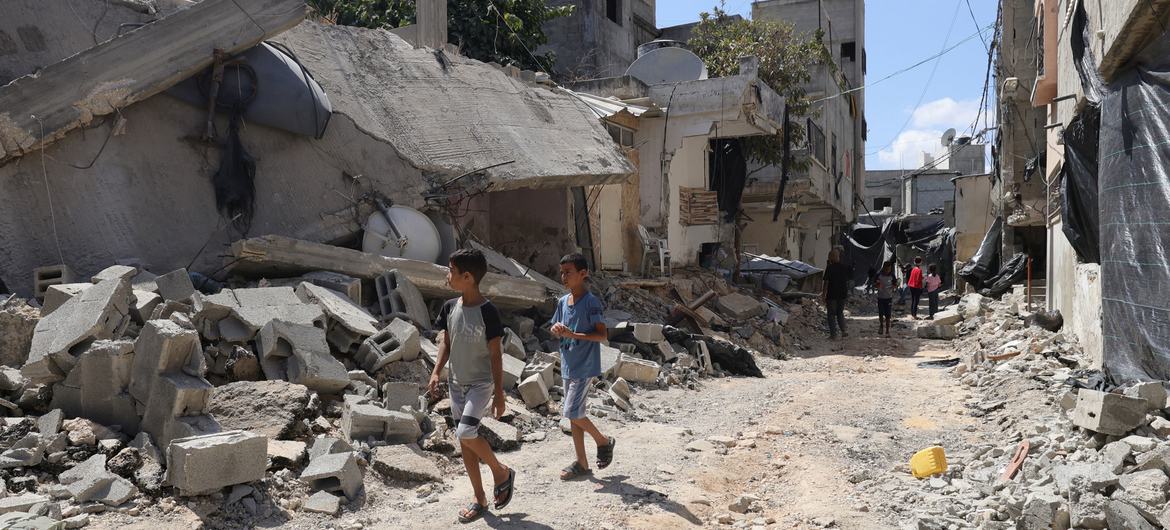
For the 2.1 million Palestinians in Gaza, this will cripple efforts to rebuild the warmth of their homes and the safety of life-sustaining infrastructure vaporised by Israel’s annihilatory violence. This will further obstruct the restoration of life and the healing from nights spent beneath skies ablaze with fire and days suspended between slow and quick death in dwindling food rations.
In the West Bank and east Jerusalem, 49,000 students will be forced out of UNRWA schools, and will be left either without education or, in Jerusalem, to the whims of Israeli curricula that distort, dehumanise and erase their history and culture.
Nearly a million Palestinians will be denied medical care. The loss of thousands of jobs will further drive Palestinians into economic precarity, deepening the cycle of engineered de-development.
Political goals and neoimperial strategies
The dismantling of UNRWA is not just a humanitarian crisis; it is a political manoeuvre. Zionism has slated Palestine for erasure as part of a broader regional strategy. In this imperialist framework, the US and EU finance oppression, Israel enforces it, the local bourgeoisie complies, and the UN provides a thin veil of legitimacy.
The timing of the ban aligns with Israel’s shifting tactics. While the intensity of genocide in Gaza has momentarily slowed, violence in the West Bank—particularly in Jenin and Tulkarem refugee camps—has escalated. Zionist forces use airstrikes to destroy life-sustaining infrastructure, obstruct healthcare, and drive mass evacuations, all while continuing the daily expansion of settlements and mass arrests.
Palestinians today face the same oppressive forces as during the 1936-39 revolt: self-serving leadership, Arab regime complicity, and Zionist-imperialist domination.
At the core of these dynamics is Palestinian refugeehood—a fundamental consequence of Zionist colonisation. Since 1948, Israel has displaced over 10 million Palestinians, most, descendants from the Nakba, severing them from their homeland.
The right of return threatens Zionism’s foundation because it challenges Israel’s colonial reality, built on destruction and displacement.
Israel's dismantling of UNRWA isn’t just about aid—it’s a calculated war on Palestinian return
The Zionist-Western axis‘ attacks on UNRWA aim to depoliticise its mandate, while crystallising Palestinian refugeehood into a permanent humanitarian crisis to be managed.
While the status of Palestinian refugees and their right of return cannot be solely determined by UNRWA or any international agency–as it is a condition that stems from the implementation of Zionist settler-colonialism– these attacks weaken the agency’s ability to advance Palestinian political claims within the UN.
Moreover, heavy reliance on donor-driven funding has transformed the agency into a semi-corporate entity, dependent on fluctuating foreign funding, further undermining its capacity to support Palestinian political aspirations. This, however, is a symptom of the neoliberal exploitation that, disguised as humanitarianism, treats Palestinians as disposable and expendable subjects to Western imperial expansion.
Palestinians are therefore held hostage by a global structure designed to rob them of their autonomy. This is reflected, for example, in the fact that all senior UNRWA officials are non-Palestinian, making decisions for 5.4 million refugees, yet often against their quest for national liberation.
Integration?
Meanwhile, US imperialism has dealt another blow by freezing all USAID projects–except for those in Israel and Egypt– and halting military aid to all countries except Israel, Egypt and Jordan.
The suspension of USAID serves as a coercive tool to absorb the thousands of Palestinians whom Israel’s brutal campaign aims to expel in the coming months. For example, in Jordan, where USAID plays a critical role in supporting public services like healthcare, justice, and water supply, the freeze pressures the Kingdom to participate in this plan, which has been in the works for years, but only recently the US has openly encouraged Egypt and Jordan to endorse a new wave of forced Palestinian exile.
In recent years, experts and international bodies have proposed integration into host countries or resettlement in third countries as pathways to securing a modicum of rights and emancipation for Palestinians who have been forcefully encamped for over seven decades.
While access to civil and political rights in places of exile is crucial, these proposals must not be weaponised to suppress the central struggle for return. At this moment, such narratives risk legitimising forced expulsions, under the guise of legal solutions, erasing Palestinian claims from the global agenda.
Access to rights must never serve as a strategy to downplay or marginalise the central struggle for return and efforts to secure it. At this moment, it is crucial to recognise how such narratives and solutions can be exploited—either to hinder Palestinian survival amid genocide or to suppress resistance against forced displacement.
Many Palestinians in the West Bank already hold Jordanian citizenship—remnants of the Nakba and Oslo. If Palestinians will be forced to relocate to Jordan or third states under the pretense of naturalisation and resettlement, this strategy, framed as a legal solution, will ultimately legitimise further forced expulsions and erase their right of return from the international agenda.
This will facilitate the elimination of 10 million Palestinians as a political force challenging Western imperial expansion.
The time for return
A just solution cannot emerge from the very institutions and structures that have perpetuated Palestinians’ plight and the plundering of their land for decades. Such alternatives merely rebrand subjugation of the people.
The answer lies in the steadfastness of Palestinians themselves. Over the past 16 months, in defiance of over a century of disenfranchisement and exile, including 480 days of settler-colonial erasure, Palestinians alone have transformed return from a distant dream, into a tangible reality.
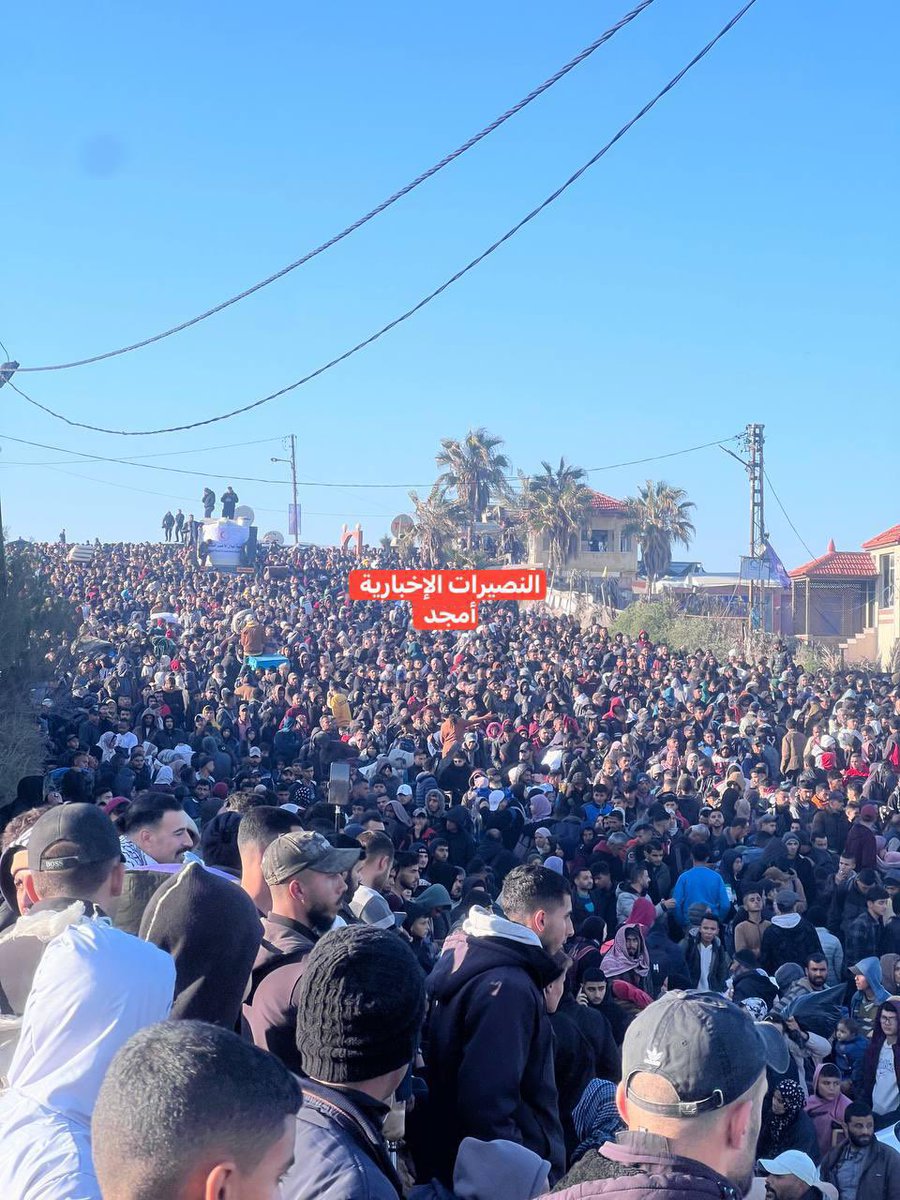
As displaced Palestinian in Gaza flood back towards their destroyed homes in Gaza City, Beit Lahiya, Jabaliya, and Beit Hanoun, this marks only the beginning of their Great March of Return. Eighty percent of Gaza’s population descends from those expelled from 247 villages in central-southern Palestine through waves of Zionist massacres.
This must be the guiding principle for any just and lasting solution—one that restores Palestinians to their homes, land, and dignity from which they have been forcibly expelled for far too long.
Sara Troian is a Hume PhD Scholar in the Department of Law and Criminology at Maynooth University. Her PhD research examines the tension between international law and settler-colonialism in Palestine.
Israeli military analyst Amos Harel has dismissed a “total victory” for Tel Aviv in the Gaza war, arguing that such assertions, promoted by supporters of Prime Minister Benjamin Netanyahu, are contrary to the ground reality.
Harel, a military affairs analyst for the Israeli newspaper Haaretz, in his write-up published on Friday, stated, “One has to be a blind follower who has shed all vestiges of doubt and criticism to believe that Israel actually defeated Hamas.”
“The organization sustained a tremendous military blow, but it certainly did not surrender,” he noted, adding that “that’s not consistent with Netanyahu’s declarations about the war’s goals, or with his promises in its course.”
US mediation efforts
Harel also touched on the role of the US in the region, highlighting that the administration of President Donald Trump is pushing for the full implementation of a multi-phase ceasefire and prisoner exchange agreement between Israel and Hamas. This contrasts with Netanyahu’s preference to focus solely on the initial phase.
The ceasefire, which began on Jan. 19, is set to last for 42 days in its first stage, with negotiations ongoing for subsequent phases under the mediation of Egypt, Qatar, and the US.
According to Harel, “The visit to the region by Steve Witkoff, US President Donald Trump’s special Mideast Envoy, attested to the mood of the administration.
“Washington views the first phase of the deal as a necessary point of transition to the second phase, which in itself is preparation for the bigger deal.
“Washington views the first phase of the deal as a necessary point of transition to the second phase, which in itself is preparation for the bigger deal: huge US-Saudi contracts accompanied by normalization between Riyadh and Jerusalem.”
He added that “Witkoff was here to ensure that Israel continues on the track laid out by Trump,” with key details expected to be discussed next week in a meeting between Trump and Netanyahu in Washington. This meeting, Harel suggested, holds significant weight as reported in Anadolu.
Challenges to Gaza deportation plans
Harel also addressed Trump’s controversial suggestion of relocating Palestinians from Gaza to neighboring countries, highlighting the practical difficulties in implementing such a proposal.
The idea is partly aimed at maintaining Netanyahu’s coalition with the far right. However, he noted that the chances of executing such a plan are slim.
“Washington’s bargaining power in the Middle East on emigration doesn’t resemble what it’s capable of achieving with its neighbors in Latin America,” said the analyst.
“Trump appears to be looking at Gaza like the real estate entrepreneur he used to be. To resettle the destroyed area, an evacuation-construction project is needed,” he explained.
Harel pointed out that while these proposals align with the long-standing aspirations of Israel’s right-wing to remove Palestinians from the equation, they are likely to face strong resistance.
“Such schemes will inevitably encounter Palestinian opposition, backed by Arab states. At this moment, it is difficult to imagine any Arab leader endorsing Trump’s relocation plan for Gaza,” he concluded.
On Jan. 25, Trump publicly proposed relocating Gaza’s Palestinian population to nearby countries like Egypt and Jordan. His suggestion has been widely rejected by several countries, including Jordan, Iraq, France, Germany, the Arab League, the Organization of Islamic Cooperation, and the UN.
United States President Donald Trump announced his plan to expel the Palestinians in the Gaza Strip from their homes there, and has called on neighbouring nations to accept the Palestinians into their countries. These remarks, which were made after Israel egregiously violated international law by committing genocide against the Palestinian people in the Strip for over 15 months—including by destroying all essential necessities for life in the enclave—are deeply concerning.
The Palestinians, who are already suffering from the devastating effects of Israel’s attempts to annihilate them, should not have to pay a further price for this genocide by being forcibly displaced outside of their homeland. Israel, as the occupying power, is the only entity that must take moral and legal responsibility for the crimes it has committed in the Gaza Strip, pay reparations to the Palestinians, and rebuild the Strip as quickly as possible.
Since the Fourth Geneva Convention expressly forbids the forced displacement of populations under occupation, any plans to do so would be a blatant violation of this agreement. The facilitation of these plans would also violate the Palestinian people’s inalienable right to stay on their land and in their homeland, a right which is protected by international law, and would be crimes against humanity and war crimes. In addition to being an international crime, the forced displacement of Palestinians is a component of a larger plan to strengthen the systematic expulsion and forced relocation crimes Israel has been committing against Palestinians for many years.
Not surprising, Gaza was made unlivable & it's elite targeted precisely so it couldn't be rebuilt. Mass deportation of Palestinians to Egypt & Jordan has also been a key Jewish supremacist talking point throughout the genocide in Gaza. Trump is parroting his AIPAC backers. https://t.co/fBou1hxH5a
In addition to directly supporting Israel’s expansionist and colonial policies, which systematically aim to remove Palestinians from their lands in favour of its illegal colonial settlement projects, Trump’s statements call for the evacuation of Gaza’s population by forcing neighbouring countries to absorb refugees from the Strip. This runs counter to the strong historical and cultural ties that bind Palestinians to their land.
For months, Israel has been committing genocide by carrying out mass killings against civilians and methodically demolishing Gaza Strip cities, neighbourhoods, and infrastructure in an effort to drive Palestinians from their land and force them to flee. In order to weaken the Palestinians’ ability to survive on their land, and to establish a coercive environment that forces them to flee, these policies have gone beyond simply killing, destroying, and starving them. They have also included destroying the essentials of life, such as access to water, electricity, education, and health care.
Trump stated today (26 Sunday) that more Palestinians from the Gaza Strip should be sent to Jordan and Egypt, and that he is pleading with the leaders of the two nations to allow them to do so because the Strip is “in a state of chaos”.
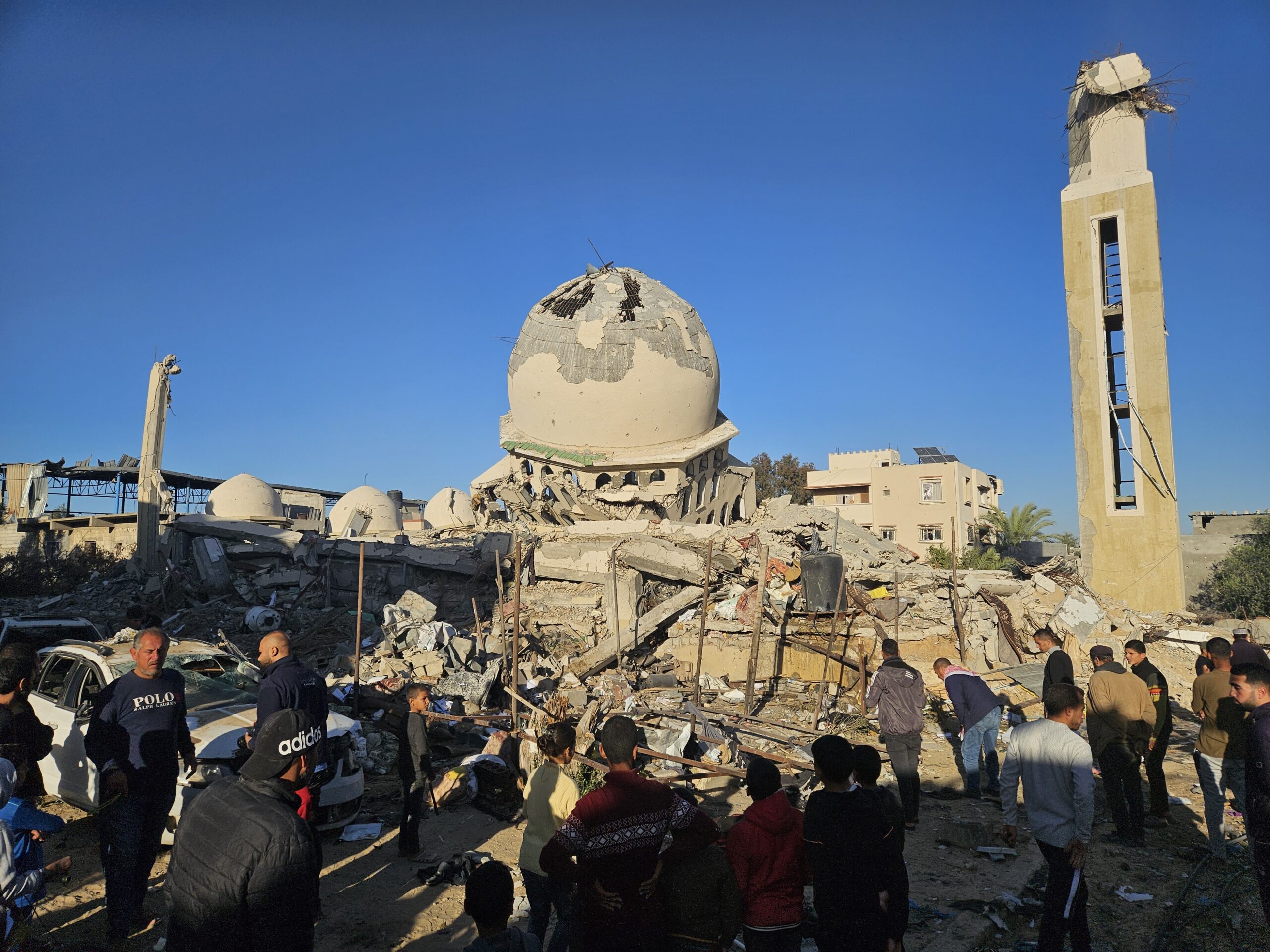
Since the reopening of the Rafah land crossing with Egypt, which was closed last May, Israel has purposefully bombed cities, residential neighbourhoods, and infrastructure in the Gaza Strip, including streets, schools, and essential facilities there. Israel’s deliberate attempt to either kill or drive Palestinians from their land is especially obvious given the dearth of basic necessities in the besieged enclave, such as homes and infrastructure like water, electricity, communications, Internet, and school networks. In addition, statements made by Israeli ministers and officials publicly promote voluntary migration.
Israel has been committing genocide in the Gaza Strip since 7 October 2023, and the destruction of entire Palestinian cities and neighbourhoods by the Israeli army is a glaring example of this crime and a key instrument of its execution.
This crime has gone beyond simply killing 10s of thousands—or potentially hundreds of thousands—of Palestinians and progressively destroying the lives of over two million people by removing their basic necessities for survival. It has also included the total destruction of Palestinian cities and their architectural and cultural heritage; the erasure of the Palestinian people’s national and cultural identity; the forced relocation of Palestinian people from their lands, and the imposition of this permanent displacement; the dismantling of their communities; and the obliteration of their collective memory in an attempt to eradicate their physical and human existence as well as their past, present, and future.
A regional and global stance opposing Trump’s claims of deporting Gaza Strip residents is absolutely necessary. Mass displacement as a solution to the current conflict not only ignores the underlying causes of the issue but also exacerbates the injustices already experienced by the Palestinian people, and denies them their rightful self-determination and safe residence in their homeland. Trump’s claims, along with any actions that follow, are likely to exacerbate tensions and undermine regional stability.
The international community must fully uphold the principles of international law and adopt solutions that respect Palestinian rights. These solutions should include ending Israel’s illegal occupation of Palestinian territories, holding Israel accountable for its ongoing crimes, and establishing a clear path to achieving justice for the Palestinian people. Additionally, the international community should ensure that all Palestinian refugees and displaced persons are able to return to their original areas in accordance with relevant international resolutions, rather than supporting any policies that would uproot Palestine’s indigenous population in favour of Israel’s colonial policies.
The impact of the year-long war in Gaza and escalations in the West Bank has set development in the State of Palestine back by about 69 years, according to a new UN report released on Tuesday.
“Without lifting economic restrictions, enabling recovery, and investing in development, the Palestinian economy may not be able to restore pre-war levels and advance forward by relying on humanitarian aid alone,” Gaza war: Expected socioeconomic impacts on the State of Palestine, concludes, produced by the UN Development Programme (UNDP) and the UN Economic and Social Commission for Western Asia (ESCWA).
The analysis suggests three recovery scenarios for Palestine. Given that the recovery will be a long-term process, the report assessed both the immediate impact projected for 2025 and the long-term impact anticipated by 2034, a decade after the start of the conflict.
“Our assessments serve to sound the alarm over the millions of lives that are being shattered and the decades of development efforts that are being wiped out,” said ESCWA Executive Secretary Rola Dashti.
“It is high time to end the suffering and bloodshed that have engulfed our region. We must unite to find a lasting solution where all peoples can live in peace, dignity and reap the benefit of sustainable development and where international law and justice are finally upheld.”
Projections estimate that the gross domestic product (GDP) will contract by 35.1 per cent in 2024 compared with a no-war scenario, with unemployment potentially rising to 49.9 per cent.
Three recovery scenarios
Building on findings published in November and May, the report estimates that poverty in Palestine will rise to 74.3 per cent in 2024, affecting 4.1 million people, including 2.61 million people who are newly impoverished.
The assessment also examines the extent and depth of deprivation, employing multidimensional poverty indicators and includes recovery prospects for Palestine after a ceasefire is reached as well as three early recovery scenarios.
The non-restricted early recovery scenario sees restrictions on Palestinian workers lifted and withheld clearance revenues restored to the Palestinian Authority.
In addition to $280 million in humanitarian aid, $290 million is allocated annually for recovery efforts, resulting in an increase in productivity by one per cent annually, enabling the economy to recover and putting Palestinian development back on track.
Unrestricted aid can help
The assessment suggests that a comprehensive recovery and reconstruction plan, combining humanitarian aid with strategic investments in recovery and reconstruction along with lifting economic restrictions, could help put the Palestinian economy back on track to realign with Palestinian development plans by 2034.
But, this scenario can only play out if recovery efforts are unrestricted, said UNDP Administrator Achim Steiner.
“Projections in this new assessment confirm that amidst the immediate suffering and horrific loss of life, a serious development crisis is also unfolding – one that jeopardises the future of Palestinians for generations to come,” he said.
“The assessment indicates that, even if humanitarian aid is provided each year, the economy may not regain its pre-crisis level for a decade or more.”
As conditions on the ground allow, he said, the Palestinian people need a robust early recovery strategy embedded in the humanitarian assistance phase, laying foundations for a sustainable recovery.
Humanitarian situation deteriorating
The humanitarian situation is catastrophic and deteriorating daily, said UNDP’s Chitose Noguchi, briefing reporters in Geneva from Deir Al-Balah, Gaza, where many displaced people are currently living.
“The State of Palestine is experiencing an unprecedented setback in development to the year 1955,” she said.
“Restrictions that are currently stifling the economy must be lifted,” she stressed, underlining the new assessment conclusion’s importance for the region. Currently, assessments are being conducted in Lebanon and Syria.

 CrossFireArabia