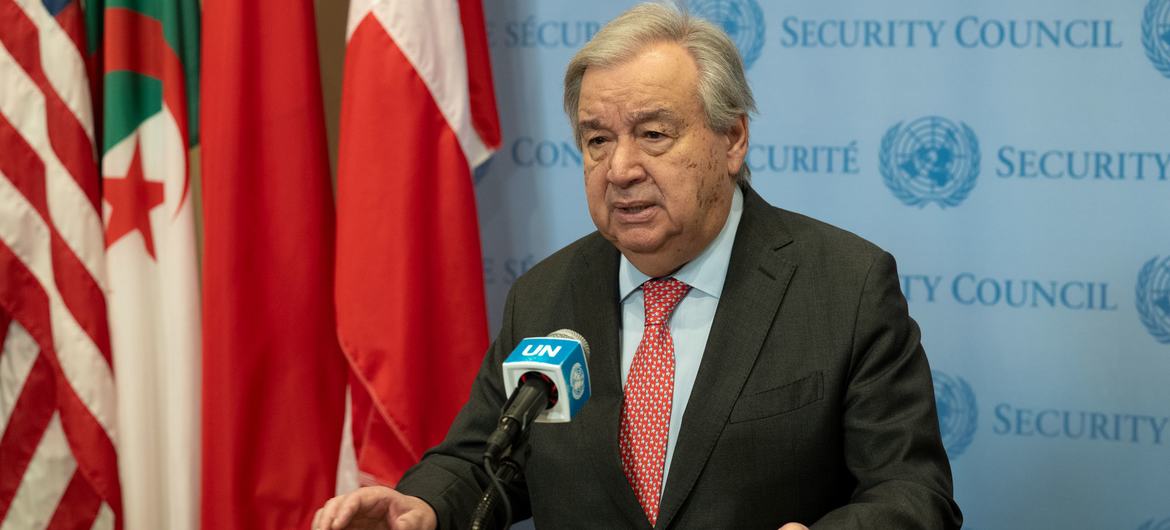
UN Secretary General António Guterres welcomed on Sunday a new peace deal between the United States and Iran, calling it a “critical step” toward ending the conflict.
According to a statement issued by his Spokesman, the agreement provides for an immediate and permanent ceasefire, the reopening of the Strait of Hormuz, and a framework for further negotiations.
The Secretary‑General expressed “deep appreciation” for the role of Pakistan, Qatar, Egypt, Saudi Arabia, Türkiye and other regional countries in supporting the talks.
He said he hopes the parties will build on the momentum and “redouble their efforts” toward a final resolution. He also reaffirmed that the United Nations stands ready to support efforts toward a “durable and comprehensive peace.”
The conflict began in late February with US and Israeli strikes across Iran. Iran responded with attacks on Israel and US‑allied states in the Gulf.
The fighting led to the effective closure of the Strait of Hormuz, a key shipping lane through which about 20 per cent of the world’s oil and liquefied natural gas normally passes.
Despite a ceasefire agreed in April, the United States and Iran have exchanged intermittent fire, including two rounds of tit‑for‑tat strikes this week.
Earlier on Sunday, Mr. Guterres strongly condemned Israeli airstrikes on Beirut. In a separate statement, he said the strikes took place despite a ceasefire and at a time when Washington and Tehran were expected to reach an agreement to help pave the way to peace.
He warned that the conflict is having a “devastating impact” on the global economy and urged all parties to show “maximum restraint” at a crucial moment. He also expressed hope for a successful outcome to ongoing efforts by the United States and Iran.
The crisis in Lebanon is part of unrest across the wider region. It erupted on 2 March, just days after the US and Israel began bombing Iran, prompting Hezbollah militants in Lebanon to fire on Israel. UN News
UN Secretary-General António Guterres and the heads of UN agencies have condemned Saturday’s joint Israeli and US attacks on Iran and the Iranian retaliatory strikes on Israel and the Gulf Regions.
The attack on Iran reportedly targeted military sites as well as the leadership of the Iranian regime. Explosions were heard in Israel and Gulf countries after Iran launched a wave of drones and missiles.
I condemn today’s military escalation in the Middle East. The use of force by the United States & Israel against Iran, and the subsequent retaliation by Iran across the region, undermine international peace & security.
Mr. Guterres declared that the military escalation in the region undermines international peace and security, and recalled that all Member States must “respect their obligations under international law, including the Charter of the United Nations,” which prohibits “the threat of the use of force against the territorial integrity or political independence of any state, or in any other manner inconsistent with the Purposes of the United Nations.”
The UN Chief called for an immediate cessation of hostilities and de-escalation and warned that a failure to do so risks a wider regional conflict with grave consequences for civilians and regional stability.
Risk of ‘destruction on an unimaginable scale’
Senior officials added their own responses on Saturday morning: Volker Türk, the High Commissioner for Human Rights said that bombs and missiles are not the way to resolve differences but “only result in death, destruction and human misery.” Civilians, he noted, “end up paying the ultimate price.”
Mr. Türk called for all parties to return to negotiations in order to avoid a wider conflict that would mean further civilian deaths and “destruction on a potentially unimaginable scale, not just in Iran but across the Middle East region.”
World Health Organization (WHO) Director-General Tedros Adhanom Ghebreyesus said in a statement that he was deeply troubled by the situation and urged leaders to “choose the challenging path of dialogue over the senseless route of destruction.”
Emergency Security Council meeting scheduled
A Security Council meeting to discuss the attacks has been called by French President Emmanuel Macron. The meeting is scheduled for 4PM Eastern Time on Saturday.
Follow the meeting live on UN News and on UN WebTV
Reactions from across the UN system
António Guterres, UN Secretary-General“I condemn today’s military escalation in the Middle East. The use of force by the United States & Israel against Iran, and the subsequent retaliation by Iran across the region, undermine international peace & security.”
Tedros Ghebreyesus, Director-General, World Health Organization (WHO)“I am deeply concerned about the current situation in the Middle East. My heart is with the civilians caught in the crossfire.”
Volker Türk, High Commissioner of Human Rights“As always, in any armed conflict, it is civilians who end up paying the ultimate price.”
Annalena Baerbock, President of the General Assembly“The UN Charter is clear: all Member States must settle their international disputes by peaceful means in such a manner that international peace and security, and justice, are not endangered.”
International Atomic Energy Agency“The IAEA is closely monitoring developments in the Middle East, and urges restraint to avoid any nuclear safety risks to people in the region.” – UN News
More than half a million people in Gaza are trapped in famine, marked by widespread starvation, destitution and preventable deaths, according to a new UN-backed food security report released on Friday.
“Famine is not about food; it is the deliberate collapse of the systems needed for human survival.”
Famine conditions are projected to spread from Gaza Governorate to Deir Al Balah and Khan Younis Governorates in the coming weeks, the IPC estimates.
Israel’s obligations
“As the occupying power, Israel has unequivocal obligations under international law – including the duty of ensuring food and medical supplies of the population,” said the UN chief, reacting to the famine declaration from the IPC, which is endorsed by dozens of governments, UN agencies and NGOs as the key evidence-based measure of food insecurity and malnutrition.
UN agencies operating in Gaza joined the UN chief in calling for an immediate ceasefire to finally allow unimpeded, large-scale humanitarian response and the immediate release of all hostages taken by Hamas and other militants during the 7 October 2023 terror attacks.
Agencies also expressed grave concern over the threat of the intensified military offensive on Gaza City and any further escalation in the conflict, as it would have further devastating consequences for civilians where famine conditions already exist.
“Many people – especially sick and malnourished children, older people and people with disabilities – may be unable to evacuate,” they said in a joint statement.
Famine set to expand
By the end of September, more than 640,000 people will face ‘catastrophic’ levels of food insecurity – classified as IPC Phase 5 – across the Gaza Strip.
An additional 1.14 million people in the enclave will be in phase 4 with a further 396,000 people facing phase 3 ‘crisis’ conditions.
Conditions in North Gaza are estimated to be as severe – or worse – than in Gaza City. However, limited data prevented an IPC classification, highlighting the urgent need for access.
Classifying famine means that the most extreme category is triggered when three critical thresholds – extreme food deprivation, acute malnutrition and starvation-related deaths – have been breached. The latest analysis now affirms on the basis of reasonable evidence that these criteria have been met, UN agencies said.
Briefing journalists on Friday at UN headquarters in Geneva, the UN Emergency Relief Coordinator Tom Fletcher said it was a famine that could have been prevented “if we had been allowed.”
A young severely malnourished girl is helped into her clothes.
Famine in a fertile land
“Yet food stacks up at borders because of systematic obstruction by Israel. It is a famine within a few hundred metres of food, in a fertile land.
It is a famine that we repeatedly warned of – but that the international media has not been allowed in to cover, to bear witness,” he added.
“It is a famine in 2025. A 21st century famine watched over by drones and the most advanced military technology in history. It is a famine openly promoted by some Israeli leaders as a weapon of war.”
On a wider scale, Mr. Fletcher said it was “the world’s famine. It is a famine that asks ‘but what did you do?’ A famine that will and must haunt us all.”
Malnutrition among children in Gaza is accelerating “at a catastrophic pace”, said UN agencies, who note that in July alone, more than 12,000 children were identified as acutely malnourished – the highest monthly figure ever recorded and a six-fold increase since the start of the year.
“It is a war crime to use starvation as a method of warfare, and the resulting deaths may also amount to the war crime of willful killing,” he said.
“Israeli authorities must take immediate steps to end the famine in the Gaza Governorate and prevent further loss of life across the Gaza strip. They must ensure immediate entry of humanitarian assistance in sufficient amounts, and full access to UN and other humanitarian organizations.”
First Middle East famine
Since the last IPC Analysis in May, the number of children expected to be at severe risk of death from malnutrition by the end of June 2026 has tripled from 14,100 to 43,400.
The new assessment reports the most severe deterioration since the IPC began analysing acute food insecurity and acute malnutrition in Gaza Strip, and it marks the first time a famine has been officially confirmed in the Middle East region.
Since July, food and aid supplies entering Gaza increased slightly but remained vastly insufficient, inconsistent and inaccessible compared to the need.
Meanwhile, approximately 98 percent of cropland in the territory is damaged or inaccessible – decimating the agriculture sector and local food production – and nine of ten people have been serially displaced from homes.
The UN Secretary-General António Guterres described the United States’ bombing of three nuclear sites in Iran as a “dangerous escalation” on Saturday following eight days of deadly strikes and counter strikes between Tehran and Tel Aviv.
“I am gravely alarmed by the use of force by the United States against Iran today,” said the UN chief, reiterating that there is no military solution.
“This is a dangerous escalation in a region already on the edge – and a direct threat to international peace and security.”
President Donald Trump delivered a televised address to the nation from the White House at 10pm local time and said that Iran’s nuclear facilities at Fordo, Natanz and Isfahan had been “totally obliterated” describing the long-range bombing raid as a “spectacular military success.”
President Trump called on Iran’s leadership to now “make peace” and return to negotiations over its nuclear programme or suffer a far greater wave of attacks.
Iranian authorities have yet to confirm the extent of the damage to the three sites in central Iran. Earlier in the day, Iran’s foreign minister reportedly warned the US against any involvement in the Iran-Israel conflict which erupted on 13 June.
Deadly strikes
At least 430 Iranians are believed to have been killed during waves of strikes since then with around 3,500 injured, according to figures from the Iranian health ministry.
In Israel, 24 civilians have died in the retaliatory attacks according to local authorities with more than 400 missiles reportedly fired towards the country.
B-2 bombers were involved in the US strikes, President Trump confirmed, dropping so-called “bunker buster” bombs on the uranium enrichment site at Fordow which is buried deep inside a mountain south of the capital Tehran.
‘Avoid a spiral of chaos’
In his statement, the Secretary-General reiterated his concerns voiced in the Security Council during Friday’s emergency meeting on the crisis that the conflict “could rapidly get out of control – with catastrophic consequences for civilians, the region, and the world.”
He called on all Member States to de-escalate the situation which threatens the stability of the Middle East and beyond, calling for everyone to uphold their obligations under the UN Charter and international law.
“At this perilous hour, it is critical to avoid a spiral of chaos,” he added calling for an immediate return to negotiations between the warring parties.
“There is no military solution. The only path forward is diplomacy. The only hope is peace.”
The UN human rights chief Volker Turk echoed the UN chief’s statement on social media early on Sunday saying that it was now “of utmost importance for all parties to exercise the fullest restraint in order to avoid the untold human rights impacts of a widening conflict on civilians across the region.”
UPDATE: No sign of radiation level increase beyond sites
Meanwhile, the head of the UN’s atomic energy agency, IAEA, said in a statement on Sunday that there was no sign of any health-impacting radiation resulting from the US strikes beyond the three Iranian sites targeted, citing Iranian nuclear energy authorities.
Director General Rafael Grossi noted that the sites had all contained enriched uranium verified by IAEA inspectors “to different levels” and confirmed that “radioactive and chemical contamination” may have occurred inside the facilities hit.
Read our UN News explainer on the role and importance of the IAEA here.
“In view of the increasingly serious situation in terms of nuclear safety and security, the Board of Governors will meet in an extraordinary session tomorrow, which I will address,” Mr. Grossi said.
“As of this time, we don’t expect that there will be any health consequences for people or the environment outside the targeted sites,” he added as reported by UN News.
The UN humanitarian affairs chief has welcomed Israel’s decision to allow limited aid to cross into Gaza after 11 weeks of complete blockade – but significantly more is needed “starting tomorrow morning”.
Tom Fletcher said in a statement on Monday that nine UN trucks were cleared to enter the southern Kerem Shalom crossing earlier in the day.
“But it is a drop in the ocean of what is urgently needed…We have been reassured that our work will be facilitated through existing, proven mechanisms. I am grateful for that reassurance, and Israel’s agreement to humanitarian notification measures that reduce the immense security threats of the operation.”
Alarm over Israeli bombardment: UN chief
The UN Secretary-General on Monday expressed his alarm over the intensifying air strikes and ground operations in Gaza “which have resulted in the killing of hundreds of Palestinian civilians in recent days, including many women and children, and, of course, large-scale evacuation orders.”
António Guterres reiterated his call for the rapid, safe, and unimpeded delivery of humanitarian assistance at scale directly to civilians, in order to avert famine, alleviate widespread suffering, and prevent further loss of life.
Briefing reporters on Monday, UN Spokesperson Stéphane Dujarric said Mr. Guterres “welcomes the ongoing efforts by the mediators to reach a deal in Gaza. He has repeatedly warned that the continued violence and the destruction will only compound civilian suffering and heighten the risk of a broader regional conflict.”
He added that the Secretary-General “firmly rejects any forced displacement of the Palestinian population.”
Minimise risk of aid theft
Relief chief Fletcher said in his statement that he was determined to ensure UN aid reaches those in greatest need and make sure that any risk of theft by Hamas or other militants battling Israeli forces in the Strip amid a new offensive, would be minimised.
He said the UN aid coordination office, OCHA, had realistic expectations: “Given ongoing bombardment and acute hunger levels, the risks of looting and insecurity are significant.”
UN aid workers are committed to doing their jobs, “even against these odds,” he said, thanking humanitarian colleagues for their courage and determination.
Practical plan
“The limited quantities of aid now being allowed into Gaza are of course no substitute for unimpeded access to civilians in such dire need,” Mr. Fletcher continued.
“The UN has a clear, principled and practical plan to save lives at scale, as I set out last week.”
He called on Israeli authorities to:
Open at least two crossings into Gaza, in the north and south
Simplify and expedite procedures together with removing quotas limiting aid
Lift access impediments and cease military operations when and where aid is being delivered
Allow UN teams to cover the whole range of needs – food, water, hygiene, shelter, health, fuel and gas for cooking
Ready to respond
Mr. Fletcher said to reduce looting, there must be a regular flow of aid, and humanitarians must be permitted to use multiple routes.
“We are ready and determined to scale up our life-saving operation Gaza and respond to the needs of people, wherever they are,” he stressed – calling again for the protection of civilians, a resumption of the ceasefire and the immediate and unconditional release of all hostages.
He concluded saying the operation would be tough – “but the humanitarian community will take any opening we have.”

 CrossFireArabia