In Washington: Trump, Zelenskyy, Vance Locked in Verbal Fight

READ the Full transcript of heated exchange at the Oval Office in the White House.

Ukrainian President Volodymyr Zelenskyy on Friday got in a heated war of words with US President Donald Trump and Vice President JD Vance Friday during a critical meeting at the White House.

The public spat was over Zelenksyy’s doubts that Trump’s efforts to broker a deal to end the three-year-long war with Russia may not yield lasting peace.

Zelenskyy departed the White House following the argument, and a planned signing ceremony for a deal on critical minerals and press conference were canceled. ​​​​​​  

Here is the full transcript of the heated exchange at the White House:

Reporter: Poland was under Russian control for decades after the Second World War. When I was a kid, I looked at the United States not only as a most powerful country, richest country in the world, the country that has great music, great movies, great muscle cars, but also as a force for good. And now I’m talking with my friends in Poland, and they are worried that you align yourself too much with Putin. What’s your message for them?

Trump: Well, if I didn’t align myself with both of them, you’d never have a deal. You want me to say really terrible things about Putin and then say, hi, Vladimir. How are we doing on the deal? It doesn’t work that way. I’m not aligned with anybody. I’m aligned with the United States of America, and for the good of the world, I’m aligned with the world, and I want to get this thing over with. You see, the hatred he’s got for Putin that’s very tough for me to make a deal with that kind of hate. He’s got tremendous hatred, and I understand that, but I can’t tell you the other side is exactly in love with you know him, either. So it’s not a question of alignment. I have to I’m in line with the world. I want to get the thing said. I’m aligned with Europe. I want to see if we can get this thing done. You want me to be tough? I could be tougher than any human being you’ve ever seen. I’d be so tough, but you’re never going to get it done that way. So that’s the way it goes. One more question.

Vance: I will respond to this. So look, for four years, the United States of America, we had a president who stood up the press conferences and talked tough about Vladimir Putin, and then Putin invaded Ukraine and destroyed a significant chunk of the country. The path to peace and the path to prosperity is maybe engaging in diplomacy. We tried the pathway of Joe Biden of thumbing our chest and pretending that the President of the United States’ words mattered more than the President of the United States’ actions. What makes America a good country is America engaging in diplomacy. That’s what President Trump’s doing.

Zelenskyy: Can I ask you?

Vance: Sure? Yeah.

Zelenskyy: He (Putin) occupied our parts, big parts of Ukraine, part of East and Crimea. So he occupied in 2014. so during a lot of years. So I not speaking about just President Obama, then President Trump, then President Obama, now President Trump, God bless now President Trump will stop him. But during 2015 nobody stopped him. He just occupied and took. He killed people.

Trump: I was not here.

Zelenskyy: Yes. But during 2014 till 2022. The situation the same that people are been dying on the contact line. Nobody stopped him. You know that we have conversations with him, a lot of conversation, many bilateral conversation, and we signed with him.. In 2019 I signed with him, the deal, I signed with him, Macron and Merkel, we signed ceasefire. Ceasefire. All of them told me that he will never go. We signed him, gas contract. Gas contract, yes, but after that, he broke the ceasefire. He killed our people and he didn’t exchange prisoners. We signed the exchange of prisoners, but he didn’t do it. What kind of diplomacy JD you are speaking about? What do you mean?

Vance: I’m talking about the kind of diplomacy that’s going to end the destruction of your country, Mr. President, Mr. President, with respect. I think it’s disrespectful for you to come to the Oval Office to try to litigate this in front of the American media. Right now, you guys are going around and forcing conscripts to the front lines because you have manpower problems, you should be thanking the president for trying to bring it into this.

Zelenskyy: Have you ever been to Ukraine that you see what problems we have?

Vance: I have been to.

Zelenskyy: Come once.

Vance: I’ve actually, I’ve actually watched and seen the stories, and I know what happens is you bring people. You bring them on a propaganda tour, Mr. President. Do you disagree that you’ve had problems bringing people in your military? and do you think that it’s respectful to come to the Oval Office of the United States of America and attack the administration is trying to prevent the destruction of your country?

Zelenskyy: A lot of questions. Let’s start from the beginning. First of all, during the war, everybody has problems, even you, but you have a nice ocean and but don’t feel now, but you will feel it in the future.

Trump: You don’t know that.

Zelenskyy: God bless, you will not have a war…

Trump: Don’t tell us what we’re going to feel. We’re trying to solve a problem. Don’t tell us what we’re going to feel, because you’re in no position to dictate that exactly.

Zelenskyy: I am not telling you.. (inaudible) I am answering… question…

Trump: You’re in no position to dictate what we’re going to feel. We’re going to feel very good.

Zelenskyy: You will feel influence…

Trump: You’re right now not in a very good position. You’ve allowed to be in a very bad position, and it happens to be….

Zelenskyy: From the very beginning of the war.. (inaudible)…

Trump: You’re not in a good position. You don’t have the cards right now. with us, you start having problems right now.

Zelenskyy: I’m not playing cards…

Trump: You are playing cards. You’re gambling with the lives of millions of people.

Zelenskyy: I am the president of.. (inaudible)

Trump: You’re gambling with World War II. You’re gambling with World War III, and what you’re doing is very disrespectful to the country, this country, that’s back to you far more than a lot of people say they should..

Vance: Have you said thank you?

Zelenskyy: A lot of times…

Vance: No, in this entire meeting?

Zelenskyy: Even today…

Vance: You went to Pennsylvania and campaigned for the opposition in October, offer some words of appreciation for the United States of America and the president who’s trying to save your country.

Zelenskyy: Please, you think that, if you will speak very loudly about the war…

Trump: He is not speaking loudly, your country is in big trouble.

Zelenskyy: Can I answer?

Trump: No, no, you’ve done a lot of talking. Your country is in big trouble.

Zelenskyy: I know…

Trump: You’re not winning. You’re not winning this. You have a damn good chance of coming out okay, because of us.

Zelenskyy: We are staying in our country, staying strong, from the very beginning of the war, we’ve been alone, and we are thankful. I said, thanks…

Trump: You haven’t been alone…

Zelenskyy: I said thank you…

Trump: We gave you, through this stupid president, $350 billion we gave you military equipment…. if you didn’t have our military equipment, if you didn’t have our military equipment, this war would have been over in two weeks…

Zelenskyy: In three days. I heard it from Putin in three days. This is something…

Trump: Maybe less…

Zelenskyy: in two weeks.. of course.

Trump: It’s going to be a very hard thing to do business like this.

Vance: You said thank you.

Zelenskyy: I said… (inaudible)…

Vance: Except that there are disagreements, and let’s go litigate those disagreements, rather than trying to fight it out of the American media, when you’re wrong, we know that you’re wrong.

Trump: You see, I think it’s good for the American people to see what’s going on. I think it’s very important. That’s why I kept this going so long. You have to be thankful you don’t have the cards. You don’t have the cards..

Zelenskyy: I am thankful…

Trump: You’re buried there.

Zelenskyy: I can tell you again…

Trump: People are dying. You’re running low on soldiers.

Zelenskyy: Listen…

Trump: You’re running low on soldiers. It would be a damn good thing. Then you tell us, I don’t want to ceasefire. I don’t want to ceasefire. I want to go and I want this… Look, if you could get a ceasefire right now, I tell you, you take it so the bullets stop flying and your men stop being killed…

Zelenskyy: Of course, we want to start the war, but I …

Trump: You are saying you don’t want to ceasefire. I want a ceasefire because you get a ceasefire faster than…

Zelenskyy: Ask our people about ceasefire. What they think… (inaudible)…

Trump: That wasn’t with me, that was with a guy named Biden who was not a smart person.

Zelenskyy: It was your president…

Trump: That was with Obama who gave you sheets and I gave you javelins. Yes, I gave you the javelins to take out all those tanks. Obama gave you sheets. In fact, the statement is Obama gave sheets and Trump gave javelins, you got to be more thankful, because, let me tell you, you don’t have the cards. With us, you have the cards, but without us, you don’t have any cards.

Anadolu

Continue reading
Saudi Arabia Plays Host to Superpower Politics

By Maksym Skrypchenko 

Diplomatic efforts to end the Russia-Ukraine War are once again in the spotlight, as US and Russian officials meet in Saudi Arabia on Tuesday. In a sharp contrast to the previous administration’s strictly defined red-line policy, representatives from the newly formed US President Donald Trump-aligned diplomatic team—Secretary of State Marco Rubio, National Security Advisor Mike Waltz, and Middle East envoy Steve Witkoff—are set to engage with their Russian counterparts in discussions that many fear may sideline Ukraine’s own interests.

The stakes in this conflict extend far beyond territorial disputes. For Ukraine, the war is an existential struggle against an enemy with centuries of imperial ambition. Every defensive maneuver is a stand for sovereignty and self-determination. Yet recent diplomatic moves suggest that Ukraine’s central role in negotiations may be diminished. Ukrainian President Volodymyr Zelenskyy’s absence from the Saudi meeting underscores the deep-seated concern in Kyiv that their security concerns might be marginalized in a process dominated by transactional interests.

https://twitter.com/canon75gaz81/status/1891836717696450562

Under the previous administration, Washington’s policy was driven by a clear set of red lines designed to deter any actions that could provoke a nuclear-armed adversary. That approach was predicated on a belief that excessive support for Ukraine might lead to a dangerous escalation. However, the new strategy, as signaled by Trump’s team, appears less encumbered by these constraints. Instead, the focus seems to have shifted toward a pragmatic resolution—a process that prioritizes ending the war at the expense of Ukraine’s moral imperatives underpinning their fight for survival. This shift represents not only a departure in tone but also in substance. While the previous policy imposed strict limitations to avoid provoking Moscow, the current approach appears more willing to concede Ukraine’s positions if it serves the broader goal of ending the fighting.

Trump’s affiliation with Saudis


The decision to hold talks in Saudi Arabia is far from arbitrary. The Saudi Kingdom provides a neutral venue and a longstanding trusted mediator especially for figures like Steve Witkoff and Donald Trump, whose longstanding business and diplomatic ties in the region are well known. This credibility is further reinforced by Saudi Arabia’s recent announcement of a $600 billion package with the US, comprising investments and procurement agreements from both public and private sectors.

Moreover, Saudi Arabia’s position outside NATO shields it from the obligations that compel Western allies to enforce international legal mandates, including the ICC arrest warrants issued against top Russian officials, notably Putin. In such an environment, Saudi Arabia offers a secure venue for direct negotiations with Moscow, free from the pressures of external legal mandates.

Meanwhile, high-ranking European officials express growing concern over their exclusion from the process. UK Prime Minister Keir Starmer has even suggested the possibility of deploying British troops to enforce any resulting peace deal, a move that underscores the importance European leaders give to Ukraine’s future. The concerns are not merely about the cessation of hostilities, but about the long-term security guarantees that Ukraine desperately needs. European officials argue that a peace process that excludes Kyiv from the initial stages could lead to an agreement lacking the robust assurances necessary to prevent future Russian aggression.

Russian approach

Russia, for its part, is approaching the negotiations with its signature long-game strategy. Recent reports suggest that Kremlin officials are assembling a team of seasoned negotiators well-versed in securing maximum advantage. Their method is well known—ask for a shopping mall when all they need is a cup of coffee. Just one day before the talks, Russian diplomats are already staging a narrative of victory, asserting that the EU and the UK are entirely non-negotiable parties to any future agreements on Ukraine. According to the Russian representative at the UN, Ukraine has irretrievably lost key territories, and any new arrangement should force Kyiv into accepting a demilitarized, neutral state determined by future elections. This approach is designed to create the illusion of strength while ultimately settling for concessions that heavily favor Russian interests.

Meanwhile, for Ukraine, the principle that “nothing about Ukraine without Ukraine” is more than just a slogan—it is a critical security principle. Ukrainian leaders are rightfully wary of any agreement negotiated without their active participation. With the current US strategy favoring swift and transactional outcomes rather than comprehensive negotiations, there is a real danger that Kyiv’s position could be compromised. The absence of Ukraine from these early discussions may result in a peace agreement that fails to address the existential risks the nation faces. Without strong security guarantees built into any deal, Ukraine remains vulnerable to renewed incursions and a potential destabilization of the entire region.

In this evolving diplomatic landscape, the contrast between the old and new approaches is stark. The previous risk-averse strategy sought to maintain clear boundaries to prevent escalation, whereas the current approach appears more willing to blur those lines in the hope of bringing an end to the bloodshed. Yet by doing so, there is an inherent risk: the very nation fighting for its survival might be reduced to a bargaining chip in a broader geopolitical deal.

It is imperative that Ukraine’s interests remain at the forefront of any negotiations. The war in Ukraine is not just a regional conflict—it is a struggle that speaks to the fundamental principles of sovereignty and self-determination. Any peace settlement that fails to incorporate Ukraine’s security concerns is likely to be unstable at best, and catastrophic at worst.

Maksym Skrypchenko is the president of the Transatlantic Dialogue Center

Continue reading
First Russia-US Talks Conclude in Saudi Arabia

Talks between Russia and the US on improving ties as well as the Ukraine war – the first such talks in years – concluded after 4 1/2 hours, Russian state media reported Tuesday.

Speaking at a press briefing on the sidelines of the meeting in the Saudi capital Riyadh, which was broadcast live on Russian television, Russian presidential aide Yury Ushakov said the negotiations were productive, with Moscow and Washington agreeing to consider each other’s interests.

However, the date for a meeting between Russian President Vladimir Putin and his US counterpart Donald Trump has yet to be determined, and it is unlikely to take place next week, Ushakov said.

“The delegations of Russia and the United States held a serious discussion on all key issues,” he stated.

The two sides also agreed to form working groups on the Ukraine issue. While the number of members and specific participants have yet to be decided, both parties aim to establish contacts quickly, he added.

Talks between Russia and the United States aimed at mending relations, addressing the conflict in Ukraine, and preparing a meeting between the Russian and US presidents marked the first meeting between diplomats of the two countries since the Ukraine war began on Feb. 24, 2022, nearly three years ago according to Anadolu.

Continue reading
Why is Halevi Visiting Washington Weeks Before He Steps Down?

Israeli Chief of Staff Herzi Halevi is set to travel to Washington on Sunday for talks with US military officials, the army said.

A military statement said Halevi will meet with the chairman of the Joint Chiefs of Staff, the Commander of the US Central Command (CENTCOM), and other senior officials to discuss key strategic and operational issues.

Halevi “will take the opportunity to express his gratitude to his counterparts for their support, commitment, and personal ties,” the statement said.

The three-day visit comes a few weeks before Halevi steps down.

Last month, the army chief of staff said he would resign as of March 6.

The visit comes as a ceasefire agreement took effect in Gaza on Jan. 19, halting Israel’s genocidal war, which has killed more than 48,200 Palestinians, most of them women and children, and left the enclave in ruins.

The International Criminal Court issued arrest warrants in November for Israeli Prime Minister Benjamin Netanyahu and his former Defense Minister Yoav Gallant for war crimes and crimes against humanity in Gaza.

Israel also faces a genocide case at the International Court of Justice for its war on the enclave according to Anadolu.

Continue reading
Trump, Gaza and The New Political Ploy


Dr Sami Al-Arian

The infamous 19th-century imperialist and racial supremacist, Cecil Rhodes, once remarked: “It is our duty to seize every opportunity to acquire more territory and we should keep this one idea steadily before our eyes that more territory simply means more of the Anglo-Saxon race.” He then added: “Just fancy those parts that are at present inhabited by the most despicable specimens of human beings, what an alteration there would be if they were brought under Anglo-Saxon influence.”

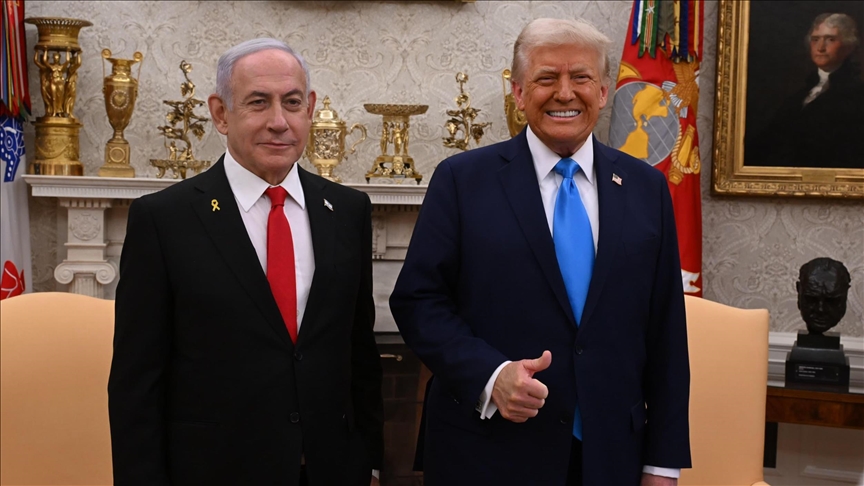
More than a century later, US President Donald Trump expressed similar attitudes during his meeting on Feb. 4, with the Israeli prime minister and indicted war criminal Benjamin Netanyahu, when he said: “We will take over the Gaza Strip, will own it long-term and will redevelop it … I do see a long-term ownership position.” In a settler-colonialist spirit, Trump callously continued, “I don’t think people should be going back to Gaza. I think that Gaza is not a place for people to be living.” He neglected to mention, of course, the exception for Jewish settlers in prime real estate along the Gaza beach. He then added, “They’re living in hell,” without any hint of irony, considering the 15-month US-sponsored genocide, supported by funds, bombs, and diplomatic protection.

Strategic agenda and regional dynamics

There were many items on the agenda between Trump and Netanyahu, including Iran’s nuclear program, the future of Gaza and the West Bank, and normalization with Saudi Arabia.

To be sure, Trump was not an unknown quantity. In his first term, he demonstrated total hostility towards the Palestinians and embraced the most radical positions espoused by extremist Zionists. These included recognizing Jerusalem as Israel’s capital and relocating the US Embassy there, the annexation of the Syrian Golan Heights (occupied by Israel since 1967), the closure of the Palestine Liberation Organization (PLO) office in Washington, DC, ending all humanitarian aid to the Palestinians through the UN refugee agency (UNRWA) or US agencies, and integrating Israel within US Central Command (CENTCOM), the US military command responsible for a region stretching from Egypt to Afghanistan.

Furthermore, throughout his presidency Trump completely disregarded the so-called two-state solution — a long-touted US goal — in favor of Netanyahu’s approach of normalizing relations with Washington’s Arab client regimes while pursuing an aggressive settlement expansion policy intended to establish a de facto Greater Israel. In effect, it appears that “Trump 2.0” is trying, in his own way, to fulfill his promises of securing a greater Israel for his right-wing Zionist donors [1], benefactors [2] and appointees [3]. The proposal to forcefully remove over 2 million Palestinians from Gaza does not appear serious or achievable, since the Palestinians will never cooperate in their own displacement, nor would neighboring countries be willing to support a dangerous plan that would destabilize the region. In the past, Trump proposed similar hyperbolic ideas that failed to materialize, including his calls [4] for constructing a Riviera on the beaches of North Korea.

Netanyahu came to the White House with several objectives in mind. He sought Trump’s support to continue his war of extermination in Gaza after freeing many Israeli captives at the end of the first stage of the ceasefire deal. His political allies pressured him to resume the war in order to achieve his elusive objective of dislodging Hamas and eradicating the resistance — an aim he has not accomplished during the 15-month onslaught. It would appear that Trump wants to achieve this goal using political means through his outrageous proposal rather than through military pressure. If that is the case, this would be Trump’s way of handing Netanyahu the fig leaf he needs to silence his hard right critics and conclude the second stage of the ceasefire deal.

On Iran, Trump has doubled down on his policy of applying extreme pressure through economic sanctions in order to get the Iranians to negotiate a deal on their nuclear program. In return, the Iranian Foreign Minister Abbas Araghchi has called [5] for “maximum wisdom” to be applied to relations between Washington and Tehran, instead of the “maximum pressure” policy Trump has espoused. Since these are the early stages of diplomatic maneuverings, it’s very doubtful that Netanyahu received a green light from Trump to use military strikes against Iran in the near term.

On the West Bank, the Zionist regime has been escalating its aggressive settlement policy as well as its unprecedented attacks on several Palestinian cities, particularly against refugee camps in Jenin, Nablus, Tobas and Tulkarem.

Towards a Saudi-Israeli accord and its fallout

In the past, Trump and many of his administration officials, such as the new US ambassador to the Zionist regime, Mike Huckabee, have endorsed the expansion of Israeli settlements and the calls for annexing large parts of the West Bank. But backing such a policy now will certainly impede the central piece of Trump’s main objective in the region, which is to conclude a normalization deal with Saudi Arabia. To negotiate a deal with the Saudis, Trump must rein in Netanyahu and his extremist allies by promising them what they desire most: a Gaza free not only of Hamas’ rule but also of Palestinians, as well as the annexation of a large part of the West Bank, in exchange for a normalization deal with the Saudis and possibly beyond.

The Israelis certainly know that they will not get the Palestinians to leave voluntarily when they could not compel them to do that through their genocidal war. They recognize that they cannot unilaterally annex parts of the West Bank before the normalization deal with the Saudis is concluded. They also know that Trump has a very long agenda, both domestically and internationally, particularly with regard to the Ukraine war and China, and will not allow a devastating war with Iran to disrupt his agenda. Once the fog of the visit clears, it will become apparent that Trump’s primary policy in the Middle East is to cement a Saudi-Israeli agreement, one that cannot be finalized without putting a hold on other contentious issues such as a military escalation with Iran, West Bank annexation, or the resumption of the Gaza genocide. But that does not mean that the Zionist regime and its supporters within the Trump administration will not push hard to achieve all their objectives in Gaza, the West Bank and against Iran. Regardless, the Palestinians and their supporters worldwide must be vigilant to resist and defeat all their nefarious plans, particularly in Gaza, the West Bank, as well as any plans to integrate a genocidal regime in the region.

People across the Middle East have witnessed the true colors of the Zionist regime. Achieving a normalization deal with the Saudis or any other party would require nothing less than the total erasure of their collective memory. It would appear that the main lesson of the Oct. 7 attacks has not been learned. They took place at a time when regional and international actors had all but buried the Palestinian cause and ignored the plight of the Palestinians in pursuit of their own interests. Not only will none of the policies advanced by Trump address these issues, but they will exacerbate them. And thus, like his forgotten deal of the century, these policies are doomed to fail.

[1] https://www.nytimes.com/2024/06/25/us/politics/miriam-adelson-trump-israel.html

[2] https://www.thejc.com/news/usa/from-jared-kushner-to-miriam-adelson-meet-the-jewish-figures-in-trumps-inner-circle-sllz2ky1

[3] https://www.palestinechronicle.com/from-stefanik-to-hucabee-donald-trumps-cabinet-is-a-pro-israel-swamp/

[4] https://www.youtube.com/watch?v=P-iTikGb-CY

[5] https://www.thenationalnews.com/news/mena/2025/02/06/irans-foreign-minister-calls-for-maximum-wisdom-in-response-to-trumps-maximum-pressure-tehran-policy/

Dr Sami Al Arian is public affairs professor and the director of the Center for Islam and Global Affairs at Sabahattin Zaim University in Istanbul.

Continue reading