Macron Calls on States to Stop Weapons Supply to Israel

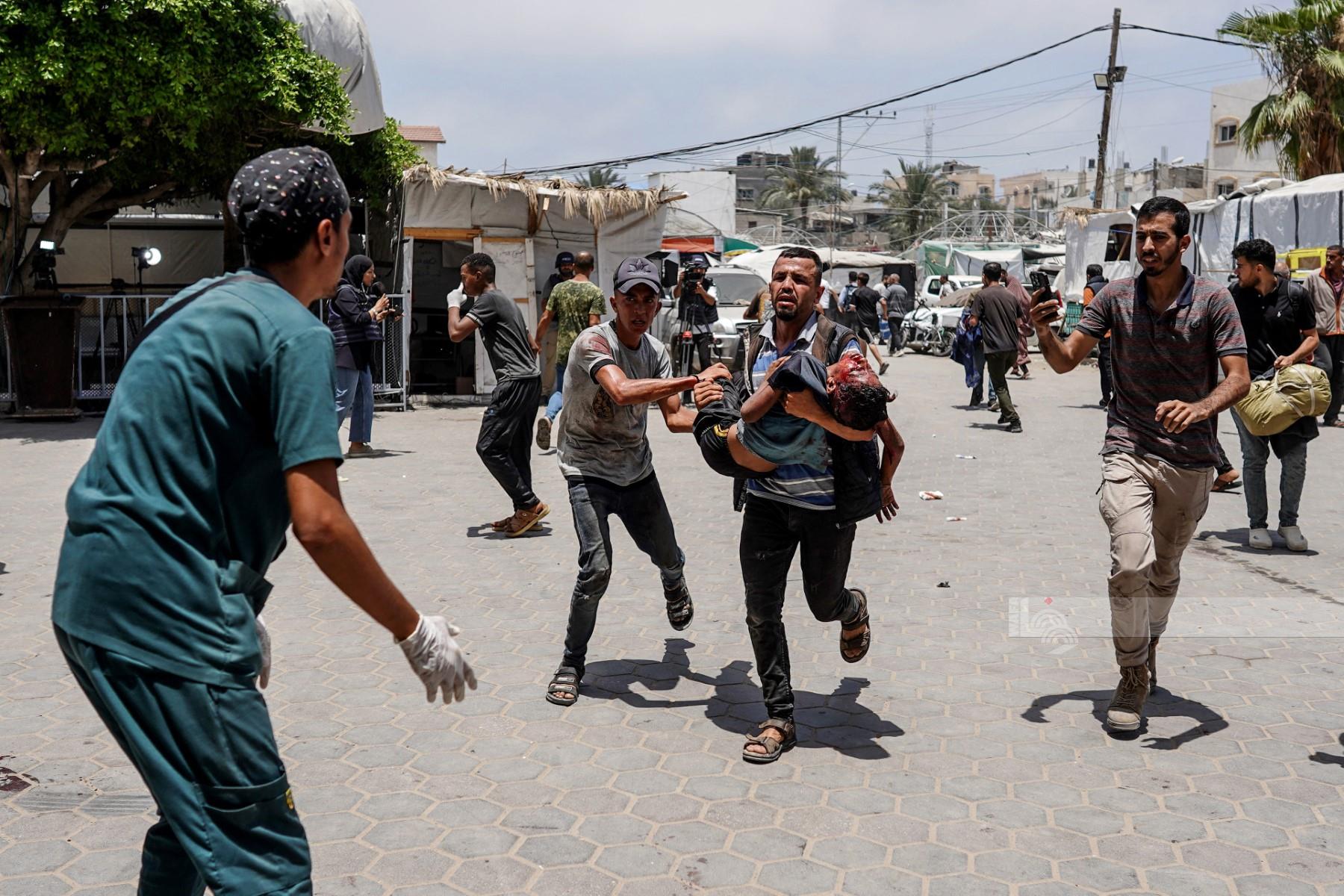
French President Emmanuel Macron urged countries to stop providing weapons to Israel for its ongoing genocide war in the Gaza Strip and expressed concern that Lebanon should not be allowed to “become a new Gaza.”

“The priority is that we return to a political solution, that we stop delivering weapons to carry out fighting in Gaza,” Macron said in an interview with France Inter, a public radio station aired Saturday.

Macron added, “France is not delivering any” weapons to Israel.

He stated: “I think we are not being heard.”


“I think it is a mistake, including for the security of Israel,” he said, adding that the war was leading to “hatred”.

Macron’s call comes amid mounting public scrutiny of the high death toll in Gaza and Israel’s widening aggression in Lebanon.

Macron said Lebanon should not be allowed to “become a new Gaza,” referring to Israel’s ground and air offensive in the country. “The Lebanese people cannot, in turn, be sacrificed,” he added.

According to the Stockholm International Peace Research Institute, while France did not export any major arms to Israel in recent years, it has supplied components for arms.

At a summit for French-speaking leaders in Paris, Saturday, according to the Washington Post, Macron said, “If we call for a cease-fire, consistency is to not provide weapons of war. And I think that those who provide them cannot every day call for a cease-fire alongside us and continue to supply them.”

Last month, Britain suspended some arms exports to Israel over concerns about potential violations of international humanitarian law, joining several other nations that have taken similar actions in the wake of the war in Gaza.

Speaking in Paris, Saturday, Macron said that while both the US and France had called for a ceasefire in Lebanon, he added: “I regret that Prime Minister Netanyahu has made another choice, has taken this responsibility, in particular, for ground operations on Lebanese soil.”

Netanyahu, in a video statement Saturday after Macron’s remarks, criticized the French president and other leaders who “call for an arms embargo on Israel.”

“Israel will win with or without their support, but their shame will continue long after the war is won,” he said.

In response to Netanyahu, Macron’s office said France remains a “steadfast friend of Israel,” describing Netanyahu’s reaction as “excessive and detached from the friendship between France and Israel,” according to Le Monde as reported in the Quds News Network.

Continue reading
Quarter of Jews Want to Leave Israel After Gaza  

A poll revealed, Saturday, about a quarter of Israelis have been thinking about leaving the country and settling abroad in the past year, due to the “current political and security situation,” the Jewish media reported.

The latest poll by the Israeli official Kan channel, showed 23 percent of Israeli respondants “thought about leaving the country in the past year, starting from October 2023 till October 2024), due to the current political and security situation.”

However the poll also showed that 67 percent of Israelis said they “did not think about leaving the country,” but the rest refused to answer the question.

Revealing is the fact that 14 percent of those who support the government coalition of Prime Minister Benjamin Netanyahu have thought about leaving, compared to 36 percent of the opposition parties’ supporters.

Thus the poll showed “secularists are more inclined to leave, compared to Haredi (religious) Jews.”

The Kan channel’s survey showed however, that negative migration – that is Israelis leaving the country – was evident even before 7 October with the numbers of people exiting exceeding the number of new immigrants coming to Israel.

Kan stated this trend of negative migration seems to be continuing for 2024 which could worsen.

Last September, official Israeli data by the Central Bureau of Statistics showed a significant increase in this phenomenon  with more than 40,000 leaving in the first seven months of 2024.

In 2023, about 55,300 citizens immigrated from Israel, compared to 38,000 who immigrated in 2022, according to the same source as reported by the Anadolu news agency.

Continue reading
Israel to Face a Decade of Death, Pain and War Says Maariv Columnist

Israeli writer Dror Raphael presents a bleak vision of the future of Israel. In an article published in Maariv newspaper, almost a year after the events of 7 October and the start pf the “Al-Aqsa Flood”, he stresses that “every Israeli has been walking around with a black hole in his heart for a year now.”

He explains there is no need to remind Israelis of what they are going through, because they live with pain and losses daily. The displaced (in the north and south) are still far from their homes, the prisoners are still in the tunnels of the Gaza Strip, and the pain of the dead does not subside.

“Every Israeli has been walking around with a black hole in his heart for a year now,” referring to the role of social media, such as the famous Israeli account on X “News from last year”, which republishes newspaper headlines that predicted the crisis before it happened, he added.

He pointed out it was clear to everyone that Israel was heading towards disaster, but the leaders were busy with the “legal revolution”, unaware of the looming danger, noting that “the most common greeting these days is ‘the return of the kidnapped’ and the expression of negativity and pessimism.”

The writer expresses his disappointment with the political and social situation in Israel, considering that “the assumption of responsibility and other values ​​that the Israelis believed they lived by turned out to be illusions,” noting in particular that “the government investigation committee, which was supposed to be established automatically after the attacks of 7 October, has become almost illegitimate.”

He believes that the young Israeli generation is suffering from a state of despair, and sites what former British Prime Minister Winston Churchill said during World War II, expressing his hope that Israel would receive promises of “blood, sweat and tears” as Churchill promised his people, and says that “the reality indicates that we are facing a decade of death and wars with no light at the end of the tunnel.”

Titanic and Ice

Raphael sees that Israel is facing a “decade of death, pain and war” without clear leadership or  vision to get out of this dark tunnel, likening the situation in Israel to the Titanic that is hurtling towards an iceberg.

The writer highlights the political situation in Israel, pointing to the extreme composition of the government, criticizing the leaders and officials, from Prime Minister Benjamin Netanyahu to the heads of the army and intelligence, describing them as “short-sighted, arrogant, boasting about Israel’s strength and deterrence without actually understanding what is happening.”

The writer points to the division in Israel and its future impact, saying, “people between the ages of 40 and 50 feel disgusted with the Knesset and the government, and therefore hesitate to participate in leadership.

The writer refers to the phenomenon of reverse migration among Israelis due to despair over the conditions in Israel, and said, “those born last year will live in another, different and colder country, a country whose citizens vowed not to leave, but have already established colonies in Cyprus, Thailand or Puerto Rico on the Atlantic coast.”

While the writer tries to alleviate the “gloomy picture” by referring to the young soldiers who he said are “fighting to repair the country that collapsed,” he concludes by directing a question to future generations: “How did they not see this happening? How did they not know? How did they not prevent or warn? And most importantly, how were they not ashamed?”

Continue reading
Trump Calls on Israel to Hit Iran’s Nuclear Sites

The ex-US President and the current Republican presidential candidate for US presidency elections next November, Donald Trump has called on Israel to launch a ‘preemptive’ strike on Iran’s nuclear facilities in what is seen as careless talk.

Speaking at a rally in North Carolina, and no doubt to beef up his support among the American electorate, Trump criticized the stance of the outgoing US President Joe Biden on the matter,

This is while he is advocating for a more aggressive approach to handling Iran’s nuclear program. His approach might be due the fact that Kamala Harris continues to be ahead of him in national votes at 49.3% while Trump continues to clock at 46% of voters.

Continue reading
After Gaza: Israel’s Economy Collapsing  

As Israel’s genocidal war casts a dark shadow over the region and world, experts warn the billions spent to decimate Gaza and Palestinians could prove a cost too high for its own economy.

There are little to no signs of recovery, according to an Israeli economic researcher, with weak indicators, declining foreign investments and tourism, along with an alarming exodus of citizens, painting a bleak picture for Israel’s future.

“The economic crisis will only get worse and worse. There is no prospective for recovery,” Israeli political economist Shir Hever warned in an interview with Anadolu.

His words echoed a recent assessment by Yoel Naveh, a former chief economist at the Israeli Finance Ministry, who said the government has to act “vigorously and with immediate action to … stave off the risk of a looming financial crisis.”

The current trajectory, he added, could “drag its war-battered economy into a recession and endanger the country’s national security.”

The economic cost of Israel’s deadly assault on Gaza, where it has killed and injured nearly 140,000 Palestinians since Hamas’ cross-border attack last October, is believed to be somewhere over $67 billion, according to an August estimate by Israeli economists.

The Bank of Israel said in May that the war costs would spike to about 250 billion shekels ($66 billion) through the end of next year.

The Israeli economy, on the other hand, grew by just 0.7% in the second quarter of 2024, significantly below the 3% forecast of Tel Aviv Stock Exchange analysts.

By August, the budget deficit to GDP ratio was at minus 8.3%, increasing from minus 7.6% in June, minus 6.2% in March, and minus 4.1% last December.

In August alone, the budget deficit was at 12.1 billion shekels ($3.22 billion).

“Prices are high. Standard of living is going down. There is inflation. There is a decline in the value of the Israeli currency,” said Hever.

Foreign investment has dried up, more than 85,000 people have dropped out from the workforce, and there are “a quarter million people who have been displaced internally and lost both their jobs and their houses,” he added.

“And, of course, the very large number of people who are just leaving … The number of people who are leaving is unprecedented, really, in the history of Israel,” he said.

“You see people just buying a one-way ticket to see what will happen. When you see so many people are doing this just to protect their families, the result is that those who stay are feeling that the state is in a process of collapse.”

Economic indicators are “not the full story,” he emphasized.

“The full story is what is the perspective of the population regarding the future. People who don’t believe that there is a future. People who don’t believe that the state of Israel will ever be able to recover from this crisis,” he said.

“They don’t invest. They don’t want to raise their children in Israel. They don’t want to look for a job or study. This means that the economic crisis will only get worse and worse. There is no prospective for recovery.”

Israelis are pulling out their savings to take them out of the country and the government has responded by threatening to take “your pension funds and investing them in the economy,” he said.

Constant state of emergency

Regarding the domestic financial situation, the economist said more than 46,000 businesses have gone bankrupt, while even larger entities are also feeling the financial heat.

“The port of Eilat has gone bankrupt as well, which is the only port that Israel has on the Red Sea,” said Hever.

“Tourism is at zero. There is no tourism … Overall, international investment in Israel has gone almost to nothing.”

A major concern, Hever said, is the Israeli high-tech sector, which used to be “the most important part of the Israeli economy.”

“These high-tech companies are using all of the resources to try to relocate. They’re very much concerned that they cannot function in Israel under the current conditions,” he said.

“They don’t trust that the workers will not be sent to fight in a war. They don’t trust that the areas are safe. They don’t trust that the economy is stable. They don’t trust the government not to intervene and confiscate their property.”

These firms are now “trying to get themselves to be sold outside,” he said, citing the example of Israeli cybersecurity company Wiz, which was aiming for a $23 billion Google acquisition that drew major media attention in the country.

“But, of course, Google cancelled this deal. They never bought … They don’t want to make such an investment.”

International law and sanctions

The Israeli economy, Hever said, is working in a constant state of emergency, which is the only thing preventing a complete collapse.

“People want to have elections. They want to have a process of investigating all of the corruption and the cases,” he said.

“But as long as the military and security situation are so difficult and so much in a moment of emergency, all of this is postponed.”

Another hit to the Israeli economy has been due to the global Boycott, Divestment and Sanctions (BDS) movement, which Hever views as never having been “so large, so powerful.”

Israel, he said, is around the third and last stage of sanctions.

“When governments say they cannot continue to trade with a state that is committing crimes against humanity … then you really know that that it’s the last stage,” he said.

“The Israeli economy is very dependent on international trade and on international agreements. Their biggest trading partner is the European Union.”

The concerns here, he explained, center around dual-use items that are “on the one hand necessary sometimes for the civilian economy to function, but they can also be made into weapons.”

The 19 July ruling of the International Court of Justice declared Israel’s occupation of Palestinian territories unlawful and “it is a war crime to assist occupation,” he said.

This means, he continued, Israel cannot import any materials for infrastructure unless they prove that they will not be used to make weapons or for any purpose to do with illegal Israeli settlements.

“There is an obligation on third states not to trade those items at all … If people think that it’s possible to have a functioning economic system in which dual-use items are banned … then this is an illusion,” said Hever.

“The Israeli economy will just collapse under the international sanctions until they recognize the demands of international law.”

Anadolu

Continue reading