Israel Closes Al Aqsa Mosque For Day 35

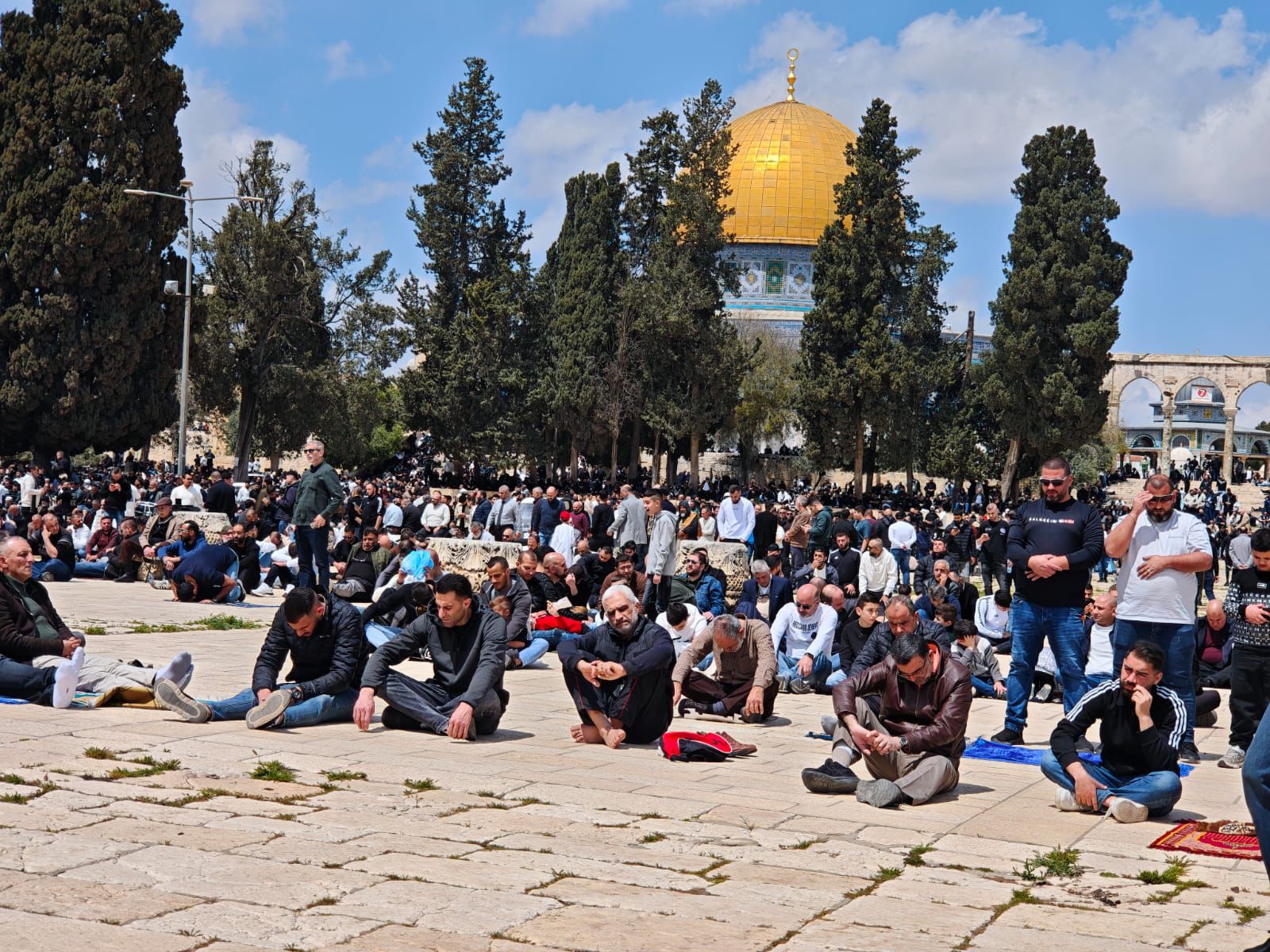
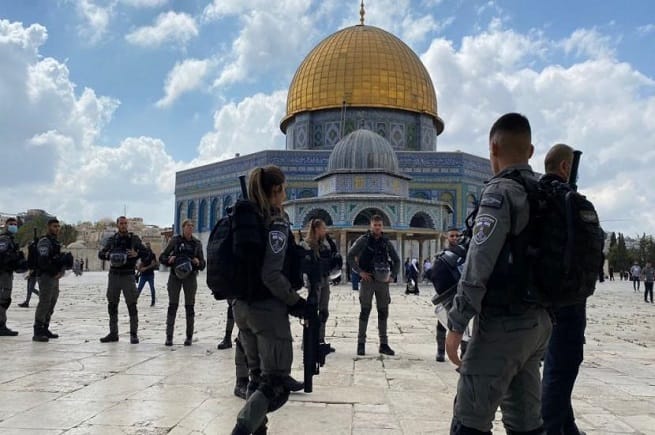
The Israeli occupation continues its closure of the Al-Aqsa Mosque for the 35th consecutive day. This is a move that is described as unprecedented in decades and comes amid escalating calls for mass mobilization and protests in support of the mosque.

The continued closure comes amid warnings of attempts to impose a new reality on the Al-Aqsa by enshrining a temporal and spatial division of the site and coincides with the increased activity of extremist Israeli settler Temple Mount groups who want to storm the mosque and perform Talmudic rituals in its courtyards.

These settlers intensified their incitement to storm the mosque in the Jewish Passover holiday and calling for the “sacrifice of animals” on its grounds and demanding its reopening in the holiday period, which extends from 2-9 April. Meanwhile, the Israeli occupation is exploiting the current state of emergency to consolidate its control over the mosque, while Jerusalemites and the wider Palestinian public are calling for mass mobilization towards the nearest military checkpoints and barriers surrounding it to break the Israeli military siege and force the reopening of the mosque.

In parallel, the Israeli occupation authorities are preparing to open the Western Wall on 5 April to dozens of rabbis for the Priestly Blessing, a move seen as part of attempts to solidify their Jewish presence, including religious rituals in the vicinity of Al-Aqsa Mosque.

Jerusalem affairs researcher Abdullah Marouf warned of the seriousness of the current situation. He noted the mosque has not been closed in this way since the liberation of Jerusalem in 1187. He believes that these Temple Mount groups are seeking to exploit the holiday period to impose a reality that paves way for their plans.

Meanwhile, there are calls for escalation to transform the coming days into a widespread wave of anger. Hamas is calling for general mobilization under the slogan of “Friday of the Night Journey and the Prisoners,” in light of the ongoing violations against the mosque and Palestinian prisoners. An international campaign titled “Al-Aqsa is Crying for Help” has also been launched, with the participation of Arab and Islamic institutions to mobilize public opinion and pressure for an end to the violations.

Jerusalemite activists warned that the continued closure of Al-Aqsa Mosque represents a “dangerous escalation,” stressing that it falls within attempts to impose realities that are difficult to change, and are calling for increased presence and vigilance around the mosque to emphasizine its Arab and Islamic identity.

Continue reading
‘7 Million Iranians Wait For US Troops’

Iranian leaders warn of mass mobilization, issue direct threats, and signal readiness for escalation amid ongoing US-Israeli attacks.

Key Developments

  • Ghalibaf says nearly 7 million Iranians have volunteered to take up arms in defense of the country.
  • Hatami warns that no enemy troops should survive any ground attack on Iranian territory.
  • IRGC commander Majid Mousavi issues direct threat to US leadership as tensions continue to escalate.

‘Bring It On’

Iranian officials on Thursday issued some of their strongest warnings yet since the start of the US-Israeli war, pairing threats of wider retaliation with declarations of mass popular readiness for battle.

The sharpest political message came from Parliament Speaker Mohammad Bagher Ghalibaf, who said a nationwide campaign had already drawn millions of volunteers prepared to defend the country.

“Right now, in less than a week, a powerful national campaign sweeping the country has brought forward around 7 million Iranians who have already stepped up and declared they’re ready to pick up arms and stand in defense of our nation,” Ghalibaf wrote on X.

He followed that with an even more direct warning: “You come for our home… you’re gonna meet the whole family. Locked, loaded, and standing tall. Bring it on.”

‘No Survivors’

Those remarks did not emerge in isolation. Just last week, Tasnim reported that more than one million Iranian combatants had already been organized for possible ground confrontation with US forces, while describing a wider influx of young volunteers to Basij, IRGC, and army centers.

That earlier report gives Ghalibaf’s new figure a clearer military and political backdrop: the Iranian leadership is presenting the current confrontation not simply as an exchange of strikes, but as a moment of national mobilization.

The military tone was reinforced by Army commander Amir Hatami, who ordered operational headquarters to monitor “enemy movements with utmost pessimism and accuracy” and remain ready to counter any method of attack.

Reuters, citing Iranian state media, reported Hatami’s warning in blunt terms: “No enemy troops should survive if adversaries attempt a ground operation.”

https://www.palestinechronicle.com/us-israel-bomb-irans-pasteur-institute-sudans-al-shifa-shadows-reawaken/embed/#?secret=yjszBpR7Fy#?secret=KvQhWOePC3

‘Hollywood Illusions’

That message was echoed in even harsher language by IRGC Aerospace Force commander Majid Mousavi.

In a post carried by Defa Press, Mousavi responded to recent US threats by writing: “You are the one who is taking your soldiers to the grave, not Iran, who wants to take it back to the Stone Age.”

He added: “Hollywood illusions have so contaminated your thinking that you are threatening a civilization that is more than 6,000 years old with a meager 250-year history.” Palestine Chronicle

Continue reading
Iranian, Houthi Missiles Land in Israel

Incoming missile sirens sounded Thursday evening in central and southern Israel following barrages from Iran and Yemen in less than two hours, Israeli media reported.

Army Radio said missile fragments fell near Tel Aviv after a new wave of Iranian missiles targeted the area.

The daily Yedioth Ahronoth said one of the missiles made a direct impact in the city of Petah Tikva near Tel Aviv.

Channel 12 said sirens sounded in the Dead Sea in southern Israel after a missile attack from Yemen.

The outlet said a missile fired by the Houthi group was intercepted by air defenses.

No details were given about damage or injuries.

Regional tensions have escalated since the US and Israel launched a joint offensive on Iran on Feb. 28, killing more than 1,340 people to date, including then-Supreme Leader Ali Khamenei.

Tehran has retaliated with drone and missile strikes targeting Israel, as well as Jordan, Iraq, and Gulf countries hosting US military assets. Anadolu

Continue reading
Trump Threatens to Leave NATO But Can He?

US President Donald Trump on Thursday urged the members of NATO to gather the courage to send naval vessels to the Strait of Hormuz, again disparaging the longtime military alliance.

Asked why he had not mentioned NATO in his Wednesday night address to the nation, Trump said it was not a NATO speech but that he had referenced the strait and those who were absent. “They gotta get guts and go in and just send your ships up there and enjoy it,” he told Politico.

Pressed on whether he was frustrated with the alliance, Trump said: “I couldn’t care less. I didn’t need them.”

He added: “But if I ever did need them, they wouldn’t be there.”

NATO has invoked Article 5 – its collective defense clause – just once in its history, after the 2001 terrorist attacks on the United States. NATO allies have criticized Trump for starting the war on Iran without consulting them.

The remarks are the latest in a string of pointed criticisms Trump has directed at NATO over its response to the Strait of Hormuz crisis. He has previously called alliance members “cowards” and, in a separate interview with British daily The Telegraph, described NATO as a “paper tiger” and said leaving the alliance was “beyond reconsideration.”

Leaving NATO unilaterally – a move Trump has hinted at since his first term – would face significant legal hurdles. A 2023 law bars any US president from withdrawing from the alliance without the backing of a two-thirds majority in the US Senate.

The strait, through which roughly 20 million barrels of oil pass daily, has been effectively disrupted since early March following Iranian measures taken in retaliation for the US-Israeli offensive on Iran that began on Feb. 28.

Trump has repeatedly urged European allies and Gulf states to take a more active role in securing the strait, arguing that countries dependent on its oil should bear responsibility for reopening it.

Trump will meet with NATO chief Mark Rutte in Washington next week, according to The Wall Street Journal. Anadolu

Continue reading